
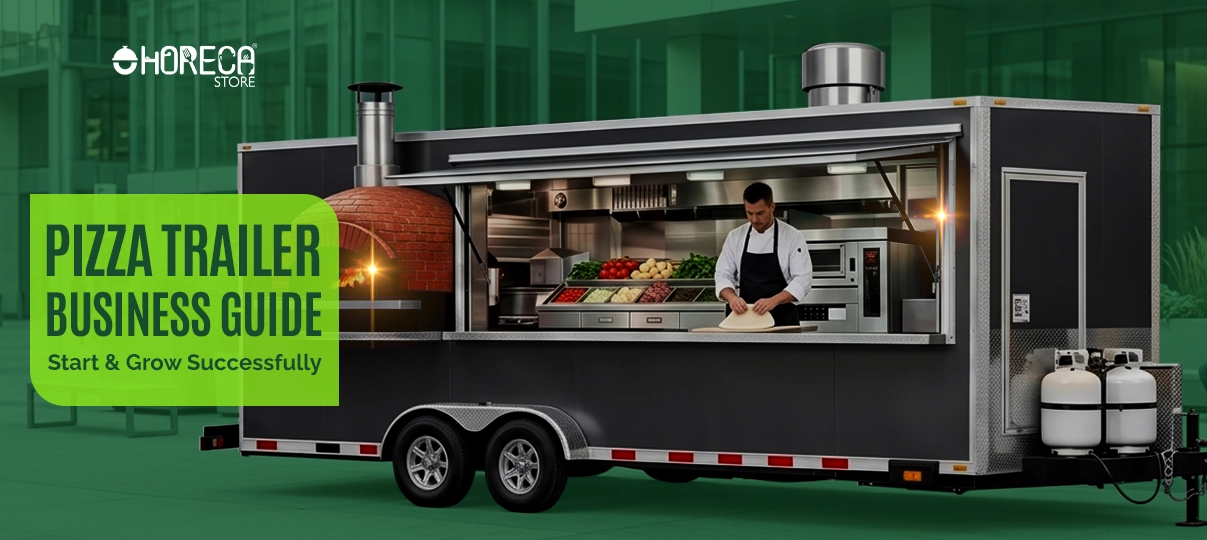
You don't need a $500,000 brick-and-mortar storefront to serve the best crust in your city. According to restaurant industry data, launching a pizza food truck or trailer slashes that entry price down to a realistic $30,000 to $60,000. This drastic reduction completely transforms your unit economics (the direct revenue and costs tied to selling a single item). Instead of paying crushing monthly rent while waiting for diners to find you, mobile operations let you pack up and follow hungry crowds directly to neighborhood breweries or bustling farmer's markets.
Designing profitable pizza on wheels is essentially building a high-speed laboratory optimized for quick service. While traditional dining rooms tether you to one geographic spot, low-overhead mobility grants you the ultimate flexibility to pivot instantly based on daily demand. Success in this industry requires shifting your mindset from being a stationary cook to becoming a strategic operator who controls both expenses and customer reach.
Transforming this culinary passion into a viable business means executing a proven roadmap before ever firing up the oven. The typical journey from an initial concept to your very first profitable service involves four key steps:
- Adapting your home dough recipe into a fast-baking, highly scalable menu.
- Securing local health permits and a certified commissary (a rented commercial kitchen used for daily prep work).
- Selecting durable cooking equipment that safely withstands highway travel.
- Booking high-traffic community events to guarantee immediate cash flow.
Navigating the Red Tape: Your 3-Step Licensing Roadmap
Everyone knows starting a pizza trailer business requires permits, but few realize the health department isn't just checking temperatures—they are analyzing your "Flow of Food." This concept tracks every ingredient from the moment you buy it to the second it reaches the customer. Think of it like a strict highway system inside a tiny footprint; raw sausage cannot cross paths with ready-to-eat mozzarella. Meeting your mobile food vendor licensing requirements means proving your physical layout actively prevents cross-contamination.
Because you cannot wash large dough mixers or store bulk flour inside a compact trailer, inspectors require a Commissary Agreement (a signed contract to use an approved commercial kitchen as your home base). You must secure this before submitting your "Plan Review." A Plan Review is a paper inspection where officials approve your blueprints before construction begins. Skipping this step often forces new owners into costly remodels just to meet mobile food trailer commissary kitchen requirements.
To ace that paper inspection and avoid opening delays, arrive at your local office with these five essential documents:
- Detailed menu outlining all preparation steps
- Signed and notarized commissary kitchen agreement
- Scaled floor plan showing your trailer layout
- Equipment specification sheets (including BTUs and power draws)
- Standard operating procedures for wastewater disposal
Once the red tape is cleared, the next challenge is putting those blueprints on wheels and finding the right truck to safely tow your new kitchen.
Choosing Your Chariot: Payload Capacity and the Best Towing Vehicles
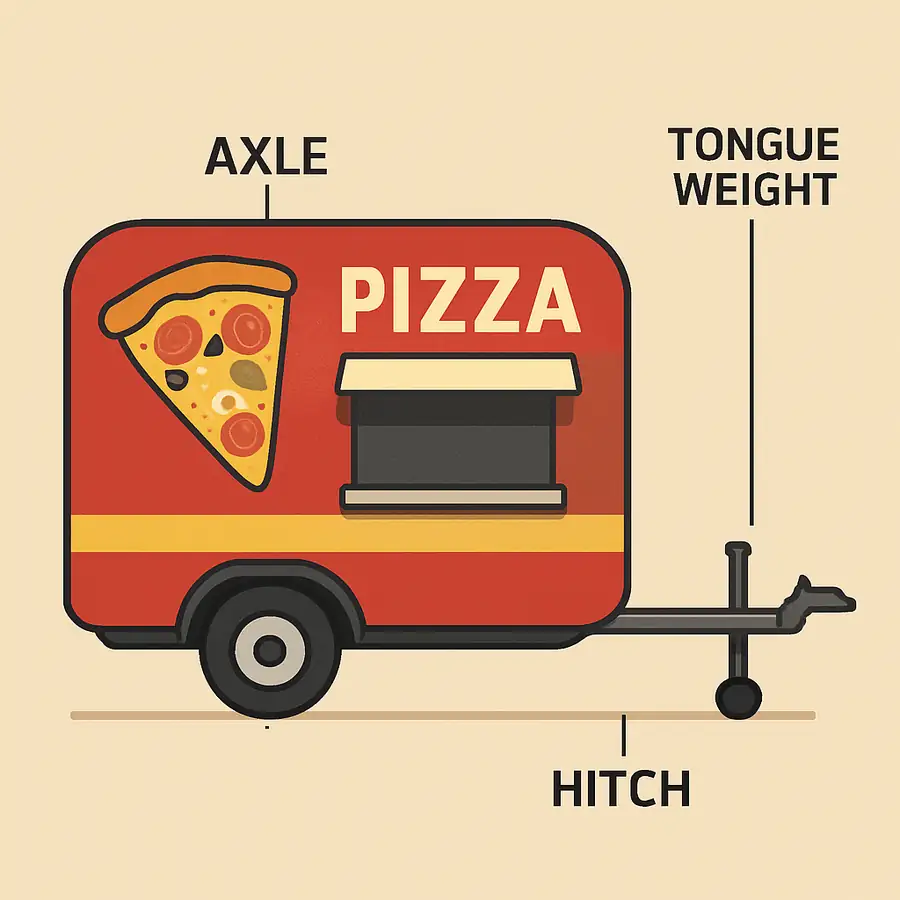
Building out your pizza on wheels starts with smart layout choices, like utilizing a side-service window rather than a rear one to effectively manage customer lines along curbsides. However, physics ultimately dictates your build. An empty steel shell seems lightweight until you load it with dense brick ovens, heavy dough mixers, and full 40-gallon water tanks. All this added gear must stay strictly under your payload capacity (the maximum equipment weight the trailer's axles can safely support). Finding the best truck for towing a pizza trailer requires calculating your GVWR (Gross Vehicle Weight Rating), which is the absolute maximum legal weight of your fully loaded operation.
Protecting your investment also means respecting tongue weight, which measures the heavy downward pressure resting directly on your truck's hitch. Think of it like holding a 50-pound sack of flour; if you hold it awkwardly away from your center of gravity, you easily lose balance. To prevent dangerous highway sway and protect your transmission, select a tow vehicle with a capacity at least 20% higher than your trailer's GVWR. With your pizza trailer safely hitched, you face a critical operational choice between wood-fired and gas ovens.
The Great Debate: Wood-Fired vs. Gas for Mobile Catering Efficiency
Stepping into the debate of a wood-fired vs. gas pizza oven for catering forces you to weigh romance against reliability. A blazing fire provides unbeatable curb appeal, filling the festival air with signature smoke to instantly draw a crowd to your pizza food truck. However, wood requires constant tending and hauling heavy logs. Gas burners, conversely, offer push-button consistency, guaranteeing every pie bakes exactly the same way during a hectic four-hour neighborhood brewery shift.
High-volume service depends entirely on your oven's "thermal mass," regardless of your ultimate fuel choice. Think of the heavy stone floor like a rechargeable battery. When you slide a batch of cold pizzas onto the deck, they rapidly absorb that stored energy, risking "floor saturation"—the exact point where the stone loses its intense baking heat. If your oven's thermal mass is too thin, the battery drains entirely, leaving your bottom crusts pale and soggy while the tops burn.
This rapid heat drain introduces "recovery time," the crucial window your oven needs to reheat the stone between bakes. Gas systems typically offer predictable recovery times for back-to-back orders, while traditional wood-fired pizza ovens require skilled fire management to keep the deck consistently hot. Once you match your oven's heating capabilities to your expected customer volume, your next challenge is ensuring your dough recipe survives the environmental shifts of a mobile operation.
Mastering the Mobile Crust: 65% Hydration and Dough Resilience
Your reliable home recipe might behave completely differently on a humid July afternoon at a local farmer's market. Ambient humidity alters how your flour absorbs water, making your hydration percentage (the exact ratio of water to flour) a critical variable. A 65% hydration sweet spot prevents the crust from burning before the center fully cooks in a blistering oven. Any higher, and your wood-fired pizza dough hydration for events becomes incredibly sticky and difficult to stretch in a cramped space.
Survival during a busy weekend relies heavily on cold fermentation, a technique where you rest dough in a cooler to slow yeast activity and deepen flavor. Leaving dough out too long causes over-proofing—the yeast exhausts its food supply, leaving you with flat, useless crusts. Factoring ample refrigeration into your mobile pizza trailer business plan ensures you can successfully manage your dough supply across a lucrative two-day festival without ever sacrificing quality.
To guarantee consistency, use this three-step management plan for high-heat outdoor environments:
- Hold it cold: Keep reserve dough trays tightly stacked in a cooler until 60 minutes before service.
- Drop the water: Reduce your hydration slightly on highly humid days to offset atmospheric moisture.
- Rotate smartly: Only pull out what you can realistically bake within the next hour.
Protecting your fragile dough requires precise spatial organization inside your limited footprint.
The Essential Equipment List for a 60-Square-Foot Kitchen
Outfitting your trailer is where home cooking meets commercial reality. You cannot legally use residential appliances; health inspectors require NSF Certification (a manufacturing standard ensuring equipment is easily cleanable and food-safe). A proper commercial pizza trailer equipment list includes seven non-negotiable items: a high-temperature oven, a refrigerated prep table, a dough mixer, a three-compartment sink, a handwash station, a ventilation hood, and a 12V power system (a battery setup running vital water pumps without noisy generators).
Budget vs. Pro Equipment Costs
- Oven: $2,000 (Basic gas deck) vs. $8,000 (Wood-fired)
- Refrigerator: $1,200 (Standard) vs. $3,000 (High-capacity)
- Mixer: $1,000 (Refurbished) vs. $3,500 (New spiral)
- Sinks & Power: $1,500 (Basic install) vs. $4,500 (Turnkey setup)
Exactly how much does it cost to start a pizza trailer? Expect to spend between $10,000 and $25,000 on gear alone, making this the heaviest initial expense in your mobile pizza trailer business plan. To maximize that investment, arrange these tools into a tight "work triangle"—a design layout minimizing the physical steps between your dough fridge, prep counter, and oven. Once your optimized 60-square-foot kitchen is built, your next major challenge is identifying high-traffic locations to park it.
Mining for Gold: Identifying High-Traffic Spots Beyond the Farmer’s Market
Securing the perfect spot means reading crowd behavior, not just counting cars. When finding profitable locations for food trailers, veteran owners prioritize "Hunger Cues" and high "Dwell Time" (how long a customer stays somewhere). A neighborhood brewery where people linger for hours generates far more natural hunger than a busy sidewalk full of rushing commuters.
Finding a lingering crowd brings you to the "Pitch Fee"—the amount an organizer charges you to park. Some venues ask a $50 flat rate, while festivals often demand 10% of total sales. To survive high fees, your profitable mobile pizza menu design must feature high-margin, fast-cooking items. If an expensive parking fee consumes your margin on a cheap cheese slice, you end up working for the venue instead of yourself.
Before signing any agreement, always calculate your daily Break-Even Point. This is the exact number of pizzas you must sell to cover your pitch fee, fuel, and labor before seeing a dollar of profit. If an event charges $200 and you net $10 per pie, your first 20 pizzas merely pay admission. Mastering this math ensures true profitability and prepares your operation for high-volume service.
Managing the Rush: POS Systems and Mobile Safety Regulations
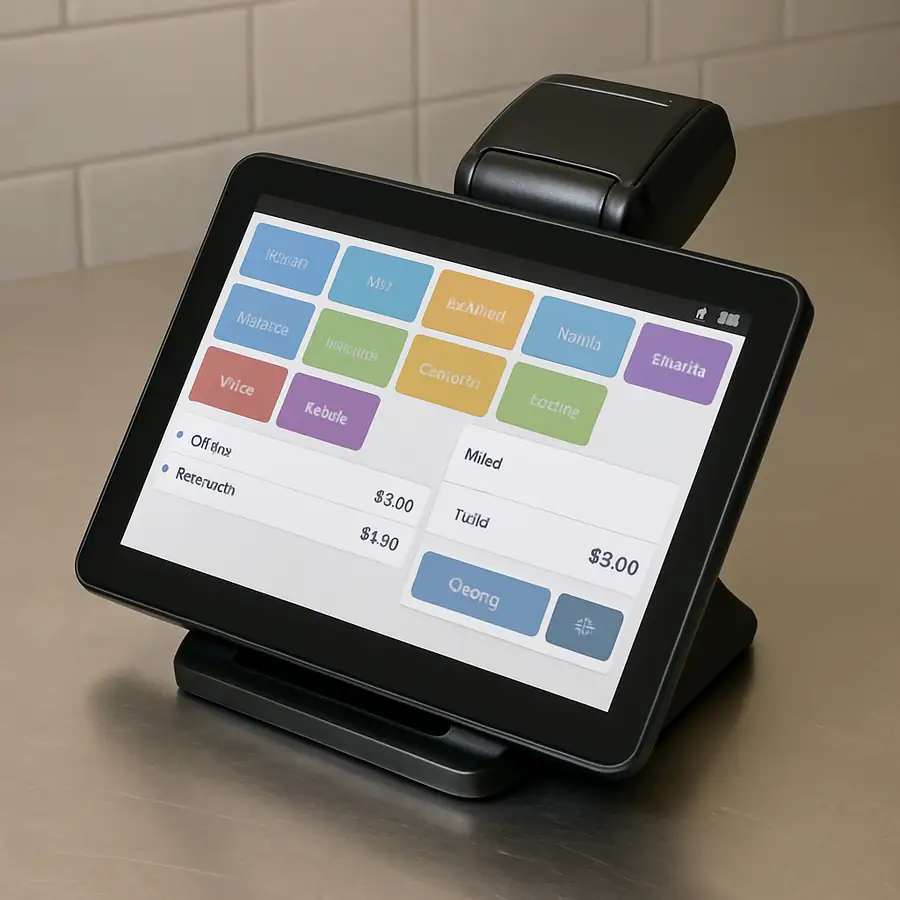
Picture this: fifty hungry festival-goers are in line, and the local cell tower suddenly overloads. Your card reader drops its connection. To survive these inevitable dead zones, the best POS system for mobile pizza catering needs "Offline POS Caching." This essential feature temporarily stores credit card data directly on your device, processing the payments automatically once internet returns so you never miss a rush sale.
Protecting that hard-earned cash means navigating strict portable pizza trailer fire safety regulations. Fire marshals typically mandate a Type 1 hood—a specialized ventilation system built to safely capture grease and smoke. This hood must pair with an "Ansul System" (a commercial fire suppression unit that automatically sprays chemical retardants if temperatures spike). Think of it as a heavy-duty, automatic fire extinguisher guarding your rolling kitchen.
Proper safety hardware is only half the battle; the rest falls to mobile catering insurance for pizza vendors. Standard car insurance won't protect your business. You need three distinct policies:
- General Liability: Protects against customer injuries or foodborne illness claims.
- Commercial Auto: Covers the physical trailer during highway transit.
- Inland Marine Insurance: Replaces your expensive ovens and POS gear if damaged or stolen while parked at an event.
With payments and protections successfully secured, you can shift your focus to booking lucrative private events and growing your brand.
Filling the Calendar: Booking $1,500 Private Events and Growing Your Brand
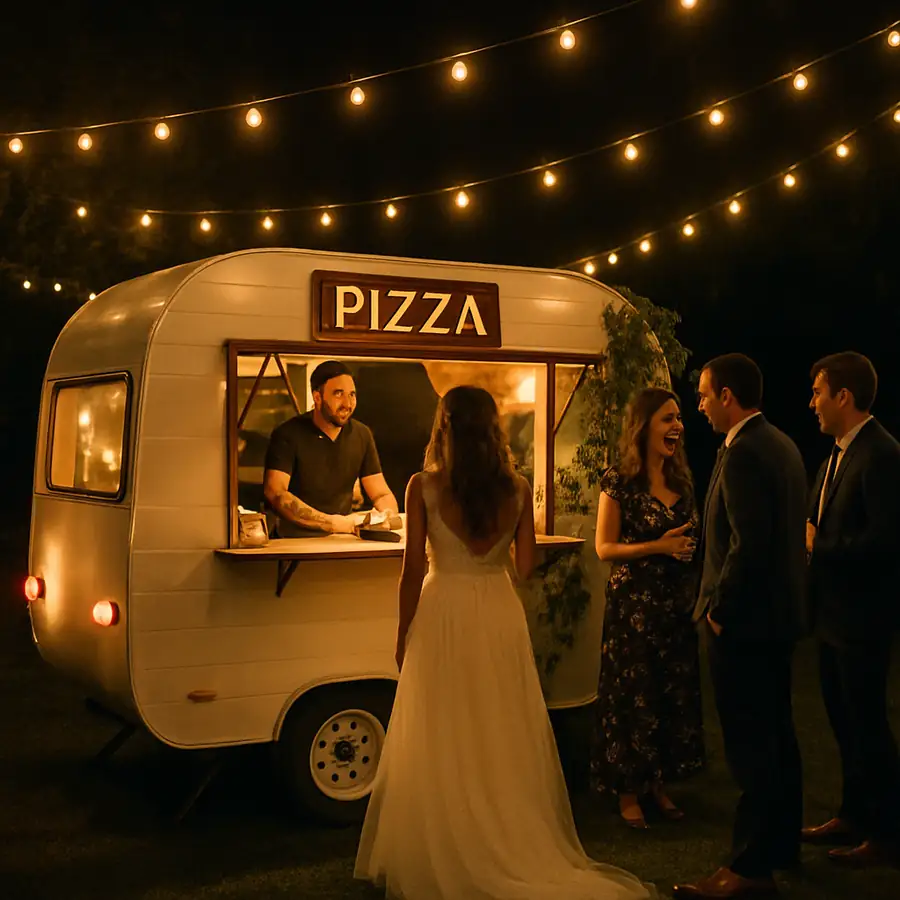
Securing reliable income means shifting away from unpredictable street corners and mastering the art of booking private events for pizza trailers. When a client wants your wood-fired pies for a wedding, you utilize "Per-Head Pricing"—charging a flat fee per guest regardless of how much they eat. This guarantees revenue before you even turn on the oven. Always protect your calendar by requiring a 50% non-refundable deposit upfront.
On days you aren't catering parties, social media marketing for mobile food businesses becomes your digital megaphone. Instead of hoping people stumble upon your daily setup, utilize "Geotagging"—attaching your specific physical coordinates to digital posts so nearby customers can navigate directly to you. Posting a live tracking story turns passive online followers into a physical line of hungry fans outside your service window.
Once your calendar is entirely full, you face the exciting challenge of "Scalability," meaning you design your systems to handle expansion without breaking down. The true goal of launching a mobile operation is transitioning from a sweaty owner-operator stretching every dough ball yourself to a manager overseeing multiple profitable units. Establishing this growth strategy relies on mapping out a strict timeline for your first year.
From Day 1 to Day 365: Your Action Plan for Mobile Pizza Success
You no longer just have a great dough recipe; you have the practical blueprint for a profitable pizza trailer business. Remember the mobile food 80/20 rule: your long-term success will be 80% smart prep and location scouting, and only 20% baking. You now understand how to navigate health permits, size your commercial ovens, and protect your profit margins before turning the ignition.
To maintain this momentum, follow this 12-month milestone checklist:
- Month 1: Call your local health department to clearly outline permit requirements.
- Month 3: Secure your commissary kitchen agreement and finalize a fast-baking, high-margin menu.
- Month 6: Launch at low-stakes neighborhood events to stress-test your physical workflow.
- Month 12: Evaluate your net profit per hour and leverage your new reputation to book lucrative private catering.
Mastering this business model fundamentally changes how you view the food industry. You aren't just serving slices; you are commanding a flexible, low-overhead operation. Your Monday morning task is simple: write down three potential local events and research their vendor rules. Keep your menu focused, trust your preparation, and take that confident first step toward building your profitable mobile operation.
Buy Pizza Trailer Equipment from The Horeca Store
Starting and growing a successful pizza trailer begins with investing in dependable commercial equipment that delivers consistent cooking performance and maximizes efficiency in a limited space. The Horeca Store offers a complete range of pizza trailer equipment, including commercial pizza ovens, refrigerated prep tables, dough mixers, undercounter refrigerators, freezers, food warmers, stainless steel worktables, and essential pizza preparation tools. Our commercial-grade equipment is built to handle the demands of busy mobile food operations while helping you serve high-quality pizzas every time.
Whether you're launching your first pizza trailer or expanding an established mobile pizza business, The Horeca Store provides premium equipment from trusted brands to suit different production volumes and budgets. Our knowledgeable team can help you select the right equipment based on your menu, workspace, and daily service requirements. With competitive pricing, reliable customer support, and durable commercial kitchen solutions, The Horeca Store is your trusted partner for building and growing a successful pizza trailer business.