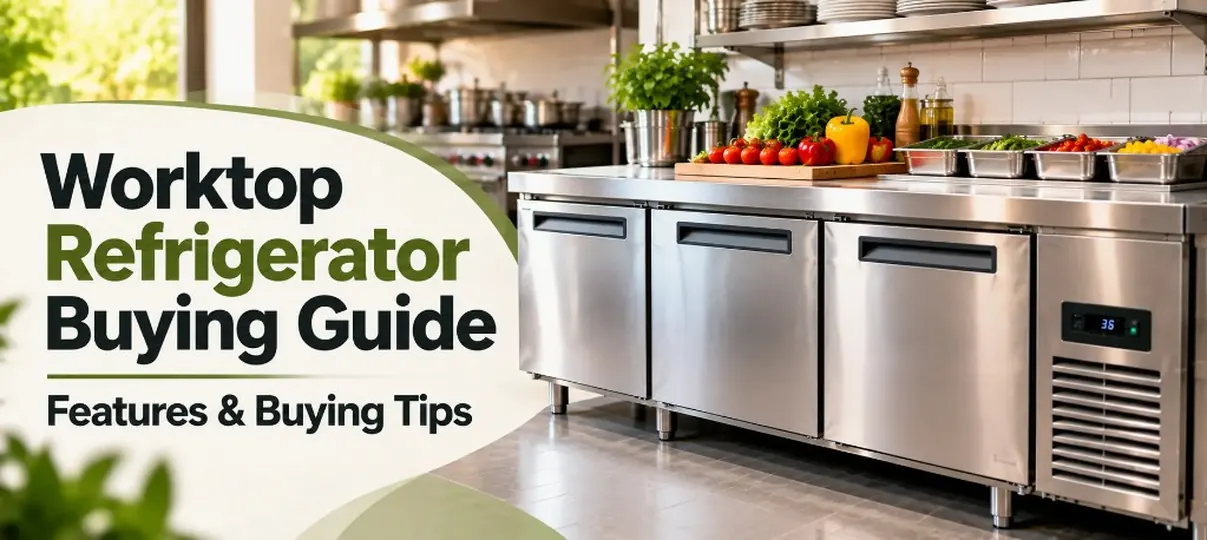
A worktop refrigerator gives a commercial kitchen two essentials in one footprint: cold storage below and usable prep space above. Instead of sending staff across the line for ingredients, it keeps frequently used items within arm's reach while adding a durable countertop for plating, prep, or small equipment. This Worktop Refrigerator Buying Guide explains how to choose a unit that fits your layout, supports your workflow, and avoids common installation mistakes.
What makes a worktop refrigerator different from other compact units?
Also compare a reach-in refrigerator and an undercounter refrigerator when the station needs more than one cold zone.
A worktop refrigerator is a commercial refrigeration unit designed with a work surface on top, while an undercounter fridge is usually built primarily for cold storage beneath an existing counter. A compact refrigerator or small space fridge may save room, but it may not provide the same prep-friendly surface, commercial-duty construction, or configuration options needed on a busy line. In practice, a worktop model is both a space-saving fridge and a workstation, which is why it is common in prep kitchens, sandwich stations, bars, cafés, food trucks, and back-of-house service areas.
The distinction matters because commercial kitchens rarely have "extra" space. If a unit only stores product, it solves one problem. If it stores product and creates a reliable countertop fridge station for prep, garnish assembly, or service support, it can improve the way the kitchen moves during rush periods.
A worktop refrigerator also differs from a chef base. Chef bases are often built lower and heavier to support cooking equipment such as griddles or ranges. Worktop refrigerators are more general-purpose: they provide refrigerated storage plus a usable top surface, but the exact load and heat tolerance depend on the model, so operators should confirm specifications before placing equipment on top.
Start with the space, then choose the size
Frozen backup usually belongs in a reach-in freezer or a walk-in freezer, not in the worktop cabinet.
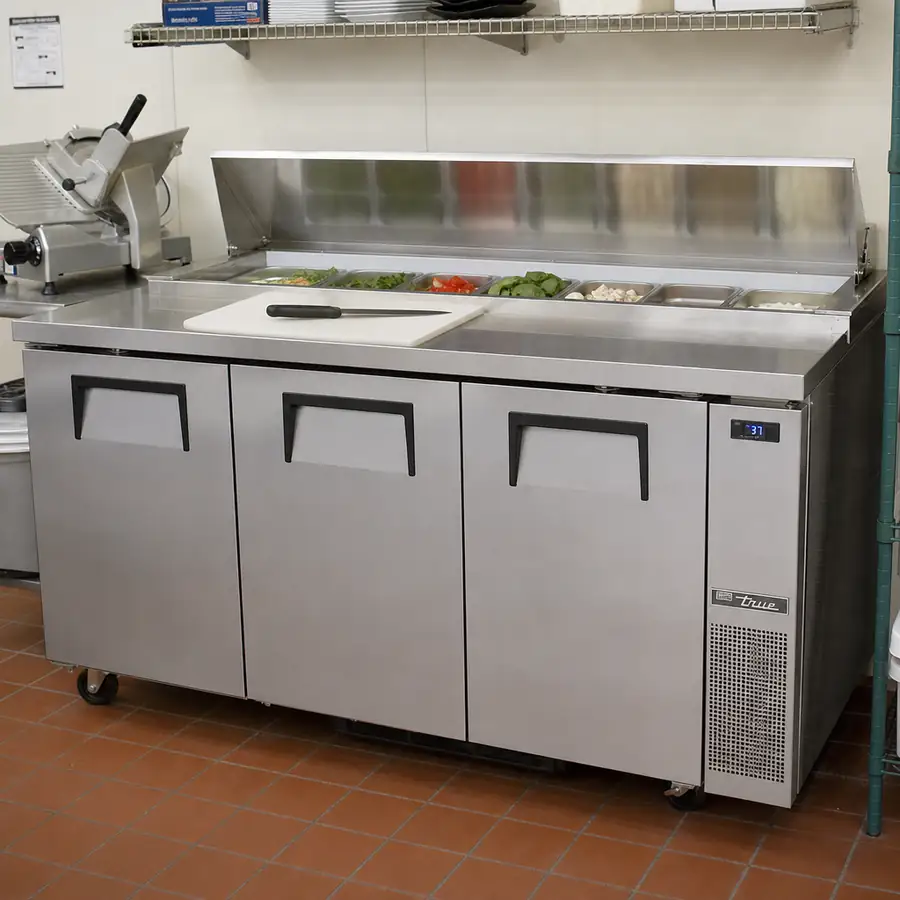
Sizing is the first practical decision because the wrong dimensions can create traffic jams, block drawers, or leave too little prep room. Commercial worktop refrigerators commonly range from compact single-section units to long multi-section models, with widths often spanning roughly 24 to 108 inches and heights often around 27 to 40 inches. Those ranges make the category flexible, but the best size is the one that fits the station without making staff work around it.
Measure more than the empty opening. You need to account for door or drawer swing, employee movement, nearby equipment, cleaning access, and ventilation clearances. If the top surface extends beyond the refrigerated cabinet footprint, measure the full countertop dimensions as well, not just the cold storage base.
Before choosing a size, map the station in real use:
- Measure the available width, depth, and height. Include floor irregularities, wall trim, plumbing lines, and any counter overhang.
- Check the service path. Staff should be able to open doors or drawers without stepping into a major traffic lane.
- Plan the prep surface. The top should support the actual task, whether that is portioning ingredients, assembling plates, or staging containers.
- Confirm delivery access. A unit that fits the final space still has to pass through doors, corridors, and turns.
- Leave room for maintenance. Technicians may need access to the compressor, condenser, filters, and electrical components.
A larger unit may look efficient on paper, but oversized equipment can slow a kitchen down if it crowds the line. A smaller model may be better when it places the right ingredients exactly where staff need them.
Refrigerated storage should match your menu and service rhythm
High-volume menus often add a walk-in refrigerator or a commercial freezer beside the station.
Capacity is not only about cubic feet. It is about whether the storage layout matches the way ingredients are used during service. A prep cook who needs hotel pans of portioned vegetables has different needs from a bartender storing mixers, garnishes, and bottled items.
Think in categories instead of general volume. What products must be held at the station? How often are they restocked? Are they stored in pans, jars, bottles, wrapped proteins, dairy containers, or bulk tubs? The answers determine whether the interior needs adjustable shelves, pan-friendly drawers, or a mix of both.
For a high-throughput station, refrigerated storage should reduce trips to the walk-in without turning the worktop refrigerator into a cluttered catchall. The goal is targeted access. Keep the fastest-moving ingredients in the unit and leave slower-moving backup inventory elsewhere, so the station stays organized and temperatures recover more efficiently after openings.
Useful capacity checks include:
- Daily peak demand: Stock enough for the busiest service period without overloading the cabinet.
- Container compatibility: Confirm that shelves or drawers fit the pans, bottles, and bins you actually use.
- Air circulation: Avoid packing product so tightly that cold air cannot move around the cabinet.
- Restocking pattern: Choose enough capacity to reduce unnecessary trips, but not so much that product rotation becomes harder.
- Food separation: Plan storage so raw, ready-to-eat, allergen-sensitive, or strongly scented items do not create handling problems.
A well-sized worktop refrigerator supports both speed and food quality. Staff can find items quickly, managers can monitor product rotation, and the station is less likely to become a disorganized cold box under pressure.
Doors, drawers, and mixed configurations shape workflow
A sandwich prep table or a pizza prep table is the closer match when the top must hold ingredient pans all service.
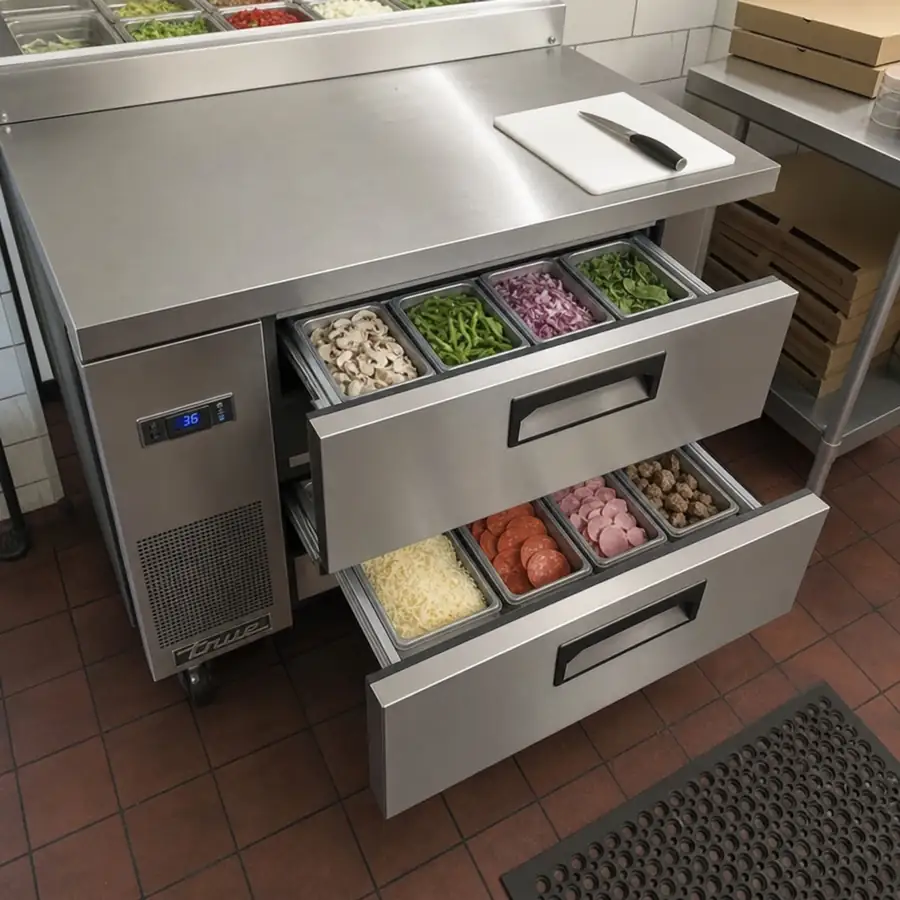
Door configuration is one of the biggest differences between models. Hinged doors usually work well for larger containers, bulk items, bottles, and products that do not need to be accessed every few seconds. Drawers are often better for portioned pans, organized mise en place, and fast repetitive access during service.
Drawers can reduce bending and make it easy to pull out exactly the category of ingredients needed. For example, a sandwich station might keep proteins in one drawer, cheeses in another, and prepped vegetables in a third. Staff can open a drawer, grab what they need, and close it quickly.
Doors may offer more flexible vertical storage. If your station holds tall jars, sauce containers, cartons, or backup ingredients, a door section with adjustable shelving may be more practical. Doors can also be easier to clean around when storing irregularly shaped items.
Many commercial kitchens benefit from mixed configurations. A unit with one door section and one drawer section can hold both bulk backup and fast-access pans. This is especially useful where menus shift throughout the day, such as cafés that move from breakfast prep to lunch service.
When comparing configurations, consider these workflow questions:
- Which items are grabbed most often during peak service?
- Do staff need full visibility into pans or flexible shelf space?
- Will an open door block another cook, server, or aisle?
- Are products stored in standardized pans or varied containers?
- Will drawers become too heavy when fully loaded?
The right door setup should feel natural to the station. If employees have to pause, rearrange containers, or step aside every time they open the unit, the configuration is working against the kitchen.
How does ventilation affect installation and performance?
Leave clearance for an exhaust hood and review the commercial kitchen layout before the unit is rolled in.
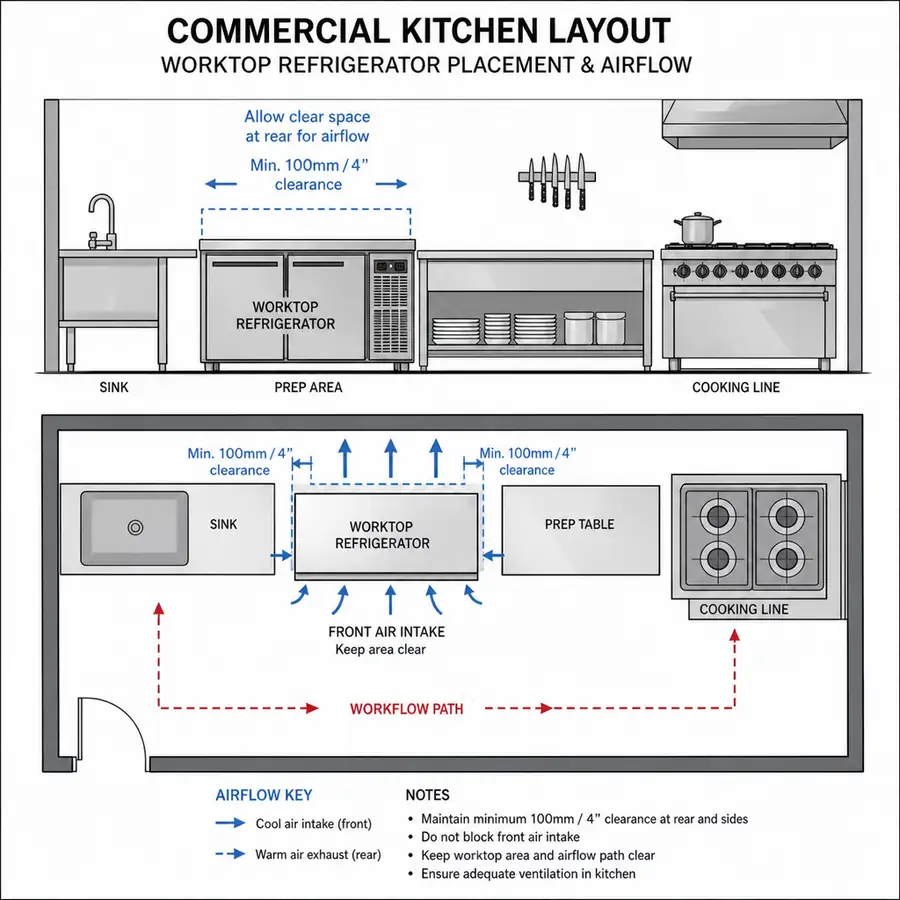
Ventilation affects where a worktop refrigerator can be installed and how reliably it performs. Front-breathing models are often preferred for tighter built-in refrigerator applications because they can move air through the front of the unit, while side- or rear-breathing models typically need clearance around the cabinet for heat to escape. If airflow is blocked, the compressor may work harder, temperatures may become less stable, and maintenance issues can appear sooner. Drink service may also need a bottle cooler and a back bar cooler beside the station.
This is why ventilation should be checked before purchase, not after delivery. A unit that fits physically may still be wrong for the space if it cannot breathe. Tight cabinetry, walls, equipment on both sides, or a closed front panel can all affect performance.
For built-in or semi-built-in installations, front ventilation is usually the simplest path. The front grille must remain unobstructed, which means no toe-kick panels, stored towels, boxes, or equipment should block it. If the refrigerator vents from the side or rear, follow the manufacturer's clearance requirements and make sure the final layout leaves enough open space for air movement.
Compressor placement also matters. Rear-mounted compressors may need back access and adequate clearance. Side-mounted or front-access designs may be easier to service in certain kitchen layouts. In hot kitchens, near ovens or dish machines, ventilation becomes even more important because ambient heat can make refrigeration systems work harder.
A good installation plan should confirm:
- Vent direction: Front, side, rear, or a combination.
- Clearance needs: Space around vents, walls, and neighboring equipment.
- Service access: Room to clean coils and reach mechanical components.
- Heat exposure: Distance from hot equipment, direct sunlight, or poor air circulation.
- Electrical placement: Safe access to the correct outlet without stretching cords across work areas.
Ventilation is not a small technical detail. It is a major factor in whether a space-saving fridge remains efficient and dependable in a demanding commercial setting.
Countertop workspace should support real kitchen tasks
Nearby stainless steel work tables and a prep table should be measured with the same aisle clearance.
The top surface is the feature that separates a worktop refrigerator from many compact refrigeration options. In a commercial kitchen, that surface might be used for assembling salads, wrapping portions, staging garnishes, setting cutting boards, or placing lightweight countertop tools. The more clearly you define the task, the easier it is to choose the right model.
Stainless steel is common because it is durable, cleanable, and well suited to foodservice environments. Some units include a backsplash to help protect walls from spills, while others may have a flat top for more flexible placement under existing counters or pass-through areas. Marine edges or raised edges can help contain small spills and keep tools from sliding off in fast-paced stations.
Think about height as much as width. A unit that is too low may force staff to bend during prep, while a unit that is too high may make repetitive tasks uncomfortable. If accessibility is a priority, look for models designed to meet relevant ADA height or reach considerations, and confirm the actual specifications before ordering.
The work surface should also complement nearby equipment. For example, a garde manger station may need generous open prep space, while a bar station may need a narrower surface for garnishes and glassware staging. A compact refrigerator with a top that cannot handle the station's daily use may save space initially but create frustration later.
Build quality and features that matter in commercial use
The same service plan often includes a commercial refrigerator and ice machines.
Commercial worktop refrigerators are exposed to frequent openings, spills, impacts, cleaning chemicals, and long operating hours. Build quality is therefore more than appearance. Stainless steel or durable metal construction can help the unit stand up to daily use, while smooth interior surfaces make cleaning and product rotation easier.
Self-closing doors can help limit cold-air loss when staff are moving quickly. Magnetic gaskets should seal firmly and be easy to inspect, because damaged seals can affect temperature consistency. Heavy-duty handles, drawer slides, and hinges matter because these parts receive constant use.
Casters can be valuable in kitchens that clean behind equipment often or reconfigure stations for different service periods. If mobility is important, confirm that the casters lock securely and that the unit remains stable during prep. If the refrigerator will stay fixed in one location, legs may provide a more permanent setup and can help with leveling.
Defrost and maintenance details are also worth reviewing. Automatic defrost can reduce manual upkeep, but operators still need to clean coils, inspect gaskets, monitor temperatures, and keep vents clear. A refrigerator that is easy to maintain is more likely to perform consistently because staff are more likely to complete routine care.
Worktop refrigerator, undercounter fridge, or built-in refrigerator?
Choose a worktop refrigerator when you need refrigerated storage and a usable prep surface in the same footprint. Choose an undercounter fridge when you already have counter space and mainly need cold storage beneath it. Choose a built-in refrigerator only when the model's ventilation and clearances are designed for enclosed or tight installations.
These terms overlap, which can make shopping confusing. A worktop unit may be an undercounter-style appliance in height, and some models may be suitable for built-in placement if they are front-breathing. But not every undercounter fridge is designed to function as a prep surface, and not every compact refrigerator can be enclosed safely.
Use the station's job to guide the decision:
- Prep line: A worktop refrigerator often makes the most sense because it shortens ingredient access and adds workspace.
- Bar area: A compact undercounter fridge may work if the counter already exists, but drawers or doors should match bottle and garnish storage.
- Tight cabinetry: A front-breathing built-in refrigerator may be necessary to avoid airflow problems.
- Mobile or flexible station: A worktop model with casters can support changing layouts.
- Bulk backup storage: A larger undercounter or reach-in unit may be better than using the worktop station for overflow.
The best choice is not simply the coldest or largest unit. It is the refrigerator that supports the task without wasting space, blocking movement, or creating maintenance problems.
A practical buying checklist for commercial kitchens
Score the unit with the rest of the restaurant equipment and commercial kitchen equipment on that line.
Before purchasing, bring the decision back to daily operations. The right unit should fit the space, hold the right products, ventilate properly, and make staff faster without creating new obstacles.
Use this checklist to narrow your options:
- Confirm the exact footprint. Measure width, depth, height, counter overhang, and delivery path.
- Match capacity to use. Store high-demand items at the station, not every backup product.
- Choose doors, drawers, or both. Base the decision on container type, access frequency, and aisle clearance.
- Verify ventilation. Select front-breathing models for tight spaces when appropriate, and keep vents clear.
- Evaluate the countertop. Make sure the surface size, height, material, and edge style suit the work being done.
- Plan for cleaning. Look for accessible interiors, removable components, and enough space to clean around the unit.
- Check mobility needs. Decide between casters and fixed legs based on cleaning routines and layout flexibility.
- Review compliance needs. Confirm any required sanitation, accessibility, or foodservice standards with the model documentation.
- Consider service access. Make sure staff or technicians can reach coils, filters, and mechanical areas.
- Think about future menus. Choose enough flexibility to handle realistic menu changes without oversizing.
A careful checklist prevents the most common buying mistake: choosing a refrigerator based only on dimensions or price. In a commercial kitchen, the better question is how the unit will perform during a busy shift.
The best choice improves the entire station
Put the cabinet in the restaurant kitchen equipment cost plan, add a walk-in cooler for overflow, and compare models at The Horeca Store.
A worktop refrigerator is a small equipment decision with a large effect on workflow. When it is sized correctly, ventilated properly, and configured for the right ingredients, it can reduce steps, keep prep organized, and turn limited square footage into a more productive station.
The strongest option is not always the biggest model or the one with the most compartments. It is the unit that fits your layout, supports your menu, gives staff the countertop workspace they need, and keeps refrigerated storage close to the point of use. Use this guide as a practical starting point, then confirm the details against the specific model and installation requirements before you buy.