
HoReCa is the collective term for hotels, restaurants and cafes, with catering also included in many industry definitions. It connects accommodation, food and drink service, and the suppliers that support those businesses. Understanding the sector helps operators, buyers and newcomers see how guest experience, purchasing, management and marketing fit together.
What is the HoReCa industry?
The HoReCa industry comprises businesses that provide short-term accommodation or prepare and serve food and beverages for immediate consumption. Its name combines Hotel, Restaurant and Cafe, although "Ca" can also refer to catering. The European Labour Authority describes the sector as accommodation and food service activities.
The HoReCa industry meaning extends beyond the three businesses named in the abbreviation. Bars, takeaway restaurants, food trucks, canteens and event caterers can also fall within its scope. The important connection is the service being provided, rather than whether the venue has tablecloths, bedrooms or a traditional dining room.
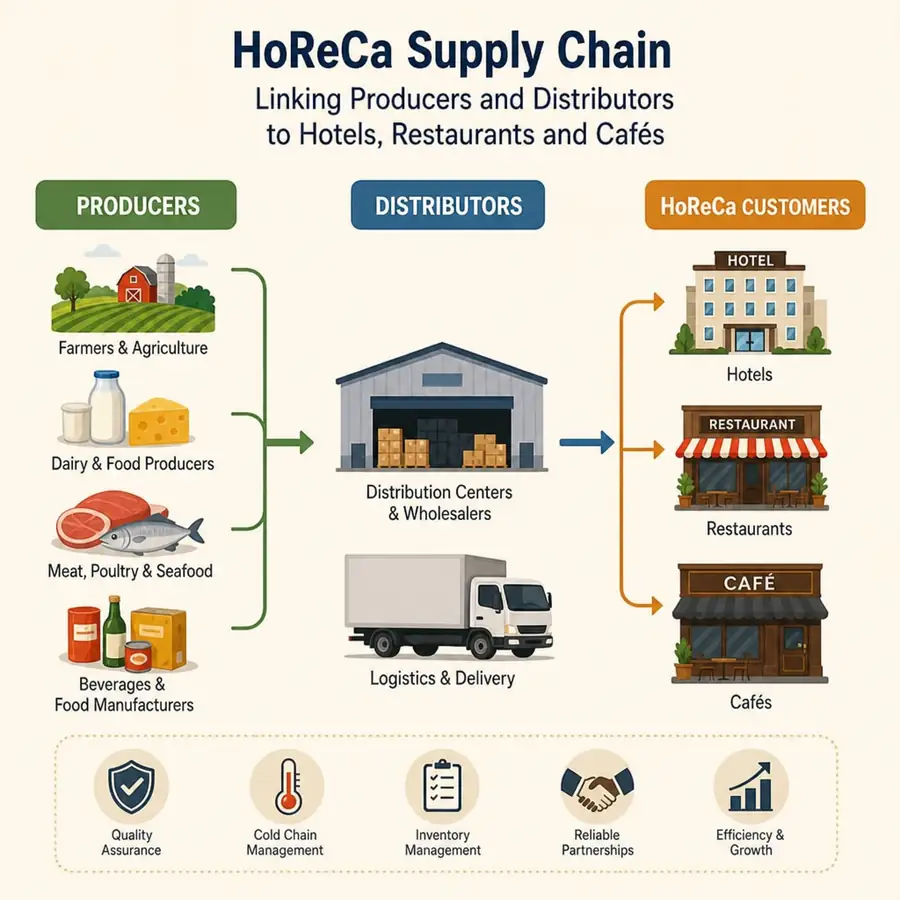
For suppliers, "HoReCa" also describes a business-to-business sales channel. A coffee roaster supplying cafes, an equipment manufacturer serving commercial kitchens and a food distributor delivering to hotels all sell into this market. They support HoReCa operators without necessarily running hospitality venues themselves.
The main businesses within HoReCa
Hotels, restaurants and cafes share a service focus, but their operating models differ. Accommodation and food service frequently overlap within one establishment, which helps explain why they are grouped together. A hotel restaurant, for example, belongs to a wider lodging operation while also providing a distinct dining service.
These segments sit within the broader accommodation and food service sector; the priorities above offer practical starting points rather than universal operating rules.
Hotels combine several service functions
Accommodation businesses range from lodging-only establishments to properties offering meals and recreational facilities. Their service scope therefore determines how many functions need coordination. A room-only property and a hotel with restaurants and events should not use identical operating plans.
For a hotel serving breakfast, consider linking expected guest numbers to kitchen preparation and staffing. Keep restaurant availability visible to reception, too, so staff can give useful answers rather than send guests between departments. The practical goal is one coherent experience, even when several teams deliver it.
Restaurants, cafes and caterers serve different occasions
Food service includes full-service dining, limited-service outlets, catering and other meal providers. Customers may eat on site, collect an order or have it delivered; seating alone does not define the category.
Plan around the occasion you serve. A cafe targeting commuters should examine ordering and collection, while an event caterer should clarify guest numbers, service timings and responsibilities before production begins. Use the business model-not the HoReCa label alone-to decide what deserves attention.
How does HoReCa differ from hospitality, tourism and retail?
HoReCa identifies accommodation and food service businesses, while tourism covers a broader set of activities, including transport, travel agencies and rentals. The categories overlap, but they are not interchangeable: a neighborhood restaurant serves local residents as well as visitors. Hospitality is commonly used as a broader umbrella for guest-focused services.
Retail and food service also represent different routes to the customer. EUMOFA, the European Market Observatory for Fisheries and Aquaculture Products, distinguishes retail outlets such as fishmongers from foodservice businesses such as restaurants and caterers. A supplier may serve both channels, but each needs a separate customer proposition.
When assessing a potential customer, ask what happens to the product next. Will the buyer resell it, prepare it for a meal or use it to deliver an accommodation service? That question provides a more useful starting point for product selection and sales conversations than the label alone.
HoReCa management connects service with commercial discipline
HoReCa management brings together people, purchasing, service delivery and performance monitoring. European hospitality employers identify digital, interpersonal and environmental skills as important operational needs, alongside specialist roles such as chefs and maintenance staff. Effective management therefore needs more than a good booking system or an attractive menu.
Start with a manageable review routine rather than a dashboard nobody uses. Give each measure an owner, agree how it will be recorded and decide what action an unexpected result should trigger. Keep the discussion close to real service problems: unavailable dishes, delayed rooms, missed requests or unnecessary preparation.
Build a small, useful operating dashboard
Choose measures that answer a specific management question. Avoid adopting a long list simply because software makes it available. A practical starting dashboard could include:
- Demand: Compare bookings, occupied rooms or customer covers with the staffing and preparation plan.
- Revenue: Review sales by service period, product category or booking channel rather than relying only on the total.
- Purchasing: Check agreed specifications, delivery discrepancies and supplier substitutions.
- Waste: Record discarded food and investigate where it originates.
- Service: Group complaints by cause and assign follow-up actions.
For food waste specifically, WRAP recommends consistent measurement to establish a baseline and identify opportunities for prevention and savings. Use that principle to guide purchasing and preparation changes rather than guessing which items cause the biggest losses.
For example, review repeated breakfast leftovers before changing the menu. Test smaller preparation batches or a different replenishment schedule, then compare the results. Treat the change as an operational experiment, not a guaranteed saving.
Give staff clear standards and escalation routes
HOTREC's January 2026 skills roadmap highlights communication, problem-solving, digital competence and environmental awareness as important capabilities. It also reports that labor shortages remain a structural challenge in many European countries, despite easing from the post-pandemic period.
Translate those priorities into short, role-specific training. Practice handling a booking discrepancy, explaining an unavailable dish and escalating a complaint. Make clear which decisions staff can take independently and when they should involve a manager.
HoReCa marketing should make the next step easy
HoReCa marketing should connect a clear offer with an easy way to book, visit or enquire. Online visibility, review management and digital customer communication are among the skills HOTREC identifies as increasingly important for hospitality teams. Use those channels to explain the experience accurately, not just to attract attention.
Start by identifying the audience and occasion. A restaurant seeking weekday lunch customers needs a different message from a hotel targeting weekend stays. Likewise, a supplier selling to chefs should explain practical product suitability rather than copy consumer-facing dining language.
Build a simple path from discovery to action:
- State the offer clearly. Explain the cuisine, accommodation style, service format or professional product range.
- Remove basic uncertainty. Keep menus, opening hours, booking information and contact details current.
- Use specific evidence. Show the actual rooms, dishes, equipment or packaging being offered.
- Choose one primary action. Make reserving, ordering or requesting a quotation easy to identify.
- Review completed outcomes. Compare enquiries, bookings or orders, rather than judging activity only by views.
For supplier marketing, prepare a buyer-focused information sheet. Include available specifications, pack formats, ordering arrangements and substitution policies where relevant. Do not claim savings, sustainability benefits or performance advantages unless you can substantiate them.
HoReCa trends in 2026 favor practical improvements
European hospitality discussions in 2026 emphasize workforce capability, digital tools and environmental performance. HOTREC identifies skills needs across all three areas, while Amadeus's research with European hotel leaders highlights cost pressures, technology adoption and changing guest expectations. These are useful planning themes, not proof that every market is moving identically.
Use the following priorities as a filter for investment:
- Train before adding complexity. Check that staff can use existing systems before introducing another platform.
- Choose technology around a problem. Define whether the goal is better forecasting, fewer booking errors or faster access to guest information.
- Measure environmental actions. Start with a documented baseline for food waste instead of an unsupported claim about being "green."
- Protect human service. Decide which routine tasks can be simplified while keeping help available for unusual requests.
Amadeus identifies integrated data, automation and personalization as themes among surveyed hotel leaders. Before adopting them, specify the intended result and how your team will evaluate it. A smaller, well-used improvement is a sensible starting point when resources are limited.
What do 2026 HoReCa restaurant trends mean for Europe's seafood and fish industry?
For seafood buyers, the practical priorities are careful costing, dependable supply information and credible sourcing communication. The European Commission's 2025 EU Fish Market report describes volatile prices and pressure on purchasing power, while European Parliament research highlights consumers' interest in better seafood information. These findings provide context for 2026 purchasing decisions, rather than a complete forecast of restaurant demand.
Keep the dates and channels straight. The Commission's report, published on December 1, 2025, mainly describes earlier market conditions; its findings on declining household fresh-fish consumption should not be presented as a measured decline in restaurant seafood orders during 2026. EUMOFA analyzes retail and out-of-home channels separately.
For a restaurant reviewing its seafood offer, use a purchasing checklist:
- Specify the product: Confirm species, product form, portion requirements and acceptable substitutions.
- Compare usable cost: Ask how preparation requirements and usable portions affect the dish, rather than comparing invoice prices alone.
- Verify sourcing descriptions: Request supporting information before adding origin or sustainability claims to menus.
- Plan for availability changes: Agree how substitutions will be approved and communicated to kitchen and service staff.
- Test before expanding: Trial a dish, record preparation and waste, and review customer response before making it permanent.
For example, trial a fish special before committing to a wider menu change. Ask the supplier for clear product information, agree the delivery requirements and brief the service team on the description. Keep the trial focused enough that purchasing, kitchen and sales feedback can inform the next decision.
Avoid treating "local," "wild-caught" or "farmed" as a complete explanation of sustainability. European Parliament research describes seafood sustainability information as a complex area involving environmental, social and economic considerations. Use specific, supportable descriptions instead of broad labels that promise more than the available evidence shows.
The takeaway: understand the sector, then focus on the operation
HoReCa provides a useful name for connected accommodation and food service businesses, but each operation needs its own priorities. Start by identifying the customer occasion, the service promise and the processes required to deliver it. Then choose a few meaningful measures, train the team around real situations and make marketing reflect what customers can actually expect.