
Choosing the right commercial display refrigerator is one of the most critical decisions you'll make for your food business. Picking the wrong one isn't just an inconvenience—it's a multi-thousand-dollar mistake that can lead to spoiled products, shocking energy bills, and even failed health inspections. This guide is designed to cut through the confusion, ensuring you buy with confidence and invest in a tool that works for you.
It’s helpful to stop thinking of a commercial merchandiser as just a box that keeps things cold. Instead, view it as your most reliable, silent salesperson. Working 24/7, its only job is to make your drinks, sandwiches, and desserts look absolutely irresistible to every customer who walks in. The right unit boosts sales, while the wrong one becomes a constant drain on your profits.
But what happens when that "salesperson" isn't up to the job? A weak unit that can’t maintain a safe temperature means throwing out spoiled inventory and risking your reputation. Industry data consistently shows that an inefficient model can quietly add hundreds of dollars to your yearly operating costs. Even something as simple as dim lighting or foggy glass can discourage those crucial impulse buys, leaving money on the table every single day.
Navigating the options can feel overwhelming, but the process is simpler when broken down into four key areas. First is determining the right size for your physical space, followed by the non-negotiables of food safety and health code compliance. From there, you'll learn how to choose a model that won’t drain your bank account with high running costs. Finally, you’ll dive into the features that actively boost sales, turning your new refrigerator into a true business asset.
Step 1: How to Choose the Right Size Refrigerator (and Avoid a Delivery Day Disaster)
Imagine this: your brand-new, $3,000 glass-door refrigerator arrives on a truck, gleaming and ready to boost sales. The only problem? It won’t fit through your front door. This happens more often than you’d think, leading to frustrating delays and expensive restocking fees. The first step in choosing the right size commercial refrigerator isn’t about what it holds, but whether you can get it into your building.
To prevent this costly mistake, grab a tape measure and check these three measurements before you add anything to your cart. The exterior refrigerator dimensions are just as important as its capacity.
- Measure the Final Location: Check the width, depth, and height of the space where the unit will live.
- Measure the Delivery Path: Measure the height and width of ALL doorways, tight hallways, and corners the fridge must pass through from the delivery truck to its final spot.
- Add Airflow Clearance: Plan for at least 2-3 inches of open space around the back and sides of the unit for proper ventilation. Without this, the refrigerator has to work harder, driving up your energy bill and shortening its lifespan.
Once you know what size unit physically fits, you can decide on the internal capacity, which is measured in cubic feet. A good rule of thumb for a commercial merchandiser capacity is to think in terms of product. For example, a standard one-door glass cooler (around 23 cubic feet) can typically hold about 200 standard 20-ounce soda bottles. If you’re selling bulkier items like large salads or pre-packaged meals, that number will be significantly lower.
It’s tempting to buy a smaller unit to save money upfront, but this is often a mistake. If your drink cooler is empty by 2 PM during the afternoon rush, you're leaving money on the table for the rest of the day. A unit that’s too small also creates a hidden labor cost, forcing your staff to constantly restock it instead of serving customers. Choosing a size that can handle your peak demand is a smart investment.
Swing Door vs. Sliding Door: Which Is Right for Your Business?
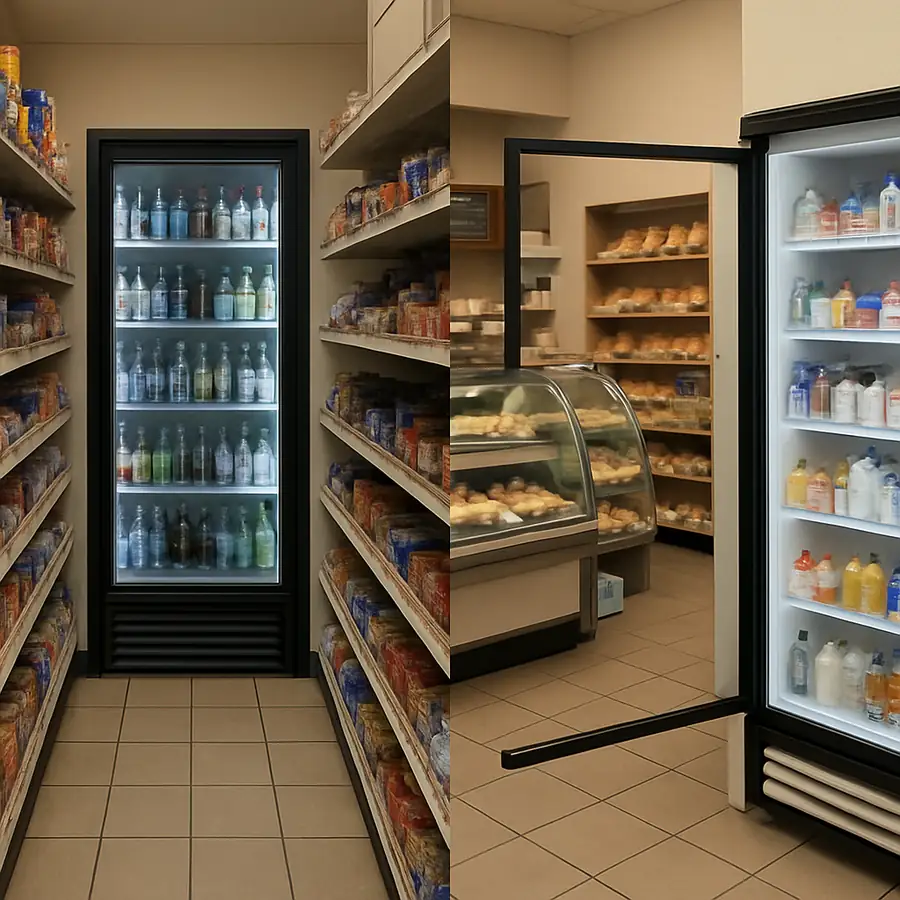
The type of door on your cooler does more than just open and close—it directs how customers move through your store. A swing door display cooler opens outward, just like a regular door. In a spacious deli or cafe, this works perfectly. But in a narrow convenience store aisle, that same door can create a traffic jam, preventing other customers from passing by. Before choosing, visualize a customer holding the door open while they decide. If that blocks the path for others, a swing door will frustrate shoppers and could even cost you sales from people who won't wait.
Beyond aisle space, the door you choose impacts both your energy bill and what you can sell. Commercial refrigerator doors with hinges, or swing doors, typically press into the frame to create a very tight seal, which can be slightly more energy-efficient when closed. On the other hand, sliding doors are the undisputed winner for tight spaces, allowing for smooth customer flow in high-traffic, grab-and-go areas. Any small difference in the seal is often less important than a crucial feature for both types: self-closing doors. This ensures the unit isn't left open by a distracted customer, which is the biggest energy-waster of all.
So, how do you decide? For narrow aisles where maximizing customer movement is key, like in a busy convenience store, sliding doors are the clear choice. If you have more floor space and need to stock bulky items like sheet cakes or large platters, a swing door provides wider, unobstructed access. But whether your customers slide or swing the door open, what truly matters is what's on the other side of the glass.
The Non-Negotiables: Why Temperature Safety and NSF Certification Are Critical
While your refrigerator at home might be opened a dozen times throughout the day, your business’s display cooler could see that much action in a single hour. This constant use puts an incredible strain on the cooling system. A residential fridge simply can’t keep up, creating a serious risk of spoiled inventory and lost profit. A true commercial unit isn't just a bigger box; it’s a powerful machine built for a completely different job.
The key difference is something called temperature recovery time. Imagine your lunch rush: the door swings open every 30 seconds as customers grab drinks and sandwiches. Each time, warm air floods in. A commercial refrigerator is designed to fight back immediately, using a powerful compressor to pull the temperature back down to a safe level in moments. This rapid recovery is what you're paying for—it’s the single most important feature for keeping your food fresh and your customers safe.
Health codes are built around a simple, unbending rule: keep cold food cold. The temperature range between 40°F and 140°F (4°C to 60°C) is known as the "Food Danger Zone," where bacteria can multiply at an alarming rate. A commercial refrigerator’s entire purpose is to hold your products safely below 40°F, even when your shop is at its busiest. This isn't a "nice-to-have" feature; it's the foundation of food safety.
So how can you be certain a refrigerator is truly built for this demanding job? You look for an official seal of approval. The most important one is NSF-7 certification. This standard, set by the global public health organization NSF International, certifies that a refrigerator can maintain safe temperatures under commercial conditions. It’s what your local health inspector will look for, making it an absolute requirement for any business serving food to the public.
Top-Mount vs. Bottom-Mount Compressor: Where Should the 'Engine' Go?
Manufacturers place the compressor—the component doing all the hard work—at either the top or the bottom of the unit. This isn’t a random design choice; it’s a strategic decision that should be based entirely on where the refrigerator will live in your business. The right placement can add years to your unit’s life, while the wrong one can lead to frequent maintenance headaches and higher running costs.
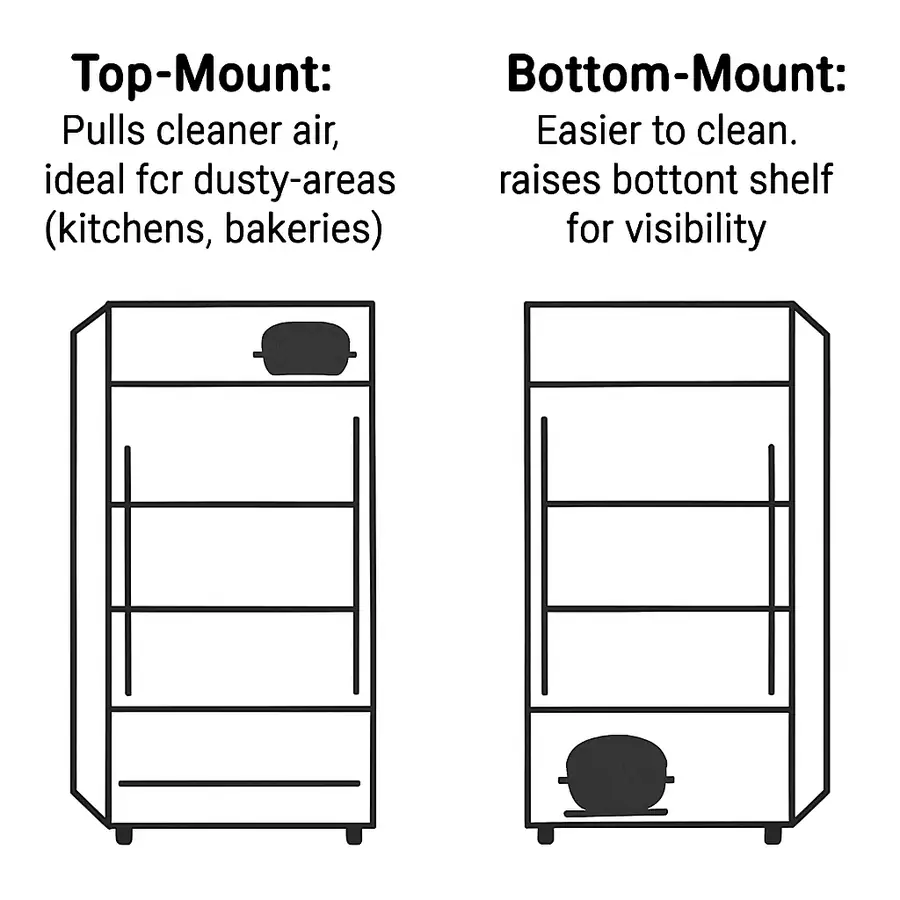
Imagine a busy bakery or a hot commercial kitchen. The air is often filled with heat rising from ovens and fine particles like flour or grease. A top-mount compressor is the clear winner here. By sitting on top of the unit, it pulls in cleaner, cooler air from above, avoiding the dust and debris that naturally settles on the floor. This prevents the compressor from getting clogged and overworked, helping it run more efficiently and last longer in a demanding environment.
On the other hand, a bottom-mount compressor is perfect for a cooler, cleaner, customer-facing area like a café or convenience store aisle. Its main advantage is ergonomics. By placing the heavy machinery at the base, it raises the lowest shelf to a more comfortable height, putting your products directly in your customers’ line of sight and reach. This can make a real difference for "grab-and-go" sales. As a bonus, the compressor is easier to access for routine cleaning, a simple task that is vital for the unit's long-term health.
How to Lower Your Energy Bill: Decoding Efficiency Ratings and Refrigerants
Beyond the initial purchase, your refrigerator’s biggest financial impact will be on your monthly electricity bill. A commercial unit runs 24/7, making it one of the hardest-working pieces of equipment in your business. Choosing an energy-efficient model isn’t just an eco-friendly choice; it’s a strategic financial decision that directly lowers your overhead and increases your profit margin month after month. The initial price tag rarely tells the whole story of what a refrigerator will truly cost you.
To find these efficient models, you don't need to be an engineer. Just look for two key indicators. The first is the Energy Star certification. Think of this as a government-backed guarantee that the unit meets strict standards for low energy consumption. The second is the type of refrigerant—the fluid that actually does the cooling. The modern standard is R290, a type of natural hydrocarbon refrigerant. All you need to know is that units using R290 are significantly more efficient and better for the environment than older models. A refrigerator with both an Energy Star label and R290 refrigerant is the gold standard for saving money on electricity.
This is where you need to think about the Total Cost of Ownership (TCO), not just the sticker price. Imagine you’re choosing between two similar refrigerators. Unit A costs $2,500 and will use about $50 in electricity per month. Unit B is an Energy Star model with R290, costs $3,000, but will only use $25 in electricity per month. While Unit B is $500 more expensive upfront, it saves you $25 every single month. In just 20 months, it will have completely paid back that extra cost. From that point on, it’s putting an extra $300 back into your pocket every year for the life of the unit.
Ultimately, an energy-efficient refrigerator is an investment that pays you back. The small premium you might pay at the start is quickly returned through lower operating costs, making it the smarter long-term purchase.
Features That Sell: Why Lighting and Glass Can Make or Break a Sale
While efficiency saves you money, a display refrigerator’s most important job is to make you money by turning browsers into buyers. This is where the right visual features transform your cooler from a simple storage box into your best salesperson. The single most impactful feature is modern LED lighting. Unlike the dim, yellowish fluorescent tubes of the past, bright and even LEDs make your products look vibrant and irresistible. A well-lit display makes colors pop, highlights freshness, and creates an inviting presentation that can dramatically increase impulse buys. As a bonus, LEDs produce very little heat, which means your compressor doesn’t have to work as hard, further lowering your energy bill.
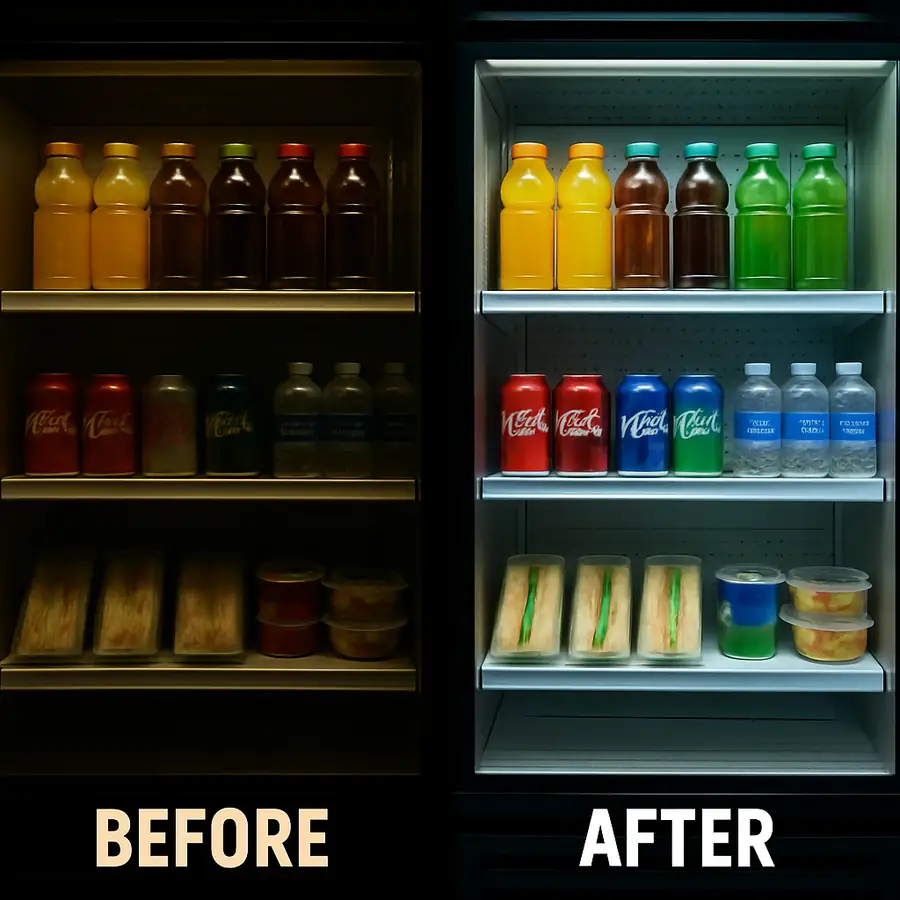
Of course, the best lighting in the world is useless if customers can’t see through the glass. Have you ever noticed a cooler door completely fogged over on a humid day or during a busy rush? That condensation is a sales killer. If a customer can’t clearly see your selection of drinks or sandwiches, they’re likely to just walk away. To solve this, many commercial refrigerators offer anti-fog or heated glass doors. These doors have a transparent, low-energy heating element that gently warms the glass just enough to prevent condensation from forming. In humid climates or high-traffic businesses where the door is opened constantly, this isn't a luxury—it's essential for keeping your products visible and ready to sell.
Choosing a unit with brilliant lighting and fog-free glass ensures your products are always presented in the best possible way. These features work together to maximize customer appeal and drive sales, directly impacting your bottom line.
Don't Forget the Day-to-Day: Shelving, Cleaning, and Maintenance
While your products need to look great to sell, the refrigerator itself must be easy for you and your staff to manage every single day. This is where the interior design, specifically the shelving, plays a surprisingly large role. Your product lineup will inevitably change. One month you might stock short soda cans, and the next you might add tall energy drinks or boxed sandwiches. Units with adjustable shelving for commercial merchandisers give you the flexibility to reconfigure your display in minutes, maximizing every inch of valuable space. Furthermore, look for shelves with a heavy-duty coating, usually made of epoxy or PVC. A spilled drink or leaky container on a plain wire rack can lead to rust and a sticky, hard-to-clean mess. A coated rack, on the other hand, resists corrosion and can be wiped clean in seconds, a small feature that saves significant time during daily cleaning.
The ease of cleaning extends beyond just the shelving. One of the most critical—and often overlooked—components for hygiene is the door gasket. This is the soft rubber seal that lines the inside of the door, and it's a magnet for crumbs and sticky residue. On cheaper units, these gaskets are fixed in place, making them nearly impossible to clean thoroughly. A quality commercial refrigerator will feature removable door gaskets. They are designed to be pulled out easily without any tools, washed in a sink, and snapped back into place. This makes it simple to maintain a truly hygienic unit that will pass any health inspection and also ensures a tight seal to keep cold air in, saving you energy.
These seemingly small details are what truly make a unit an easy to clean commercial refrigerator and simplify long-term commercial refrigerator maintenance. Features like coated, adjustable shelves and removable gaskets are not just conveniences; they are time-savers that reduce labor costs and prevent daily frustrations. They represent the thoughtful engineering that separates a frustrating appliance from a reliable business partner.
A Quick Word on Brands and Warranties: What Are You Really Paying For?
When you begin shopping, you'll quickly notice a significant price difference between various brands. It’s natural to ask why you might pay hundreds, or even thousands, more for a unit that looks nearly identical to a budget model. The answer rarely lies in the stainless steel finish or the brightness of the lights; it's about what happens when something goes wrong. A higher price tag often buys you better internal components and, more importantly, a stronger safety net for your business.
This safety net is built on two pillars: a solid commercial refrigerator warranty and a robust service network. Esteemed brands, such as True Refrigeration or Turbo Air, invest heavily in having certified technicians and parts available across the country. This means that if your compressor fails during a heatwave, you're not waiting a week for a part to be shipped from overseas while your inventory spoils. You’re getting a qualified professional to your door quickly. Think of the extra upfront cost as a form of downtime insurance—you're paying a premium to drastically reduce the risk of losing thousands of dollars in sales and product.
Before you make a final decision, always ask two critical questions about any model you’re considering. First, "What does the warranty cover, specifically for parts, labor, and the compressor, and for how long?" Second, and most importantly, "Who provides commercial refrigerator service for this brand in my area, and what is their average response time?" A great warranty is useless if there's no one around to honor it. Answering these questions shifts your focus from the initial price to the total cost of ownership, ensuring your new refrigerator is a reliable partner, not a future liability.
Your Smart Buying Checklist: Turning This Guide into Action
What once seemed like a large, expensive box can now be seen as what it truly is: a powerful business tool. You are no longer guessing what features matter; you understand how the right lighting can boost sales, how a specific compressor placement can prevent costly repairs, and how a simple certification sticker can save you from a failed health inspection. This knowledge transforms a daunting purchase into a strategic business decision.
Use this simple checklist to ensure you’re not missing any critical factors when buying a commercial cooler for your business.
Your 5-Point Final Checklist:
- Measure My Space & Delivery Path: Will it fit in its spot and through the door?
- Choose My Door Type: Swing for a wide display, or slide for tight spaces?
- Confirm It's NSF-7 Certified: Is it approved for commercial food safety?
- Match the Compressor to My Environment: Top-mount for dusty areas, bottom-mount for easy access.
- Compare Energy Star/R290 Models: Which one offers the best long-term savings on my electricity bill?
You now have the knowledge to look past the price tag and choose a commercial display refrigerator that will be a reliable, profitable partner for your business for years to come.
Why Buy a Commercial Display Refrigerator from The Horeca Store?
A commercial display refrigerator is more than just a cooling unit—it also helps showcase your products, attract customers, and boost sales. The Horeca Store offers a wide range of commercial display refrigerators, including upright display coolers, glass door refrigerators, countertop display units, and merchandising refrigerators from trusted brands. Ideal for restaurants, cafés, bakeries, supermarkets, convenience stores, hotels, and beverage outlets, our display refrigerators are designed to provide excellent product visibility, consistent temperature control, energy efficiency, and reliable performance in busy commercial environments.
Whether you're displaying beverages, dairy products, desserts, sandwiches, or ready-to-eat meals, The Horeca Store helps you find the perfect display refrigerator to match your business requirements and budget. With competitive pricing, expert product guidance, dependable customer support, and a comprehensive range of commercial refrigeration equipment, The Horeca Store is your trusted one-stop destination for high-quality display refrigerators that enhance product presentation, improve operational efficiency, and keep your products fresh while creating an attractive shopping experience for your customers.