
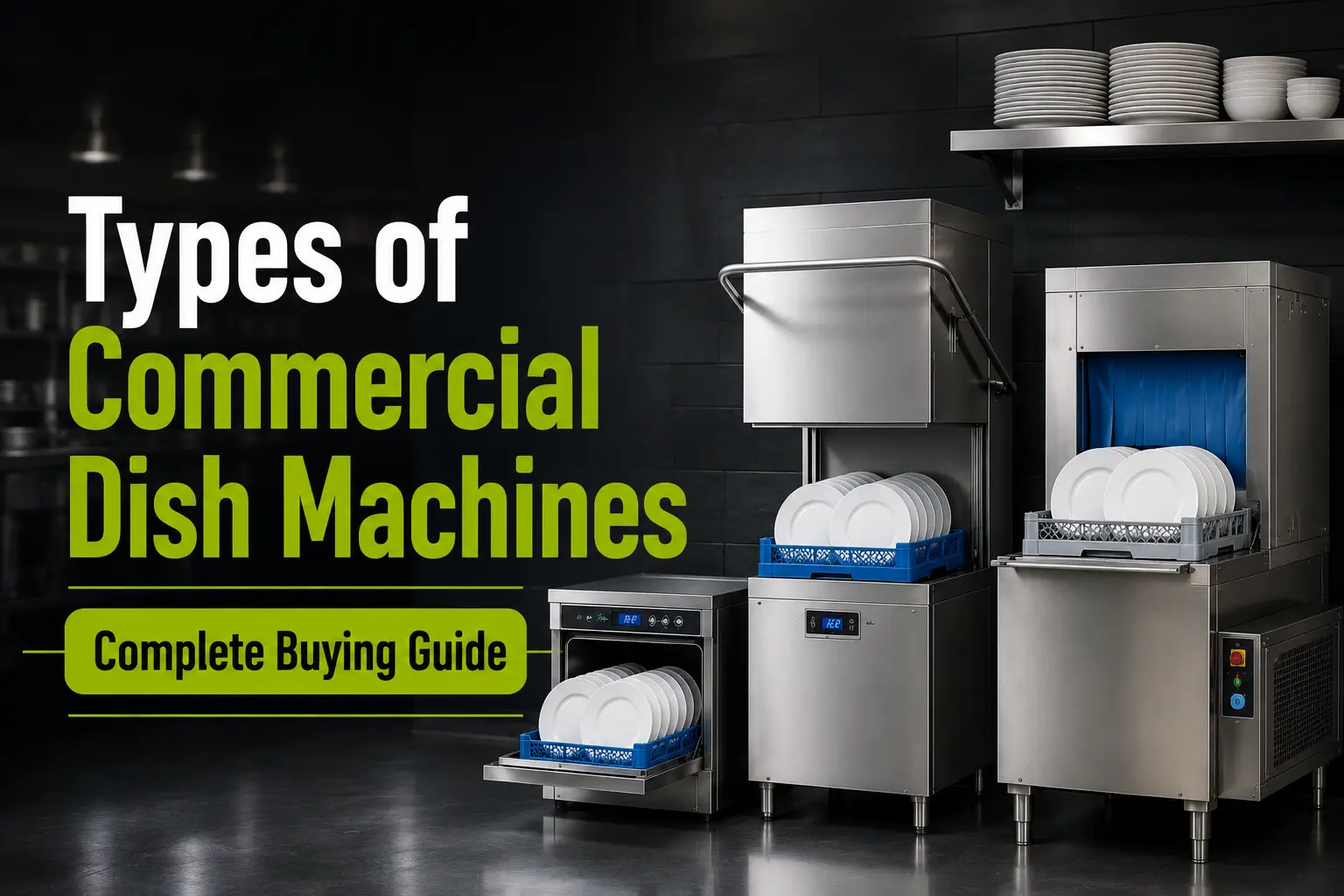
Imagine a bustling restaurant kitchen on a Friday night. Orders are flying in, the chefs are moving at lightning speed, and plates are going out to hungry guests. But what happens when the plates run out? The entire operation grinds to a halt. The dish pit is the unsung heartbeat of any food service establishment, and at the center of that pit is one of the most critical pieces of commercial kitchen equipment you will ever invest in: the commercial dishwasher.
If you are looking for an all-encompassing guide on commercial dish machines: types, use cases, and how to choose the perfect unit for your business, you are in exactly the right place. Navigating the world of commercial dish washing machines can be overwhelming. From compact units designed for small cafes to massive industrial models built for university cafeterias, the options are seemingly endless.
This guide will break down everything you need to know about restaurant dishwashing equipment, empowering you to make an informed decision that boosts your efficiency, saves you money on utilities, and keeps the health inspector happy.
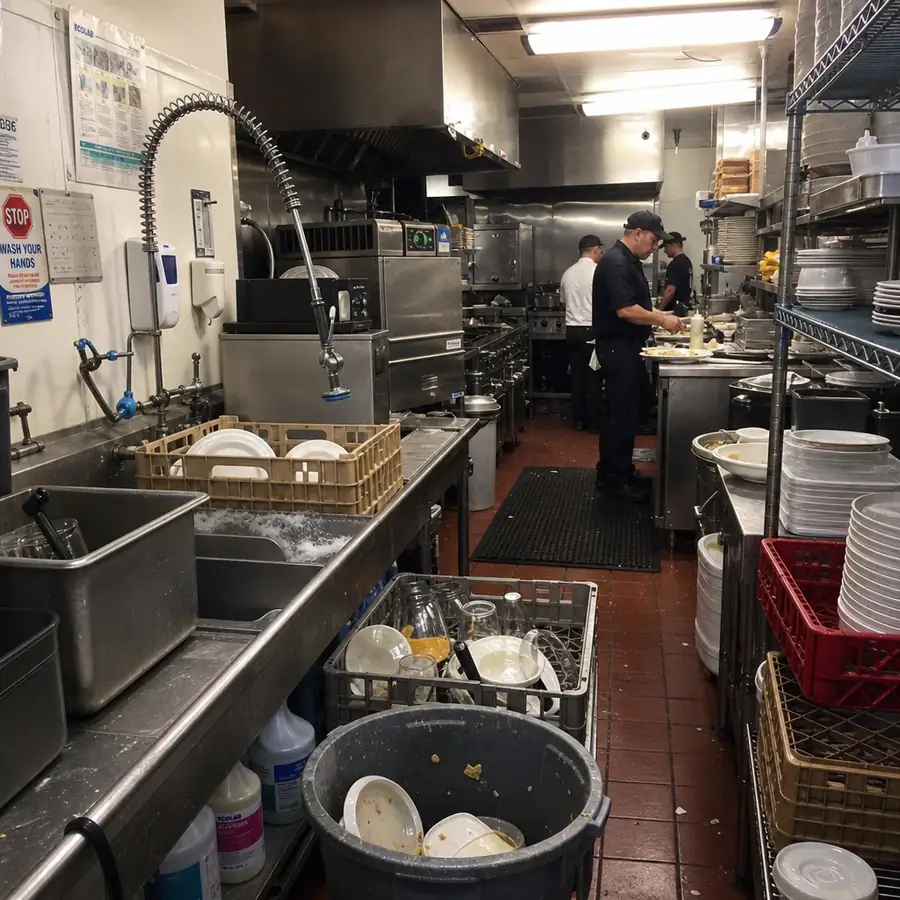
The Backbone of Food Service: Why Your Choice Matters
Choosing the right unit goes far beyond just looking for commercial dish machines for sale and clicking "buy." The machine you select dictates your kitchen's workflow, your utility bills, your labor costs, and your adherence to health codes.
Commercial dish machines are vastly different from residential models. While a home dishwasher might take two hours to run a cycle, commercial restaurant dish machines complete a cycle in as little as 60 to 90 seconds. They are built for relentless, back-to-back usage. Selecting the wrong machine can lead to bottlenecks in the kitchen, spotty glassware, excessive water consumption, and costly breakdowns.
Before we dive into the specific shapes and sizes of these machines, we need to address the most fundamental divide in the industry: how the machine sanitizes your dishes.
High Temperature vs Low Temperature Commercial Dishwashers
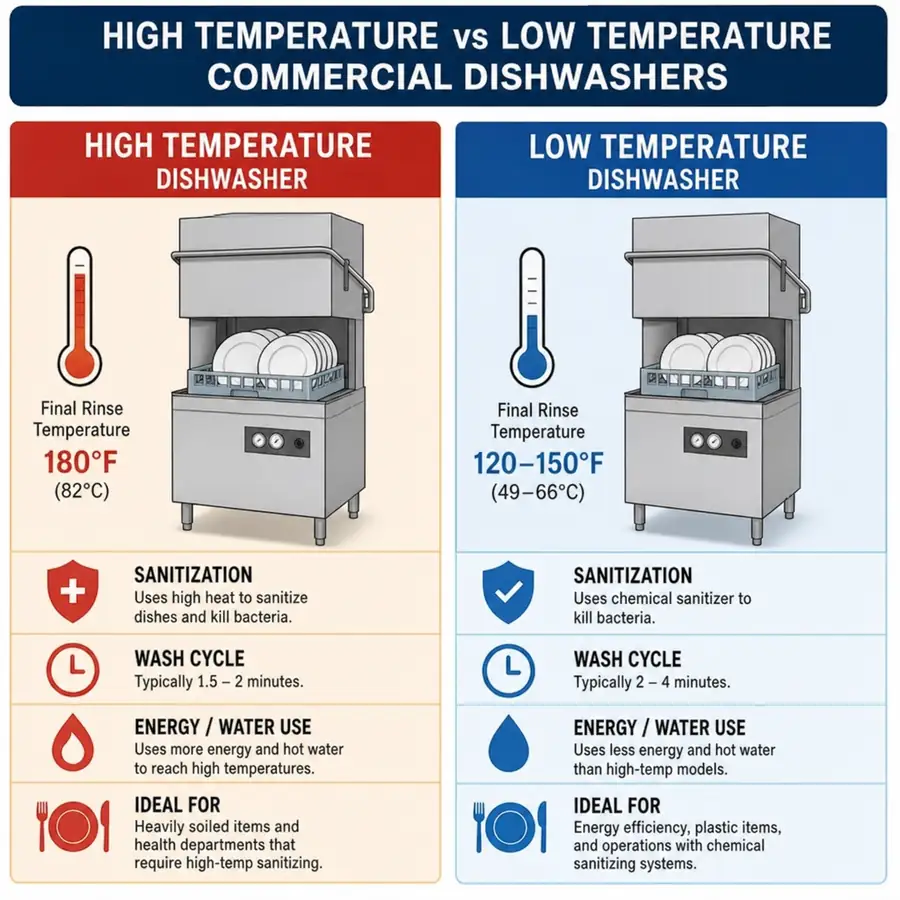
One of the first decisions you will make is choosing between high temperature vs low temperature commercial dishwashers. Both types wash dishes effectively, but they use completely different methods to achieve food-safe sanitation.
High-Temperature Commercial Dishwashers
High-temperature machines use intense heat to sanitize dishes. According to health regulations, the rinse water in these machines must reach a minimum of 180°F (82°C) to effectively kill bacteria.
How they work: Because most standard facility water heaters only supply water at about 120°F to 140°F, high-temperature machines require a "booster heater." This is an additional heating element (either built-in or installed alongside the unit) that boosts the water temperature up to the required 180°F for the final sanitizing rinse.
Superior cleaning power: Hot water cuts through stubborn grease, baked-on food, and lipstick on glasses much more effectively than cooler water.
Flash drying: Because the dishes come out incredibly hot, the water evaporates almost instantly. This eliminates the need for hand-towel drying, speeding up turnaround times.
No chemical residue: Since heat is doing the sanitizing, there is no risk of chemical tastes or odors lingering on your plates or glassware.
Higher upfront and operating costs: The booster heater draws a significant amount of electricity, increasing your energy bills.
Ventilation requirements: The intense steam produced by high-temp machines usually requires the installation of a Type II ventilation hood, which adds to the initial setup cost.
Low-Temperature Commercial Dishwashers
Low-temperature machines wash and rinse dishes using water that is typically between 120°F and 140°F (49°C to 60°C). Because this water is not hot enough to kill bacteria on its own, these machines rely on chemical sanitizers (usually chlorine, iodine, or quaternary ammonium) introduced during the final rinse cycle.
How they work: These machines utilize automatic chemical dispensing systems that inject the exact amount of detergent, rinse aid, and chemical sanitizer needed for each cycle.
Lower energy costs: Because there is no booster heater heating water to 180°F, you save significantly on electricity.
Easier installation: They typically do not require an overhead ventilation hood because they produce very little steam.
Lower initial purchase price: The machines themselves are generally less expensive upfront.
Chemical costs: What you save on electricity, you will eventually spend on purchasing chemical sanitizers month after month.
Slower drying times: Dishes come out cooler, meaning they take longer to air-dry.
Potential for residue: If not calibrated perfectly, chemical sanitizers can tarnish certain metals (like silver and pewter) or leave a faint chlorine odor on delicate glassware.
Exploring the Different Types of Commercial Dish Machines
Once you have decided on your sanitation method, the next step is choosing the physical style of the machine. The right style depends entirely on your floor space, your menu, and your volume.
1. Undercounter Commercial Dishwashers
For establishments with limited space, undercounter commercial dishwashers are a lifesaver. Visually, they resemble residential dishwashers, fitting neatly beneath a standard 36-inch high counter. However, they possess the rapid-cycle power of true commercial dishwashers.
These units typically wash between 20 to 35 racks per hour. Because of their compact footprint and respectable output, an undercounter unit is widely considered the best dishwasher for small restaurants, coffee shops, daycares, and food trucks.
Best feature: Space-saving design that integrates directly into standard cabinetry or bar setups.
Drawback: The door drops down, meaning staff must bend over repeatedly to load and unload racks, which is not ergonomically ideal for high-volume, all-day washing.
2. Under-counter Commercial Glasswashers
While they look nearly identical to standard undercounter dishwashers, under-counter commercial glasswashers are engineered specifically for delicate drinkware.
Bars, pubs, and fine-dining restaurants rely heavily on glasswashers. They use slightly lower water pressure to prevent fragile wine glasses and pint glasses from breaking or etching over time. Many models feature specialized racks and dividers. Having a dedicated glasswasher in the bar area prevents staff from having to haul heavy racks of glassware back and forth to the main kitchen dish pit, drastically reducing breakage.
3. Door-Type (Pass-Through) Dishwashers
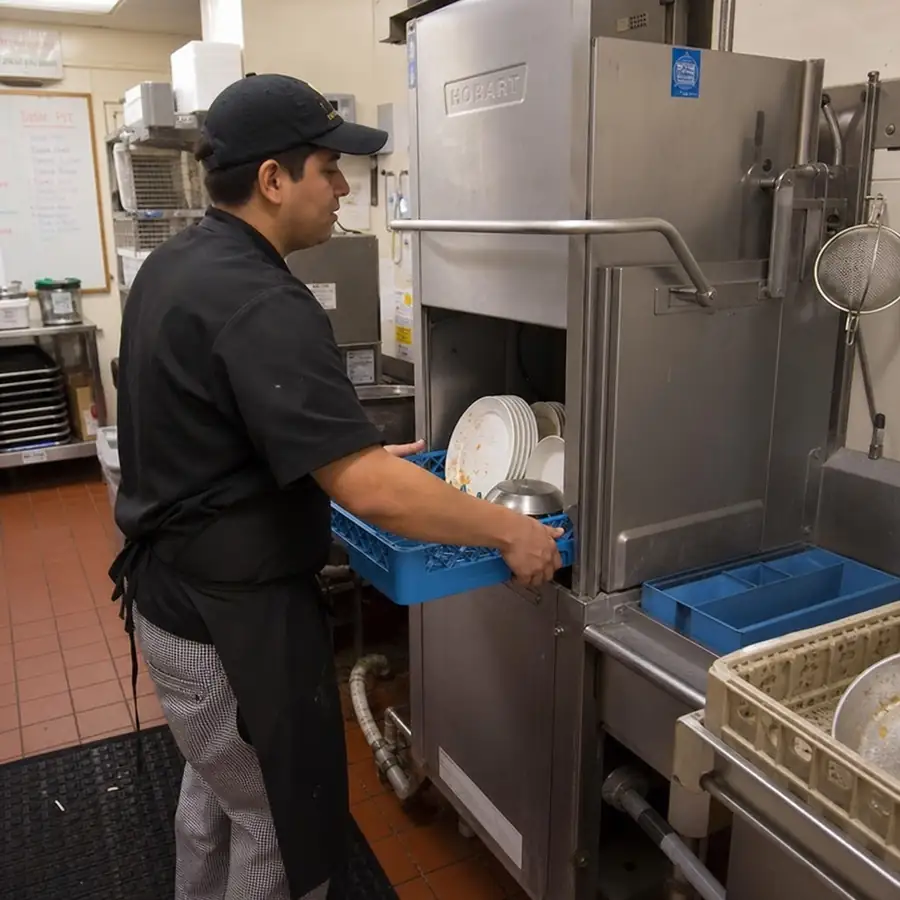
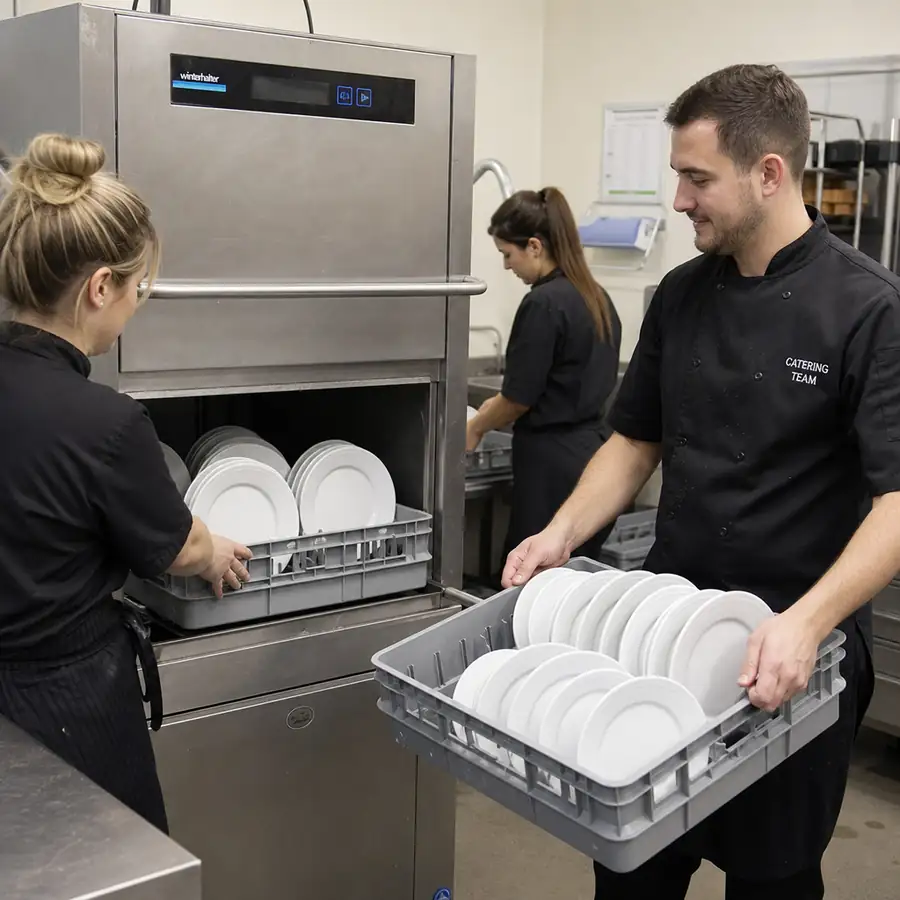
The door-type dishwasher is the quintessential workhorse of the mid-sized restaurant. Also known as pass-through dishwashers, these units are designed to connect seamlessly to clean and soiled dish tables on either side.
When looking at a pass-through dishwasher vs undercounter unit, the differences in workflow are stark. With a pass-through machine, a dishwasher (the person) slides a rack of dirty dishes straight into the machine from the prep table, pulls down the large door to start the cycle, and then pushes the clean rack out the other side once finished.
Capacity: They typically handle 40 to 80 racks per hour.
Best feature: Ergonomics. Staff rarely have to bend down. The continuous linear workflow is incredibly efficient.
Drawback: They require dedicated wall space or a corner setup, consuming significantly more square footage than undercounter models.
4. Conveyor Dishwashers
When you cross the threshold from a busy neighborhood restaurant to a high-volume cafeteria, hotel, or hospital, standard door-type machines can no longer keep up. Enter the conveyor dishwasher.
These are high-capacity dishwashers where racks are hooked onto a motorized chain or belt. The rack is pulled slowly through different chambers within the machine: a pre-wash zone, a main wash zone, a power rinse zone, and a final sanitizing rinse zone.
Capacity: Ranging from 200 to over 400 racks per hour.
Best feature: Unmatched speed. Multiple racks are inside the machine being washed simultaneously at different stages.
Drawback: They are massive, often measuring anywhere from 44 inches to over 100 inches long. They also require heavy-duty electrical setups.
5. Flight-Type Dishwashers
At the absolute peak of the dishwashing food chain are flight-type dishwashers. These are truly industrial dish machines designed for universities, massive banquet halls, airlines, and correctional facilities.
When comparing conveyor vs flight type dishwashers, the primary difference lies in the rack system. While conveyor machines pull racks of dishes through the wash zones, flight-type machines dispense with racks entirely. Instead, they feature a continuous, built-in conveyor belt made of durable pegs. Staff simply place thousands of plates, bowls, and trays directly onto the pegs of the moving belt.
These heavy-duty dishwashers are custom-built, often taking up the length of an entire room. They can process anywhere from 8,000 to over 20,000 individual dishes per hour.
Industry Use Cases: Finding Your Perfect Match
To make the selection process easier, let's look at how different food service models utilize these commercial dishwashers.
Small Cafes, Bakeries, and Bars
If you operate a 40-seat coffee shop that primarily serves pastries on small plates and coffee in ceramic mugs, space is likely your biggest constraint. You don't have the room or the volume to justify a massive dish pit.
The Match: An undercounter dishwasher and an under-counter commercial glasswasher near the espresso machine. This keeps your baristas moving efficiently without leaving the front-of-house area.
Mid-Sized Restaurants (75 to 150 Seats)
A full-service restaurant turning tables over twice a night generates a mountain of plates, silverware, pots, and prep pans. An undercounter unit will quickly become a bottleneck, leading to frustrated chefs waiting for clean sauté pans.
The Match: A door-type (pass-through) dishwasher. Set it up in a linear configuration with a pre-rinse sink and a garbage disposal on the soiled side, and a long drying rack on the clean side.
Catering Businesses
Many people wonder how to choose a dishwasher for a catering business. Caterers face unique challenges: unpredictable volume, varying dishware types (from rustic chargers to fine china), and intense, sudden bursts of dishwashing after an event concludes. You need flexibility.
The Match: A high-temp door-type dishwasher is usually the sweet spot. High temp ensures rapid drying, so you can quickly pack plates back into transport crates. If you process thousands of plates in a single post-wedding cleanup shift, a small conveyor model might be justified.
Large-Scale Institutions
Hospitals, corporate dining halls, and large university dormitories have no time to waste. Dishes arrive in massive, continuous waves during narrow lunch and dinner rushes.
The Match: Conveyor or flight-type industrial dish machines. These environments also benefit greatly from specialized ventilation and dedicated energy-recovery systems to handle the immense heat generated.
Essential Factors to Consider When Choosing
Beyond the style and sanitation method, you must evaluate a few critical metrics and certifications to ensure your investment pays off.
Calculating Your Racks Per Hour Capacity
The industry standard for measuring commercial dishwasher output is the racks per hour capacity. A standard dish rack measures 20" x 20".
To calculate what you need, you must estimate the maximum number of dishes you will generate during your busiest hour.
Count your seats: Let’s say you have 100 seats.
Estimate turnover: In your busiest hour, maybe you turn over 75% of your tables (75 customers).
Count items per customer: Include the plate, salad bowl, side plate, water glass, wine glass, and silverware. Let’s estimate 6 items per guest.
Add kitchen prep items: Add about 20% to account for the pots, pans, and spatulas the kitchen uses.
Calculate the total: (75 customers x 6 items) + 20% = 540 items per hour.
Convert to racks: An average rack holds about 18 plates or 36 glasses. Let’s assume an average of 20 mixed items per rack. 540 items / 20 = 27 racks per hour.
In this scenario, a machine rated for 35 to 40 racks per hour (giving you a buffer for growth and operational inefficiency) would be perfect. Always buy a machine with a capacity roughly 20% to 30% higher than your strict mathematical need.
Prioritizing NSF Certification
When browsing commercial dishwashers, you must ensure the unit holds an NSF certification for food service sanitation. The National Sanitation Foundation (NSF) is an independent organization that tests and certifies that equipment meets strict public health standards.
Health inspectors will actively look for the NSF sticker on your dishwasher. It proves that the machine is capable of reaching the required temperatures or accurately dispensing the right ratio of chemical sanitizers to effectively neutralize pathogens. Never purchase uncertified, generic equipment for a commercial kitchen.
Commercial Dishwasher Installation Requirements
One of the biggest mistakes new restaurant owners make is purchasing a dishwasher without verifying their building's infrastructure. Commercial dishwasher installation requirements are stringent and highly specific.
Electrical and Ventilation Needs
Commercial dishwashers draw massive amounts of power. While a residential unit might plug into a standard 120V wall outlet, commercial units-especially high-temp models with booster heaters-often require 208V, 240V, or even 480V three-phase electrical connections. You must consult a licensed electrician before purchasing to ensure your breaker box can handle the amperage.
Ventilation is equally critical. High-temperature door-type and conveyor models release plumes of steam when opened. Most local building codes mandate the installation of a Type II exhaust hood directly above the dishwasher to pull this moisture-laden air out of the building. Failure to do so will result in ruined drywall, peeling paint, and toxic mold growth in your kitchen.
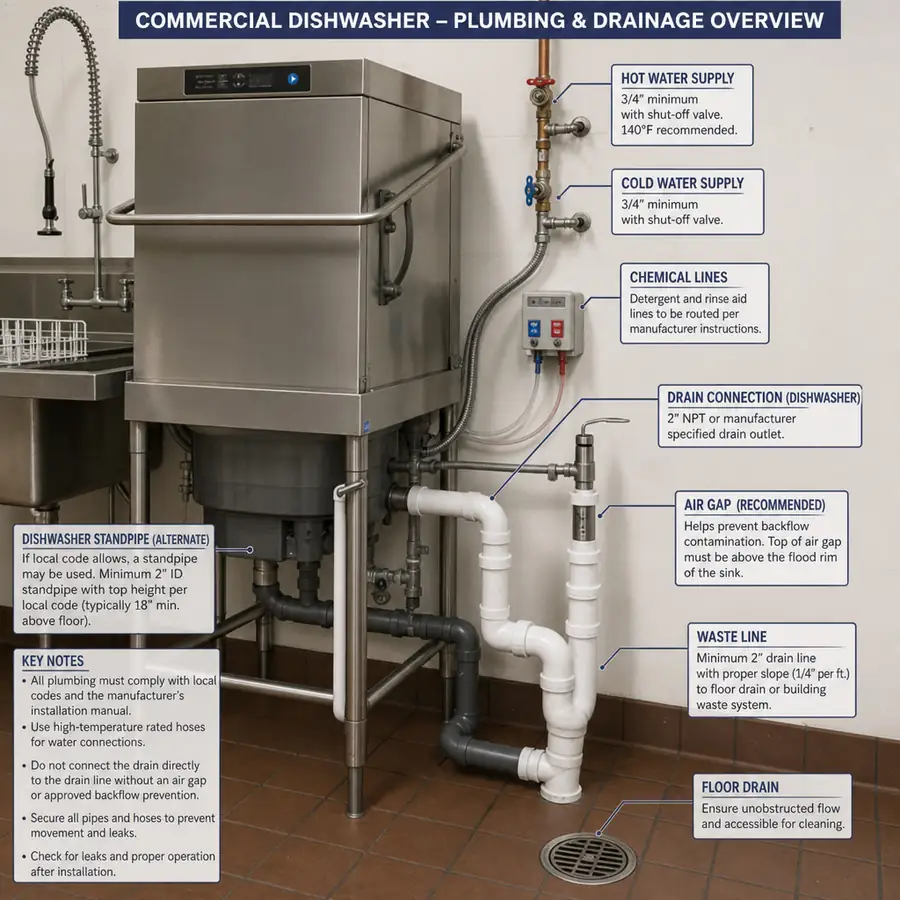
Commercial Dishwasher Drainage and Plumbing Needs
Water goes in, and water must go out. Commercial dishwasher drainage and plumbing needs require careful planning with a commercial plumber.
Water Supply: Ensure your incoming water lines have the correct diameter (usually 1/2" to 3/4") and sufficient flow pressure (typically 20-25 PSI) to feed the machine.
Drainage: Most local health codes prohibit commercial dishwashers from being hard-plumbed directly into the municipal sewer line. Instead, they require an "indirect drain." The dishwasher must drain into a floor sink through an "air gap." This gap prevents contaminated sewer water from ever backing up into the clean dishwasher if the city sewer lines clog.
Grease Interceptors: Because commercial dishwashers process heavy food grease, local municipalities often require the machine's drain line to be routed through a grease trap or grease interceptor before the water reaches the public sewer system.
The Economics: How Much Does a Commercial Dishwasher Cost to Run?
When you begin looking at commercial dish machines for sale, you might suffer a bit of sticker shock. Undercounter models can cost between $3,000 and $6,000, while door-type models range from $5,000 to $15,000. Conveyor and flight models can easily stretch into the tens or hundreds of thousands of dollars.
But the purchase price is only the beginning. You must ask: how much does a commercial dishwasher cost to run?
The Total Cost of Ownership (TCO) includes water consumption, electricity or gas, chemical detergents, sanitizers, and maintenance. Over a 10-year lifespan, the cost of running the machine will far exceed the initial purchase price.
The Value of Energy Star Ratings
This is why investing in Energy Star rated commercial dishwashing equipment is highly recommended. Energy Star certified machines are engineered with advanced features like heat recovery systems, variable frequency drives on the pumps, and low-water-usage spray arms.
Water savings: Standard models might use 1.5 gallons of water per rack. Energy Star models can pull that down to 0.7 gallons per rack.
Energy savings: By using less hot water, the booster heater runs less frequently. Energy Star models are on average 40% more energy-efficient and 50% more water-efficient than standard models.
Financial impact: A certified door-type machine can save a business roughly $1,500 a year in energy and water costs. Over a decade, that is $15,000 in savings-essentially paying for the machine itself.
When evaluating machines, do not just look for the cheapest upfront price. Look at the specification sheet for "Gallons Per Rack" (GPR) and factor that into your long-term budget.
Maintenance Tips for Longevity and Performance
Even the most expensive, top-of-the-line dishwasher will break down if it is treated poorly. Commercial dishwashers are subjected to harsh conditions: boiling water, corrosive chemicals, abrasive food debris, and continuous use. Implementing a strict maintenance protocol is the only way to protect your investment.
The Threat of Hard Water
One of the most silent killers of restaurant dishwashing equipment is hard water. If your municipality has a high mineral content in its water supply (calcium and magnesium), those minerals will bake onto the heating elements, spray arms, and internal walls of your machine.
Hard water scaling in commercial dishwashers leads to several massive problems:
Inefficiency: Scale acts as an insulator. If your heating element is coated in white calcium, it has to work twice as hard (and use twice as much electricity) to heat the water to 180°F.
Clogged spray arms: Minerals will clog the tiny nozzles that spray the dishes, resulting in plates that come out dirty.
Part failure: Severe scaling will eventually burn out booster heaters and destroy water pumps.
The Solution: If your water hardness is above 3 grains per gallon (GPG), you should strongly consider installing a commercial water softener for the building. Additionally, you must incorporate a regular "deliming" process into your maintenance schedule, using acidic deliming chemicals to dissolve the scale build-up.
Daily Maintenance Checklist for Industrial Dishwashers
To keep your kitchen running smoothly, print out and laminate a rigorous maintenance schedule. Here is a recommended daily maintenance checklist for industrial dishwashers:
Check the scrap screens: Ensure the drain screens are in place and completely clear of debris.
Check chemical levels: Verify that the detergent, rinse aid, and sanitizer (if low-temp) buckets have enough liquid for the shift. Prime the lines if necessary.
Verify temperatures: Run a test cycle and check the temperature gauges. Ensure the wash tank is hitting at least 150°F and the final rinse is hitting 180°F (for high-temp models).
Scrape and pre-rinse: The dishwasher is not a garbage disposal. Staff must rigorously scrape plates and use the pre-rinse spray valve before loading racks. This preserves the wash water quality.
Monitor the water: If the wash water becomes murky or heavily soiled, drain the tank and allow it to refill with fresh water. Washing dishes in dirty water is counterproductive.
Drain the machine: Never leave water in the wash tank overnight. It breeds bacteria and causes foul odors.
Remove and clean scrap trays: Take out the internal strainer pans and scrap baskets. Dump the food waste into the trash and scrub the screens in the sink.
Clean the wash and rinse arms: Remove the rotary spray arms. Check the nozzles for toothpicks, citrus seeds, or plastic wrap. Rinse them thoroughly.
Wipe down the interior: Use a clean cloth to wipe down the internal walls and the water level sensors.
Leave the door open: Prop the door open overnight. This allows the interior to air dry, preventing mold growth and extending the life of the internal gaskets.
Shop Commercial Dish Machines at The Horeca Store
Looking for reliable commercial dishwashing equipment for your restaurant, café, hotel, or foodservice operation? The Horeca Store offers professional restaurant equipment and warewashing solutions designed for different kitchen sizes and workloads. Explore our selection of commercial dishwashers and dish machines to find an option that matches your washing volume, available space, and operational requirements.
Conclusion
The dish pit may not be the most glamorous part of the culinary world, but it is undoubtedly the engine that keeps the restaurant running. Understanding the landscape of commercial dish machines is paramount for any successful food service operation.
Whether you are seeking the best dishwasher for small restaurants, comparing a pass-through dishwasher vs undercounter model for your growing eatery, or sizing up massive industrial dish machines for a hospital, the principles remain the same. You must assess your volume, understand your facility's electrical and plumbing capabilities, and calculate the long-term utility costs.
By choosing the right equipment-and committing to rigorous daily maintenance-you will create an efficient, stress-free work environment for your staff. You will save thousands on water and energy bills, ensure flawless health code compliance, and most importantly, guarantee that your beautiful culinary creations are always served on a perfectly pristine plate.