
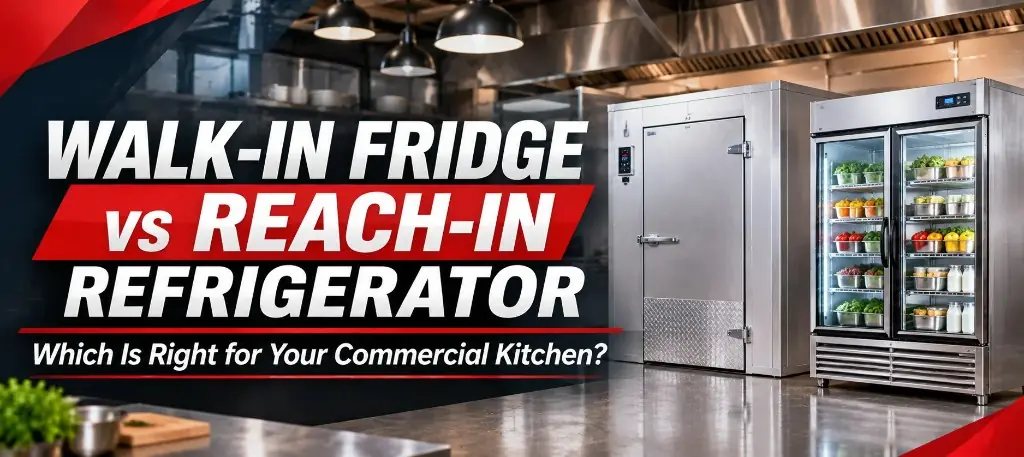
A walk-in fridge suits kitchens that need centralized bulk storage, while a reach-in refrigerator suits accessible, cabinet-based storage near daily workstations. Your choice should follow your inventory, delivery schedule, available space, and installation requirements - not simply the size of your restaurant. This comparison helps you evaluate both refrigeration solutions, including when combining them makes more sense than choosing one.
Which does your kitchen need: a walk-in fridge or a reach-in refrigerator?
Choose a walk-in when your storage plan requires staff to enter a refrigerated room to organize and retrieve bulk inventory. Choose a reach-in when cabinet-access storage meets your needs, especially where ingredients should stay close to preparation areas. These are different equipment configurations, not competing quality levels: walk-ins provide an enclosed refrigerated space, while stand-alone reach-ins integrate refrigeration components into a cabinet.
Start by separating two jobs: holding reserve stock and supplying the next service. Your delivery inventory may need substantial storage, while cooks need only a smaller selection within easy reach. Treating those jobs separately gives you a clearer purchasing brief.
Use these starting points to frame your decision:
- Consider a reach-in first if your inventory fits an organized cabinet layout and you want ingredients positioned near specific tasks.
- Consider a walk-in first if bulk deliveries, large containers, or multiple storage categories make a room-based layout worth evaluating.
- Consider both if you need centralized reserve storage alongside smaller quantities positioned for service.
These are planning recommendations, not capacity guarantees. Validate the actual layout and refrigeration load before committing.
Compare usable storage, not just advertised capacity
A walk-in's refrigerated space includes access aisles, while a reach-in's cabinet must accommodate shelves, containers, and airflow. Neither headline dimensions nor a capacity figure tells you exactly how your inventory will fit. Refrigeration system sizing also needs to account for factors beyond enclosure size, including product loads and operating conditions.
Build your comparison around the containers you actually use. List produce cases, dairy cartons, covered food pans, beverage stock, and any unusually tall or wide items. Then ask for a proposed shelf layout rather than assuming everything will fit because the total volume looks sufficient.
A useful storage assessment includes:
- Peak stock after delivery. Record what must fit when inventory is highest, not when shelves are nearly empty.
- Prepared-food storage. Include the containers your production schedule adds between deliveries and service.
- Access requirements. Show how staff will retrieve products without unloading unrelated stock.
- Manufacturer-required airflow space. Keep vents and circulation paths outside your usable-storage calculation.
- Defined growth needs. Allow for a planned menu change or service expansion, rather than an unspecified future increase.
Avoid buying the largest equipment your budget allows. The Department of Energy advises selecting appropriately sized commercial refrigeration because oversizing increases purchase costs and energy losses.
Make the layout work during a busy shift
Test a proposed refrigeration layout against a real shift before accepting it. Mark where deliveries arrive, where ingredients are prepared, and where staff need replenishment during service. Then trace the movement between those points.
For example, imagine a sandwich operation receiving bulk ingredients but using only a few open containers at its preparation station. Evaluate reserve storage separately from the cabinet supplying that station. Conversely, a small menu with frequent deliveries may not justify dedicating a room to refrigerated inventory.
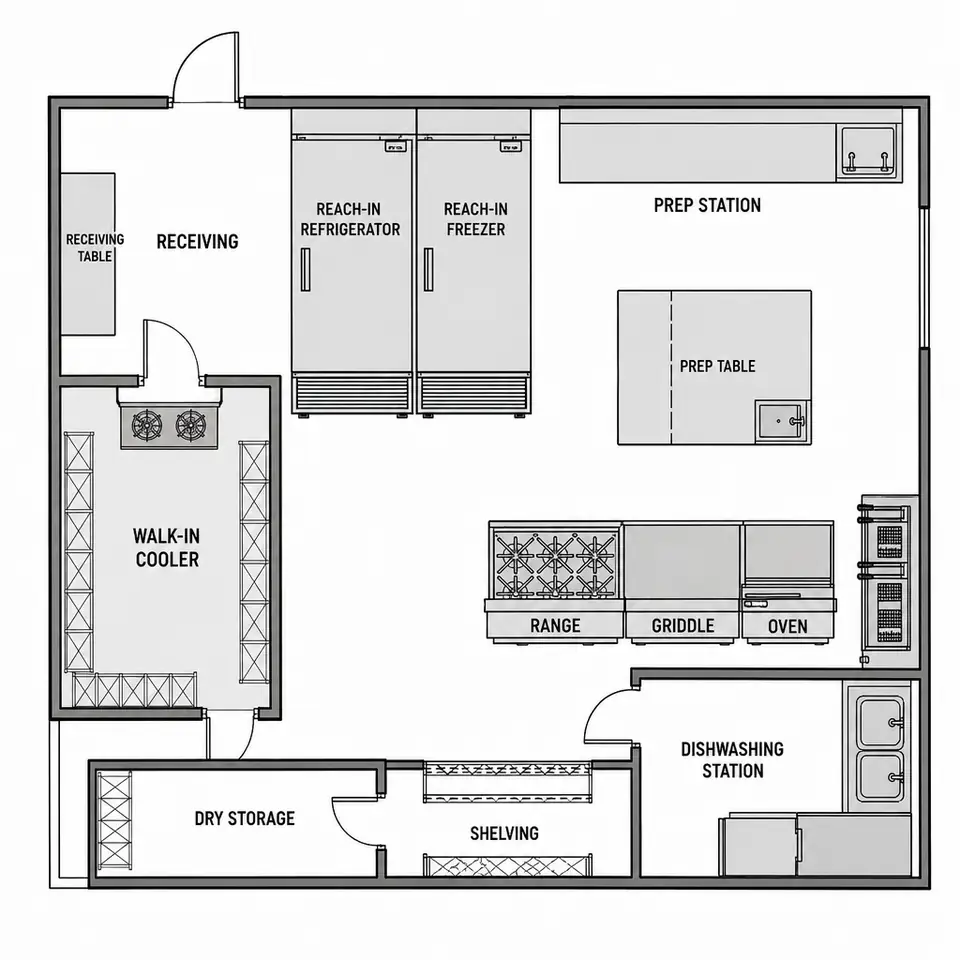
Use a floor-plan review to answer practical questions:
- Can receiving staff put deliveries away without crossing the busiest cooking area?
- Can a refrigerator door open without blocking a workstation or circulation route?
- Can two employees retrieve different products without repeatedly moving around each other?
- Is there a clear route for cleaning and servicing the equipment?
Treat this as a rehearsal. Tape equipment footprints on the floor where possible, then walk through delivery, preparation, and service tasks. A layout that looks tidy on paper still needs to work with doors open and people carrying containers.
What affects refrigeration efficiency most?
Refrigeration efficiency depends on the specific equipment, appropriate sizing, installation conditions, and operating practices - not simply whether you choose a walk-in or reach-in. Department of Energy guidance emphasizes appropriate sizing, while ASHRAE identifies door sealing and measures that limit warm-air infiltration as important considerations for walk-ins.
For reach-ins, compare published energy consumption only between models offering similar storage functions and temperature performance. ENERGY STAR certification can help identify qualifying commercial refrigerators, but walk-in coolers are excluded from that particular certification category. Do not assume a certification comparison between these two equipment types is available on equal terms.
Ask suppliers to explain the assumptions behind any energy-cost estimate. A forecast is more useful when it states the electricity rate, operating conditions, equipment configuration, and expected usage. Avoid accepting a broad claim that one format always costs less to run.
For your own comparison, use:
Estimated annual electricity cost = estimated annual electricity use in kWh × your electricity rate per kWh.
Treat the result as one input, not a complete ownership-cost calculation. Ask whether the estimate covers every component in the proposed system and whether the operating assumptions resemble your kitchen. If two quotations use different boundaries, request clarification before comparing totals.
Look beyond the equipment price
Compare installed, usable refrigeration rather than a cabinet price against a walk-in enclosure price. Walk-ins comprise multiple principal components, including panels, doors, and refrigeration systems. Stand-alone refrigeration integrates its refrigeration components and is typically factory charged, although the chosen equipment still needs a suitable installation location and electrical supply.
Request itemized quotations so you can identify what is included, excluded, or conditional. Avoid assuming that shelving, delivery positioning, assembly, or commissioning comes with every purchase. Have the installer confirm the site requirements for the exact configuration under consideration.
Your quotation checklist should cover:
| Cost or requirement | What to confirm |
|---|---|
| Equipment scope | Exact cabinet, enclosure, refrigeration components, controls, and accessories included |
| Delivery access | Route through entrances, corridors, loading areas, and any restricted openings |
| Installation work | Assembly, electrical work, refrigeration connections, and other site-specific work |
| Storage fit-out | Shelving, supports, container compatibility, and agreed layout |
| Commissioning | Who verifies operation before food is loaded |
| Ongoing support | Warranty terms, maintenance responsibilities, and service arrangements |
When comparing options from The Horeca Store, use this checklist alongside model specifications and written quotations. Keep a separate list of unresolved items rather than treating an incomplete estimate as a lower final price. A purchasing decision becomes easier once both options describe the same scope of work.
Keep food safety separate from storage convenience
Neither format removes the need for temperature control and verification. FDA Food Code guidance generally calls for cold holding of time/temperature control for safety food at 41°F or below, with specified exceptions. Check the requirements applicable to your establishment with your local regulatory authority.
Do not judge food safety from storage capacity alone. Include temperature checks in the operating plan, and use appropriate food-temperature measurements rather than relying solely on the cabinet display. Public-health inspection guidance emphasizes checking food temperatures in different locations within large holding units.
Also distinguish refrigerated holding from cooling freshly cooked food. FDA guidance treats cooling as a separate controlled process; purchasing more holding space does not, by itself, establish a compliant cooling procedure. Discuss your production methods and cooling needs during equipment selection rather than assuming either refrigerator format handles every task.
Before purchase, ask your team to document who checks temperatures, how results are recorded, and what happens when a reading is unacceptable. Include the intended shelving arrangement in your review. This turns food safety from an equipment assumption into an operating responsibility.
Would a combined setup serve your kitchen better?
A combined setup is worth evaluating when your kitchen has two distinct requirements: substantial reserve inventory and frequent access to smaller working quantities. The proposed arrangement is straightforward: use the walk-in for reserve stock and position reach-ins where staff need service ingredients. Treat that as a workflow option to test, not an automatic upgrade.
Consider a hypothetical catering kitchen that receives ingredients for several events. Its planning exercise might assign bulk inventory to the walk-in and the next production task's ingredients to nearby reach-ins. The key question is whether that separation improves the actual work enough to justify purchasing and maintaining both.
Before choosing a combined arrangement, define:
- Stock locations: Decide which products belong in reserve and which belong at each workstation.
- Replenishment responsibility: Assign who transfers stock and when, rather than relying on ad hoc trips.
- Working quantities: Set practical limits so station refrigerators do not become unplanned overflow storage.
- Failure response: Identify what the team would do if either storage area became unavailable.
Do not count a second refrigerator as guaranteed backup. Instead, calculate how much stock could realistically be relocated and establish a separate response plan for any remaining inventory.
Plan maintenance before placing the order
Service access deserves attention during selection, not after a problem develops. Manufacturer maintenance instructions can require access to condenser compartments, while walk-in upkeep includes checking door seals and closing mechanisms. Confirm the requirements of the exact equipment instead of applying one generic schedule to every refrigerator.
Ask who will perform routine cleaning, who handles technical service, and whether your intended layout leaves the required access. Review the warranty documents for exclusions and owner responsibilities. Keep the manuals available to both managers and maintenance staff.
Use a simple handover checklist:
- Record model details, service contacts, and warranty documentation.
- Assign routine inspection and cleaning tasks according to manufacturer instructions.
- Confirm how staff should report damaged seals, unusual operation, or temperature concerns.
- Schedule professional maintenance where specified or needed.
- Keep service records with the equipment documentation.
For tasks involving electrical or refrigeration components, follow the manufacturer's safety instructions and use qualified personnel as appropriate. The goal is an achievable maintenance plan, not a checklist nobody has time or authority to complete.
Choose around your busiest realistic day
Make the final decision using a representative peak day: the delivery has arrived, prepared inventory needs storage, and service is approaching. Compare how each proposed layout accommodates that situation. Do not select equipment solely around an unusually quiet day or an undefined expansion plan.
Bring an inventory list, container dimensions, delivery schedule, and measured floor plan when discussing options with The Horeca Store. Request specifications and an itemized quotation for each shortlisted configuration. Resolve installation and service questions before ordering.
Choose a reach-in if organized cabinet storage meets your needs. Choose a walk-in if your validated bulk-storage plan calls for a refrigerated room. Choose both only when the separate storage and service roles justify the additional equipment - the best fit is the one your team can use, monitor, and maintain consistently.