
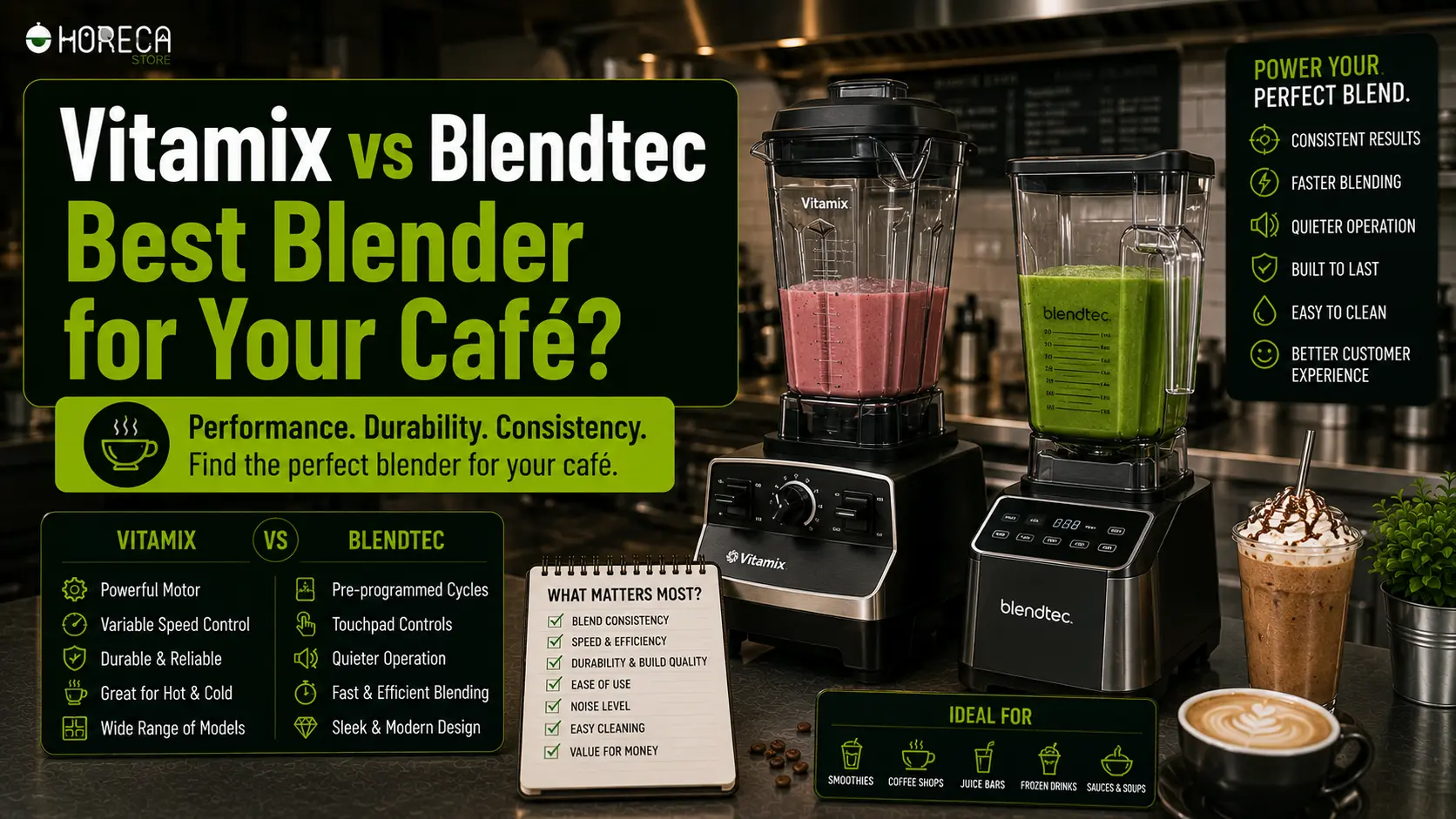
If you own a cafe, coffee shop, or smoothie bar, you already know that the morning rush is a make-or-break period for your business. When a line of uncaffeinated, hungry customers is stretching out the door, the last thing you need is a blender that stalls, overheats, or leaves chunks of ice in a premium $8 frappe.
For industry professionals, the debate over the best equipment almost always boils down to a clash of the titans: Vitamix vs Blendtec: Best Commercial Blender for Your Cafe.
Both of these powerhouse manufacturers have built their reputations on creating machines that can pulverize ice, blast through frozen fruit, and withstand the punishing environment of a commercial kitchen. But which one is truly the right fit for your specific business model?
In this comprehensive guide, we will dive deep into everything you need to know about choosing the ultimate blending equipment for your cafe. From motor longevity and blade design to noise reduction and return on investment, we’ll leave no stone unturned.
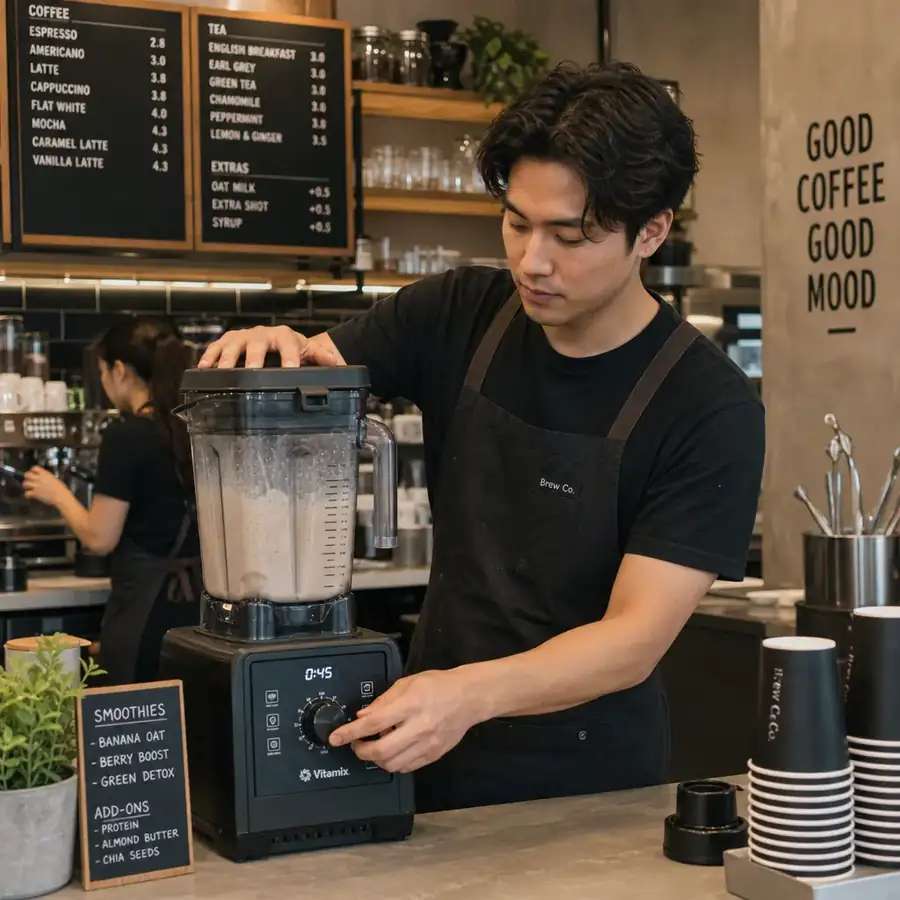
Why You Absolutely Need a Commercial Grade Blender
Before comparing brands, we need to address a common mistake new cafe owners make: buying a high-end residential blender to save money. While home blenders from premium brands are fantastic for morning smoothies at your kitchen island, they are fundamentally not designed for commercial use.
The Danger of Overheating
In a commercial setting, a blender might be expected to run 50, 100, or even 200 times a day. If you use a residential machine, the motor will quickly burn out. To prevent blender motor overheating in smoothie shops, you must invest in a true commercial grade blender. These machines feature advanced cooling fans, robust thermal protection, and heavier components designed to run back-to-back cycles without breaking a sweat.
Food Safety and Compliance
Health inspectors are strict, and rightly so. Commercial kitchens are required to use NSF certified beverage equipment. The National Sanitation Foundation (NSF) tests equipment to ensure it is easy to clean, made of food-safe materials, and designed in a way that prevents bacteria buildup. A residential blender will not pass a strict health inspection, putting your business at risk of fines or closure.
Speed and Power
When assessing the best heavy duty commercial blender, power is paramount. Commercial units boast motors with 3.0 to 3.8 peak horsepower. This sheer force shaves seconds off every drink order, improving your speed of service and ultimately increasing your daily revenue.
The Contenders: An Overview of the Best Blender Brands
When discussing top commercial blenders, Vitamix and Blendtec dominate the conversation. They are the undisputed leaders in the beverage industry, trusted by global franchises like Starbucks, Jamba Juice, and Smoothie King.
Vitamix Commercial
Based in Ohio, Vitamix has a century-long history of engineering high-quality blending equipment. In the commercial sphere, Vitamix is renowned for its precision, reliability, and smooth textures. They focus heavily on intuitive controls, unparalleled smoothness in the final product, and exceptional customer service.
Blendtec Commercial
Hailing from Utah, Blendtec made a massive cultural splash with their viral "Will It Blend?" YouTube series. But behind the marketing is a highly innovative engineering company. Blendtec is known for raw power, cutting-edge digital interfaces, and unique jar shapes that disrupt the blending vortex for faster, more efficient processing.
When you are looking for the best blender commercial kitchens can rely on, both of these high-performance blenders will deliver. The choice comes down to the nuances of their technology and how it aligns with your cafe's workflow.
Head-to-Head: Vitamix The Quiet One vs Blendtec Stealth 885
To truly understand which machine reigns supreme, we have to look at their flagship models. If you are asking which blender is better for high volume cafes, the answer almost certainly lies in the matchup of Vitamix The Quiet One vs Blendtec Stealth 885.
These are the pinnacle of beverage blending technology, featuring advanced noise dampening, incredibly powerful motors, and complete programmability.
Vitamix: The Quiet One
The Quiet One is a staple in high-end coffee shops around the world.
- Motor: 3.0 peak output horsepower.
- Noise Reduction: Features an advanced, magnetically secured sound enclosure for quiet blending. It is astonishingly quiet, allowing your baristas to take orders from customers standing just three feet away without shouting.
- Interface: 6 program buttons with 34 optimized programs loaded in memory.
- The Vibe: It feels incredibly solid. The magnetic sound enclosure is a brilliant touch because it eliminates hinges that can break or get gunked up with spilled syrups.
Blendtec: Stealth 885
The Stealth 885 is a digital powerhouse designed for relentless volume.
- Motor: 3.8 peak horsepower (one of the most powerful in its class).
- Noise Reduction: Also features a 360-degree sleek sound enclosure. While both are incredibly quiet, some users find the Stealth 885 just a fraction of a decibel louder due to the massive motor, though it is completely negligible in a bustling cafe.
- Interface: An illuminated capacitive touch control surface with an OLED display. It features 42 pre-programmed cycles.
- The Vibe: It looks like it belongs on a spaceship. The touch screen is incredibly easy to wipe clean, which is a major bonus during a sticky lunch rush.
The Verdict on Flagships: If your priority is the absolute quietest operation and ultra-smooth purees, The Quiet One is legendary. If you want maximum raw power, a futuristic touchscreen that is easy to wipe down, and slightly faster blend times for frozen goods, the Stealth 885 is a modern marvel.
Blade Technology: The Physics of Blending
One of the most significant differences between these two heavy-duty blenders is how they approach blade design. It is a fascinating study in engineering philosophy: the blunt safety blade vs sharp blender blades.
Vitamix’s Sharp Precision
Vitamix utilizes a traditional, albeit highly engineered, sharp blade system. Made from laser-cut, aircraft-grade stainless steel, these blades are designed to slice through ingredients while simultaneously creating a powerful vortex that pulls the mixture down into the center.
- The Benefit: Sharp blades are exceptionally good at micro-chopping leafy greens (like kale and spinach), tiny seeds (like chia or blackberry seeds), and creating a silky-smooth texture that is unmatched.
- The Drawback: When it comes time to clean them manually, baristas must be careful not to nick their fingers. Over years of intense use, sharp blades can eventually dull and may need replacing to maintain optimal performance.
Blendtec’s Blunt Force
Blendtec takes the opposite approach. They use a patented single-prong, cold-forged steel blade that is completely blunt. In fact, you can run your finger along the edge of a Blendtec blade without getting cut.
- The Benefit: How does a blunt blade blend? By relying on the massive power of that 3.8 horsepower motor. The blunt blade spins at over 300 miles per hour, literally pulverizing ice and frozen fruit on impact. Because the blade is already blunt, it can never dull. It is incredibly safe for staff to clean, and it rarely needs replacing.
- The Drawback: While excellent for crushing ice and frozen fruit, a blunt blade can occasionally struggle to completely liquefy the tiniest, most stubborn berry seeds compared to a fresh, sharp Vitamix blade.
When choosing the best commercial blender for smoothies, both blade styles work phenomenally well, but your staff's cleaning habits and your menu ingredients (e.g., heavily seeded berries vs. large ice cubes) might sway your decision.
Containers and Jars: Build, Capacity, and Workflow
The blender base is only half the equation. The jars you use are critical to your cafe's daily workflow.
Both companies utilize food grade polycarbonate blender containers (specifically, Eastman Tritan copolyester). This material is BPA-free, incredibly lightweight, and virtually unbreakable. Dropping a glass blender jar in a commercial kitchen is a disaster; dropping a polycarbonate jar merely results in a loud bounce.
Vitamix Advance Container
Vitamix’s standard commercial jar is the Advance Container. It has a unique shape with a wider base and a built-in dripless spout. The wider base allows ingredients to fall directly into the blades, reducing the phenomenon of "cavitation" (where an air pocket forms over the blade and blending stops). The dripless spout is a barista's best friend, ensuring clean pours and less time wiping down the counter.
Blendtec WildSide+ and FourSide Jars
Blendtec is famous for revolutionizing jar shapes. Their FourSide jar was a breakthrough, but the WildSide+ jar is a masterpiece. It features a patented fifth side—a flat angle that disrupts the blending vortex. Instead of ingredients spinning in a perfect circle (which causes cavitation), the fifth side forces the mixture to hit a wall and bounce back down into the blunt blade. This allows Blendtec to blend massive amounts of frozen ingredients quickly without ever needing a tamper tool.
How Many Jars Does a Cafe Need?
A common question from new owners is, "how many jars does a cafe need?" A good rule of thumb is to have at least one jar for every 50 blended drinks you serve daily, plus dedicated jars for allergen management.
- Example: If you serve 150 blended drinks a day, you need a minimum of 3 jars in constant rotation.
- Allergen Note: You absolutely must have color-coded or clearly labeled jars dedicated strictly to dairy-free milks or nut-free orders to prevent cross-contamination.
Most high-volume cafes operate smoothly with 4 to 6 jars per blender base. This allows the dishwasher to keep a steady rotation of clean jars flowing to the front counter without stalling service.
Menu Specifics: Matching the Machine to Your Drinks
The best commercial blender for your specific cafe depends heavily on what you are actually serving. Let's break down performance across the most common cafe menu categories.
1. The Best Blender for Thick Acai Bowls
Acai bowls are incredibly popular, highly profitable, and notoriously difficult to make. To get that thick, spoonable, ice-cream-like texture, you need to blend a massive amount of frozen fruit with very little liquid.
- Vitamix: Many operators consider Vitamix the best blender for thick acai bowls because of their classic Tamper tool. While some commercial models rely purely on programming, models equipped with a tamper allow the barista to physically push stubborn frozen ingredients down into the blade without stopping the machine. Vitamix also offers the "Aerating Container" and specific thick-blend containers designed for this exact purpose.
- Blendtec: Blendtec's answer to thick blends is the "Twister Jar." This is a smaller jar with a specialized lid featuring tines. As the blender runs, the barista twists the lid, and the tines scrape the thick acai mixture off the walls and force it back into the blades. It is incredibly effective and fast, though it requires purchasing a separate, specialized jar.
2. Smoothies, Frappes, and Milkshakes
If your menu revolves heavily around liquid-based frozen drinks, you are looking for the ultimate commercial smoothie blender.
- Blendtec shines here with its WildSide+ jar. The speed at which it shatters ice for frappes and purees frozen mango for smoothies is breathtaking. The blunt blade simply destroys ice cubes in seconds, resulting in a frosty, perfectly integrated drink that doesn't separate quickly.
- Vitamix counters with an unparalleled creamy texture. If you use fibrous ingredients like ginger, dates, or raw kale in your smoothies, the sharp blades of the Vitamix will yield a noticeably silkier mouthfeel without any gritty residue.
3. Savory Prep: Soups, Sauces, and Spreads
Many modern cafes also offer light lunch menus featuring house-made hummus, pesto, vinaigrettes, or hot soups. Both brands handle this with ease. High-performance blenders create so much friction that they can actually heat a raw soup to steaming hot in about six minutes. Vitamix often has a slight edge in savory prep simply because its sharp blades can emulsify oil-based dressings more delicately, but both are more than capable.
Programmability: The Key to Consistency
One of the hardest things to manage in a growing cafe is quality control. A drink made by your head barista on Tuesday morning should taste exactly the same as a drink made by a new trainee on Sunday afternoon.
This is where programmable cycles for consistent drink quality come into play.
The Power of Automation
Both Vitamix and Blendtec offer extensive programmability on their top-tier models. Instead of flipping a switch and guessing when a smoothie is done, your barista simply presses "Button 1" for a small frappe or "Button 2" for a large green smoothie.
The machine takes over, ramping up the speed to crush the ice, slowing down to fold in the ingredients, and automatically shutting off when the perfect texture is achieved. This allows the barista to step away, grab a pastry, process a payment, and return to a perfectly blended drink.
Customizing Your Cycles
- Blendtec’s BlendWizard: Blendtec offers an online tool called BlendWizard. You can create completely custom motor profiles on your computer—specifying exactly what percentage of power the motor should use at specific second intervals—and load them onto your Stealth 885 via a USB drive.
- Vitamix Customization: Vitamix offers a highly curated set of optimized programs designed in collaboration with beverage scientists. You can also customize these chips to fit your exact menu requirements.
Automation reduces barista fatigue, standardizes your product, and significantly lowers your ticket times.
Expanding Your Arsenal: Immersion and Hand Blenders
While countertop blenders handle your beverage program, we must not ignore the back of house. If your cafe prepares its own food, you need to look into the best commercial hand blender options.
Also known as stick blenders, these tools are essential for pureeing large batches of soup right in the stockpot, emulsifying gallons of house-made mayonnaise, or blending large batches of batters.
Finding the Best Commercial Stick Blender
When shopping for professional kitchen blenders of the immersion variety, consider the following:
- Shaft Length: Commercial immersion blenders come with shafts ranging from 10 inches to over 20 inches. A 12-to-14-inch shaft is usually perfect for a standard cafe kitchen, allowing you to reach the bottom of a 5-gallon pot without submerging the motor.
- Motor Power: Look for a machine with at least a 1/2 horsepower continuous duty motor.
- Detachable Shafts: The best commercial immersion blender will have a detachable, dishwasher-safe stainless steel shaft. This makes cleanup hygienic and effortless.
Brands like Robot Coupe and Waring dominate the heavy-duty immersion space, but both Vitamix and Blendtec are continually expanding their commercial food prep lines. Having a robust stick blender alongside your countertop beverage blenders completes your cafe's blending ecosystem.
Durability, Maintenance, and Warranties
Investing in the best heavy duty commercial blender is exactly that—an investment. You are spending upwards of $800 to $1,500 per machine. Understanding how to maintain them and what happens when they break is crucial.
The Commercial Blender Durability Test
Commercial blenders endure a unique type of torture. They suffer from spilled sugary syrups that harden like cement, constant vibrations, rapid temperature changes, and aggressive handling by rushed staff.
In almost every independent commercial blender durability test, both Vitamix and Blendtec score at the top of the industry. They feature metal drive sockets (the part that connects the motor to the jar), heavy-duty sealed bearings, and advanced cooling systems that exhaust hot air away from the motor block.
Heavy Duty Commercial Blender Warranty Comparison
When parts do fail, your warranty is your safety net.
- Vitamix Commercial Warranty: Vitamix typically offers a 3-year warranty on motor base parts and a 1-year warranty on labor for their flagship commercial models. Their customer service is widely considered best-in-class. If your machine goes down, they work rapidly to get it fixed, minimizing your downtime.
- Blendtec Commercial Warranty: Blendtec generally matches this standard, offering a 3-year parts and 1-year labor warranty on their high-end commercial bases (like the Stealth 885).
Note: Jars, blades, and drive sockets are usually considered "wear and tear" items and carry shorter warranties (often 1 year or less). Always read the specific warranty terms provided by your distributor.
Managing Industrial Blender Maintenance Costs
To keep industrial blender maintenance costs low, you must establish standard operating procedures (SOPs) for your staff.
- Never rock the jar: Baristas should never wiggle or rock the jar while the machine is running. This strips the drive socket.
- Inspect daily: Check the metal drive socket for wear. A worn socket will strip the gear on your expensive jars. Replacing a $15 socket promptly saves a $150 jar.
- Listen to the machine: If a blender starts sounding like a jet engine grinding gravel, the bearings in the jar are likely failing. Remove that jar from service immediately before it leaks liquid into the motor base.
Cleaning and Sanitation During Peak Hours
In a high-volume environment, you don't have time to run a jar through the commercial dishwasher after every single strawberry smoothie. You need efficient systems for cleaning commercial blenders during peak hours.
The Rinse Cycle Method
Both Vitamix and Blendtec offer specialized pitcher rinsers (often called a dipper well or a push-down rinser). These are plumbed directly into your counter over a drain.
- The barista finishes the drink.
- They turn the jar upside down and press it onto the rinser.
- A high-pressure blast of water jets up, washing the remaining smoothie residue down the drain in 2 seconds flat.
- The jar is immediately ready for the next similar drink.
The Blending Wash
If you do not have a pitcher rinser installed, the fastest way to clean a jar during a rush is to fill it halfway with warm water, add a single drop of dish soap, and pulse the blender on high for 3 seconds. The powerful vortex scrubs the walls and blades instantly. Dump, rinse with clear water, and sanitize.
End of Day Deep Clean
At the end of the shift, all jars, lids, and sound enclosures must be fully disassembled and sent through the three-compartment sink or commercial dishwasher.
Crucial Tip: Never leave jars sitting overnight in a sink full of sanitizer water. Prolonged exposure to harsh sanitizing chemicals will cause the polycarbonate plastic to become cloudy, brittle, and eventually crack. Wash, sanitize, and leave them upside down to air dry.
Making the Business Case: Calculating ROI
Purchasing a $1,200 commercial blender can induce sticker shock for a new cafe owner. However, successful business owners look at equipment not as an expense, but as a revenue generator. Understanding how to calculate blender ROI for business (Return on Investment) will give you peace of mind.
Let's look at a hypothetical scenario for "The Daily Grind Cafe."
- The Investment: You purchase a Vitamix The Quiet One for $1,200.
- The Product: Your signature green smoothie sells for $8.00.
- The Profit Margin: After the cost of goods sold (spinach, mango, almond milk, cup, lid, straw), your gross profit per smoothie is $5.50.
- The Volume: You sell a modest 15 smoothies a day.
The Calculation:
- Daily Profit from Blended Drinks = 15 drinks x $5.50 profit = $82.50 per day.
- ROI Timeline = $1,200 (Cost of Blender) ÷ $82.50 (Daily Profit) = 14.5 Days.
In just over two weeks, a premium, top-of-the-line commercial blender completely pays for itself. Every day after that for the next 3 to 5 years, that machine is printing pure profit for your business.
Furthermore, consider the invisible ROI of speed. If a high-performance blender saves your barista 15 seconds per drink, and you sell 100 blended drinks a day, you save 25 minutes of labor time daily. Over a year, that equates to over 150 hours of saved labor—which translates directly into thousands of dollars in payroll savings or increased output capability.
Sound Enclosures: Protecting the Cafe Atmosphere
We must take a moment to emphasize the importance of noise management in modern cafes. Today’s coffee shops are not just places to grab a quick drink; they are remote offices, study halls, and intimate meeting spaces.
If your blender sounds like a lawnmower, it will kill the vibe of your cafe. Customers will stop coming to work on their laptops, and your front-of-house staff will suffer from auditory fatigue.
This is why investing in models equipped with a sound enclosure for quiet blending is non-negotiable for front-of-house operations. The acrylic shields on both The Quiet One and the Stealth 885 are marvels of acoustic engineering. They trap the high-frequency screech of grinding ice and the low-frequency rumble of the motor, muffling it to the level of standard background conversation.
If you are hiding your blender in a back kitchen behind a closed door, you can save a few hundred dollars by buying the unenclosed versions (like the Vitamix Vita-Prep 3 or the Blendtec Connoisseur 825 without the shield). But if the machine lives on the front counter where customers can see it, the sound enclosure is a strict requirement for a premium customer experience.
Final Verdict: Which Should You Choose?
The battle of Vitamix vs Blendtec: Best Commercial Blender for Your Cafe does not have a single, definitive winner, because every cafe is unique. Both are exceptional, professional-grade tools that will elevate your beverage program.
Choose Vitamix if:
- You prioritize ultra-smooth, creamy textures, especially for drinks featuring fibrous greens, dates, or raw ingredients.
- You want the absolute quietest machine on the market (The Quiet One).
- Your menu includes incredibly thick acai bowls where a physical tamper tool gives you peace of mind.
- You prefer a tactile, button-driven interface.
Choose Blendtec if:
- Your menu is heavily focused on ice-based drinks, frappes, and frozen fruit smoothies where raw ice-crushing speed is king.
- You love the idea of completely blunt safety blades that never dull and are 100% safe to wash by hand.
- You want an easy-to-clean, modern, digital touchscreen interface.
- You are drawn to custom programming via a computer interface to dial in your exact recipes.
The Takeaway
Running a high-volume cafe requires grit, excellent staff, and equipment that won't let you down when the pressure is on. By choosing a top-tier commercial grade blender from either Vitamix or Blendtec, you are ensuring that your beverages are consistent, your staff is efficient, and your customers leave happy—and perfectly refreshed—every single time.
Take the time to evaluate your specific menu, your workflow, and your space. Whichever titan of blending you choose to place on your counter, treat it well, maintain it diligently, and it will serve as the reliable, profitable workhorse of your cafe for years to come.
Vitamix vs Blendtec: Best Commercial Blender for Your Cafe
The Horeca Store choosing between Vitamix and Blendtec depends on your café’s menu, blending needs, and daily workload. Vitamix commercial blenders are known for powerful performance, durability, and precise controls, making them ideal for smoothies, frozen drinks, and specialty beverages. Blendtec offers high-performance blending technology, easy operation, and strong motors designed for busy cafés and beverage businesses. Comparing factors such as blending power, capacity, noise levels, controls, and maintenance can help you select the best option for your operation.
The right commercial blender can improve drink quality, speed up service, and increase kitchen efficiency. The Horeca Store offers a wide range of commercial blenders, beverage equipment, coffee solutions, and restaurant supplies designed for cafés, restaurants, and hospitality businesses. With quality products, competitive pricing, and reliable support, The Horeca Store helps businesses choose equipment that delivers consistent performance and long-term value.