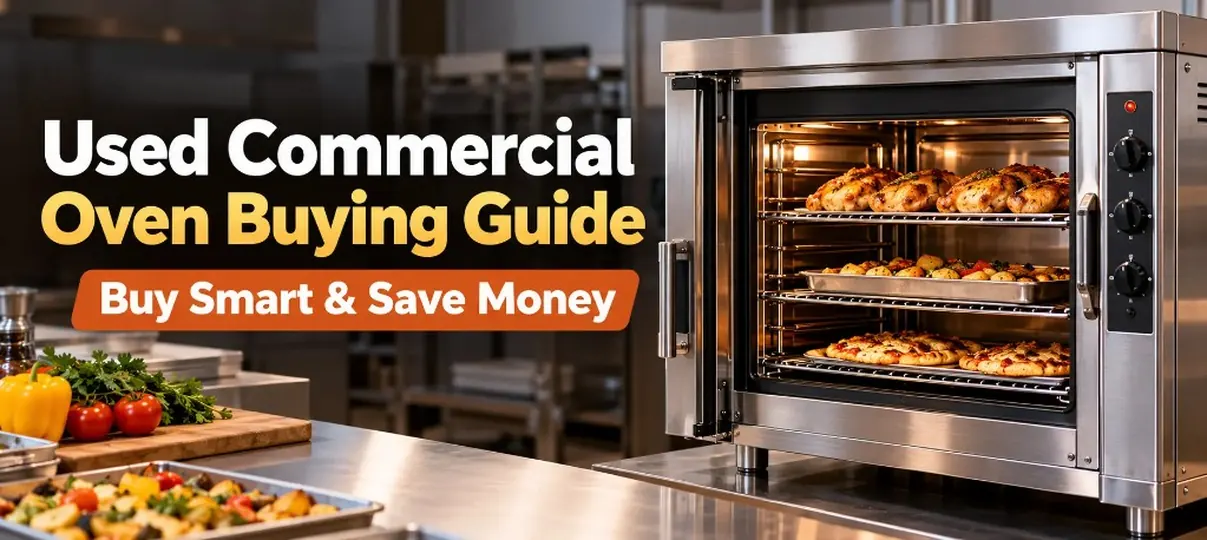
Introduction
Buying used commercial ovens can help restaurants, cafes, hotels, bakeries, and catering businesses control equipment costs without sacrificing cooking capacity. However, the right choice depends on more than the purchase price.
A used commercial oven should be evaluated for its type, capacity, size, condition, age, power requirements, cooking performance, maintenance history, and operating costs.
This used commercial oven buying guide explains what to check before purchasing. It also compares common oven types and shows which options may fit different foodservice operations.
Table of Contents
- What Is a Used Commercial Oven?
- Why Buy a Used Commercial Oven?
- Types of Used Commercial Ovens
- How to Choose a Used Commercial Oven
- Used Commercial Oven Capacity and Size
- Gas vs. Electric Commercial Ovens
- Used Commercial Oven Inspection Checklist
- How to Evaluate Oven Condition and Age
- Used Commercial Oven Costs and Pricing
- New vs. Used Commercial Ovens
- Best Used Commercial Oven for Different Businesses
- Installation Requirements
- Maintenance and Repair
- Used Commercial Oven Brands
- Commercial Oven Buying Checklist
- Frequently Asked Questions
- Final Buying Decision
What Is a Used Commercial Oven?
A used commercial oven is a previously operated oven designed for professional foodservice environments.
These ovens are built for repeated cooking during business operations. They are commonly used in restaurants, cafes, hotels, bakeries, catering operations, and other commercial kitchens.
Used commercial ovens can include:
- Convection ovens
- Deck ovens
- Combi ovens
- Pizza ovens
- Bakery ovens
- Countertop ovens
- Gas commercial ovens
- Electric commercial ovens
The best option depends on the type of food being prepared, production volume, available kitchen space, and utility requirements.
Why Buy Used Commercial Ovens?
Used commercial ovens can be attractive when a business needs professional cooking equipment while managing its equipment budget.
Potential benefits include:
Lower Initial Cost
A used commercial oven can cost less than a comparable new model.
This may allow a restaurant or cafe to allocate more of its budget to refrigeration, food preparation equipment, ventilation, or other kitchen equipment.
Faster Equipment Deployment
A suitable used oven may already be available and ready for installation.
However, the equipment should still be inspected before it is connected and put into daily operation.
Access to Commercial-Grade Equipment
The used market can include equipment from established commercial oven manufacturers.
Businesses may find older models with capacities and configurations that fit their existing kitchen setup.
Better Budget Allocation
Purchasing used commercial kitchen equipment can be useful when opening a restaurant, expanding production, or replacing equipment while controlling capital expenditure.
Types of Used Commercial Ovens
A busy line can set the oven beside a commercial range.
Choosing the correct oven type is one of the most important decisions.
Used Convection Oven
A convection oven uses a fan to circulate heated air around the cooking chamber.
It can provide more even cooking and is commonly used for:
- Roasting
- Baking
- Reheating
- Pastries
- Vegetables
- Meat
- Prepared foods
A used commercial convection oven can be suitable for restaurants and cafes that need flexible cooking performance.
Used Deck Oven
A deck oven uses one or more heated decks for cooking.
It is commonly associated with:
- Pizza
- Bread
- Artisan baking
- Pastries
- Specialty baked products
A used commercial deck oven can be a strong option when direct deck cooking is important.
Used Pizza Oven
A used pizza oven is designed specifically for pizza production.
Depending on the design, it may use gas, electricity, or other heating methods.
A used commercial pizza oven should be checked carefully for heating consistency, deck condition, temperature performance, and controls.
Used Combi Oven
A combi oven combines multiple cooking modes, typically including convection and steam.
It can be useful for operations that prepare different types of food in one cooking system.
A used commercial combi oven requires particular attention to its steam system, controls, heating system, water connections, and cleaning requirements.
Used Bakery Oven
Used bakery ovens are designed for baking applications and can vary significantly in capacity and configuration.
Before buying a used bakery oven, consider:
- Product type
- Tray capacity
- Temperature range
- Heating method
- Production volume
- Available floor space
How to Choose a Used Commercial Oven
Leave room for a prep table next to the landing space.
The best used commercial oven should match the actual production requirements of the business.
Consider these factors:
- Cooking application
- Daily production volume
- Oven capacity
- Internal dimensions
- External dimensions
- Temperature range
- Gas or electrical requirements
- Ventilation requirements
- Kitchen space
- Condition
- Age
- Maintenance history
- Replacement parts availability
- Installation requirements
- Total operating cost
The lowest purchase price is not always the lowest-cost option over the equipment's working life.
Used Commercial Oven Capacity
Capacity determines how much food can be cooked during each production cycle.
For example, a small cafe may need a compact countertop commercial oven, while a high-volume restaurant may need a larger oven with multiple racks or cooking chambers.
Capacity should be evaluated based on:
- Number of racks
- Tray capacity
- Rack spacing
- Cooking chamber dimensions
- Batch size
- Cooking time
- Daily production volume
A high-capacity used commercial oven may be more appropriate for a high-volume restaurant, bakery, catering operation, or foodservice business.
Used Commercial Oven Size and Dimensions
Measure the available kitchen area before purchasing.
Check both:
Oven dimensions
- Width
- Depth
- Height
Installation space
- Clearance
- Door-opening area
- Service access
- Ventilation space
- Utility connections
A commercial oven can have suitable cooking capacity but still be unsuitable if it cannot fit safely into the planned installation area.
Gas vs. Electric Commercial Oven
Confirm the gas supply if the kitchen already uses a gas griddle.
Both gas and electric commercial ovens can work well in professional kitchens.
The correct choice depends on the kitchen's available utilities and operating requirements.
Always verify the manufacturer's installation specifications before purchasing.
Used Commercial Oven Inspection Checklist
Plan the same side clearance you would give a charbroiler.
A thorough inspection is essential when buying used restaurant ovens.
1. Exterior Condition
Check for:
- Severe dents
- Corrosion
- Cracks
- Damaged panels
- Missing components
- Damaged handles
- Door alignment problems
Minor cosmetic wear may not affect performance, but structural damage deserves closer attention.
2. Oven Door
Check whether the door:
- Opens smoothly
- Closes properly
- Seals correctly
- Has an intact gasket
- Has functional hinges
A damaged door seal can affect cooking performance and energy use.
3. Heating System
Test whether the oven reaches the required temperature.
Check:
- Heating elements or burners
- Ignition system
- Temperature stability
- Heating consistency
- Recovery time
4. Controls
Test all available controls.
Look for:
- Fault codes
- Non-responsive buttons
- Damaged displays
- Incorrect temperature readings
- Timer problems
5. Interior
Inspect the cooking chamber for:
- Heavy carbon buildup
- Corrosion
- Damaged racks
- Broken supports
- Warped surfaces
- Excessive grease accumulation
6. Gas System
For a used gas commercial oven, inspect:
- Gas connection
- Burners
- Ignition
- Gas valves
- Flame quality
- Safety controls
Qualified professionals should handle gas-system testing and installation.
7. Electrical System
For electric models, check:
- Voltage
- Phase
- Amperage
- Power cord
- Heating elements
- Electrical connections
The oven's electrical requirements must match the facility's available supply.
Used Commercial Oven Condition
Condition is often more important than age alone.
A well-maintained older oven may be a better purchase than a newer oven that has experienced heavy use or poor maintenance.
Evaluate:
- Exterior condition
- Interior condition
- Heating performance
- Control operation
- Door seal
- Burners or heating elements
- Maintenance history
- Replacement parts
- Previous repairs
Ask for maintenance records whenever they are available.
Used Commercial Oven Age
Age can help estimate remaining service life, but it should not be the only buying factor.
A used commercial oven's practical lifespan depends on:
- Manufacturer
- Model
- Usage intensity
- Maintenance
- Cleaning
- Installation quality
- Replacement parts
- Operating environment
Instead of asking only, "How old is the oven?", also ask:
"How was the oven used and maintained?"
Used Commercial Oven Lifespan
The lifespan of a used commercial oven varies by type, manufacturer, workload, and maintenance.
Heavy production can place greater stress on heating systems, controls, doors, seals, and other components.
Regular cleaning and preventive maintenance can help reduce avoidable failures.
Before purchasing, consider both the oven's current condition and the availability of replacement parts.
Used Commercial Oven Price and Cost
The price of a used commercial oven can vary considerably.
Factors affecting used commercial oven cost include:
- Oven type
- Brand
- Model
- Age
- Capacity
- Condition
- Fuel type
- Features
- Production capacity
- Repair requirements
- Installation requirements
Do not compare purchase prices alone.
A lower-priced oven that needs major repairs or expensive installation may have a higher total cost.
Used Commercial Oven Total Cost of Ownership
Consider the total cost of ownership, including:
Purchase price + transportation + installation + repairs + utilities + maintenance + parts
This provides a more realistic view of the investment.
For example, a used commercial oven with a slightly higher purchase price may make more sense if it requires fewer repairs and fits the existing kitchen infrastructure.
New vs. Used Commercial Oven
A used oven can make sense when budget and availability are priorities.
A new oven may be preferable when the business needs the latest technology, predictable equipment history, or a specific current model.
Used Commercial Oven Pros and Cons
Pros
- Lower initial purchase cost
- Access to commercial equipment
- Potentially faster procurement
- Can fit limited equipment budgets
- May provide strong cooking capacity
Cons
- Unknown usage history
- Possible hidden defects
- Older technology
- Potential repair costs
- Parts may be harder to find
- Installation requirements still apply
A professional inspection helps reduce these risks.
Best Used Commercial Oven for Different Businesses
Different foodservice businesses have different requirements.
The final choice should be based on the menu, production volume, available space, and utilities.
Used Commercial Oven for Restaurant
A restaurant commercial oven should support the menu and expected order volume.
For example:
- Roasting-focused menu -> convection oven
- Mixed cooking requirements -> combi oven
- Pizza-focused menu -> pizza or deck oven
- Limited kitchen space -> countertop commercial oven
The right oven should support production without creating unnecessary capacity or installation costs.
Used Commercial Oven for Cafe
Cafes often have limited kitchen space.
A countertop commercial oven or compact convection oven can be useful for:
- Pastries
- Sandwiches
- Baked goods
- Reheating
- Small-batch food production
Check the oven's external dimensions before purchasing.
Used Commercial Oven for Hotel
Hotels may require higher cooking capacity and more flexible production.
A commercial combi oven or high-capacity convection oven may be appropriate for operations handling:
- Breakfast service
- Banquets
- Room service
- Large-scale food preparation
- Catering
The required capacity depends on the hotel's menu and peak production volume.
Used Commercial Oven for Bakery
Bakeries should focus heavily on:
- Baking chamber size
- Tray capacity
- Temperature range
- Heat distribution
- Recovery time
- Product consistency
A used bakery oven or deck oven may be appropriate depending on the products being produced.
Used Commercial Oven for Pizza Restaurant
Pizza restaurants should consider:
- Cooking surface
- Temperature range
- Number of pizzas per batch
- Recovery time
- Fuel type
- Available space
A used commercial pizza oven or deck oven can be suitable when pizza is the primary product.
Used Commercial Oven for Catering
Catering businesses often need flexibility.
A used convection oven or combi oven can support different menu items and batch sizes.
Portability and installation requirements should also be considered when equipment needs to operate across different venues.
Used Commercial Oven Brands
When evaluating used commercial oven brands, compare the specific model, not just the manufacturer.
Important considerations include:
- Model age
- Parts availability
- Cooking capacity
- Controls
- Heating system
- Service history
- Application
- Previous workload
A well-known brand does not automatically make every used model the right choice.
Commercial Oven Installation Requirements
Keep a commercial fryer on its own footprint so the oven door can open fully.
Before buying, confirm the installation requirements.
These may include:
Gas
- Gas type
- Gas pressure
- Connection size
- Required supply capacity
Electrical
- Voltage
- Phase
- Amperage
- Electrical connection
Ventilation
Commercial cooking equipment may require appropriate ventilation based on the oven type, fuel source, local requirements, and installation configuration.
Space
Confirm:
- Equipment footprint
- Door clearance
- Service clearance
- Ventilation clearance
- Access route
Installation should follow the manufacturer's requirements and applicable local codes.
Used Commercial Oven Maintenance
Regular maintenance can help keep a used commercial oven operating properly.
Common maintenance tasks include:
- Cleaning the cooking chamber
- Cleaning burners or heating elements
- Checking door seals
- Inspecting hinges
- Checking controls
- Inspecting electrical connections
- Cleaning ventilation components
- Checking temperature accuracy
Maintenance requirements vary by oven type and manufacturer.
Used Commercial Oven Repair
Common repair areas can include:
- Heating elements
- Burners
- Ignition systems
- Thermostats
- Temperature sensors
- Door gaskets
- Hinges
- Control boards
- Fans
- Steam components
Before buying, determine whether replacement parts are still available for the model.
Used Commercial Oven Repair Costs
Repair costs depend on the failed component, labor, model, and parts availability.
Before purchasing an older used oven, estimate potential repair costs.
A useful approach is:
Purchase price + estimated immediate repairs + installation cost = initial investment
Then compare that amount with the price of an alternative used or new oven.
Used Commercial Oven Energy Efficiency
Energy efficiency matters because ovens operate at high temperatures and may run for several hours each day.
Consider:
- Insulation
- Door seal condition
- Heating efficiency
- Cooking time
- Recovery time
- Operating temperature
- Gas or electrical consumption
A damaged door gasket or poorly maintained heating system can affect operating performance.
Used Commercial Oven Warranty and Support
If a used commercial oven includes a warranty, carefully check what it covers.
Look for information about:
- Covered components
- Warranty duration
- Labor coverage
- Parts coverage
- Exclusions
- Service requirements
Also verify whether replacement parts and technical service are available for the specific model.
Commercial Oven Buying Checklist
Before buying a used commercial oven, verify:
Equipment
- Oven type
- Brand
- Model
- Serial number
- Manufacturing age
- Capacity
- Dimensions
- Temperature range
Condition
- Exterior inspected
- Interior inspected
- Door tested
- Gasket checked
- Controls tested
- Heating system tested
- Racks inspected
- Corrosion checked
Utilities
- Gas requirements verified
- Electrical requirements verified
- Ventilation requirements verified
- Space requirements verified
Financial
- Purchase price
- Transportation
- Installation
- Immediate repairs
- Maintenance costs
- Operating costs
- Parts availability
Where to Buy Used Commercial Ovens
Shop used restaurant equipment and read the used restaurant equipment buying guide before you pay.
When looking for a used commercial oven for sale, compare the equipment based on condition, specifications, application, and total cost rather than price alone.
The HORECA Store can also be considered when evaluating commercial kitchen equipment and foodservice equipment options.
Before purchasing, confirm that the selected oven matches your kitchen's capacity, menu, space, utility connections, and production requirements.
Frequently Asked Questions
1. Is buying a used commercial oven worth it?
It can be worthwhile when the oven is in good condition, meets the required production capacity, and has reasonable installation and operating costs. A proper inspection is important before purchase.
2. How do I buy a used commercial oven?
Start by identifying the required oven type, capacity, dimensions, temperature range, fuel source, and utility requirements. Then inspect the oven's condition, maintenance history, controls, heating system, and available parts.
3. What should I check when buying a used restaurant oven?
Check the oven's age, condition, door seal, heating system, controls, interior, racks, temperature performance, gas or electrical requirements, and maintenance history.
4. Is a used convection oven good for a restaurant?
A used convection oven can be a practical option for restaurants that need flexible cooking for roasting, baking, reheating, and other food preparation tasks. The appropriate capacity depends on the restaurant's production volume.
5. What is the most important factor when buying a used commercial oven?
The most important factor is whether the oven fits the business's actual cooking requirements. Capacity, condition, application, utilities, installation, maintenance, and total cost should all be evaluated together.
Final Buying Decision
Choosing the best used commercial oven starts with matching the equipment to the business requirement.
If you need flexible cooking for a restaurant: consider a used convection or combi oven.
If pizza is your primary product: consider a used pizza or deck oven.
If you operate a bakery: consider a used bakery or deck oven based on your production requirements.
If kitchen space is limited: consider a used countertop commercial oven.
If you operate a high-volume foodservice business: prioritize capacity, recovery time, durability, and serviceability.
If budget is the main consideration: compare the purchase price with inspection, repair, installation, energy, and maintenance costs.
The HORECA Store can be part of your research when comparing commercial kitchen equipment and finding equipment suited to professional foodservice operations. The goal should be to choose an oven that fits your menu, production volume, kitchen space, utilities, and long-term operating budget, rather than simply choosing the lowest-priced used equipment.