
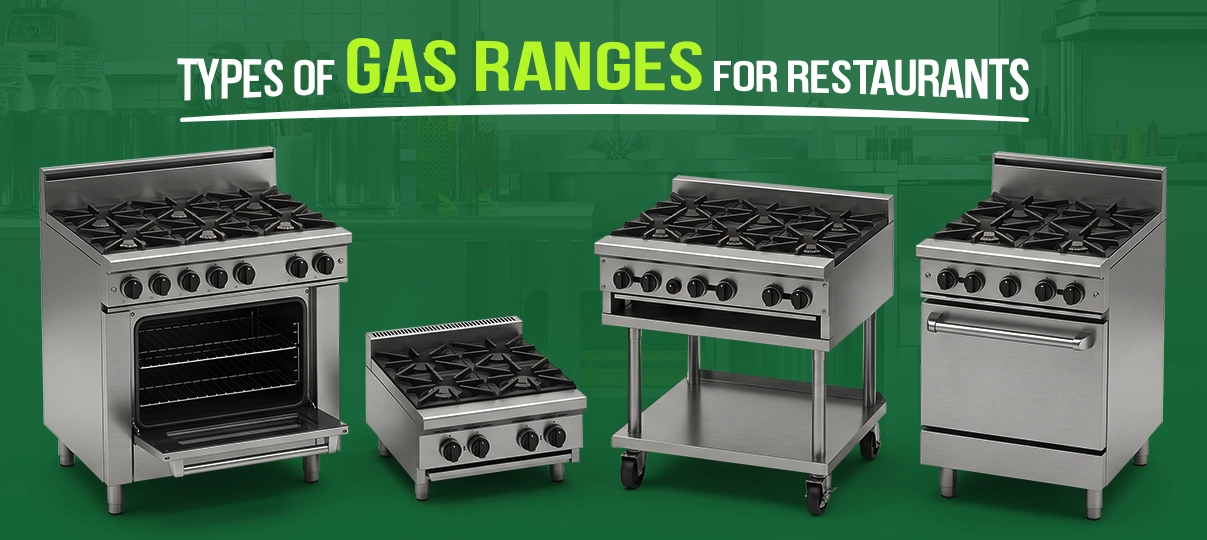
Walk into the kitchen of almost any successful restaurant in the world and you will find a gas range at its heart. Whether it is a compact four-burner unit tucked into a food truck or a heavy-duty twelve-burner professional range dominating the line of a Michelin-starred kitchen, the gas range is the most versatile, responsive, and widely trusted cooking appliance in commercial foodservice. Yet not all gas ranges are the same.
For restaurant owners and chefs navigating the commercial equipment market, the variety of available gas range types can be genuinely overwhelming. Heavy-duty ranges, medium-duty ranges, restaurant ranges, specialty ranges, combination ranges, and stock pot ranges all serve different needs and excel in different environments. Choosing the wrong type for your operation can mean underperforming equipment, unnecessary costs, wasted kitchen space, or frustrated kitchen staff.
This article breaks down the major types of commercial gas ranges available for restaurants, explains how each one functions, identifies the operations they are best suited for, and helps you make a confident, well-informed purchasing decision.
Why Gas Ranges Remain the Preferred Choice for Restaurants
Before exploring the different types, it is worth understanding why gas ranges continue to dominate commercial kitchens despite the growing availability of electric and induction alternatives. The answer lies in the unique combination of performance characteristics that gas offers.
Gas burners provide instant, highly responsive heat that chefs can adjust in real time with exceptional precision. Flames can be raised from a gentle simmer to a roaring sear in seconds, giving cooks direct control over their cooking environment. This responsiveness is difficult to replicate with electric coil burners and requires expensive, specialized induction technology to approach.
Gas ranges also work with virtually any type of cookware, including traditional carbon steel woks, cast iron pans, and copper cookware that may not be compatible with induction surfaces. The open flame enables cooking techniques such as charring, flambeing, and direct flame roasting that are simply not possible with electric alternatives.
From a cost perspective, natural gas is generally less expensive than electricity in most markets, and gas ranges tend to have lower operating costs per hour of use than comparable electric units. For restaurants operating high-volume kitchens for twelve or more hours per day, these operational savings add up significantly over the life of the equipment.
Heavy-Duty Commercial Gas Ranges
Heavy-duty commercial gas ranges represent the pinnacle of performance in the restaurant range category. These units are engineered for the most demanding kitchen environments, where the range must operate continuously throughout long service periods under the relentless pressure of high-volume cooking.
Structurally, heavy-duty ranges are built with thick-gauge stainless steel frames, cast iron grates capable of handling extremely heavy cookware, and powerful burners that typically output between 30,000 and 35,000 BTUs per burner. This elevated BTU output allows for faster boiling, more intense searing, and the ability to sustain high temperatures even when multiple pots and pans are loaded simultaneously.
Heavy-duty ranges are available in widths ranging from 24 inches to 72 inches or more, with burner counts that can reach twelve or beyond on the widest models. Many configurations include combination top options, such as a mix of open burners, a French top or hot plate, a raised griddle section, and one or two integrated ovens beneath the cooking surface.
These ranges are the preferred choice for fine dining establishments, high-volume steakhouses, hotel banquet kitchens, and any operation where multiple cooking tasks must be performed simultaneously at the highest possible output. Brands commonly associated with heavy-duty performance include Vulcan, American Range, Wolf, and Garland.
Medium-Duty Commercial Gas Ranges
Medium-duty gas ranges occupy the practical middle ground between light-duty restaurant ranges and heavy-duty commercial units. They are designed for operations that require reliable, consistent performance without the extreme output or price point associated with the heaviest commercial equipment.
Typical burner output on medium-duty ranges falls in the range of 20,000 to 30,000 BTUs per burner, with solid cast iron grate construction and stainless steel surfaces that balance durability with ease of cleaning. These units are available in standard widths of 24, 36, and 48 inches, and most configurations include one or two standard oven compartments beneath the cooking surface.
Medium-duty ranges are well suited to casual dining restaurants, mid-volume cafes, catering kitchens, and foodservice operations that experience busy but not extreme service volumes. They offer a cost-effective entry point into quality commercial cooking equipment without sacrificing the performance characteristics that professional kitchens require.
For restaurant operators who are opening a new concept and want a reliable workhorse without the capital outlay of a full heavy-duty line, a well-specified medium-duty range from a manufacturer such as Southbend, Imperial, or Montague represents an excellent investment.
Restaurant Ranges (Light-Duty Commercial Ranges)
Restaurant ranges, sometimes referred to as light-duty commercial ranges, are the entry-level tier of the professional range category. Despite their lighter construction compared to medium and heavy-duty counterparts, they are still significantly more robust than residential ranges and are built to meet the demands of regular commercial use.
Burner outputs on restaurant ranges typically range from 15,000 to 20,000 BTUs, which is sufficient for operations that do not require extremely high heat output. These ranges are generally available in 24-inch and 36-inch widths with four to six burners, and they almost always include a standard oven compartment that can be used for baking, roasting, or holding.
Restaurant ranges are particularly popular among small independent restaurants, bistros, bed-and-breakfast establishments, and low-to-moderate volume foodservice operations. They are also a common choice for ghost kitchens, pop-up dining concepts, and operators who are testing a new concept before investing in more permanent, higher-capacity equipment.
One important consideration with restaurant ranges is that they are not designed for the sustained high-volume use typical of a full-service dinner rush at a large establishment. Pushing a light-duty range beyond its design capacity will accelerate wear and increase the likelihood of costly repairs or premature failure.
Combination Ranges
Combination ranges are among the most versatile pieces of equipment available in the commercial kitchen market. As the name suggests, these units combine multiple cooking surfaces on a single platform, allowing a kitchen to address a broader range of cooking tasks without requiring multiple separate appliances.
A typical combination range might feature a set of open burners on one side of the cooking surface and a flat griddle on the other, all above one or two oven compartments. More complex configurations might include a combination of open burners, a raised griddle, a charbroiler section, and a French top, creating a highly flexible cooking station capable of supporting an entire menu from a single unit.
Combination ranges are particularly valuable in kitchens with limited floor space that need to maximize their cooking versatility per square foot. Brunch-focused restaurants that must simultaneously manage egg dishes, sauteed vegetables, pancakes, and grilled proteins in a single service window are an excellent example of an operation that benefits enormously from a well-configured combination range.
When specifying a combination range, it is important to think carefully about your menu's actual cooking requirements. The goal is to configure the cooking surface so that the proportions of each surface type match the demand your team will place on them during peak service.
Stock Pot Ranges
Stock pot ranges are highly specialized pieces of equipment designed for one primary purpose: generating enormous quantities of intense heat to bring very large volumes of liquid to a boil as quickly as possible. These units are not general-purpose cooking ranges and are not intended to replace the standard burners on a restaurant's cooking line.
A stock pot range typically features two to six extremely powerful burners with outputs ranging from 60,000 to over 100,000 BTUs per burner. The burners are set low to the ground to accommodate the large, heavy stock pots that these ranges are designed to handle, and the grates are built to support the substantial weight of a fully loaded commercial stock pot.
Stock pot ranges are essential in operations that produce large volumes of stocks, soups, broths, sauces, pasta water, and similar high-volume liquid preparations. They are standard equipment in hotel banquet kitchens, large institutional foodservice operations, pasta-focused restaurants, and any establishment where bulk liquid cooking is a daily requirement.
Because of their specialized function and very high BTU output, stock pot ranges require proper ventilation and must be placed beneath a commercial hood system rated for their output. They are also not intended for delicate cooking tasks and should always be used alongside a standard commercial range for the full spectrum of kitchen cooking needs.
Wok Ranges
Wok ranges, also known as Chinese ranges or wok cookers, are purpose-built for the high-heat, high-speed cooking techniques central to Chinese cuisine and other Asian culinary traditions. These ranges produce some of the most intense heat output available in any commercial cooking appliance, with individual wok burners commonly generating between 100,000 and 200,000 BTUs.
The burners on a wok range are configured as ring burners set into recessed well openings that cradle the curved base of a traditional carbon steel wok. Water jets are typically integrated into each wok station for rapid cooling and cleaning between dishes. The intense heat output enables the wok hei, the complex smoky, slightly charred flavor characteristic that is the hallmark of authentic high-heat wok cooking and that is impossible to achieve with lower-BTU equipment.
Wok ranges are essential for Chinese restaurants, pan-Asian establishments, dim sum houses, and any operation where authentic wok-cooked dishes are a central part of the menu. They are also increasingly found in contemporary fusion restaurants where chefs use high-heat wok techniques to create distinctive flavors in dishes that extend beyond traditional Chinese cuisine.
The extreme heat output of wok ranges demands robust ventilation infrastructure. A properly rated commercial exhaust hood with adequate capture velocity is non-negotiable when operating a wok range, and local fire codes must be carefully consulted during the kitchen design phase.
French Top and Hot Plate Ranges
French top ranges, also known as hot plate or French plate ranges, feature a thick solid steel plate surface that is heated from beneath by a series of gas burners. Unlike open-burner ranges, where the flame directly contacts the cookware, French top ranges heat the steel plate to different temperature zones, with the highest heat concentrated at the center directly above the burners and progressively lower temperatures toward the edges.
This graduated heat zone design allows a skilled cook to manage multiple pots and pans at different temperatures simultaneously by simply sliding them across the plate surface. It is an exceptionally efficient system for operations that require continuous simmering, sauce management, and precise temperature holding across many vessels at once.
French top ranges are most at home in classical European-style kitchens, particularly French and Italian fine dining establishments where sauce work, braising, and the management of many simultaneously simmering preparations are central to the cooking process. They are also valued in catering kitchens where large quantities of dishes must be held at precise temperatures during service.
Key Factors to Consider When Choosing a Gas Range
With such a wide range of options available, selecting the right gas range for your restaurant requires careful consideration of several interconnected factors:
Menu and Cooking Techniques: Your menu should be the primary driver of your range selection. A restaurant built around grilled and sauteed dishes has fundamentally different needs from one that produces large volumes of soups and sauces, or one specializing in wok-fired Asian cuisine. Match the range type to the techniques your kitchen performs most frequently.
Volume and Service Intensity: Consider how many covers you serve per service period and how intensive your cooking line operation is during peak hours. High-volume operations demand heavy-duty equipment with high BTU output and rugged construction, while lower-volume concepts may be well served by medium-duty or restaurant-grade ranges.
Kitchen Space and Layout: The physical dimensions of your kitchen and the configuration of your cooking line should guide your range width, burner count, and any combination surface choices. Measure carefully and account for required clearances from combustible materials, ventilation equipment, and adjacent appliances.
Ventilation Capacity: Every gas range must be operated beneath a properly rated commercial exhaust hood. Higher BTU output ranges require hoods with greater capture velocity and exhaust capacity. Verify that your existing or planned hood system is rated for the total BTU output of your gas range before making a purchase.
Budget and Total Cost of Ownership: Consider not just the upfront purchase price but also the long-term operating costs, expected maintenance requirements, and parts availability for the brand and model you are considering. A higher initial investment in a durable, well-supported brand often delivers better value over the life of the equipment than a cheaper unit with higher ongoing maintenance costs.
Service and Support: Choose a brand and model that has authorized service technicians available in your area. In a commercial kitchen, equipment downtime directly translates to lost revenue. Reliable access to local service support and readily available replacement parts should be a serious factor in any range purchase decision.
Explore the Best Commercial Gas Ranges for Restaurants at The Horeca Store
Choosing the right commercial gas range for restaurants plays an important role in improving kitchen efficiency, cooking speed, and food quality. The Horeca Store offers a wide range of reliable restaurant gas ranges designed for hotels, cafés, cloud kitchens, catering businesses, and professional kitchens. Our collection includes durable models with excellent heat control, multiple burner options, and heavy-duty performance to handle daily cooking demands.
At The Horeca Store, we provide high-quality commercial gas ranges that help chefs prepare meals with consistency and efficiency. Whether you need equipment for a new restaurant setup or want to upgrade your existing kitchen, our gas ranges deliver durability, performance, and value. Explore our collection to find the ideal cooking solution for your commercial kitchen needs.
Conclusion
The gas range is the defining appliance of the professional kitchen, and choosing the right type is one of the most consequential decisions a restaurant operator or executive chef can make. From the high-output intensity of a heavy-duty commercial range to the specialized precision of a French top, from the raw power of a wok range to the practical versatility of a combination unit, each type of gas range brings distinct strengths that make it the ideal tool for specific culinary environments.
Understanding these differences is not merely an academic exercise. It is a practical necessity for any operator who wants to build a kitchen that performs at the highest level, supports their culinary vision, and delivers a reliable return on the investment made in equipment. The right gas range, matched to the right operation, will serve as the backbone of your kitchen for many years, enabling your team to cook with confidence, consistency, and creativity.
Take the time to assess your menu requirements, your service volume, your kitchen's physical constraints, and your long-term operational goals before making a final decision. Consult with a reputable commercial kitchen equipment dealer who can provide hands-on demonstrations and help you navigate the range of available options. When you invest in the right gas range for your restaurant, you are investing in the foundation of every great meal your kitchen will produce.