
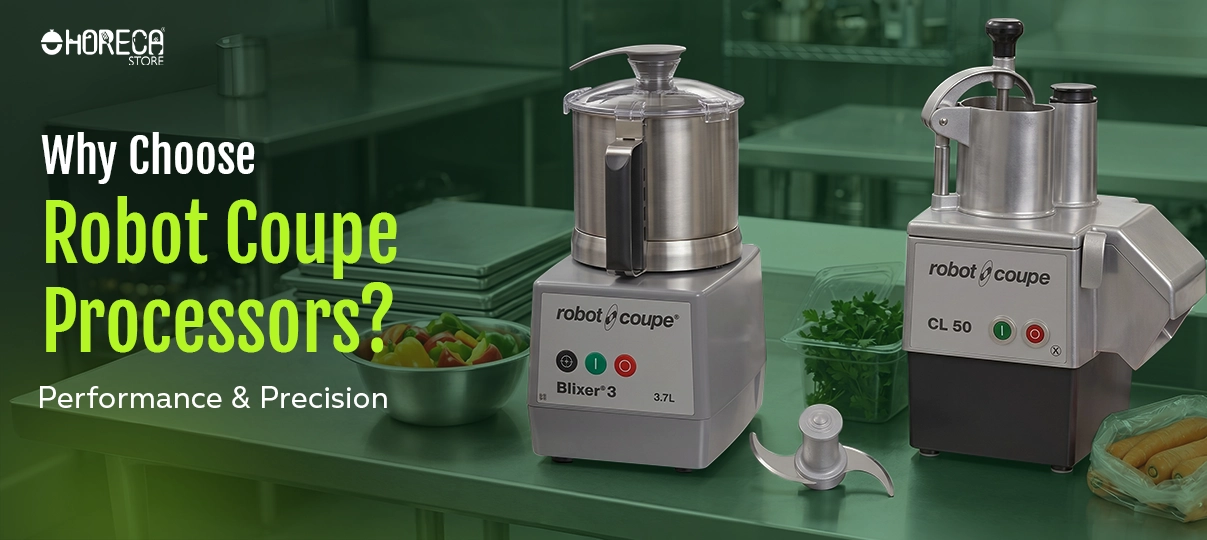
If you have ever spent an agonizing afternoon dicing onions by hand only to end up with uneven pieces, you understand the frustration of manual prep. Step into almost any high-end restaurant, and you will immediately spot the solution: a heavy, beige-and-stainless appliance anchoring the prep station. That is a Robot Coupe, the undisputed gold standard of professional kitchen equipment.
According to industry data, switching to an industrial food processor saves busy kitchens roughly three to four hours of manual labor daily. While a standard household blender might struggle through a single batch of thick hummus before overheating, commercial-grade machinery is engineered for relentless endurance. Rather than relying on lightweight plastic parts that quickly burn out, these workhorses utilize friction-free magnetic motors designed to last decades.
Why does this specialized tool command a higher price than a residential unit? Finding a reliable food processor means looking beyond the initial sticker price to grasp its true long-term value. Professionals choose these machines to transform chaotic prep work into a high-speed assembly line.
Food Processor vs. Blender: When to Reach for the Robot Coupe
Making salsa in a standard appliance often results in a watery puree. That frustrating result highlights exactly what a food processor does differently. While blenders rely on high speed and liquid to pulverize, a true food processor and blender comparison comes down to one mechanical advantage: torque. This raw twisting power pushes through dry, heavy ingredients without stalling or needing water to keep things moving.
At the center of this power is the "S-blade"—a sweeping, curved metal knife sitting low in the bowl. Instead of liquefying food, it slices cleanly, making it the ultimate tool for chopping uniform pieces without turning them to mush. When swapping a blender for a food processor, remember this practical breakdown:
- Liquids: Use a blender for smoothies, frozen cocktails, and silky soups.
- Thick Textures: Choose a processor for chunky salsas, thick nut butters, or kneading bread dough.
- Precision Cuts: Processors are essential for uniform dicing or shredding blocks of cheese.
Pushing an S-blade through dense ingredients requires an engine built for endurance, not just a quick burst of speed. Forcing a standard residential appliance to do this heavy prep daily will quickly burn it out, setting the perfect stage to evaluate why induction motors outlast standard blenders.
Why Induction Motors Outlast Standard Blenders
Smelling a faint, burning odor while pureeing thick hummus is a frustrating experience for many cooks. That smell comes from standard appliance motors, which rely on carbon brushes—small blocks that physically rub against a spinning cylinder to conduct electricity. This constant rubbing generates intense friction, and heat is a motor’s worst enemy. When pushed too hard, those brushes quickly wear down and burn out. To avoid this costly breakdown, the best food processors for heavy-duty use abandon physical brushes entirely.
Stepping up to a commercial standard introduces a completely different technology driven by magnets. An induction motor uses a spinning magnetic field to turn the blade shaft. Without brushes rubbing together, there is virtually no friction, making the machine surprisingly quiet. This heavy magnetic coil construction adds significant weight, keeping the base securely planted on your counter while delivering unmatched industrial food prep efficiency.
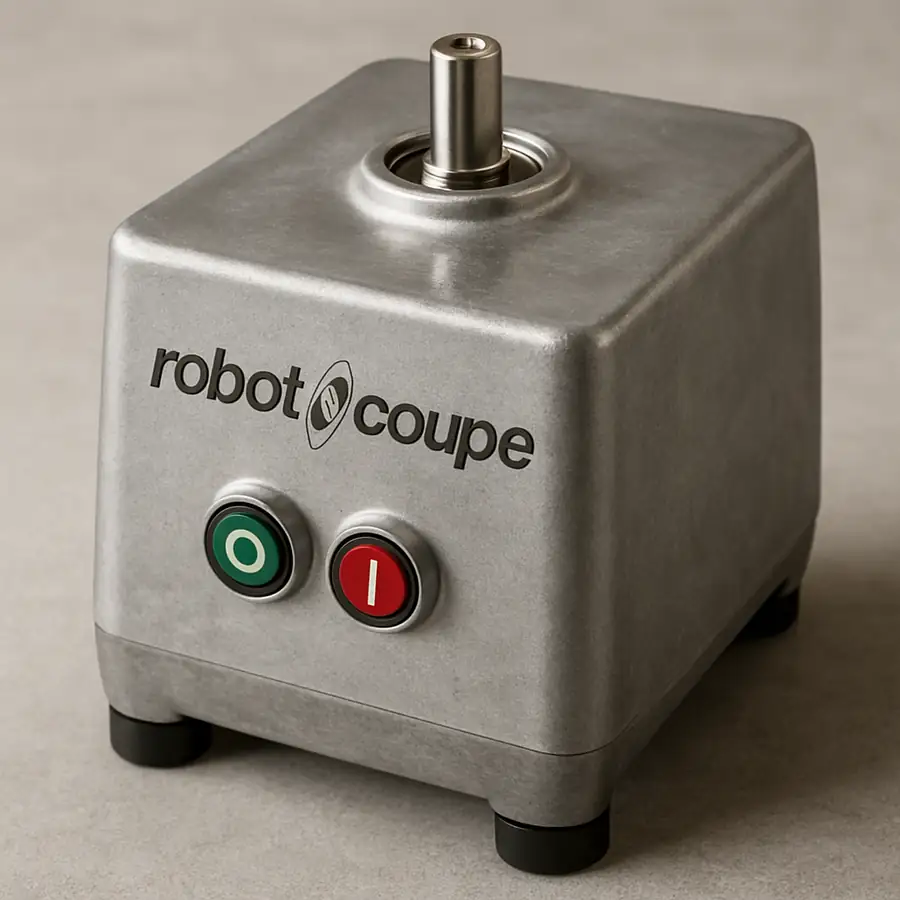
To ensure this investment lasts, professional models include thermal protection, a built-in sensor that safely shuts the motor down before it ever overheats during marathon prep sessions. Experiencing these long-term benefits of induction motors in processors proves why models like the Robot Coupe R2 are built to run for decades, not months. With a durable engine, finding the right bowl size becomes the main priority, leading naturally to choosing between the Robot Coupe R2 and R301.
Choosing Between the Robot Coupe R2 and R301
Moving to a commercial food processor requires matching machine capacity to your daily prep volume. Whether pureeing hummus for a café or cooking for a large family, kitchens need equipment packed with industrial strength. This naturally leads most buyers to a Robot Coupe R2 vs R301 comparison, since both are popular entry-level professional workhorses.
The core difference between them lies in how food moves through the machine. The R2 is a traditional batch processor: you load the 3-quart bowl, process your ingredients, and stop to empty it. Upgrading to the R301 introduces a larger 3.7-quart bowl and a "continuous feed" lid. Instead of stopping to empty a bowl, you drop vegetables into a top chute, and sliced pieces fly out a side exit directly into a collection bucket—like a high-speed assembly line.
Here are the exact specifications:
- Bowl Size: R2 holds 3 quarts; R301 holds 3.7 quarts.
- Motor Power: Both utilize a 1 HP motor spinning at 1725 RPM.
- Attachments Included: R2 comes with an S-blade; R301 adds the continuous feed vegetable prep attachment.
- Typical Use Case: R2 suits standard batch pureeing; R301 handles high-volume catering vegetable prep.
Choosing the right Robot Coupe model requires evaluating your labor costs. If you strictly puree dips, the R2 is ideal. However, if you spend hours slicing potatoes, the R301's continuous throughput easily justifies the higher price tag. Once you select your base unit, the real magic begins by mastering attachments for dicing, slicing, and shredding.
Mastering Attachments for Dicing, Slicing, and Shredding
Most new owners quickly discover that the standard bottom blade is just the beginning of what this machine can do. The secret to a food processor chopping vegetables with the precision of a trained chef lies in the vegetable prep head. This top-mounted attachment transforms your base unit into a dedicated prep station, allowing you to swap cutting tools in under 10 seconds to keep your kitchen moving smoothly during a busy lunch rush.
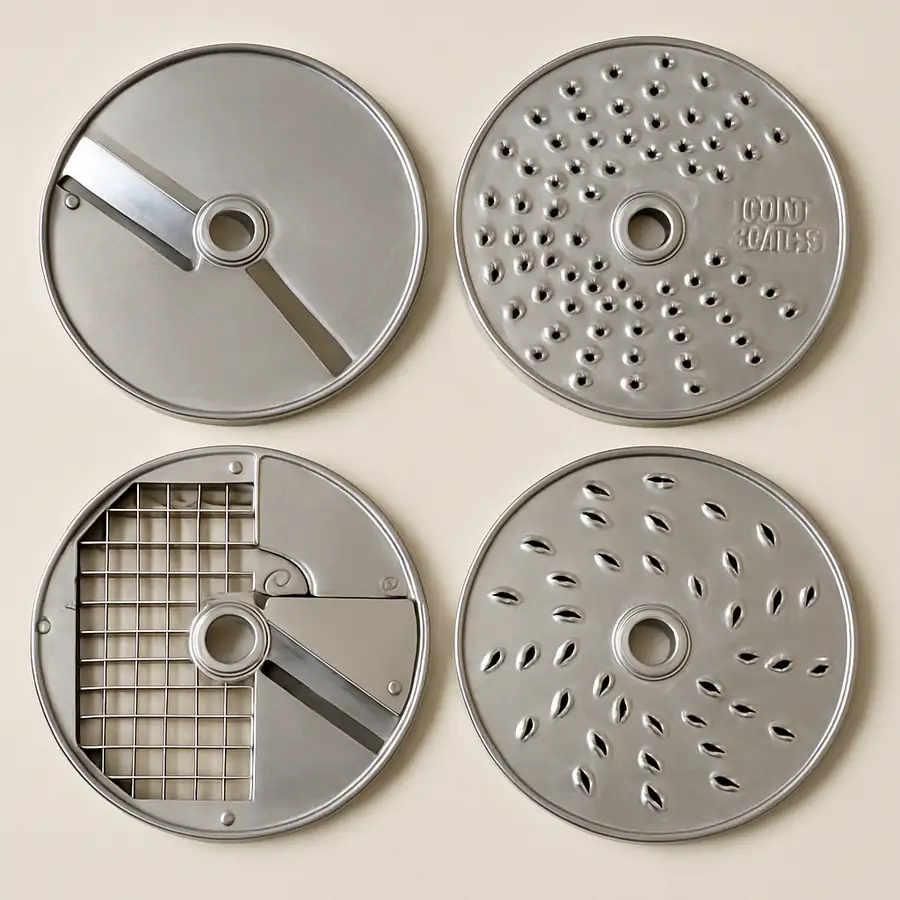
When equipping a kitchen, industry veterans always point to four primary disc types: the slicer, the grater, the julienne, and the dicing grid. Unlike basic home models, a commercial stainless steel food processor uses these specialized metal discs to shear through ingredients without bruising them. To achieve perfect cubes, the machine pairs a standard slicing disc with a rigid dicing grid, forcing the food through a metal net for absolute uniformity.
Beyond delivering consistent culinary results, these robust attachments provide a massive upgrade to workplace protection. By keeping hands far away from the sharp edges, this enclosed system effortlessly exceeds standard vegetable slicer and dicer safety standards, completely eliminating the terrifying risks of using a hand-held mandoline. Protecting your equipment and ensuring those safety features function flawlessly brings us to the next critical step: buying from a certified dealer.
The Value of Buying from a Certified Dealer
Figuring out exactly where to buy food processor equipment can be overwhelming when third-party marketplaces offer suspiciously steep discounts. These unauthorized sellers often push "gray market" units—machines manufactured for different countries that feature the wrong electrical voltage for your kitchen. Worse, if a gray market motor fails during a busy lunch rush, the manufacturer will instantly reject your repair claim because the unit bypassed official channels.
The "Certified Dealer" badge serves as your absolute guarantee of quality and protection against these expensive mistakes. Purchasing from an authorized seller ensures you actually receive complete commercial kitchen equipment warranty benefits. Buying authorized safely protects you from the three most common third-party pitfalls: instantly voided service agreements, counterfeit replacement blades, and dangerous, non-compliant power specs.
Beyond the initial purchase, a manufacturer-backed guarantee unlocks reliable local support for future upgrades and genuine replacement parts. Knowing authorized technicians are ready to supply exact factory-approved pieces rather than cheap imitations gives you total peace of mind. Once your authentic machine is safely set up on your counter, the next logical step is routine maintenance to keep your processor running for decades.
Pro Maintenance: Keeping Your Processor Running for Decades
Protecting your investment starts the moment prep finishes, and the secret to a machine lasting decades lies in avoiding water damage. While the magnetic induction motor is incredibly durable, it remains vulnerable at the center shaft. Always use the "Dry Wipe" method rather than spraying water to clean the motor seals—the protective rubber rings shielding the internal electronics.
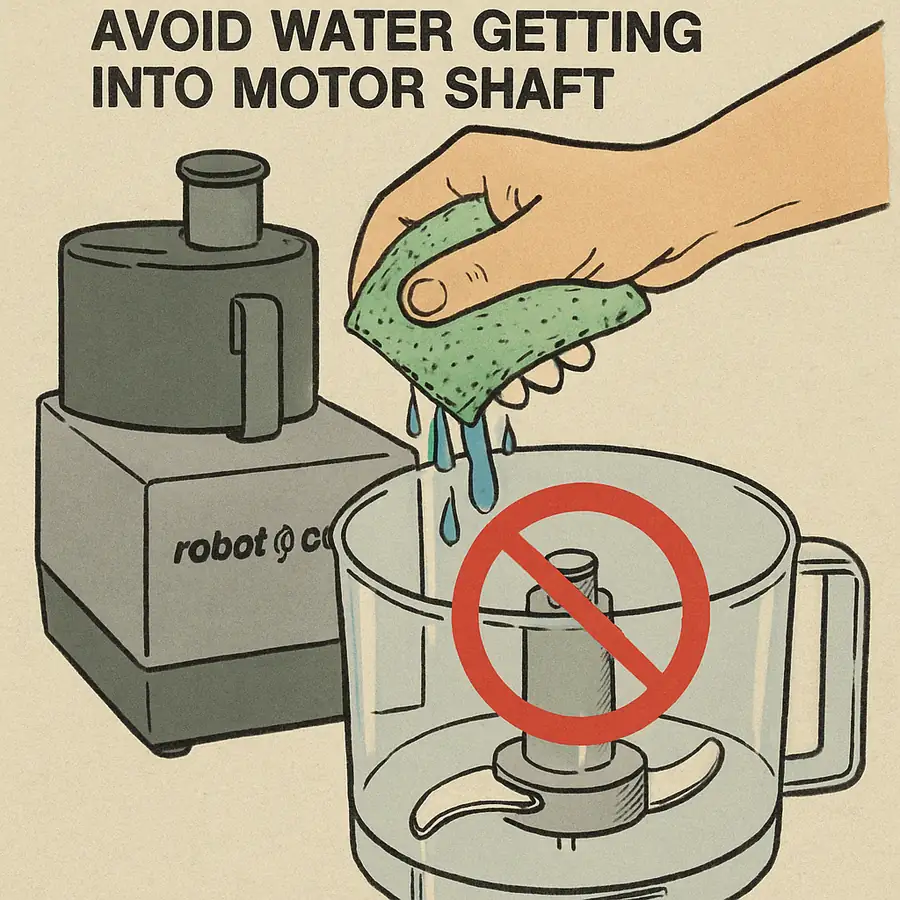
Building a reliable commercial food processor maintenance guide requires just a simple, two-minute daily routine. When cleaning vegetable prep attachments, follow this exact checklist to prevent food-borne illness and hardware failure:
- Unplugging: Always disconnect the power before disassembling any parts.
- Hand-washing blades: Scrub cutting tools in the sink, as high-heat dishwashers destroy edge retention.
- Wiping seals: Use a slightly damp towel carefully around the central shaft.
- Motor base care: Completely dry-wipe the exterior housing to prevent moisture buildup.
Recognizing a dull edge early is crucial for troubleshooting common commercial processor issues, like mushy vegetables or a struggling motor. Because the curved S-blade requires precise factory balance to operate safely, replace it when ingredients begin tearing instead of sharpening it yourself. With simple maintenance routines established, you can evaluate if a Robot Coupe is the right investment.
Buy Genuine Robot Coupe Food Processors from The Horeca Store
If you're looking to improve speed, consistency, and efficiency in your commercial kitchen, The Horeca Store offers a wide range of genuine Robot Coupe food processors designed for professional food preparation. Trusted by restaurants, hotels, catering businesses, bakeries, and institutional kitchens, Robot Coupe processors are built to handle chopping, slicing, grating, mixing, pureeing, and other prep tasks with exceptional precision. Whether you need a compact countertop model or a high-capacity processor for large-scale operations, The Horeca Store has the right solution for your kitchen.
At The Horeca Store, we are committed to providing authentic commercial kitchen equipment from trusted brands at competitive prices. Our team helps you select the ideal Robot Coupe processor based on your food preparation volume and operational requirements. With quality products, expert support, and reliable service, The Horeca Store is your trusted partner for equipping your kitchen with durable, high-performance food processing equipment that boosts productivity and delivers consistent results.
Final Verdict: Is a Robot Coupe the Right Investment for Your Kitchen?
Evaluating your daily prep hours allows you to confidently choose between the R2 and R301 models. These machines deliver unmatched speed, durability, and versatility directly to your prep station. Furthermore, purchasing from a certified dealer guarantees you receive full warranty support, genuine parts, and authorized pricing.
When researching professional equipment, calculate your specific return on investment rather than focusing on the initial cost. If this machine saves just 30 minutes of labor a day at $15 an hour, it pays for itself in less than a year. By optimizing restaurant kitchen workflow with automation, you are essentially hiring a highly efficient prep assistant. Calculate your labor savings today and step confidently into a professional-grade kitchen workflow.