
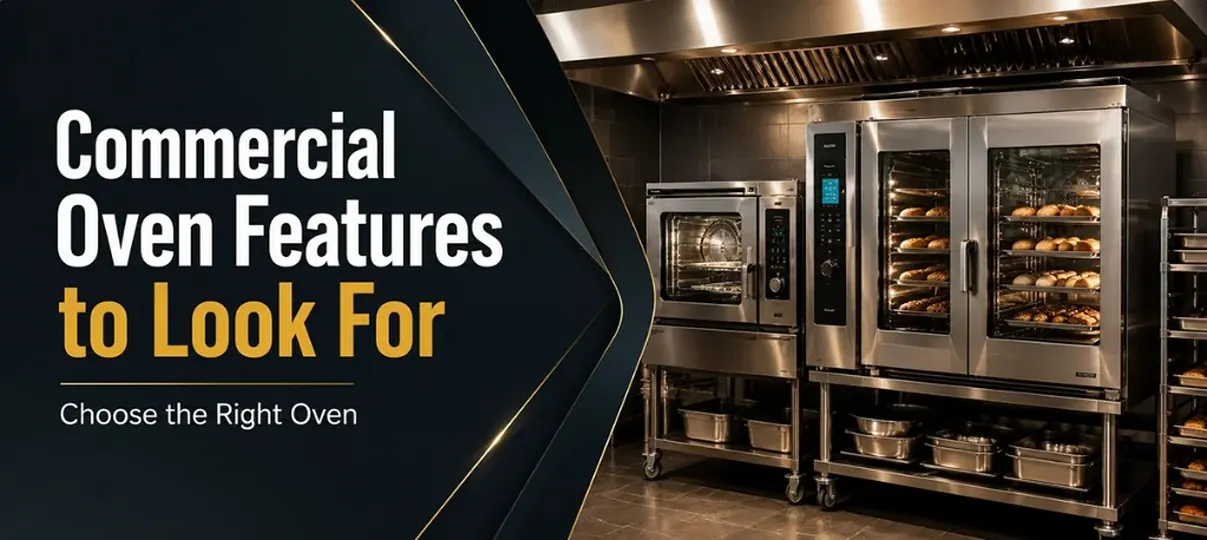
Top Features to Look for in Commercial Ovens
Choosing the right oven is one of the most important equipment decisions in a professional kitchen. The best fit is not always the biggest, most expensive, or most feature-packed model; it is the oven that supports your menu, production volume, staff workflow, utility setup, and cleaning routine. This guide walks through the features that matter most when comparing commercial kitchen ovens so you can buy with confidence and avoid costly mismatches.
Which commercial oven features matter most for your menu?
Match commercial oven features to menu volume, pan capacity, and temperature control before comparing restaurant equipment options.
The most important commercial oven features are the ones that help your kitchen produce consistent food at the speed and volume your operation requires. A bakery may prioritize airflow, steam injection, deck configuration, and gentle temperature control, while a high-volume restaurant may care more about fast heat recovery, programmable cooking, durability, and easy cleaning between shifts. Before comparing brands or models, start by mapping the oven to what you cook every day, how often you cook it, and who will be using the equipment.
A good oven should improve consistency, not complicate service. If your staff has to constantly rotate pans, adjust timing, or recover from uneven browning, the oven is adding friction to the line. On the other hand, a well-chosen unit can support batch production, reduce guesswork, and help newer staff follow repeatable cooking programs.
Use this practical buying checklist before narrowing your options:
- Menu fit: List your core products, such as breads, pastries, roasted proteins, casseroles, vegetables, pizzas, or prepared meals. The oven should support your most frequent items first.
- Daily volume: Estimate your busiest production periods, not just your average day. An oven that works on slow mornings may become a bottleneck during catering, lunch rush, or holiday demand.
- Pan capacity: Confirm how many full-size, half-size, or sheet pans the unit holds, and whether spacing allows proper airflow.
- Temperature range: Make sure the oven can handle both low-temperature holding or dehydrating tasks and high-temperature roasting or baking needs, if your menu requires both.
- Recovery speed: Consider how quickly the oven returns to temperature after the door opens. This matters in kitchens where staff load and unload frequently.
- Controls: Decide whether manual dials are enough or whether programmable controls will improve consistency across shifts.
- Cleaning access: Look for removable racks, accessible interiors, smooth surfaces, and materials that can stand up to repeated cleaning.
- Installation realities: Match the oven to your available utilities, ventilation, floor space, door clearance, and local code requirements.
That checklist may sound simple, but it prevents a common mistake: shopping by category name alone. Two ovens can both be described as convection ovens, for example, while performing very differently in terms of airflow, temperature control, recovery, and usability.
Commercial oven types and their best uses
Understanding commercial oven types helps you choose convection, combi, deck, conveyor, or steam ovens that fit your kitchen.
Understanding commercial oven types helps you separate “nice to have” features from features that genuinely affect production. Most kitchens do not need every oven style; they need the right heat transfer method for their food. Convection, combi, deck, conveyor, steam, and rotisserie ovens all have strengths, but they solve different problems.
Convection ovens for versatile daily production
A commercial convection oven is often the most flexible cooking equipment choice for daily baking and roasting.
Commercial convection ovens use fans to circulate hot air through the cavity, helping food cook more evenly and often faster than in a still-air oven. This makes them popular for roasting, baking, reheating, finishing, and batch production. They are especially useful in restaurants, cafés, schools, hotels, and catering operations where one oven may handle several jobs throughout the day.
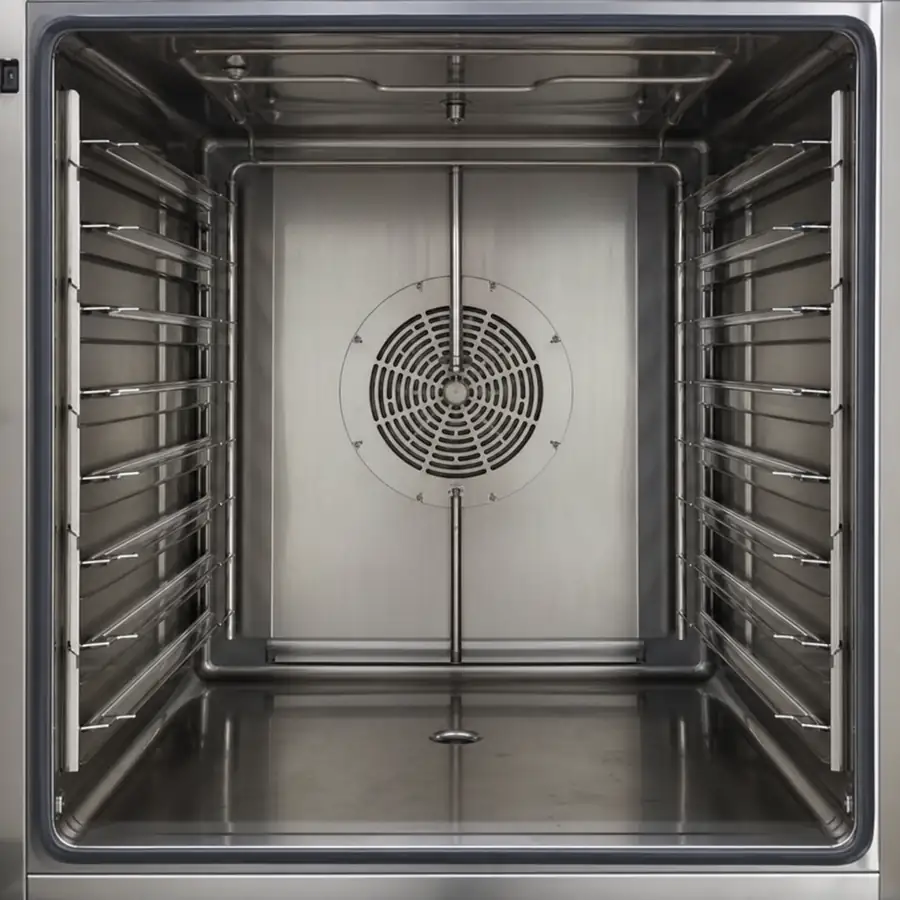
The key feature to evaluate in a convection oven is airflow quality. Strong airflow is useful, but uncontrolled airflow can dry delicate products or create uneven results if pans block circulation. Look for thoughtful fan design, adjustable fan speeds where available, and rack spacing that allows heat to move around each pan.
For bakeries, convection ovens can be excellent for cookies, pastries, rolls, and many everyday baked goods. For artisan breads or products that require specific crust development, steam injection or a deck oven may be more appropriate. The point is not that one oven is universally better; it is that the oven’s behavior should match the texture and finish you need.
Combi ovens for kitchens that need flexibility
Combi ovens combine dry heat and steam for menus that need broad commercial kitchen versatility.
Combi ovens combine convection heat with steam cooking, allowing operators to use dry heat, moist heat, or a controlled mix of both. This gives chefs more control over humidity, which can help with vegetables, proteins, rice, delicate items, reheating, and production that needs moisture retention. A combi oven can also reduce the need for several separate pieces of equipment in kitchens where space is tight.
The trade-off is complexity. Combi ovens can offer tremendous versatility, but they also require staff training, water connections, cleaning procedures, and more careful maintenance. They may be a smart investment for operations with diverse menus, prepared meals, banquet service, healthcare dining, or commissary production. For a simpler menu focused mainly on roasting and baking, a high-quality convection oven may be more practical.
Deck ovens for bread, pizza, and hearth-style results
Deck ovens deliver strong bottom heat for bread, pizza, and hearth-style results in restaurant kitchens.
Deck ovens use heated stone, ceramic, or metal decks to deliver strong bottom heat and stable baking conditions. They are a common choice for bread, pizza, and items that benefit from a crisp base or hearth-style finish. Because the heat source and deck surface play a major role in the final product, deck ovens are often chosen for quality and texture rather than maximum versatility.
If you are comparing deck ovens, think about deck height, number of decks, recovery time, steam options, and how staff will load products safely. A multi-deck unit may increase capacity without spreading equipment across the kitchen, but it also affects ergonomics and workflow. The right choice depends on both product quality and production rhythm.
Conveyor ovens for repeatable high-throughput items
Conveyor ovens support repeatable high-volume output when consistency matters more than variety.
Conveyor ovens move food through a heated chamber at a controlled speed. They are useful when your kitchen needs repeatable results for similar items, such as pizzas, flatbreads, sandwiches, or toasted products. Once time, temperature, and belt speed are set, staff can produce consistent results with less manual monitoring.
The limitation is flexibility. Conveyor ovens are not ideal for every cooking style, and they can take up significant space. They work best when the menu has steady, repeatable items that justify the footprint.
Steam ovens for gentle cooking and moisture retention
Steam ovens protect moisture for vegetables, seafood, and delicate items alongside other cooking equipment.
Steam ovens cook with moist heat, making them suitable for vegetables, seafood, rice, eggs, and foods that should not dry out. They are especially valuable in operations that prioritize batch cooking, nutrition, or gentle reheating. However, they do not brown food the way dry-heat ovens do, so they are often used alongside other commercial kitchen ovens rather than as a complete replacement.
How do commercial oven types compare?
Compare commercial oven types by heat transfer, moisture control, throughput, and fit with your restaurant equipment plan.
Commercial oven types compare by how they transfer heat, manage moisture, support volume, and fit into the kitchen workflow. A convection oven is often the most versatile everyday option, a combi oven offers the most control over humidity and cooking modes, a deck oven excels at specific baked textures, and a conveyor oven supports repeatable production of similar items. The best commercial ovens are not defined by one category; they are the models that match your menu and operating style.
Here is a simple way to think about fit without turning the purchase into a maze:
- Choose a convection oven if: you need an all-purpose workhorse for baking, roasting, reheating, and general production.
- Choose a combi oven if: you cook a wide variety of foods and need control over both heat and humidity.
- Choose a deck oven if: crust, bottom heat, and traditional baking characteristics are central to your product quality.
- Choose a conveyor oven if: you sell consistent, high-volume items that benefit from automated timing.
- Choose a steam oven if: moisture retention, batch vegetables, delicate proteins, or gentle cooking are priorities.
This comparison also helps prevent overbuying. A combi oven can be impressive, but if your team will only use it as a basic convection oven, you may be paying for functions that add little value. Likewise, a basic oven may seem budget-friendly until inconsistent output, slow recovery, or cleaning difficulty costs your team time every day.
Size, capacity, and configuration shape the real workflow
Size and pan capacity should match peak production, not just average daily restaurant kitchen volume.
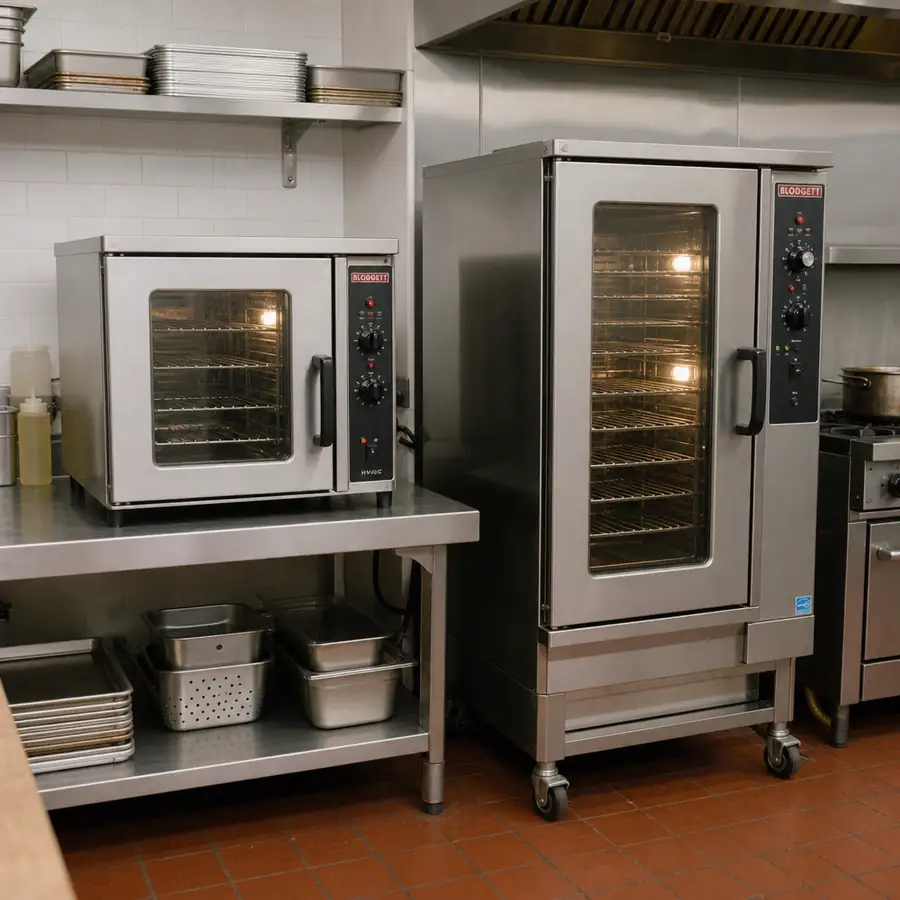
Oven capacity is not just about how many pans fit inside. It is about how efficiently staff can load, unload, rotate, stage, clean, and keep service moving. A compact countertop unit may be perfect for a small café, while a floor model or roll-in oven may be necessary for commissaries, bakeries, hotels, or institutional kitchens.
Countertop ovens are useful where space is limited or production is modest. They can support prep stations, small-batch baking, or menu expansion without a major layout change. The downside is lower capacity, so they can become a bottleneck if demand grows.
Floor models offer greater capacity and are common in restaurants, bakeries, and catering kitchens. Single-deck units may be enough for moderate production, while double-stack configurations can increase output within the same footprint. For very high-volume operations, roll-in ovens allow racks of pans to move directly from prep or proofing into the oven, reducing handling and improving flow.
When evaluating size, ask practical questions:
- What is the largest batch we need during peak demand? Size the oven for your busiest realistic scenario, not your quietest day.
- Will staff need to cook different foods at the same time? If so, airflow, controls, and odor transfer matter as much as capacity.
- Can the kitchen physically support the unit? Check doorways, floor clearance, utility access, hood space, and service access.
- Will growth change the equation? If you expect catering, wholesale, delivery, or multiple dayparts to expand, a slightly more scalable configuration may be worthwhile.
A common issue in professional kitchens is buying an oven that technically holds enough pans but does not fit the actual pace of work. If racks are difficult to maneuver, if doors block the line, or if staff must wait for temperature recovery, capacity on paper will not translate into capacity during service.
Temperature control and airflow drive consistency
Strong temperature control and even airflow keep commercial oven output consistent during busy service.
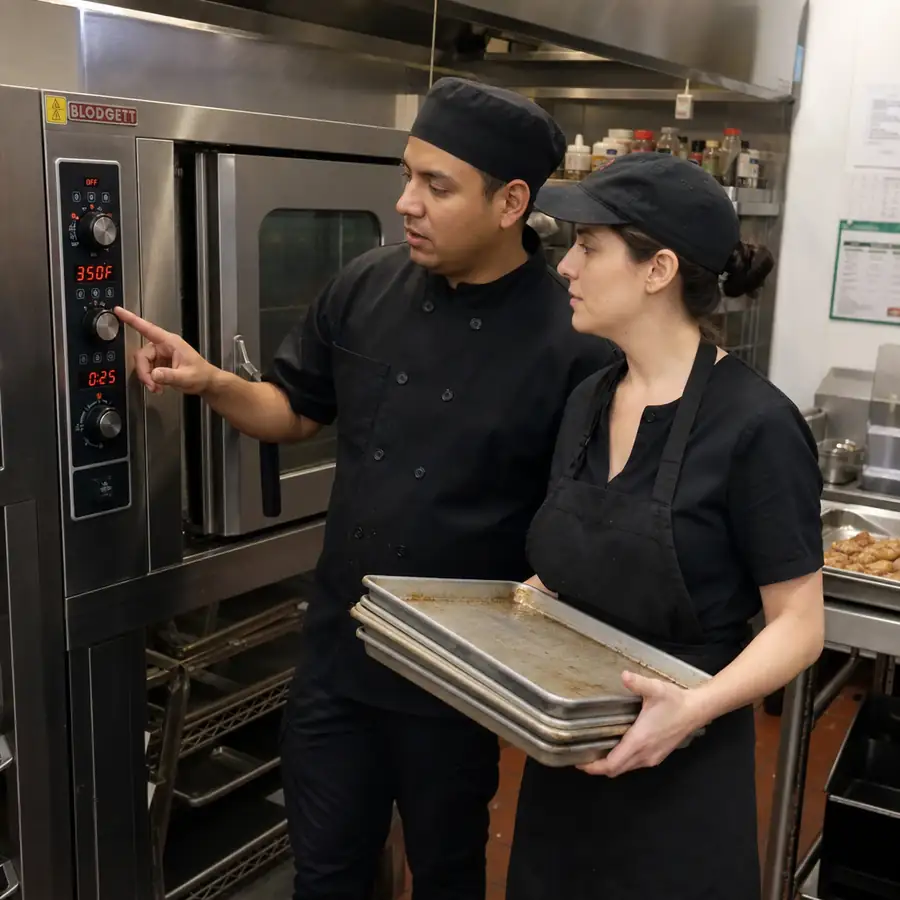
Consistent cooking depends on more than the temperature displayed on the control panel. It depends on how evenly the oven distributes heat, how accurately it measures cavity temperature, and how quickly it recovers after loading. In a busy kitchen, the door opens often, cold or room-temperature pans go in, and staff may load products with different moisture levels. The oven has to stabilize quickly.
For convection ovens, fan performance is central. Even circulation can reduce hot spots and help products brown more uniformly. Some ovens offer adjustable fan speeds, which can be helpful when switching between sturdy roasted items and delicate baked goods. High fan speed may be useful for roasting vegetables, while gentler circulation can protect pastries, cakes, or lighter products.
Precise temperature control is also important for repeatability. Manual controls can work well in experienced kitchens where staff understand timing and product cues. Digital controls and programmable settings may be better when multiple employees need to produce the same result across shifts. Programs can reduce training friction and help standardize common recipes, especially in multi-unit operations or high-turnover environments.
Look for these performance-related features:
- Reliable thermostats that help maintain target temperatures under real kitchen conditions.
- Strong but controlled airflow that supports even browning without excessive drying.
- Fast heat recovery after the door is opened or a full load is added.
- Multiple fan settings if your menu includes both robust and delicate products.
- Clear displays or controls that staff can read quickly during service.
- Programmable recipes for frequently prepared items where consistency matters.
Small details can have a large operational effect. A control panel that looks impressive but confuses staff may slow production. A simpler interface that everyone understands may produce better results in daily use.
Steam, humidity, and moisture control expand what an oven can do
Humidity and steam options expand what a commercial oven can produce beyond basic dry heat.
Moisture management is one of the biggest differences between basic and more advanced commercial kitchen ovens. Dry heat is excellent for browning, roasting, and crisping, but some foods need humidity to maintain texture, rise properly, or avoid drying out. That is why steam injection, humidity control, or combi cooking can be valuable depending on the menu.
For bread and some pastries, steam can support crust development and oven spring. For proteins, vegetables, and reheated prepared foods, humidity can help retain moisture and reduce the risk of dry edges. In banquet, catering, or institutional foodservice, this can be especially useful because food may need to be cooked, held, transported, or finished in stages.
However, moisture features should be matched to operational discipline. If an oven requires water filtration, deliming, daily cleaning cycles, or specific maintenance routines, the team needs to be ready for that responsibility. A feature only creates value when it is used correctly and maintained consistently.
Consider humidity-focused features if your kitchen regularly handles:
- Artisan or specialty breads that benefit from steam.
- Roasted meats where moisture retention is important.
- Vegetables cooked in batches.
- Prepared meals that need gentle reheating.
- Healthcare, senior dining, or institutional menus where texture consistency matters.
- Banquet production where food quality must hold across service windows.
If your menu is mostly dry baking, roasting, or finishing, you may not need advanced steam capability. If your menu is broad and changes often, humidity control can give you more room to adapt.
What should you know about gas, electric, and ventilation?
Gas, electric, and ventilation requirements affect installation and hood planning in any commercial kitchen.
Gas and electric ovens differ in installation needs, heat recovery, utility costs, control feel, and ventilation requirements. Gas ovens are often valued for strong heat output and quick recovery, while electric ovens are often chosen for precise control and simpler utility planning in some locations. Ventilation requirements vary by equipment type, cooking process, and local code, so always confirm with your local authority, installer, or ventilation professional before purchasing.
Gas ovens produce combustion byproducts, so they commonly require appropriate exhaust systems. They also need proper gas line capacity and safe installation. If your building does not already support the required gas connection or hood setup, installation costs can change the real purchase price significantly.
Electric ovens may be easier to place in certain kitchens, but they still require adequate electrical service. Larger units can demand substantial power, and upgrading panels or circuits can add cost and planning time. Electric units may offer responsive controls and even heating, but they are not automatically the best choice for every operation.
Ventilation is one of the most important topics to address early. Some ovens may require a Type I hood, some may be compatible with a Type II hood, and some ventless models may be available for specific uses. Requirements depend on grease production, heat, steam, fuel source, and local rules. Because codes vary, avoid relying on general assumptions.
Before committing to an oven, confirm:
- Whether the oven requires gas, electric, water, drainage, or multiple utility connections.
- Whether the existing kitchen has enough utility capacity.
- What hood type, fire suppression, or clearances may be required.
- Whether the oven’s heat output will affect staff comfort or HVAC load.
- Whether the installation path allows the oven to be delivered and serviced.
- Whether local inspectors or building management have specific requirements.
An oven that seems affordable can become expensive if it triggers unexpected ventilation or utility upgrades. Getting these answers early protects your budget and timeline.
Durability, cleaning, and maintenance affect lifetime value
Durable construction and easy cleaning protect long-term value from any commercial oven investment.
The best commercial ovens are built for repeated use, frequent cleaning, and the reality of busy service. Durability is not just about heavy materials; it is about whether the oven can be maintained easily enough to stay reliable. A rugged unit with hard-to-clean corners or difficult service access can still create downtime.
Stainless steel interiors and exteriors are common because they are durable and easier to clean. Removable racks, accessible fan covers, smooth interior surfaces, and clear drip management all make daily maintenance more realistic. If cleaning takes too long or requires awkward disassembly, it is more likely to be skipped or rushed.
Maintenance also depends on the oven type. Convection ovens may need attention to fans, gaskets, thermostats, and door seals. Combi ovens may require water treatment, descaling, drain care, and cleaning cycles. Steam ovens can be sensitive to mineral buildup if water quality is not managed.
Build a maintenance plan before the oven arrives:
- Daily: Wipe spills, remove food debris, clean racks as needed, and check door seals for obvious buildup.
- Weekly: Clean interior surfaces more thoroughly, inspect fans or vents where accessible, and review any error messages or performance issues.
- Monthly: Check gaskets, hinges, calibration concerns, and signs of uneven cooking.
- As recommended: Follow manufacturer guidance for professional service, descaling, filter replacement, or deeper inspection.
Easy cleaning is not a cosmetic detail. It supports food safety, reduces odors and smoke, protects components, and helps the oven perform consistently.
Controls, programming, and staff usability matter during service
Simple controls and programming help staff use commercial ovens consistently during peak hours.
Modern ovens can include programmable cooking, touchscreens, recipe storage, USB updates, probes, timers, multi-stage cooking, and automated cleaning prompts. These features can be valuable, but only if they match the skill level and pace of your kitchen. Technology should reduce decisions during service, not create a new training burden.
Programmable controls are especially useful when consistency matters across multiple cooks or shifts. A café baking the same pastries each morning, a school kitchen producing repeated menus, or a multi-unit restaurant group can benefit from saved settings. Programs can help standardize time, temperature, fan speed, steam level, and cooking stages.
For chef-driven kitchens, more manual control may be preferred. Experienced cooks may want quick adjustments based on product size, color, and doneness. In that setting, responsive controls and clear feedback may matter more than deep recipe storage.
When testing controls, think like a line cook during a rush:
- Can staff start common cooking tasks quickly?
- Are buttons, knobs, or screens easy to read with gloves or flour on hands?
- Is the timer loud and clear enough for the kitchen environment?
- Can programs be locked or standardized to prevent accidental changes?
- Is the display understandable for new employees?
- Does the oven recover gracefully if a mistake is made?
The most advanced control panel is not always the most useful. The right controls are the ones your team will use correctly every day.
Energy efficiency and throughput should be evaluated together
Balance energy efficiency with recovery speed and throughput when comparing restaurant equipment.
Energy efficiency matters, but it should be considered alongside production speed, recovery, capacity, and food quality. A lower-energy oven that slows output may not be efficient for your operation if it creates labor delays or forces multiple batches. Likewise, a powerful oven that wastes heat or sits underused for long periods may raise operating costs unnecessarily.
Think in terms of total operating value. If an oven cooks more evenly, reduces remakes, shortens batch times, and holds temperature well, it may save labor and protect product quality. If it is difficult to clean, frequently overloaded, or poorly matched to the menu, any upfront savings can disappear over time.
A practical return-on-investment review should include:
- Purchase price: The equipment cost itself.
- Installation cost: Utility upgrades, ventilation, delivery, permits, and professional setup.
- Labor impact: Time saved through faster cooking, easier loading, or programmable settings.
- Product consistency: Fewer overcooked, undercooked, or unevenly browned items.
- Maintenance needs: Parts, service access, water treatment, and cleaning labor.
- Scalability: Whether the oven can support future volume or menu expansion.
- Downtime risk: How service interruptions would affect revenue or production commitments.
This is where the phrase “best commercial ovens” becomes highly specific. The best oven for a bakery expanding wholesale production may not be the best oven for a small restaurant adding brunch. Value depends on how the oven performs in your actual business.
A practical scorecard for narrowing your options
Use a practical scorecard to compare commercial oven features before buying from The Horeca Store.
Once you understand the main features, create a simple internal scorecard. You do not need a complex spreadsheet; you need a clear way to compare models against your kitchen’s priorities. Rate each oven from low to high on the factors that matter most, then discuss the results with the people who will use, clean, maintain, and pay for the equipment.
Include these categories in your review:
- Menu compatibility: Does it handle your highest-volume and highest-value items well?
- Capacity fit: Can it support peak production without constant bottlenecks?
- Cooking consistency: Does it offer the airflow, temperature control, and recovery you need?
- Ease of use: Can staff operate it correctly with reasonable training?
- Cleaning practicality: Can the team keep it clean during real workweeks?
- Installation readiness: Does your space support the required utilities and ventilation?
- Maintenance expectations: Are service, parts, water treatment, and cleaning requirements manageable?
- Growth potential: Will it still make sense if your volume or menu expands?
For a bakery, menu compatibility may rank highest, especially if product texture and browning define the brand. For a quick-service restaurant, throughput and repeatability may matter more. For a hotel or catering operation, flexibility and holding quality may rise to the top.
The scorecard also helps align stakeholders. Chefs may focus on cooking performance, owners may focus on cost, and facilities teams may focus on installation. A shared review keeps the decision grounded in the whole operation.
Common buying mistakes to avoid
Avoid oversizing, ignoring ventilation, or choosing commercial ovens that do not match your menu.
Many oven problems begin before installation. The wrong choice can still look reasonable on paper if the buyer focuses on price, capacity, or category name without considering the daily workflow. Avoiding a few common mistakes can save frustration later.
First, do not buy more complexity than your team will use. A feature-rich oven can be valuable, but only when staff are trained and processes are in place. If no one maintains the water system, updates programs, or follows cleaning cycles, advanced features may become liabilities.
Second, do not underestimate installation. Ventilation, utilities, clearances, and delivery access should be checked before the purchase order is finalized. If the oven cannot fit through the door, connect to existing service, or pass inspection, the project can stall.
Third, do not assume capacity equals productivity. A large oven with slow recovery or poor workflow may underperform a smaller unit that fits the line better. Think about loading patterns, staging space, and how many people can use the equipment safely.
Finally, do not ignore the people who clean and maintain the oven. Daily cleaning is part of performance. If your team cannot realistically keep the oven in good condition, consistency and reliability will suffer.
Selecting the Right Commercial Oven
Select the right commercial oven by matching features to menu, staff, and kitchen layout at The Horeca Store.
Selecting a commercial oven for a restaurant is ultimately about workflow. The right model should match your menu, support your busiest production periods, and be practical for cleaning and maintenance. When considering options, The Horeca Store stands out as a convenient destination for exploring various commercial cooking equipment.
Engage with their knowledgeable team to find the ovens that best suit your needs, from commercial pizza ovens to essential refrigeration and food preparation equipment.
Incorporating your specific requirements will help ensure you choose the right commercial ovens that complement your kitchen’s workflow. Focus on features that improve consistency, speed, usability, and lifetime value rather than every available option.
Final takeaway
The best commercial oven supports consistency, workflow, and long-term value across your restaurant kitchen equipment.
When comparing restaurant kitchen equipment, prioritize the features that matter most for your operation. Focus on the aspects of ovens that will enhance your kitchen's efficiency and product quality. With careful consideration and resources like The Horeca Store, you can select commercial ovens that help your kitchen operate smoothly every day.