
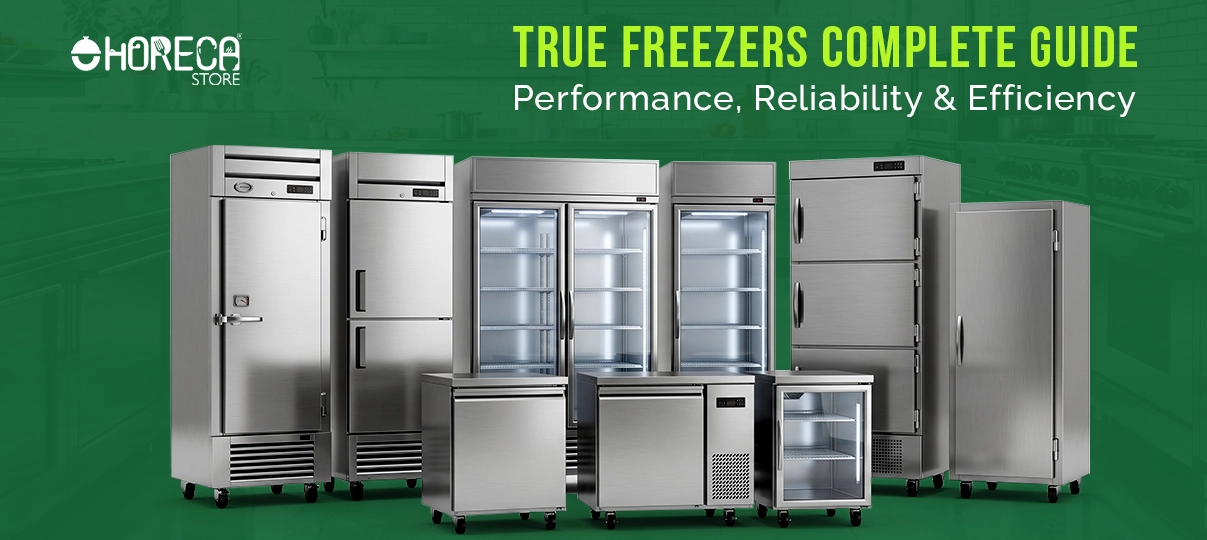
You’ve likely noticed the iconic lighted logo gleaming in your favorite deli or professional kitchen. Bringing that commercial prestige into a residential space isn't just about achieving an industrial aesthetic. Instead, asking "Are True freezers worth the investment?" comes down to moving past disposable appliances. While standard big-box models are engineered for a strict price point, these are built for relentless daily use.
According to appliance industry data, typical home freezers face an average lifespan of just seven years before hitting the landfill. True refrigeration flips this expectation entirely by building machines designed for a 15 to 20-year benchmark. This hard distinction between residential-grade plastics and commercial-grade steel represents a completely different engineering philosophy focused on long-term survival.
Why does premium meat sometimes develop freezer burn in a brand-new home unit? The answer lies in "recovery time"—a system's ability to snap back to zero degrees after the door opens. Standard models struggle for hours after a major grocery haul, but commercial engines easily conquer massive temperature fluctuations. This unmatched true freezers reliability ensures food stays perfectly preserved, even if the door swings open all day.
Protecting that perfectly chilled air requires more than a robust engine; it demands high-performance structural boundaries. High-density, foamed-in-place insulation acts like a premium cooler, locking in temperatures to lower energy costs and deliver continuous return on investment. This professional-grade ecosystem explains exactly why these powerhouse units are rapidly moving from restaurant kitchens into modern homes.
Steel vs. Plastic: Why True’s Heavy-Duty Construction Outlasts Consumer Units by Decades
Have you ever watched a cheap, plastic-lined freezer struggle and fail during a hot summer in the garage? Most home units use cost-saving materials meant to last just a few years under mild indoor conditions. True Manufacturing quality relies on a different philosophy entirely, swapping brittle plastics for commercial-grade materials built to survive decades of heavy use.
The foundation of this longevity is the metal shielding your food. Inside a typical consumer freezer, you will find easily scratched plastics or thin aluminum that dents instantly under the weight of frozen meats.
Behind that heavy-duty steel lies the secret to keeping the cold trapped: foamed-in-place insulation. Instead of using cheap, loosely packed foam panels, True injects liquid polyurethane into the walls and solid doors, where it expands and hardens into a rigid block. Think of the difference between a high-performance camping cooler and a flimsy polystyrene cup:
- Casing: 300-series stainless steel (True) vs. crack-prone plastic (Standard).
- Core: High-density polyurethane insulation efficiency (True) vs. thin, loose polystyrene (Standard).
- Doors: Solid insulated steel (True) vs. thermally leaky glass options (Standard).
Because this dense barrier locks cold air inside, the freezer's engine doesn't have to constantly run in overdrive. This superior thermal hold drastically lowers compressor strain, saving energy while protecting your bulk grocery hauls. With a vault-like exterior established, the internal engine relies on the "Snap Back" effect, utilizing R290 refrigerant and forced-air cooling to protect your food.

The 'Snap Back' Effect: How R290 Refrigerant and Forced-Air Cooling Protect Your Food
Most residential freezers struggle the moment you load them with a massive grocery haul. The internal temperature spikes, and the appliance takes hours to slowly claw its way back down to zero degrees. A commercial-grade unit is engineered for rapid "recovery time"—the precise ability to snap back to safe freezing temperatures even if the heavy door is opened repeatedly throughout the afternoon.
Achieving this lightning-fast recovery requires a completely different approach to internal airflow. Instead of relying on the passive, still air found in standard home models, True utilizes high-performance cooling through a heavy-duty forced-air system. Think of it as the "wind chill" effect; constantly moving cold air aggressively wraps around your food, freezing it faster and uniformly across every single shelf.
This continuous temperature control operates through a highly efficient, step-by-step cycle:
- Intake: Warm air radiating from newly added groceries is rapidly drawn toward the upper ventilation system.
- Evaporator Coils: The air passes directly over the evaporator coils—a series of specially chilled pipes that actively absorb and remove the heat.
- Distribution: Oversized internal fans blast the freshly chilled air back down, circulating it evenly to completely eliminate dangerous warm spots.
Powering this intense cooling cycle is an advanced chemical lifeblood known as R290. When evaluating R290 hydrocarbon refrigerant advantages, the primary benefit is its incredible thermal efficiency combined with an almost zero environmental footprint. Whether you are running a True vs Traulsen freezer performance comparison or exploring other premium commercial units, this modern gas is the undisputed standard for dropping temperatures faster while putting significantly less strain on the internal compressor.
Because your food reaches its target freezing point so rapidly, moisture stays locked safely inside your meats and produce instead of migrating to the surface as damaging freezer burn. While this muscular, fast-acting engine is undeniably powerful, bringing commercial strength into your space naturally impacts your monthly power bill, making it essential to decode energy ratings and examine the hidden trade-offs of glass doors.
Energy Savings vs. Upfront Cost: Decoding Energy Star Ratings and Glass Door Trade-offs
Looking at the price tag of a commercial unit often causes sticker shock, but true value requires looking past the initial purchase. When you invest in Energy Star certified reach-in freezers, you are buying a long-term utility reduction rather than just a cold box. A standard big-box freezer might save you money today, but over a decade, its inefficient compressor will quietly drain your wallet through higher monthly electric bills.
Behind this impressive efficiency is a quiet revolution in refrigeration technology known as the ECM motor. Instead of using traditional motors that run blindly at full speed until they shut off, Electronically Commutated Motors act like smart accelerators, adjusting their power based on exactly what the system needs. This precise control is the secret weapon for reducing energy consumption in reach-in units, as it generates significantly less excess heat—meaning the freezer doesn't have to fight its own internal temperature to stay cold.
Your choice of exterior styling also plays a massive role in that daily power usage. Many buyers love the premium look of a lighted display, but evaluating glass door vs solid door freezer efficiency reveals a stark reality. Even triple-pane thermal glass cannot insulate as perfectly as a solid, foam-filled stainless steel door, meaning a glass model will inevitably force those high-efficiency motors to run more frequently to maintain zero degrees inside a warm garage or kitchen.
Balancing that visual appeal against your tolerance for higher electricity costs is the final step in selecting your ideal configuration. However, choosing an efficient model is only half the battle when it comes to longevity. Guaranteeing those utility savings actually materialize over the next thirty years requires mastering the self-cleaning condenser and basic routine maintenance.

Keeping the Engine Cool: Mastering the Self-Cleaning Condenser and Basic Maintenance
Most residential freezers hide their mechanical parts behind sealed panels, meaning out-of-sight is usually out-of-mind. Commercial systems, however, are powerful heat exchangers that rely on exposed condenser coils to release warmth from the cabinet into the room. Think of the condenser like a car radiator. If it gets choked with kitchen dust or pet hair, the "engine" must run twice as hard to maintain zero degrees. When these coils suffocate, you risk premature compressor failure, turning a lifetime appliance into a costly repair.
To combat this exact problem, engineers developed True Manufacturing self-cleaning condenser technology. Instead of forcing you to vacuum the unit weekly, the system utilizes a reversing fan motor. Every time the compressor kicks on, this smart fan spins backward for twenty seconds, physically blowing away settled dust before resuming its normal cooling direction. This daily self-clearing acts as an automatic shield, extending compressor life by ensuring it never struggles against a blanket of insulating debris.
Even with this brilliant automation, performing a manual inspection guarantees your machine hits that twenty-year milestone. A quick commercial freezer maintenance checklist takes under five minutes a month to complete:
- Inspect the fins: Shine a flashlight through the front grill to verify the coils remain silver and free of dust mats.
- Clear the airflow: Use a stiff bristle brush—moving strictly up and down to avoid bending the metal—to dislodge any stubborn dirt.
- Check your tags: Photograph the interior data plate; having that serial number makes finding True freezer replacement parts like worn door gaskets completely effortless.
Completing this preventative maintenance cycle keeps components highly efficient, but industrial-grade airflow has distinct environmental side effects. Finalizing a spot in your kitchen or garage requires a straightforward reality check: verifying your home can actually handle the noise, heat, and power needs.
The Reality Check: Can Your Home Handle the Noise, Heat, and Power Needs?
Bringing industrial power into your kitchen requires preparation. When installing commercial freezers in residential homes, managing the physical environment is crucial to long-term success. Because these powerful engines rapidly pull heat from the internal cabinet, they exhaust significant warm air into the room. If shoved tight against a wall or enclosed in custom cabinetry without proper ambient heat clearance, the unit suffocates. This restricted airflow forces the cooling fans to run constantly, elevating the unit's normal background hum into a noticeably loud roar that disrupts a quiet home.
Electrical requirements present another major departure from standard residential appliances. Commercial compressors demand serious startup power, meaning they require a dedicated circuit—a breaker supplying electricity solely to this machine, rather than sharing a line with your garage tools. Furthermore, you must verify your NEMA plug configurations before purchasing. NEMA simply refers to the prong shape of your wall outlet. While basic homes use standard 15-amp outlets, many commercial freezers require a NEMA 5-20 plug, which features a horizontal prong and demands a heavier-duty 20-amp receptacle.
Ignoring these spatial and electrical boundaries easily leads to frustrating performance drops. Often, troubleshooting True freezer temperature issues reveals a perfectly healthy machine that is simply starved for air or voltage rather than experiencing a mechanical failure. Preparing your home's infrastructure upfront ensures your appliance runs quietly and effortlessly, maximizing your return on investment over the machine's lifespan.

The 20-Year Verdict: Calculating Your ROI on True Manufacturing Quality
You no longer have to view a freezer as a disposable appliance destined for the landfill in five to seven years. By understanding the heavy-duty components and rapid temperature recovery times, you can now evaluate a True refrigeration investment by its decades of reliable performance rather than its initial price tag. While standard residential units quickly depreciate, True's commercial-grade steel and oversized compressors hold significant resale value, offering a remarkable return on investment over a thirty-year lifespan.
Before committing to a high-performance machine, use this quick checklist to determine if an upgrade makes sense for your space:
- Buy if you need absolute temperature stability for expensive bulk storage or require one of the best commercial freezers for small restaurants.
- Buy if you have the proper electrical outlets, adequate ventilation clearance, and a tolerance for slightly higher operating noise.
- Pass if you prioritize whisper-quiet operation in a primary living space or are on a strict, short-term appliance budget.
When exploring the market for a professional machine, read specific True freezer reviews for the models that fit your dimensions. Compare pricing and services between major online retailers and your local restaurant supply dealers. Local commercial dealers can often provide specialized delivery and setup, ensuring your heavy-duty machine is perfectly calibrated to protect your food from day one.