
Restaurant kitchen equipment cost depends on your menu, service style, kitchen size, fuel type, local code requirements, and whether you buy new, refurbished, or used equipment. A realistic budget should include not only cooking appliances, refrigeration, preparation tools, warewashing, storage, smallwares, delivery, installation, ventilation, utilities, maintenance, and backup items. This guide explains how to estimate restaurant supply costs without guessing, so you can build a practical purchasing plan before requesting supplier quotes.
How much does kitchen equipment cost for a restaurant?
Kitchen equipment cost for a restaurant covers ranges, ovens, fryers, griddles, refrigeration, and smallwares.
Kitchen equipment can cost a modest amount for a compact café or cloud kitchen and a much larger amount for a full-service restaurant, hotel kitchen, bakery, or high-volume catering unit. The only reliable way to estimate the average cost of restaurant kitchen equipment is to connect every item to the menu, expected order volume, space layout, safety requirements, and utilities already available on-site.
Instead of starting with random kitchen equipment prices, begin with a working list of what the kitchen must produce each day. A dosa outlet, burger shop, bakery, fine-dining restaurant, juice bar, and central kitchen all need very different equipment. The budget changes again when you add exhaust systems, grease traps, stainless steel fabrication, gas pipelines, electrical upgrades, cold storage, and service support.
A complete estimate usually includes:
- Primary cooking equipment, such as ranges, ovens, fryers, griddles, steamers, tandoors, tilting pans, combi ovens, or induction units.
- Ventilation and fire safety, including hoods, ducts, filters, fresh-air systems, fire suppression, and installation labor.
- Refrigeration, such as reach-in chillers, freezers, undercounter units, prep counters, display chillers, and walk-in cold rooms.
- Food preparation equipment, including mixers, slicers, grinders, blenders, vegetable cutters, dough kneaders, and work tables.
- Warewashing and cleaning, such as dishwashers, sinks, sprayers, drain boards, racks, bins, and cleaning stations.
- Storage and service items, including shelving, gastronorm pans, containers, trolleys, hot cases, bain-maries, and smallwares.
- Installation and utilities, including electrical load, gas lines, water supply, drainage, flooring, wall protection, and commissioning.
What counts as restaurant kitchen equipment?
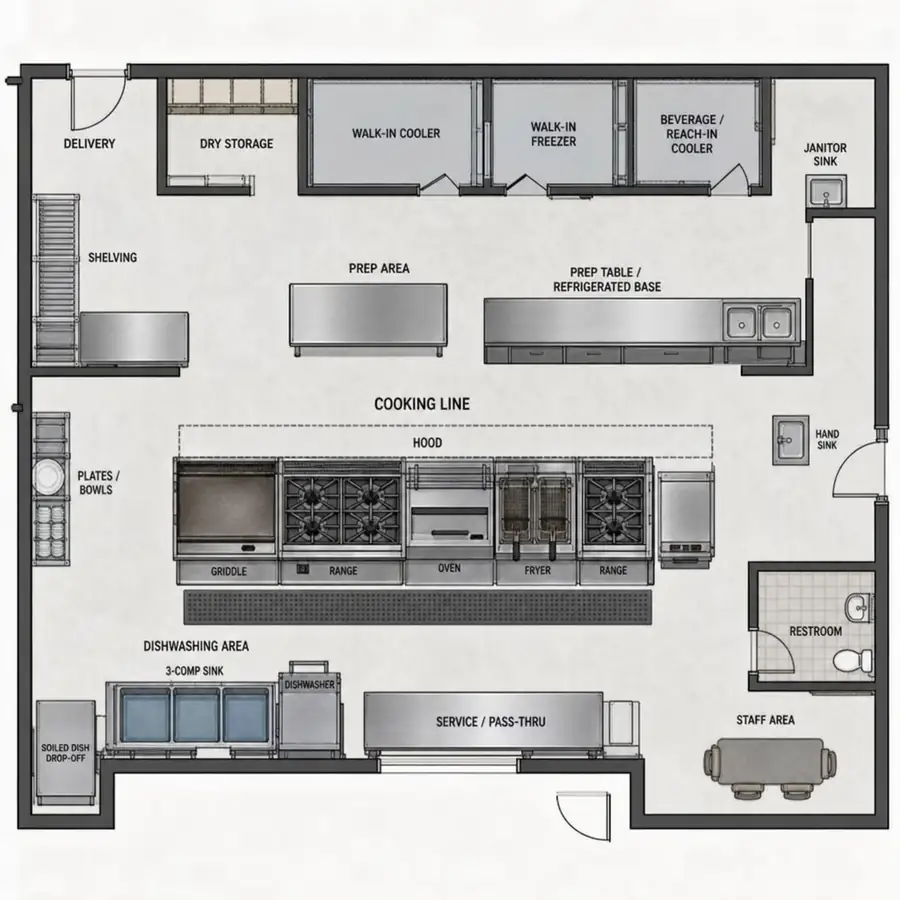
Restaurant kitchen equipment includes exhaust hoods, dishwashers, work tables, and cutting boards.
Restaurant kitchen equipment includes the commercial-grade appliances, fixtures, tools, and support systems used to receive, store, prepare, cook, hold, serve, wash, and safely manage food in a professional kitchen. It is different from domestic kitchen appliances because it must handle longer operating hours, heavier loads, faster recovery times, food-safety requirements, and repeated cleaning.
A complete restaurant equipment plan usually covers both heavy equipment and smaller recurring supplies. Heavy equipment includes ranges, ovens, refrigerators, exhaust hoods, dishwashers, prep counters, and stainless steel fabrication. Smallwares include knives, pans, ladles, trays, cutting boards, containers, thermometers, squeeze bottles, and service utensils. Both categories matter because a kitchen with expensive appliances but poor smallwares will still struggle during service.
Commercial equipment is also part of the restaurant's workflow. The right fryer capacity reduces wait time. The right refrigerator placement reduces staff movement. The right hood size protects air quality and code compliance. When equipment is selected only by price, the kitchen may save money upfront but lose speed, safety, and consistency later.
The main equipment categories that shape your budget
The average cost of kitchen equipment for restaurant projects is usually driven by a few major categories. Some kitchens spend more on cooking power, while others spend more on refrigeration, bakery machinery, or ventilation. Understanding these groups helps you decide where to invest and where a simpler option may be enough.
Cooking line equipment
Cooking line equipment often includes charbroilers, combi ovens, steamers, and holding cabinets.
The cooking line is often the heart of the kitchen. It may include gas ranges, stock pot burners, griddles, fryers, pasta boilers, charbroilers, ovens, steamers, tandoors, or combi ovens. The menu decides the configuration: a fast-food kitchen may need fryers and holding cabinets, while an Indian restaurant may need burners, tandoor, bulk cooking vessels, and strong exhaust.
The biggest cost drivers are size, material quality, burner output, automation, temperature control, energy type, brand, and warranty. Higher-capacity equipment can cost more, but undersized equipment creates delays, uneven cooking, and staff frustration. Choose equipment based on peak-hour demand, not only average daily sales.
Refrigeration and cold storage
Refrigeration and cold storage may include reach-in chillers, undercounter refrigerators, freezers, and blast chillers.
Refrigeration protects food safety, reduces spoilage, and supports faster prep. Common options include upright chillers, freezers, undercounter refrigerators, salad prep counters, blast chillers, display units, and walk-in cold rooms. A small café may only need a few reach-in units, while a hotel, bakery, or commissary may require dedicated cold rooms.
When reviewing kitchen appliance costs, refrigeration should be judged by capacity, insulation, compressor quality, temperature recovery, door type, service access, and local after-sales support. Cheaper refrigeration can become expensive if it fails during busy operations or cannot maintain safe temperatures in a hot kitchen.
Preparation equipment
Preparation equipment such as mixers, slicers, and food preparation equipment should match batch size.
Prep equipment saves labor and improves consistency. This category includes planetary mixers, spiral mixers, dough sheeters, vegetable cutters, meat mincers, slicers, wet grinders, juicers, blenders, peelers, and food processors. For many restaurants, prep machines reduce repetitive manual work and help standardize portion sizes.
The right choice depends on batch size and usage frequency. A bakery that mixes dough all day needs a stronger mixer than a café making occasional batters. A QSR with high vegetable prep may benefit from a commercial cutter, while a low-volume bistro may manage with simpler tools.
Fabrication, storage, and work surfaces
Fabrication costs include stainless steel tables, prep counters, and walk-in cold rooms.
Stainless steel tables, sinks, racks, shelves, dish landing tables, trolleys, wall shelves, and storage bins are easy to underestimate. These items shape hygiene, movement, and durability. Good fabrication also helps maintain clear separation between raw food, cooked food, washing, and plating.
Costs depend on steel grade, thickness, customization, dimensions, welding quality, load capacity, and site conditions. Custom counters can fit awkward spaces better than standard units, but they require accurate measurements before ordering.
Warewashing and sanitation
Warewashing budgets should include dishwashers and three-compartment sinks, not only the machine price.
Dishwashing is not glamorous, but it affects labor, water use, hygiene, and service speed. A small restaurant may use three-compartment sinks and manual washing. A busy restaurant, banquet kitchen, or hotel may need an undercounter dishwasher, hood-type dishwasher, rack conveyor, pre-rinse station, and dedicated drying area.
Budget for more than the dishwasher alone. You may need water softening, drainage, electrical connection, detergents, racks, landing tables, and regular service. If this area is poorly planned, clean plates become a bottleneck even when the cooking line is performing well.
Why ventilation and hood costs vary so much
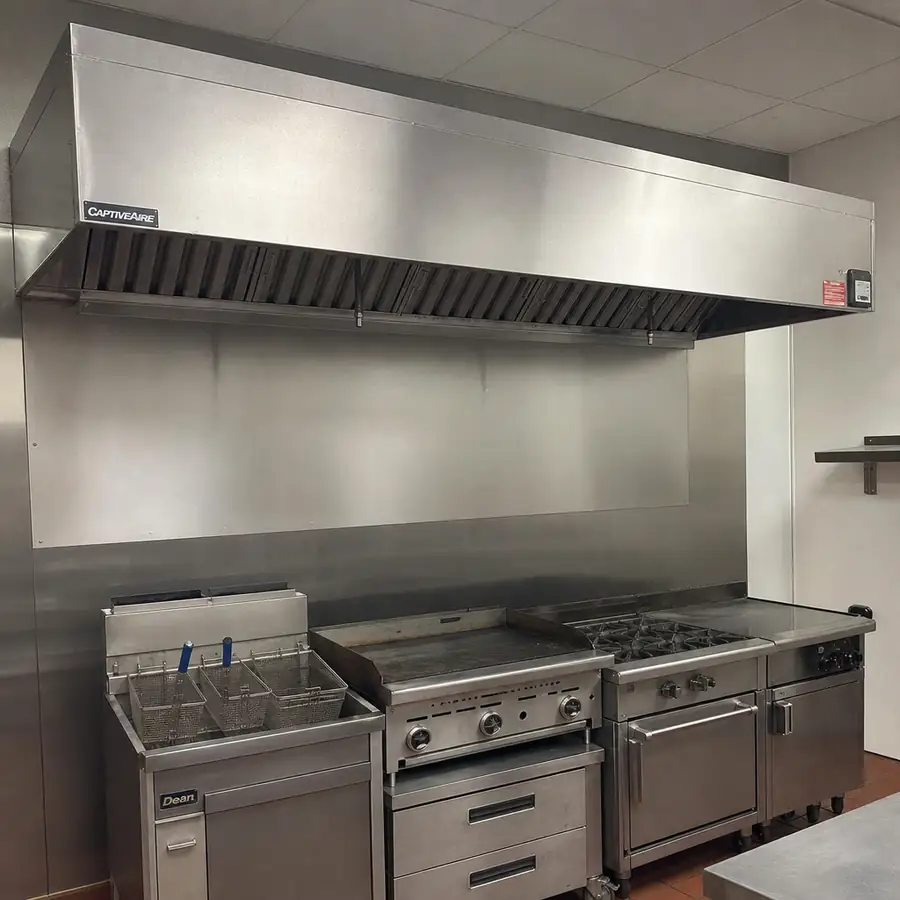
Hood cost depends on the cooking line under the exhaust hoods and the duct run to the roof.
Ventilation is one of the most variable parts of a restaurant kitchen budget because it depends on equipment heat load, smoke, grease, duct route, building rules, fire safety, and installation complexity. The phrase "12ft commercial kitchen hood cost restaurant equipment" often appears in searches because operators want a quick price, but the hood length is only one part of the final expense.
A 12-foot hood may require filters, ducting, exhaust fans, fresh-air supply, control panels, fire suppression, roof or wall penetrations, and professional installation. The final quote can change if the duct path is long, the building has restrictions, the cooking line uses heavy grease equipment, or local authorities require specific fire systems. This is why two kitchens with the same hood length can receive very different quotes.
Before approving a hood, confirm:
- The cooking equipment placed below it.
- Hood dimensions, overhang, and mounting height.
- Exhaust airflow requirements.
- Duct route and discharge location.
- Make-up air or fresh-air plan.
- Fire suppression requirements.
- Cleaning access and filter type.
- Installer scope, permits, and commissioning.
Ventilation should not be treated as an optional upgrade. Poor exhaust creates heat, smoke, odor, grease buildup, staff discomfort, and possible compliance problems. A well-planned system protects people, equipment, walls, ceilings, and the customer experience.
New, refurbished, or used equipment
Buying new equipment usually offers the strongest warranty, latest specifications, better parts availability, and fewer unknowns. It also gives you more control over exact sizes and configurations. For mission-critical items such as refrigeration, cooking line equipment, dishwashers, and ventilation systems, new equipment may reduce the risk of early failure.
Refurbished equipment can be useful when it comes from a reliable source, has been inspected, and includes a clear service history or limited warranty. Used equipment can reduce upfront spending, but it may carry hidden repair costs, missing parts, poor efficiency, or limited support. It is generally safer for simple, non-motorized items such as shelves, some tables, and certain storage fixtures than for complex refrigeration or automated cooking equipment.
When comparing options, ask:
- Is the equipment commercial-grade or domestic-grade?
- Does the capacity match peak demand?
- Are spare parts available locally?
- Is installation included or separate?
- What warranty is provided?
- Has the unit been tested under load?
- Does it meet safety and code requirements?
- Will it fit through doors, lifts, and kitchen access points?
How to build a realistic restaurant equipment budget
A realistic budget can use restaurant equipment financing when refrigeration and the cook line are phased.
A strong budget starts with operations, not catalog browsing. Once restaurant operators determine their menu, equipment list, space dimensions, utility requirements, and budget, they can research commercial kitchen equipment and supplies through suppliers such as The Horeca Store. This sequence reduces costly mistakes because every item is tied to what the kitchen must actually produce.
Step 1: Define the menu and service model
List every item you plan to sell, then group the cooking methods: frying, baking, grilling, steaming, boiling, chilling, blending, holding, and plating. A short menu may need fewer specialized machines. A large menu may require more burners, refrigeration zones, prep equipment, and storage space.
Also define whether you serve dine-in, takeaway, delivery, catering, buffet, or all of these. Delivery kitchens often need strong packaging and holding systems. Buffet operations need hot holding and display equipment. Fine-dining kitchens need precision, plating space, and reliable refrigeration.
Step 2: Estimate production volume
Equipment should match peak-hour demand. If you expect lunch rushes, weekend surges, or banquet orders, calculate how many portions each station must produce within a short window. Capacity planning helps avoid buying small appliances that work during trials but fail during real service.
Step 3: Measure the kitchen and map workflow
Measure the kitchen before you lock a commercial kitchen layout around the hood and the walk-in cold rooms.
Take accurate measurements of walls, doorways, ceiling height, drains, columns, gas points, electrical points, and ventilation paths. A powerful appliance is useless if it blocks movement or cannot be installed safely. Plan the flow from receiving to storage, prep, cooking, plating, washing, and waste disposal.
Step 4: Check utilities before purchasing
Many equipment problems happen because the site does not support the appliance. Confirm gas pressure, electrical load, voltage, phase requirement, water pressure, drainage, ventilation route, and floor load. Utility upgrades can affect the final budget as much as the equipment itself.
Step 5: Separate must-have items from later upgrades
For a controlled opening budget, divide the list into essentials, near-term additions, and future upgrades. Essentials are items needed to open safely and serve the core menu. Future upgrades may include extra automation, larger mixers, premium display cases, or specialized cooking equipment once demand is proven.
Equipment choices by restaurant type
Equipment choices by restaurant type should follow an essential restaurant kitchen equipment list, not a generic catalog.
Different businesses should spend differently. A compact café may prioritize espresso equipment, undercounter refrigeration, display chillers, a small oven, prep counters, and warewashing. A QSR or fast-food outlet may need fryers, griddles, heated holding, freezers, prep lines, and high-speed service equipment.
An Indian restaurant often requires strong burners, tandoor or curry cooking equipment, wet grinders or mixers, bulk storage, and robust ventilation. A bakery needs mixers, ovens, proofers, cooling racks, dough sheeters, refrigeration, and display cases. A cloud kitchen should prioritize space efficiency, delivery flow, packaging storage, and equipment that supports multiple menus without crowding the line.
For the cost of restaurant kitchen equipment in India, location, import duties, steel prices, brand availability, installation standards, and service access can all influence the final quote. The practical approach is to compare complete project costs rather than only appliance sticker prices. Suppliers such as The Horeca Store can be part of that research stage when operators are ready to compare specifications, categories, and supply options.
Features and specifications that affect price
Kitchen equipment prices are not random. They usually reflect capacity, material, engineering, controls, compliance, durability, and after-sales support. Understanding these features helps you compare quotes fairly.
Look closely at:
- Capacity: Bigger is not always better; the right size handles peak demand without wasting energy or space.
- Material quality: Stainless steel grade, thickness, insulation, and fabrication quality affect hygiene and lifespan.
- Energy type: Gas, electric, induction, steam, and hybrid systems have different installation and running requirements.
- Controls: Digital controls, timers, programmable settings, and sensors can improve consistency but may raise upfront cost.
- Cleaning design: Removable parts, smooth surfaces, drain points, and access panels reduce labor and downtime.
- Serviceability: Equipment should have accessible components, available spares, and technicians who can support it.
- Compliance: Ventilation, fire, electrical, gas, and food-safety requirements can affect both product selection and installation.
Brands and models should be compared by specification sheet, warranty terms, service network, and suitability for your menu. A known brand is helpful only if the model fits the job and can be maintained locally.
Hidden costs many operators miss
The average cost of restaurant kitchen equipment often looks lower when installation and support are excluded. A more accurate budget should include the items that turn delivered boxes into a working kitchen.
Common hidden costs include:
- Freight, unloading, and movement into the site.
- Installation labor and commissioning.
- Gas pipelines, regulators, and safety valves.
- Electrical panels, wiring, sockets, and load upgrades.
- Plumbing, drainage, water filters, and softeners.
- Hood ducting, exhaust fans, and fire suppression.
- Stainless steel customization and wall cladding.
- Staff training and operating manuals.
- Preventive maintenance and spare parts.
- Backup smallwares for breakage and peak service.
These costs are not always visible in a product listing, but they determine whether the kitchen opens smoothly. Always ask suppliers what is included, what is excluded, and what must be handled by contractors.
Buying decision guidance
Buying decisions should confirm how to set up a commercial kitchen before the purchase order is sent.
The best equipment choice is the one that supports your menu, volume, space, staff skill level, and budget with the least operational friction. Do not buy only because an item is popular, discounted, or used by another restaurant. A premium combi oven may be excellent for one kitchen and unnecessary for another.
Use this decision checklist before placing orders:
- Confirm the final menu and production volume.
- Map the kitchen layout and equipment footprint.
- Verify gas, electrical, water, drainage, and ventilation requirements.
- Compare at least a few suitable models or product categories.
- Ask for warranty, installation, and service details in writing.
- Include freight, fabrication, utilities, and compliance costs.
- Prioritize critical equipment over nice-to-have upgrades.
- Keep a reserve for repairs, extra smallwares, and opening adjustments.
Once you have determined the menu, equipment list, space dimensions, utility requirements, and budget, you can research commercial kitchen equipment and supplies through suppliers such as The Horeca Store and compare options with a clearer brief.
Installation, maintenance, and service support
Installation and service support protect refrigeration, exhaust hoods, and dishwashers after delivery.
Restaurant equipment is not finished when it is purchased. Correct installation, operator training, cleaning schedules, and preventive maintenance protect the investment. Poor installation can reduce performance, void warranties, or create safety risks.
Create a maintenance calendar for refrigeration coils, burner cleaning, fryer oil filtration, hood filter washing, dishwasher descaling, gasket checks, and calibration where needed. Keep manuals, invoices, warranty cards, and service contacts in one place. Train staff on correct startup, shutdown, cleaning, and basic troubleshooting so small issues do not become expensive breakdowns.
A smart restaurant equipment budget is not just a shopping list. It is an operating plan that connects the menu, space, utilities, people, compliance, and long-term service needs. When those details are clear, equipment buying becomes less risky, more accurate, and far easier to manage.