
Pizza food truck equipment starts with three connected systems: an oven that suits your pizza, refrigeration that protects your ingredients, and prep stations that keep orders moving. This guide explains how to choose those systems, organize a practical equipment list, and plan the supporting utilities. Start with your menu and service model-not an appliance shopping cart. The Horeca Store stocks the ovens, cold holding, and prep pieces this list covers.
What equipment does a pizza food truck need?
A pizza food truck needs an appropriate commercial oven, cold storage, a pizza assembly surface, dough-handling tools, and serving supplies. The supporting setup also needs provisions for handwashing, cleaning, water, power, and fire safety, with requirements confirmed by the authorities overseeing your operation. Think of these as one production system rather than separate purchases.
Before choosing models, write down your pizza diameter, dough process, topping selection, staffing plan, and expected ordering pattern. A truck selling made-to-order whole pies needs a different workflow from one selling reheated slices. Decide which tasks belong onboard and which you intend to complete in an approved commissary.
Use this initial pizza equipment list to organize your planning:
Treat this as a planning checklist, not a universal approval list. FDA's Food Code is a model used by jurisdictions to develop their rules; your local requirements determine the final specification.
Match the oven to your pizza and service rhythm
Compare pizza oven options by testing the product you intend to sell. Bring your dough, toppings, pans, and largest pizza size to a demonstration where possible. Ask to run consecutive orders rather than judging an oven from one successful bake.
Also separate oven design from fuel type. Deck and conveyor describe cooking configurations; gas and electric describe energy sources. Manufacturers offer both gas and electric equipment in these categories, so neither fuel choice automatically determines the baking format.
Deck ovens for hands-on baking
Commercial deck ovens provide a baking chamber with a deck surface; depending on the model and product, pizzas may bake directly on the deck or on screens and pans. Available configurations include different chamber sizes and independently controlled baking chambers. Check the specific oven's instructions rather than assuming every deck handles every pizza equally well.
During testing, watch the complete loading routine. Can the baker reach the back without crossing another worker's station? Is there somewhere to set a peel without blocking the aisle? Include those working movements in the floor plan-not just the oven's exterior dimensions.
Conveyor ovens for a repeatable production path
Conveyor ovens move food through a heated chamber on a belt. Impingement models direct hot air toward the product, and models with adjustable conveyor speed let operators establish a repeatable baking process. The belt and overall equipment dimensions are distinct, making the full specification sheet important for layout planning.
Test your heaviest topping combination alongside your simplest pizza. Plan clear loading and unloading areas, then assign responsibility for removing finished pies. A repeatable bake is useful only when the rest of your line can keep pace.
Hearth and live-fire concepts need installation review
If a visible flame or wood-fired concept is central to your menu, make installation feasibility an early decision. Ask the manufacturer to confirm the intended commercial mobile application, then submit the proposed arrangement for local fire review. Resolve fuel storage, exhaust, clearances, and fire protection before building around the oven; NFPA specifically advises checking jurisdictional requirements for mobile cooking operations.
Do not treat an oven's small footprint as proof that it belongs inside a truck. Request documentation for the exact model and installation rather than relying on photographs of another operator's build.
How much refrigeration should you plan for?
Plan refrigeration around your largest intended service load, including topping pans, reserve ingredients, and dough that requires chilled storage under your process. Separate the stock needed at the assembly station from backup inventory, then test the proposed arrangement using actual containers. Capacity should be a physical storage plan, not just a cabinet-volume figure.
For foods requiring time and temperature control for safety, confirm the applicable cold-holding rules with your health department. For example, Massachusetts mobile food guidance requires cold-holding equipment to maintain these foods at 41°F or below. The guidance also requires refrigeration to be installed and used according to manufacturer instructions.
Combine service refrigeration with reserve storage
A refrigerated pizza prep table brings ingredient pans and an assembly surface together, with refrigerated storage underneath on many models. Manufacturer configurations can include doors or drawers, insulated lids, and different cabinet sizes. Compare the actual pan arrangement and usable workspace rather than choosing by width alone.
Before ordering, make a storage map:
- Service rail: Assign a pan position to each topping and identify which items need the most replenishment.
- Reserve cabinet: Check that your lidded containers fit without awkward stacking or constant rearrangement.
- Dough storage: Measure the boxes you actually use, including the space needed to remove them.
- Overflow plan: Decide how you will handle extra event stock without improvising during service.
Ask the supplier to confirm ambient operating limits, ventilation clearances, compatible pans, and maintenance access. Keep the written installation requirements with your build documents. Mobile food guidance explicitly calls for following the refrigeration manufacturer's installation and use instructions.
Make temperature checks part of opening
Include refrigerator thermometers and an appropriate food thermometer in your food truck essentials. Air-temperature readings and food-temperature measurements serve different purposes; FDA's Food Code addresses both equipment temperature indicators and food temperature-measuring devices. Build checks into receiving, opening, and service procedures rather than relying on how cold a cabinet feels.
Have the health department review your response plan for refrigeration failure. Specify who checks the equipment, who makes food-disposition decisions, and when service must stop. A written plan is easier to follow than a discussion during a breakdown.
Build prep stations around the order journey
Sketch a truck kitchen setup that follows the pizza from dough handling through stretching, topping, baking, cutting, and pickup. Position equipment to support that sequence, then walk through it with your intended crew. Pay particular attention to moments when someone carries a hot pizza while another person opens a refrigerator.
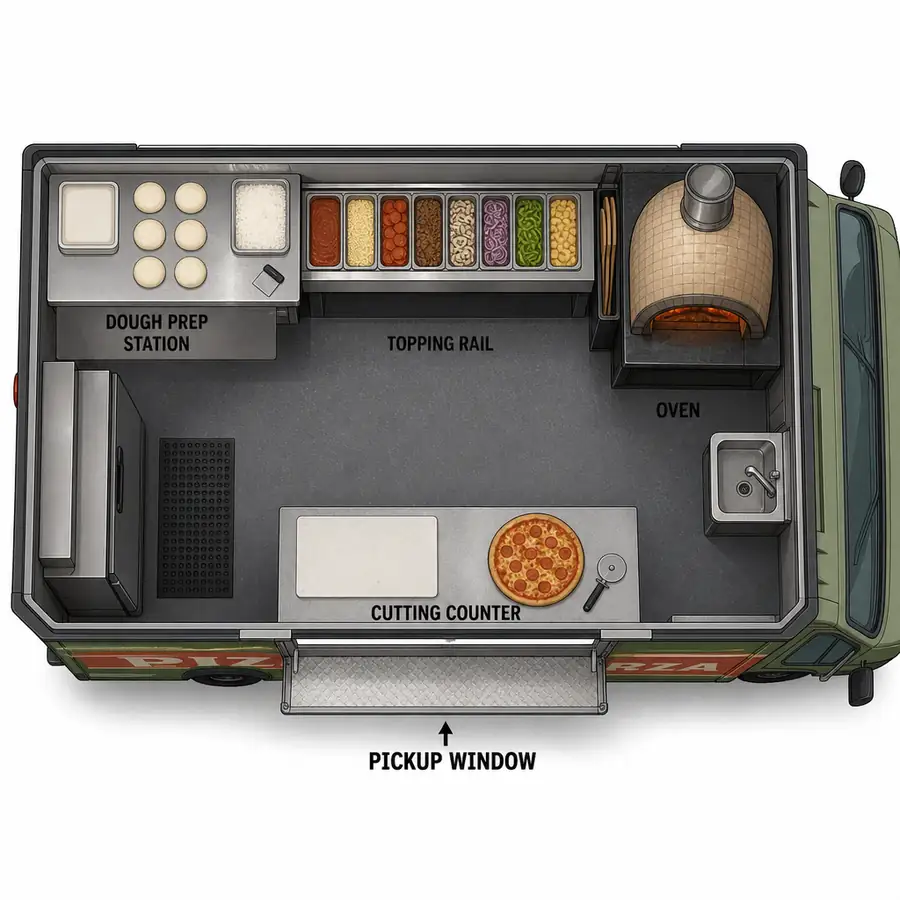
Mark the full sweep of refrigerator doors and the working space needed for oven tools. Place a mock pizza box on the cutting counter and check whether there is still room for the next order. Include trash, cleaning tools, and packaging storage in the mock-up so they do not become afterthoughts.
A pizza prep refrigerator can centralize cold ingredients and assembly, but it does not remove the need to assess workspace. Manufacturers distinguish pizza prep equipment by features such as deep cutting boards and configurable ingredient storage. Test whether the particular arrangement supports your stretching and topping method.
For a practical rehearsal, assign each worker a role and simulate several mixed orders. Note every reach across another person, search for a utensil, and interruption to retrieve stock. Adjust the layout before committing to permanent installation.
Decide where dough production belongs
Before adding a mixer to your food truck pizza equipment, decide whether onboard dough production is necessary. Ask your health department which preparation and storage activities your approved truck and commissary arrangement may support. Mobile food requirements address activities beyond service, including preparation, storage, cleaning, and water provision.
Compare two proposed routines on paper: transporting portioned dough versus mixing and dividing onboard. For each, list the containers, work surface, cleaning tasks, power needs, and storage positions involved. Select the routine your approved facilities and staffing can realistically support.
If you plan to mix onboard, ask the mixer manufacturer to evaluate your actual dough recipe and batch size. Do not select solely by bowl volume. Request a demonstration and document how the mixer will be installed, loaded, emptied, and cleaned within your proposed space.
Plan utilities and safety before finalizing purchases
Send the proposed menu, equipment specifications, floor plan, and utility arrangement to the relevant reviewers before fabrication. Health and fire requirements address different parts of the operation, so one conversation should not substitute for the other. FDA identifies state and local oversight as central to retail food regulation, while NFPA directs mobile operators to their local jurisdiction for specific fire requirements.
For electrical planning, give a qualified professional the specifications for every appliance, including refrigeration, water heating, lighting, and ordering equipment. Ask for a documented supply and distribution plan rather than choosing a generator from the oven rating alone. NFPA's mobile cooking guidance calls for compliant electrical equipment and wiring.
For fuel and fire protection, confirm the applicable exhaust, suppression, extinguisher, shutoff, and inspection requirements. NFPA guidance includes propane-system checks, accessible shutoffs, and operator emergency training. Have qualified professionals design and install these systems; do not use a generic equipment article as installation instructions.
Protect the sanitation space in your layout, too. Massachusetts guidance, for example, requires a handwashing sink for mobile operations handling and preparing food and addresses water supply and wastewater disposal. Ask your own health department to confirm handwashing, warewashing, tank, and water-heater requirements for your menu.
Buy smallwares for the complete service cycle
Your food truck supplies should cover preparation, baking, service, and cleanup-not simply opening inventory. Pizza equipment checklists commonly include dough boxes, scales, peels, pans, cutters, ladles, and takeout packaging. Match those categories to your actual production method before choosing quantities.
Use a final purchasing checklist:
- Production tools: Select peels and pans that fit the oven and your largest pizza; assign each a storage position.
- Portioning tools: Choose scales, ladles, and topping utensils around your recipes and planned portions.
- Service supplies: Test box fit and arrange cutters, labels, napkins, and order tickets at the finishing station.
- Cleaning supplies: Specify approved chemicals, compatible test supplies, brushes, and protected storage with your reviewer.
- Replacement items: Identify essential spare utensils and confirm availability of model-specific service parts.
Before buying used equipment, request its model information, manuals, service history, and a working demonstration. Have the proposed installation reviewed before paying for modifications or transport. Leave room in the budget for installation, testing, and unresolved approval items rather than allocating everything to appliances.
Choose a coordinated kitchen, not isolated appliances
Start with the pizza, map the service routine, and choose equipment that supports both. Validate oven performance, physically plan cold storage, rehearse the prep line, and resolve utilities before purchasing. The strongest equipment list is the one your crew can use comfortably-and your reviewers can assess without guesswork.