
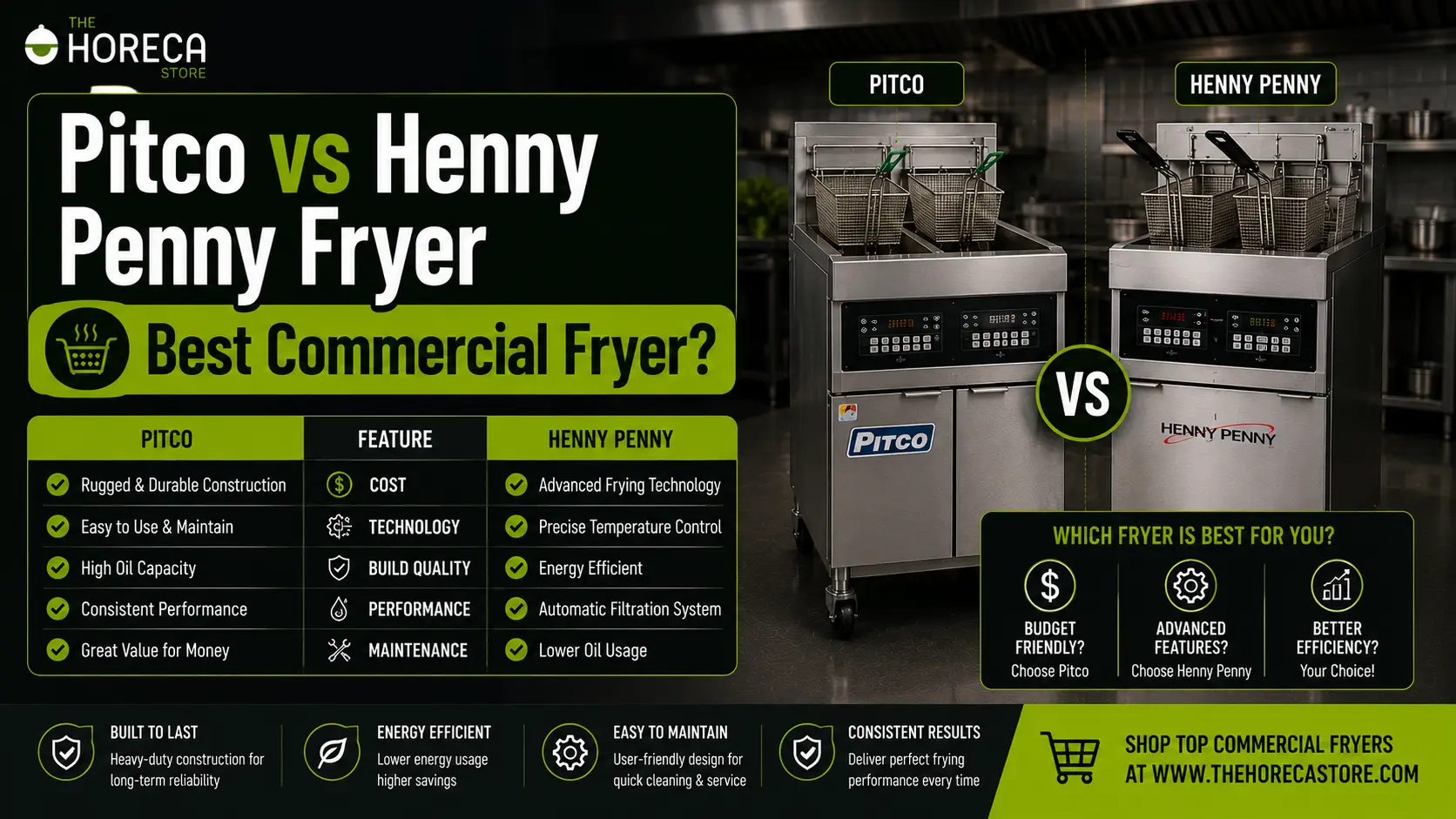
Choosing between Pitco fryers and Henny Penny fryers is less about finding a single “best fryer” and more about matching the fryer to your menu, volume, oil program, labor model, and kitchen footprint. Both brands are established names in commercial fryers, but they shine in different situations.
If your kitchen is built around fried chicken, bone-in proteins, or a signature pressure-fried product, Henny Penny is often the stronger fit. Its pressure fryer lineup is designed for high-volume chicken programs, with built-in filtration standard on every Henny Penny pressure fryer and a rectangular fry pot design intended to improve product movement and cooking consistency. Henny Penny’s PFE 500, PFG 600, and PFE 561 pressure fryer family is especially relevant for operators comparing a henny penny pressure fryer, henny penny electric pressure fryer, or pressure fryer henny penny option for chicken-focused concepts.
If your menu is broader, especially fries, wings, appetizers, frozen items, seafood, or all-purpose deep frying, a Pitco commercial fryer may be the more flexible choice. Pitco’s Solstice electric fryers offer multiple controller options, mix-and-match cabinets, fixed element design, optional automatic filtration, automatic oil top-off, and split tank configurations on select models. Pitco’s Solstice Supreme gas fryers add self-cleaning burners, matchless ignition, universal controls, and front-serviceable design, making Pitco a strong contender for operators comparing a pitco deep fryer, pitco electric fryer, or pitco gas deep fryer.
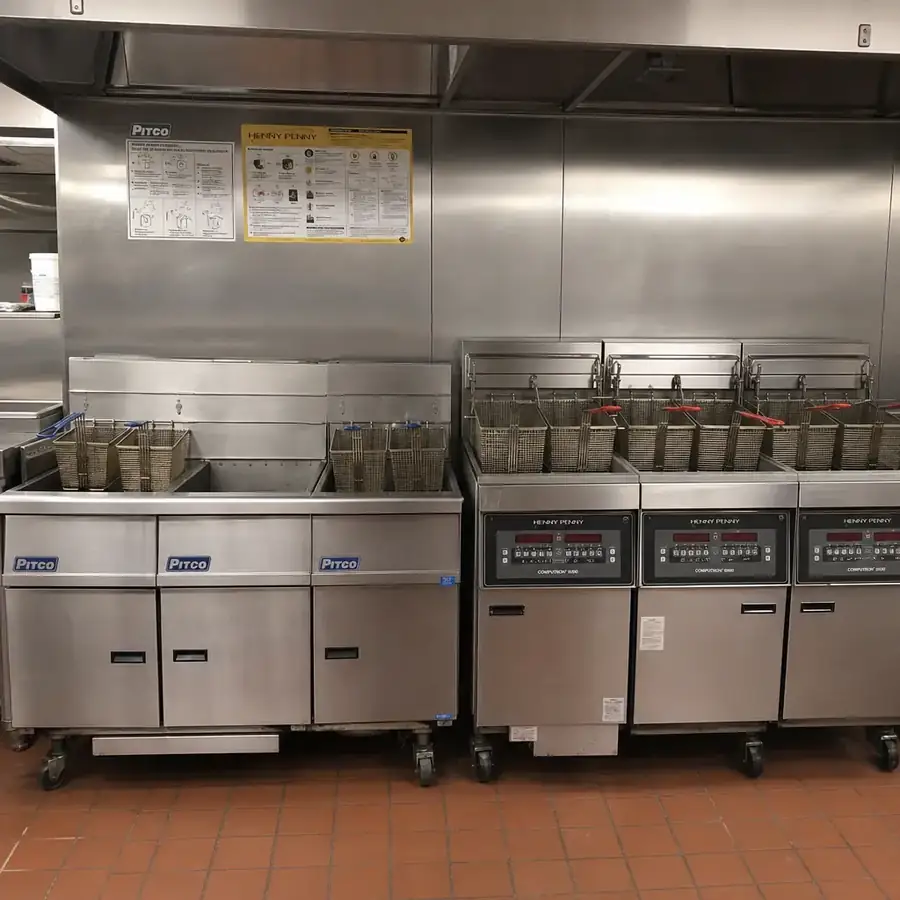
Quick Verdict
Choose Henny Penny if your priority is:
- Pressure-fried chicken or bone-in proteins
- Sealing in moisture and flavor under pressure
- A dedicated chicken program with repeatable cook cycles
- Built-in filtration as a standard part of the pressure fryer package
- A premium henny penny deep fryer or henny penny pressure fryers setup for high-volume poultry
Choose Pitco if your priority is:
- Open frying versatility across fries, appetizers, wings, seafood, and snacks
- Gas or electric fryer banks with mix-and-match configurations
- High-output open frying with strong recovery and flexible controls
- A broader selection of pitco commercial fryer models for different capacities
- A practical, operator-friendly fryer line for general restaurant use
For many restaurants, the best answer is not “Pitco vs. Henny Penny” but Pitco for open frying and Henny Penny for pressure frying. A chicken restaurant, for example, may use a Henny Penny pressure fryer for bone-in chicken and a Pitco open fryer for fries, sides, and secondary fried menu items.
What Makes These Brands Different?
Pitco and Henny Penny both manufacture commercial deep fryers, but they approach fryer performance from different angles.
Pitco is heavily associated with open fryers, high-efficiency gas models, electric fryers, reduced oil volume options, and modular fryer banks. Its lineup is especially attractive for kitchens that need flexible production across many fried items. A pitco commercial fryer is often selected for fries, wings, tenders, appetizers, and general-purpose deep fryers where speed, recovery, service access, and oil management matter.
Henny Penny, on the other hand, is strongly associated with chicken programs, pressure frying, and premium oil management. The brand also offers open fryers, including Evolution Elite models that use 40 percent less oil than standard 50 lb fryers and include Smart Touch Filtration, automatic top-off, programmable controls, and ENERGY STAR-rated performance.
The core difference is simple:
- Pitco is usually the stronger all-purpose open fryer choice.
- Henny Penny is usually the stronger pressure fryer and chicken-focused choice.
That distinction matters because pressure frying and open frying produce different results. Pressure frying is designed to seal in moisture and flavor while cooking at lower temperatures and shorter times, especially for freshly breaded, bone-in proteins. Henny Penny describes pressure frying as a good fit for high-volume cooking and products like chicken because it seals in moisture while keeping excess oil out.
Open frying is better when you want crispier texture, visibility, menu flexibility, and compatibility with freezer-to-fryer items or foods that float.
Pitco Commercial Fryer Overview
Pitco fryers are built around variety. The brand offers gas fryers, electric fryers, Solstice models, Solstice Supreme gas fryers, reduced oil volume units, economy fryers, flat bottom fryers, countertop fryers, and specialty units. For a restaurant operator comparing commercial fryers, that range gives Pitco a clear advantage when the menu includes many fried items rather than one hero product.
The Solstice electric line includes multiple controller options, mix-and-match cabinets, mercury-free relays, safe fixed element design, and optional oil management upgrades such as automatic filtration and automatic oil top-off. The SE14 is positioned as the base model in the Solstice Electric series, while models such as the SE14R and SE18R add higher-output 22 kW configurations. Split tank versions are also available for kitchens that need to cook separate items or run only one side during slower periods.
For gas kitchens, Pitco’s Solstice Supreme line is especially relevant. These fryers include automatic self-cleaning burners, matchless ignition, universal control harnesses, mix-and-match cabinets, and front-serviceable construction. Pitco also states that Solstice Supreme technology reaches up to 70 percent thermal efficiency and uses an atmospheric burner system without complex power blowers.
That makes Pitco appealing for operators who care about:
- Flexible fryer bank layouts
- Gas or electric fuel options
- High-production open frying
- Split vat or full vat choices
- Service access from the front
- Filtration and oil handling upgrades
- Strong value across multiple fryer categories
Henny Penny Fryer Overview
Henny Penny is best known in many foodservice circles for pressure frying and chicken-focused systems. Operators searching for a henny penny pressure fryer, henny penny pressure fryer 600, deep fryer henny penny, or henny penny electric pressure fryer are often looking for a fryer that can produce juicy, consistent fried chicken with a repeatable process.
The Henny Penny PFE 500, PFG 600, and PFE 561 pressure fryer family includes features such as a locking lid and seal, faster pressure cooking, pressure assist for smaller batches in applicable regions, programmable Computron controls, energy-efficient heating, and built-in filtration. Henny Penny lists the PFE 500 as electric, the PFG 600 as gas, and the PFE 561 as electric, so operators should verify fuel type when comparing specific models.
This point is important: if you are searching for “henny penny pressure fryer 600,” you are likely looking at the PFG 600 gas pressure fryer, not a henny penny electric pressure fryer. If you need electric, look closely at PFE models such as the PFE 500 or PFE 561 instead.
Henny Penny also offers open fryers, and those should not be overlooked. The Evolution Elite line is designed for reduced oil use, easier operation, and consistent food quality. It uses 40 percent less oil than standard 50 lb fryers, includes Smart Touch Filtration that filters at the touch of a button, supports automatic oil top-off, and stores up to 40 cook programs through iControl.
Henny Penny is especially attractive for:
- Fried chicken restaurants
- Grocery deli chicken programs
- Convenience stores with premium chicken menus
- High-volume kitchens that need repeatable pressure frying
- Operators prioritizing built-in filtration and oil management
- Kitchens where product consistency matters more than lowest upfront cost
Fryer Performance: Open Frying vs. Pressure Frying
Fryer performance depends on more than BTUs or kilowatts. Recovery time, oil volume, vat shape, filtration frequency, controls, basket loading, menu type, and staff training all affect results.
In an open fryer, food is submerged in hot oil while moisture escapes freely. This is why open fryers are so common for fries, mozzarella sticks, onion rings, wings, shrimp, fish, and other items where crisp exterior texture is the goal. Open fryers also allow operators to see the product during cooking and adjust the process more easily.
In a pressure fryer, the lid seals and pressure builds during cooking. This changes how moisture leaves the product. For bone-in chicken and other proteins, pressure frying can help retain juiciness while cooking efficiently. Henny Penny’s pressure fryer page specifically emphasizes high-volume cooking, moisture and flavor retention, and reduced excess oil absorption.
That difference drives the Pitco vs. Henny Penny decision:
- For fries and frozen sides: Pitco open fryers are often the more natural fit.
- For bone-in chicken: Henny Penny pressure fryers are often the better choice.
- For chicken tenders: Either can work, depending on whether you want a juicier pressure-fried profile or a crispier open-fried profile.
- For wings: Pitco is often preferred for classic open-fried crispness, though final results depend on breading, sauce style, and hold time.
- For grocery deli chicken: Henny Penny pressure fryers are a strong match because consistency and batch production are critical.
- For broad menus: Pitco may offer more day-to-day flexibility.
Fryer Features That Matter Most
When reading fryer reviews or comparing fryer features, it is easy to focus only on brand reputation. A better approach is to compare the features that affect daily operation.
Oil Filtration
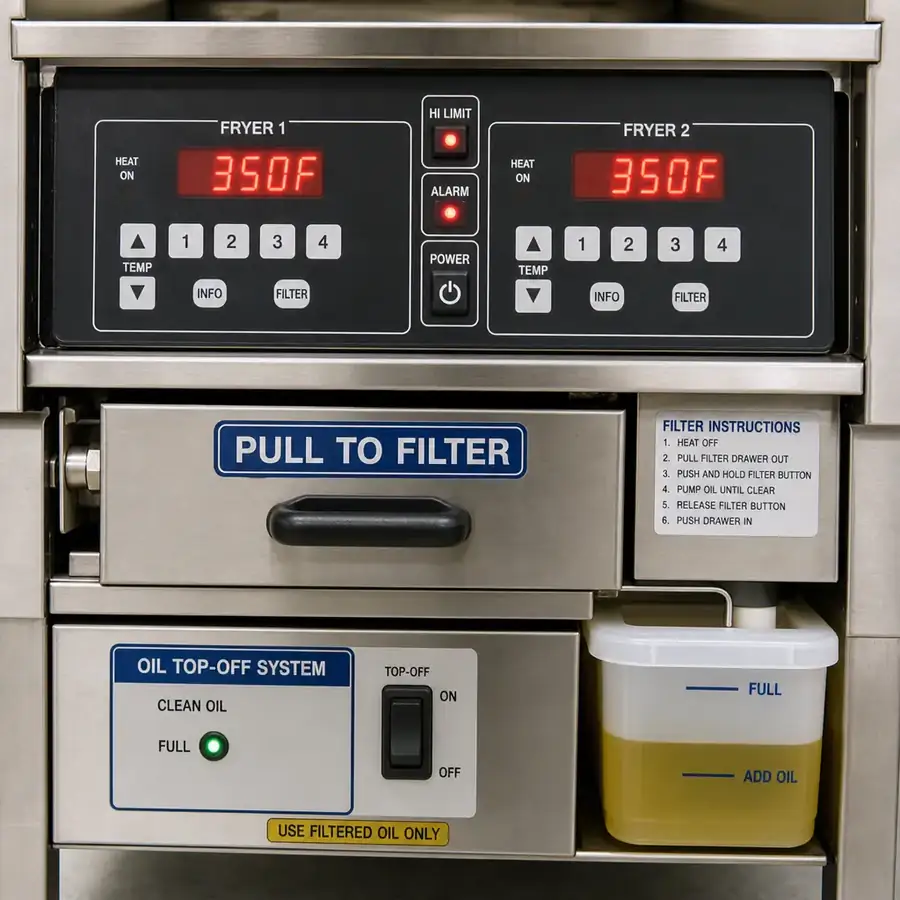
Oil filtration is one of the biggest differences between an average frying program and a profitable one. Cleaner oil improves food quality, helps control flavor transfer, and can reduce waste.
Henny Penny includes built-in oil filtration as standard on every pressure fryer, and its open fryer lineup also emphasizes built-in filtration across models.
Pitco offers built-in filtration across many fryer categories, including Flat Bottom, MegaFry, Solstice, Solstice Supreme, and ROV fryers. Pitco’s Solstice Filter System can support two or more fryers, while the Solstice SoloFilter can pair with a single gas or electric fryer.
The takeaway: Henny Penny makes filtration feel like a core part of the standard pressure fryer experience, while Pitco gives operators a wide range of filtration configurations across open fryer banks.
Oil Top-Off
Automatic oil top-off helps maintain the proper oil level, which supports consistency and reduces manual handling. Pitco lists automatic oil top-off and JIB management as upgrades for Solstice electric and Solstice Supreme systems.
Henny Penny Evolution Elite open fryers include automatic oil top-off from a JIB or onboard reservoir, and Henny Penny also highlights automatic top-off in its energy-saving fryer systems.
For high-volume kitchens, automatic top-off can be worth prioritizing regardless of brand.
Controls and Programming
Pitco’s Solstice Electric line offers multiple controller options and a universal control harness that can support choices such as Intellifry computer, digital control, or solid state control.
Henny Penny’s pressure fryer family offers simple or feature-rich computer control, while Evolution Elite open fryers use iControl with up to 40 cook programs and USB connectivity for data and updates.
If your staff changes frequently, controls matter. A more programmable fryer can help reduce training gaps, but simpler controls may be easier for smaller kitchens that do not need complex menu programming.
Serviceability
Pitco emphasizes front-serviceable designs in several lines, including Solstice electric fryers where components are accessible from the front and heating elements can be removed without back access.
Henny Penny emphasizes heavy-duty stainless steel vats, onboard filtration, and support resources such as manuals, parts lists, data sheets, and accessories for its pressure fryer family.
Your local service network should influence the final decision. Even the best fryers can become expensive if parts, warranty support, or qualified technicians are hard to access in your area.
Pros and Cons of Pitco Fryers
Pitco Pros
- Strong choice for all-purpose open frying
- Broad lineup of gas, electric, economy, Solstice, Solstice Supreme, and ROV models
- Good fit for fries, wings, appetizers, seafood, and mixed fried menus
- Flexible bank configurations and mix-and-match cabinets
- Split tank options available on select electric models
- Front-serviceable designs in key product lines
- Filtration and oil management options available across many fryer categories
- High-efficiency gas options available through Solstice Supreme models
Pitco Cons
- Not the first choice if your main product is pressure-fried chicken
- Filtration and automatic oil management may depend on the specific model or configuration
- The broad lineup can make model selection more complex
- Operators may need dealer guidance to choose the right vat size, burner output, controls, and filtration setup
Best Fit for Pitco
Pitco is best for restaurants that need dependable open frying across a wide menu. Burger concepts, bars, diners, seafood restaurants, food trucks with gas capacity, fast casual kitchens, and high-volume side-item programs can all benefit from the flexibility of a pitco commercial fryer.
If your search includes “pitco fryers,” “pitco deep fryer,” “pitco electric fryer,” or “pitco gas deep fryer,” focus less on brand alone and more on oil capacity, full vat versus split vat, filtration package, available utilities, and expected pounds of product per hour.
Pros and Cons of Henny Penny Fryers
Henny Penny Pros
- Excellent fit for pressure-fried chicken and bone-in proteins
- Built-in filtration standard on Henny Penny pressure fryers
- Strong oil management story across pressure and open fryer lines
- Pressure fryer models support consistent flavor, moisture retention, and high-volume cooking
- Evolution Elite open fryers offer reduced oil use, automatic top-off, Smart Touch Filtration, and programmable controls
- Premium reputation in chicken programs, grocery deli operations, and high-volume foodservice
Henny Penny Cons
- Pressure fryers are more specialized than open fryers
- Pressure frying requires specific procedures, safety training, and lid operation discipline
- May be more fryer than a simple bar, café, or low-volume kitchen needs
- Some operators may still need separate open fryers for fries, sides, and crispier items
- Exact model selection matters because Henny Penny pressure fryers include both gas and electric options
Best Fit for Henny Penny
Henny Penny is best for operators who want a premium frying system for chicken, especially if pressure frying is central to the concept. A henny penny pressure fryer is a natural fit for fried chicken restaurants, grocery deli programs, convenience stores, and high-volume kitchens that need repeatable batches.
If you are comparing henny penny fryers vs pitco for chicken, Henny Penny has the edge when pressure frying is required. If you are comparing them for fries and appetizers, Henny Penny’s open fryers are capable, but Pitco may offer a more flexible and cost-effective range depending on your needs.
Side-by-Side Buying Criteria
Menu Type
Pitco is usually the better fit for menus with many fried items. Think fries, tenders, cheese curds, pickles, wings, fish, shrimp, hush puppies, and rotating specials.
Henny Penny is usually the better fit when fried chicken is the centerpiece. Pressure fryers are designed for products where moisture retention and batch consistency matter.
Texture Goals
Choose Pitco if you want a crisp, classic open-fried finish.
Choose Henny Penny pressure fryers if you want juicy, pressure-fried chicken with consistent interior moisture.
Choose Henny Penny open fryers if you want premium oil management and automation in an open fryer format.
Volume
Both brands can support high-volume operations. Pitco’s Solstice Supreme gas fryers are built for high-production frying, and Henny Penny’s high-volume pressure fryer category includes 8-head pressure fryers with fry pots holding up to 24 lb of product per load.
Your true volume requirement should be calculated by menu mix, batch size, peak-hour orders, recovery time, and holding strategy.
Oil Cost
Both brands address oil cost, but in different ways.
Pitco offers filtration, reduced oil volume models, and automatic oil top-off options across many fryer systems. Henny Penny’s Evolution Elite open fryers use 40 percent less oil than standard 50 lb fryers, while Henny Penny pressure fryers include built-in filtration as standard.
If oil cost is a major concern, do not compare only purchase price. Compare oil capacity, filtration speed, filtration compliance, top-off automation, oil disposal workflow, and staff behavior.
Energy Efficiency
Pitco’s Solstice Supreme technology is promoted for high-efficiency gas frying and up to 70 percent thermal efficiency. Henny Penny Evolution Elite open fryers are ENERGY STAR rated, and ENERGY STAR listings show certified Henny Penny electric and gas fryer models with published efficiency data.
Utility rates, ventilation load, idle time, fryer sizing, and production patterns can all change the real-world operating cost.
Footprint
Henny Penny’s PFE 500, PFG 600, and PFE 561 pressure fryer page highlights a narrow footprint using less than 20 inches of wall space for its 4-head and 6-head pressure fryer family.
Pitco offers a wide range of sizes, vat types, and fryer bank configurations, which may make it easier to build a custom line for a mixed menu. If kitchen space is tight, compare not only fryer width but also lid clearance, filter pan access, service clearance, gas line placement, and basket workflow.
Which Fryer Is Best for Fried Chicken?
For bone-in fried chicken, Henny Penny is usually the better choice because pressure frying is specifically designed for that product style. The henny penny pressure fryer lineup is built to seal in juices, cook efficiently, and support repeated high-volume batches. The PFE 500, PFG 600, and PFE 561 family also includes onboard filtration, programmable controls, and a rectangular fry pot design that promotes turbulence.
That does not mean Pitco cannot fry chicken. A pitco commercial fryer can produce excellent open-fried chicken, wings, tenders, and breaded items. In fact, if your chicken concept focuses on extra-crispy tenders, wings, or boneless items, open frying may be exactly what you want.
The better question is: what chicken texture are you selling?
- For juicy, pressure-fried bone-in chicken, choose Henny Penny.
- For crispy wings, tenders, and open-fried chicken, consider Pitco.
- For a full chicken restaurant with sides, consider using both.
Which Fryer Is Best for Fries and Sides?
For fries, sides, appetizers, and freezer-to-fryer items, Pitco often has the edge because its open fryer lineup is broad, practical, and flexible. Split tank options can help separate products or reduce oil use during slower periods, while gas and electric models let operators match the fryer to available utilities.
Henny Penny open fryers are also strong, especially if you want advanced oil management and automation. The Evolution Elite line is a compelling choice for operators who want reduced oil volume, automatic top-off, Smart Touch Filtration, and programmable controls.
In short:
- Choose Pitco for flexible, workhorse open frying.
- Choose Henny Penny Evolution Elite for premium automated open frying.
- Choose Henny Penny pressure fryers for chicken, not fries as the main use case.
Total Cost of Ownership
The cheapest fryer is not always the least expensive fryer to own. Total cost includes purchase price, installation, utility work, hood requirements, oil usage, filtration labor, cleaning time, downtime, parts, warranty support, and staff training.
A lower-cost deep fryer may be attractive at purchase, but if staff skip filtration or oil breaks down quickly, food quality and oil spend can suffer. A premium fryer may cost more upfront but provide better controls, easier filtration, faster recovery, and more consistent output.
When comparing fryer reviews, ask these questions:
- How much oil does each vat require?
- How often will oil be filtered during a normal day?
- Is filtration built in, optional, automatic, or manual?
- Can staff filter safely during service?
- How quickly does the fryer recover after a full basket drop?
- Does the fryer match the menu’s peak-hour load?
- Are parts and service available locally?
- Does the fryer require gas, electric, or both?
- Will the fryer fit under the hood with proper clearance?
- Does the kitchen need pressure frying, open frying, or both?
Final Recommendation
For most general restaurants, Pitco is the better all-around commercial fryer brand because it offers a wider range of open fryer configurations for everyday frying. If you need a pitco commercial fryer for fries, wings, appetizers, seafood, or mixed menus, Pitco is a practical and flexible choice.
For chicken-focused operations, Henny Penny is the better pressure fryer choice. If your concept depends on juicy pressure-fried chicken, a henny penny pressure fryer, henny penny electric pressure fryer, or PFG 600 gas pressure fryer should be high on your shortlist.
The smartest buying decision may be a combination:
- Henny Penny pressure fryer for bone-in chicken
- Pitco open fryer for fries, sides, wings, and appetizers
- Henny Penny open fryer if premium oil automation is the top priority
- Pitco Solstice or Solstice Supreme if flexible open frying and serviceability are the top priorities
Pitco vs. Henny Penny Fryer: Which Commercial Fryer Is Best?
The Horeca Store choosing between Pitco and Henny Penny fryers depends on your restaurant’s cooking volume, menu requirements, and efficiency goals. Pitco fryers are known for their durability, reliable performance, and wide range of models suitable for restaurants, fast-food operations, and high-volume kitchens. Henny Penny fryers are recognized for advanced technology, energy efficiency, precise temperature control, and features that help improve cooking consistency while reducing oil usage. Comparing factors such as capacity, recovery time, maintenance, and operating costs can help you choose the right fryer.
Investing in the right commercial fryer helps improve food quality, speed up service, and maximize kitchen productivity. The Horeca Store offers a wide selection of commercial cooking equipment, including fryers, ovens, refrigeration solutions, and restaurant supplies designed for professional foodservice businesses. With quality products, competitive pricing, and dependable support, The Horeca Store helps restaurants and hospitality businesses find reliable equipment solutions for long-term success.