
Stepping into the world of restaurant ownership or commercial food service is an exhilarating journey. From conceptualizing the menu to designing the dining room, every decision shapes the future of your culinary enterprise. However, when it comes to outfitting your kitchen, the process can quickly become overwhelming. You are suddenly faced with an alphabet soup of acronyms on specification sheets and equipment labels.
If you have ever found yourself staring at a catalog, wondering about the complexities of NSF vs UL Certification: What It Means When Buying Commercial Kitchen Equipment, you are not alone. These small, circular stamps on the back of a commercial refrigerator or prep table carry massive implications for your business. They dictate everything from the safety of your staff and customers to whether or not you can legally open your doors after a health inspection.
In this comprehensive guide, we will break down exactly what these certifications mean, why they matter, and how to navigate the complex landscape of commercial kitchen safety.
The Foundation of Safety: Why Product Certification Matters
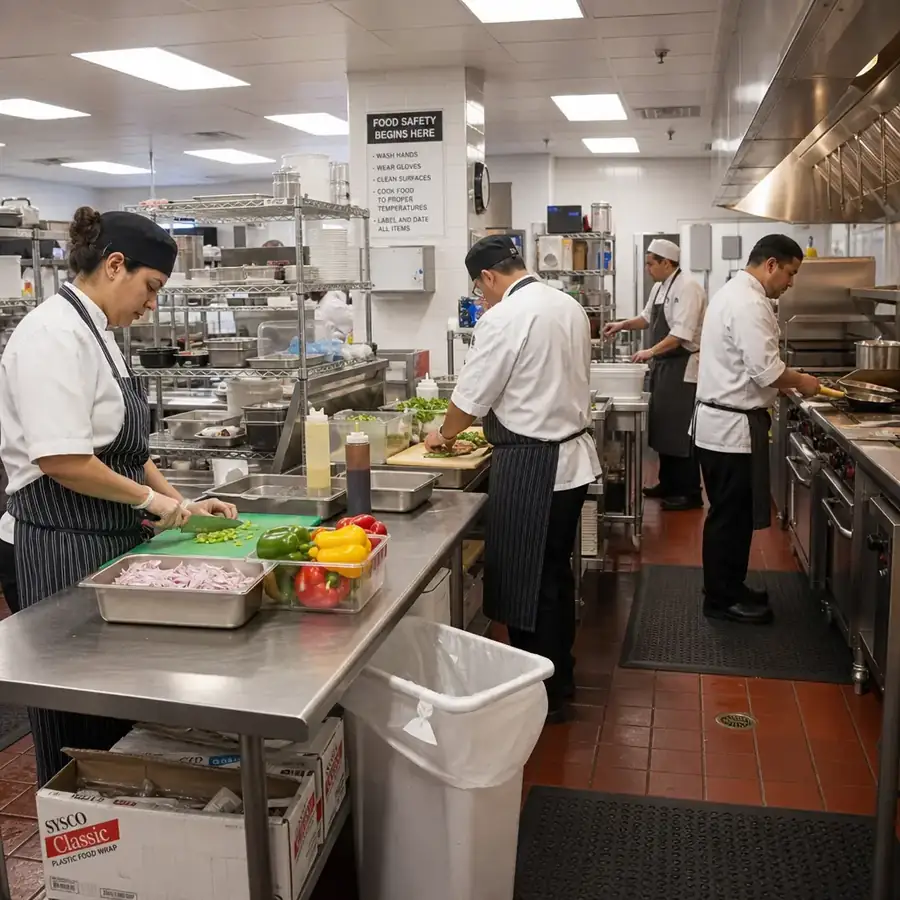
Before we dive into the specific differences, it is crucial to understand the broader role of product certification in the food service industry. Commercial kitchens are high-stress environments. They combine intense heat, sharp implements, high-voltage electricity, pressurized gases, and perishable organic matter in a confined space.
Without rigorous safety standards, a commercial kitchen is a recipe for disaster—be it foodborne illness outbreaks, electrical fires, or severe workplace injuries.
Independent testing organizations exist to mitigate these risks. They subject appliances, prep tables, and tools to extreme testing before they ever reach the market. When you buy certified equipment, you are not just buying a machine; you are buying peace of mind. You are ensuring that third-party experts have verified the equipment can handle the relentless demands of a professional kitchen without compromising safety.
What is NSF Certification?
When people talk about food safety in a restaurant, the conversation almost always starts with NSF. Originally founded in 1944 as the National Sanitation Foundation, NSF International is an independent, non-profit organization dedicated to public health and safety.
If a piece of equipment carries the NSF mark, it means it has been rigorously tested to ensure it complies with strict public health standards. But what exactly does that entail?
The Focus: Sanitation and Food Safety
NSF certification is primarily concerned with sanitation. It ensures that the equipment will not contaminate the food being prepared and that the equipment itself can be thoroughly and easily cleaned.
When evaluating equipment, NSF engineers apply stringent sanitation standards for food service equipment. They look for specific sanitary design principles for food equipment, which include:
- Smooth, easily cleanable surfaces: There can be no microscopic pits, crevices, or hard-to-reach corners where bacteria, grease, or food particles can hide and multiply.
- Material safety: The materials used cannot leach harmful chemicals, heavy metals, or toxins into the food.
- Non-porous surfaces for food safety: Wood and certain plastics absorb moisture and harbor bacteria. NSF-certified prep areas usually utilize high-grade stainless steel or specific food-grade polymers that are entirely non-porous.
- Welds and seams: All seams must be continuously welded and smoothly polished. Rivets or exposed threading in food zones are strictly prohibited because they are impossible to clean properly.
"NSF Approved" vs. NSF Certified
In the restaurant industry, you will often hear chefs and managers say a product is "nsf approved." However, strictly speaking, NSF does not "approve" products; they certify them. Certification means the product has met all the requirements of specific NSF standards (such as NSF/ANSI Standard 2 for food equipment or Standard 7 for commercial refrigerators).
What Does "NSF Component" Mean?
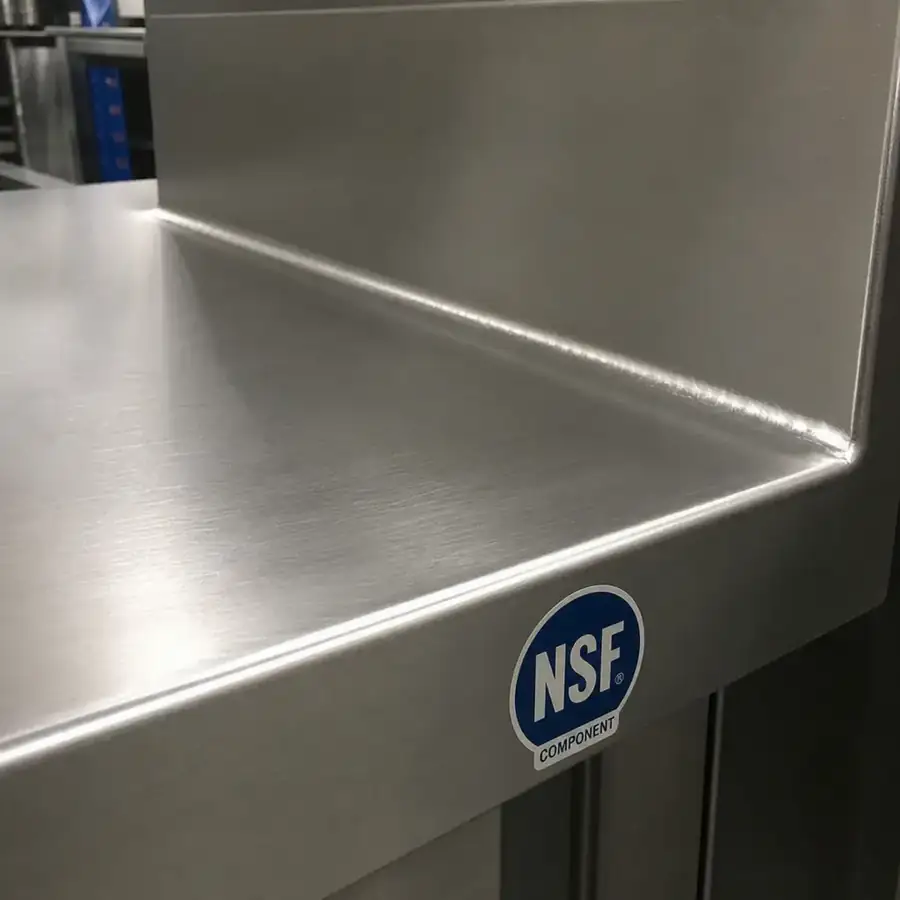
While shopping, you might see a label that says "NSF Component." What does nsf component mean, and is it the same as a fully certified machine?
An NSF Component mark indicates that a specific part of the equipment—such as a water valve, a specific type of tubing, or a thermostat—meets NSF standards, but the entire machine as a whole has not been evaluated. If you are outfitting a commercial kitchen, you generally want the entire unit to be NSF certified, not just a single component.
What is UL Certification?
While NSF protects your customers from microscopic pathogens, UL protects your staff and your building from immediate physical catastrophes. Underwriters Laboratories (UL) is a global safety certification company founded in 1894. Originally focused on fire safety in the early days of electricity, UL has grown to test millions of products across various industries.
The Focus: Fire, Electrical, and Physical Safety
UL certification focuses on the physical safety of the machine. When it comes to commercial kitchens, UL is looking for risks associated with electricity, heat, moving parts, and structural integrity.
The UL standards dictate strict electrical safety requirements for commercial kitchens. Commercial blenders, deep fryers, and industrial mixers draw massive amounts of power. A poorly wired appliance could easily overload a circuit, cause a severe shock to an employee, or spark a catastrophic fire.
Key elements of UL testing include:
- Electrical Shock Protection: Ensuring wiring is properly insulated and grounded, even in the wet, humid environment of a commercial kitchen.
- Fire Safety: Testing heating elements, gas lines, and thermal insulation to ensure they are reducing fire hazards in professional kitchens.
- Physical Injury Prevention: Ensuring guards are in place over moving parts (like mixer blades or meat slicers) and that the machine will not tip over or shatter under normal use.
How to Verify UL Listed Products
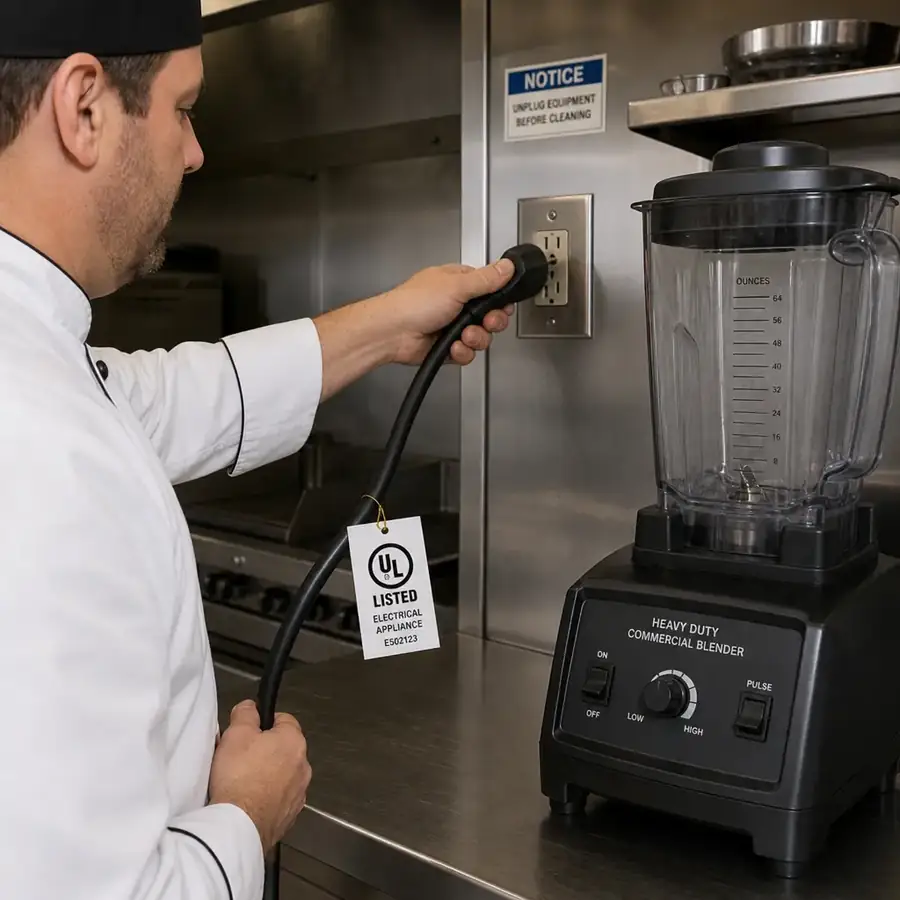
Because UL marks are highly coveted, counterfeit marks unfortunately exist in the global marketplace. Knowing how to verify ul listed products is a vital skill for any restaurant owner. You can use the free UL Product iQ database on their official website. By typing in the manufacturer's name or the control number found on the UL label, you can instantly confirm if the certification is genuine and current.
The Core Showdown: NSF vs UL Certification
To make informed purchasing decisions, you need a clear certification comparison. Let's break down nsf vs ul directly.
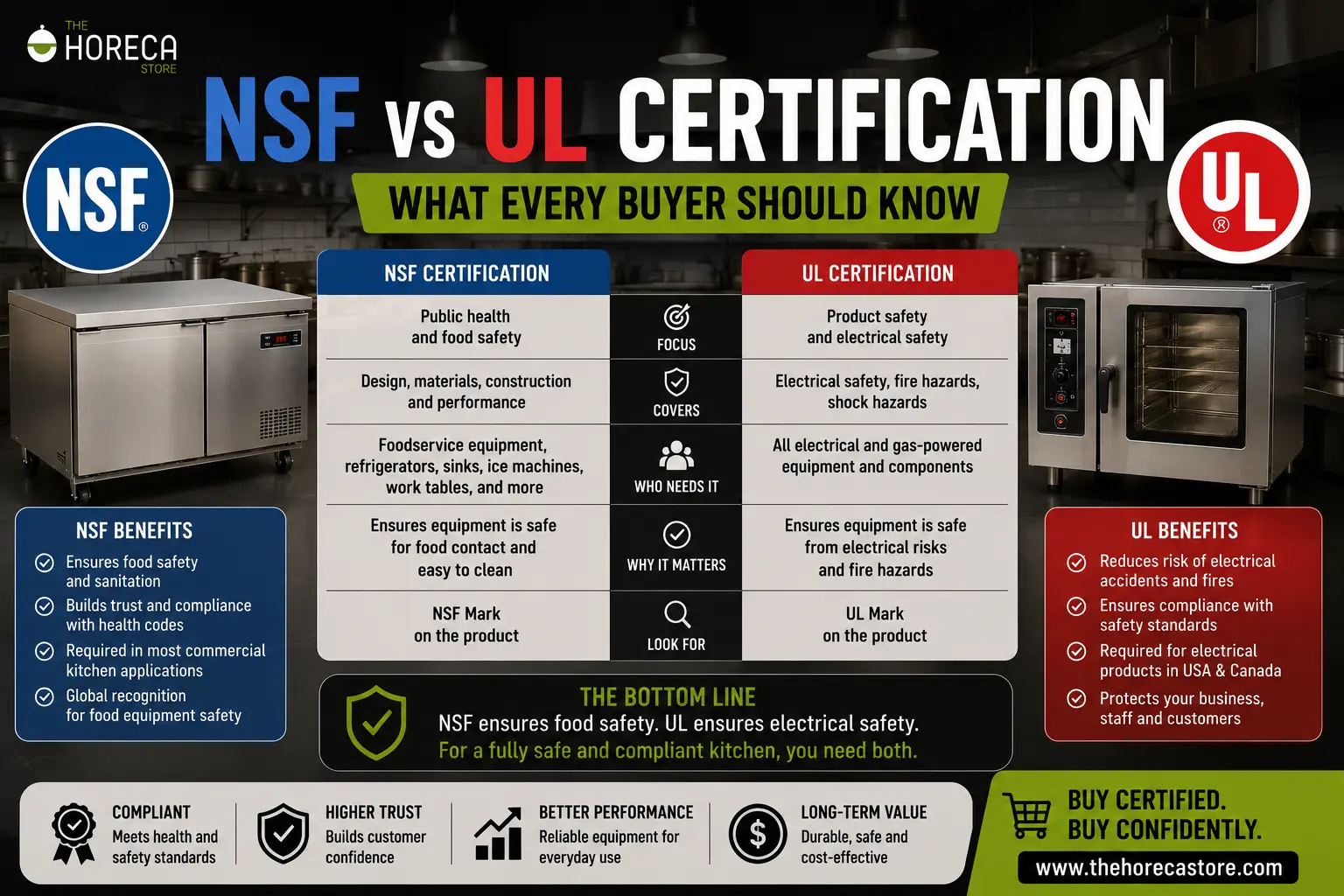
While both are third-party testing organizations dedicated to safety, their jurisdictions within your kitchen are entirely different. The easiest way to understand the difference between nsf and ul standards is this: NSF protects the food; UL protects the facility and the user.
UL Certification vs NSF: A Side-by-Side Look
| Feature | NSF Certification | UL Certification | | :--- | :--- | :--- | | Primary Focus | Public health, sanitation, and food safety. | Electrical, fire, and physical safety. | | What They Test | Material toxicity, cleanability, surface porosity, temperature retention (for food). | Wiring, grounding, flammability, structural integrity, pinch points. | | Who It Protects | The consumer (preventing foodborne illness). | The staff and the building (preventing shock, fire, and injury). | | Common Equipment | Prep tables, cutting boards, ice machines, food storage containers. | Ovens, fryers, heavy-duty mixers, refrigerators (compressor/wiring). | | Key Risk Mitigated | Salmonella, E. coli, cross-contamination. | Electrical fires, electrocution, mechanical amputations. |
When comparing ul certification vs nsf, it is not a matter of one being better than the other. They are complementary. In fact, most high-quality, motorized commercial kitchen equipment (like a commercial stand mixer or a walk-in refrigerator) should carry both certifications.
Beyond UL: The Role of NRTLs and the ETL Mark
As you start reading commercial kitchen spec sheets, you might notice that some electrical equipment doesn't have a UL mark, but rather an ETL mark. This often causes confusion among buyers.
To understand this, we need to introduce the concept of NRTL recognized testing laboratories. In the United States, the Occupational Safety and Health Administration (OSHA) recognizes several independent labs as Nationally Recognized Testing Laboratories (NRTLs). Both UL and Intertek (the company that issues the ETL mark) are NRTLs.
ETL vs UL for Commercial Appliances
When evaluating etl vs ul for commercial appliances, the truth is that they are functionally equivalent in the eyes of the law and safety inspectors. Both UL and Intertek test to the exact same published safety standards (which are often written by UL in the first place).
If an oven is ETL Listed, it means it has been tested by Intertek to meet the exact same rigorous safety standards as it would if it were tested by UL. Manufacturers often choose ETL because Intertek's testing process can sometimes be faster and more cost-effective, allowing them to bring products to market quicker. As a restaurant owner, you can buy either a UL or ETL-listed appliance with equal confidence regarding electrical and fire safety.
Note: UL also has a sanitation mark that competes directly with NSF. If you see a "UL EPH" (Environmental and Public Health) mark, it means UL has tested the product to NSF sanitation standards.
The Legal Landscape: Inspections and Compliance
Understanding these marks is helpful, but the reality of restaurant management brings up a critical question: Is nsf certification required by law?
The short answer is: Federally, no; locally, almost always yes.
There is no overarching federal law in the United States that states a restaurant must use NSF-certified equipment. However, the FDA Food Code strongly recommends it. More importantly, state, county, and city health departments adopt local codes based on these FDA guidelines.
Passing Health Department Kitchen Inspections
Local health inspectors are the ultimate authority on whether you can open your doors. When it comes to passing health department kitchen inspections, having certified equipment is your golden ticket.
Health inspectors are trained to look for the NSF mark (or equivalent). If they see an uncertified residential refrigerator or a non-certified prep table in your commercial kitchen, they can legally demand that you remove it. They do this because uncertified equipment poses an unquantifiable risk to public health. A residential fridge, for instance, is not designed to recover its internal temperature quickly enough when the door is opened fifty times an hour during a busy dinner rush, leading to dangerous food temperature danger zones.
Electrical and Fire Codes
Similarly, local fire marshals and building inspectors will mandate that all electrical and gas equipment meets certain safety standards to comply with the National Electrical Code (NEC) or local fire codes. If your heavy appliances are not UL or ETL listed, a fire inspector can shut down your operation. Furthermore, if an uncertified appliance causes a fire, your commercial property insurance provider will likely deny your claim, leaving you financially responsible for the disaster.
How to Choose Certified Restaurant Equipment
Now that you understand the theory, how do you put it into practice? Choosing certified restaurant equipment requires a strategic approach.
1. Master Reading Commercial Kitchen Spec Sheets
When buying equipment, don't just look at the glossy photos; dive into the specification sheets. Reading commercial kitchen spec sheets is a learned skill. Look at the bottom corners of the document. This is where manufacturers typically display their certification logos.
Ensure that the spec sheet explicitly states compliance with relevant standards. For a refrigerator, you want to see compliance with NSF/ANSI Standard 7. For an electrical appliance, look for UL 197 (Commercial Electric Cooking Appliances) or a similar designation.
2. Prioritize Durability and Rigorous Testing
Commercial kitchen equipment is an investment. While certified equipment costs more upfront than residential counterparts, it is subjected to intense commercial kitchen equipment durability testing.
During testing, NSF will subject doors, hinges, and handles to hundreds of thousands of open/close cycles to ensure they won't break down and create unsanitary crevices. UL will subject machines to deliberate electrical surges and tip-over tests. Buying certified means buying a product engineered for the brutal, non-stop environment of food service. It will save you thousands of dollars in replacement costs and downtime in the long run.
3. Be Wary of Used Equipment
Buying used equipment is a great way to save money, but it requires extreme caution. Certifications apply to the machine as it leaves the factory. If a previous owner modified a UL-listed oven—say, by splicing the wiring or bypassing a safety thermostat—that certification is void.
Similarly, if an NSF-certified stainless steel table has been deeply gouged, scratched, or improperly welded by a previous owner, it no longer features the non-porous surfaces for food safety that earned it the mark in the first place. A health inspector can penalize you for a damaged table, even if the NSF sticker is still attached.
Actionable Tips for Outfitting Your Commercial Kitchen
To ensure your kitchen is safe, legal, and built to last, follow these actionable tips:
- Audit Your Needs: Determine what equipment actually touches food (requires NSF) and what equipment draws significant power or uses gas (requires UL/ETL). Most heavy machinery will need both.
- Consult Your Health Inspector Early: Before making massive purchases, invite your local health inspector for a preliminary walkthrough or consultation. Ask them directly about their specific local requirements regarding NSF and UL marks.
- Budget Properly: Never budget for residential equipment. A home stand mixer might cost $300, while the NSF/UL-certified commercial equivalent costs $1,000. The commercial one is legally required, built to withstand daily continuous use, and won't invalidate your insurance. Plan your capital accordingly.
- Train Your Staff: Having safe equipment is only half the battle. Train your staff on the importance of maintaining that equipment. Abrasive cleaning pads can scratch NSF surfaces, rendering them non-compliant over time. Train staff to clean equipment using approved, non-abrasive chemicals to maintain the sanitary finish.
- Keep Your Manuals and Spec Sheets: Create a binder containing the spec sheets and certification proof for every piece of equipment in your kitchen. When the health or fire inspector arrives, handing them a neatly organized binder proves you take compliance seriously and speeds up the inspection process.
Shop Certified Commercial Kitchen Equipment at The Horeca Store
When investing in restaurant equipment, choosing products with appropriate sanitation and safety certifications can help support compliance, safe operation, and long-term reliability. The Horeca Store offers a wide range of commercial restaurant equipment for professional kitchens, including cooking equipment, refrigeration, food preparation equipment, and more. Browse The Horeca Store to find equipment suited to your restaurant's operational and compliance needs.
Conclusion
Outfitting a commercial kitchen is a monumental task, and the upfront costs can be intimidating. When you are looking at two seemingly identical refrigerators, and one costs twice as much simply because it carries the NSF and UL labels, it can be tempting to cut corners.
However, understanding NSF vs UL Certification: What It Means When Buying Commercial Kitchen Equipment transforms how you view these purchases. You are not just paying for a sticker; you are investing in the legal viability, safety, and longevity of your business.
NSF certification ensures your food remains safe, protecting your reputation and your customers' health. UL certification ensures your facility remains standing and your staff remains unharmed. By prioritizing certified equipment, learning how to read spec sheets, and keeping open lines of communication with your local inspectors, you lay a rock-solid, safe foundation for culinary success. Keep your kitchen compliant, keep your staff safe, and focus on what you do best: creating incredible food.