
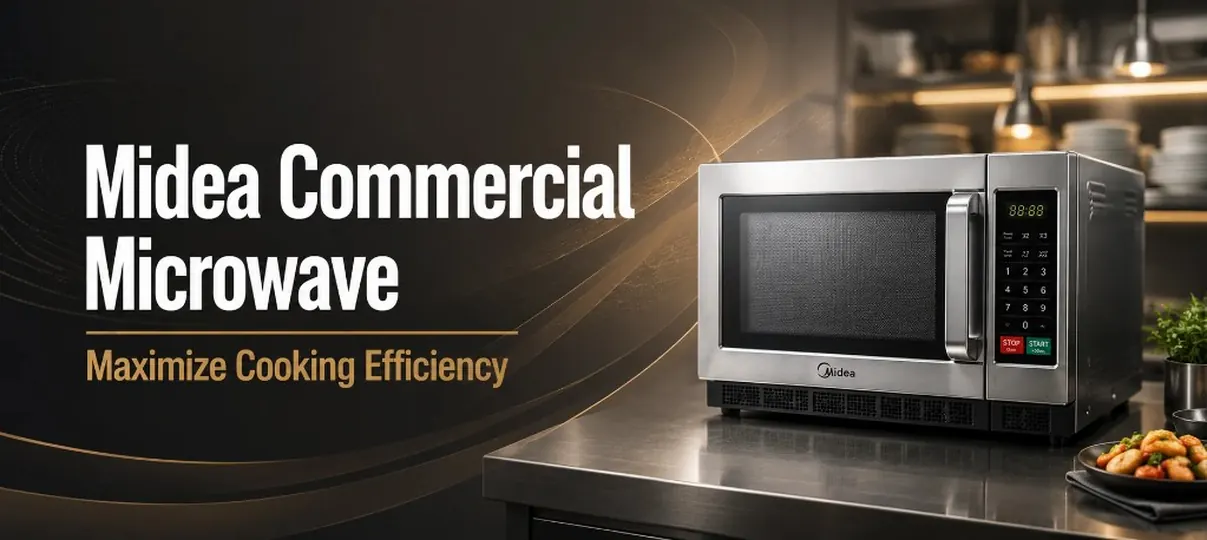
Maximize Cooking Efficiency with Midea Microwave
A Midea microwave can make everyday cooking faster, cleaner, and more predictable, whether you are reheating family meals at home or building a high-volume foodservice workflow. The right choice depends on how you cook: a compact digital unit, a midea over the range microwave, a model with a midea microwave turntable, or a midea commercial microwave designed for repeated service use. This guide explains how to match features, wattage, capacity, and cleaning needs so you can get more value from every heating cycle. For reliable Midea microwaves and other commercial kitchen equipment, Horeca Store offers a wide range of solutions designed for professional kitchens.Explore Horeca Store to find quality cooking equipment that helps restaurants and foodservice businesses maximize efficiency and performance. Horeca Store makes it easy to find Midea microwaves and essential commercial kitchen equipment for faster, more efficient cooking.With a wide selection of professional-grade products, Horeca Store helps restaurants equip their kitchens for consistent performance and productivity.
What does cooking efficiency really mean with a Midea microwave?
Cooking efficiency with a Midea microwave means faster reheats, even results, and less guesswork across home or commercial microwave workflows.
Cooking efficiency means more than shaving a few seconds from a timer. It is the combination of speed, consistency, usable space, simple controls, easy cleaning, and the ability to repeat the same result without extra effort. A Midea microwave can support that goal by helping you choose the right cavity size, power level, preset program, and installation style for the way your kitchen actually works.
For a home kitchen, efficiency might mean reheating leftovers evenly, defrosting without overcooking the edges, or using a silver 30L digital model that fits larger plates and containers. In a café, convenience store, office pantry, or quick-service environment, efficiency may mean programmable menu items, multiple-portion settings, multi-stage cooking, and durable construction that stands up to repeated use.
The key is not simply buying the most powerful microwave available. It is choosing a unit that fits the food, container sizes, available counter or wall space, cleaning routine, and expected number of heating cycles. When those pieces line up, a microwave becomes a dependable part of the kitchen instead of a bottleneck.
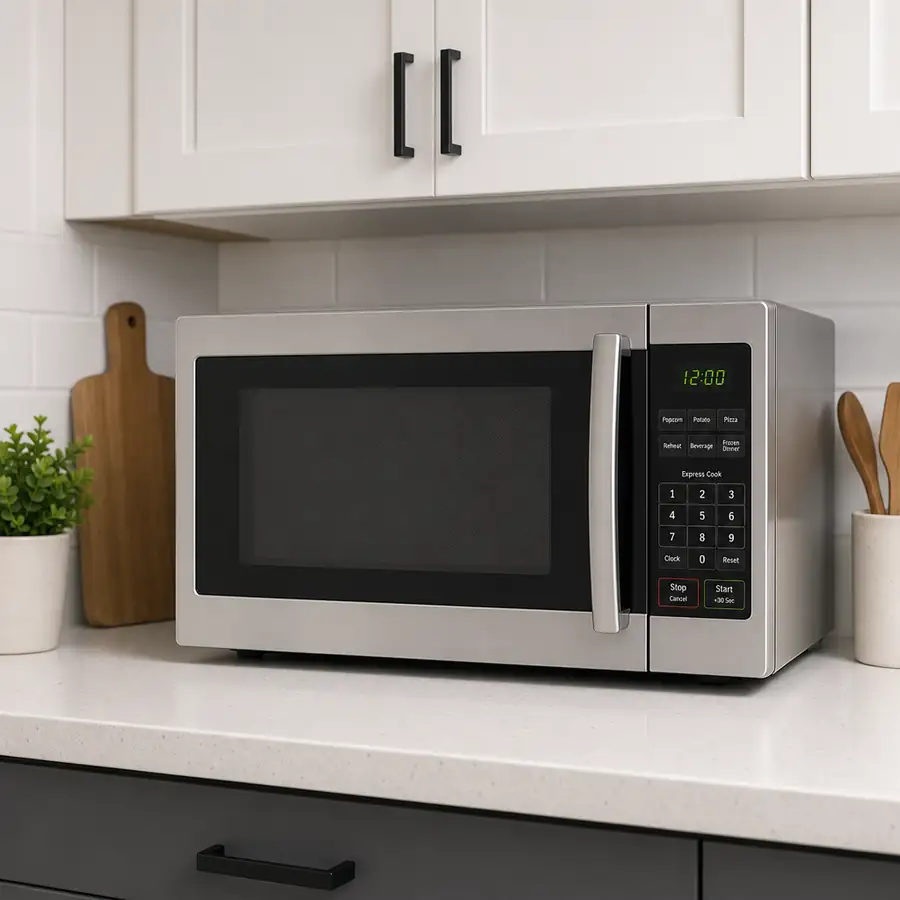
Matching a Midea microwave to the way you cook
Matching a Midea microwave to your menu starts with portion size, frequency, and whether you need a commercial microwave oven or lighter duty unit.
A microwave used for morning oats, soup, and occasional leftovers does not need the same design as one heating dozens of prepared meals each hour. Before comparing buttons, finishes, or wattage, think about your real cooking pattern. This keeps you from paying for features you will rarely use or choosing a model that looks right but slows you down.
A household buyer may focus on capacity, style, defrost functions, a turntable, and whether the appliance fits neatly into the kitchen layout. Someone searching for a midea 30l digital microwave - silver may be looking for a practical balance: enough interior space for everyday dishes, simple digital controls, and a neutral finish that suits most kitchens. If you see phrases like midea 30l digital microwave happypay or midea 30l digital microwave - silver pay off in product listings, treat them as retail or payment-plan wording rather than performance specifications; always check the actual capacity, wattage, dimensions, and features before deciding.
Foodservice operators should think differently. A midea commercial microwave is built around repeatability and workload. Instead of asking only, "How fast can it heat?" ask how easily staff can run the same program every time, how well the cavity handles your containers, how quickly the unit can be wiped down, and whether the model is rated for the intensity of your service.
A quick kitchen-use checklist
A quick kitchen-use checklist helps compare capacity, power, and controls before ordering restaurant equipment.
Use this checklist before choosing a model:
- Food type: Soups, plated meals, beverages, frozen items, sauces, and bakery products all heat differently.
- Portion size: A single mug, a dinner plate, and a covered pan require different cavity space and time settings.
- Frequency: Occasional home use is very different from back-to-back service use.
- Available space: Countertop, built-in-style, and over-the-range setups solve different layout problems.
- Cleaning routine: Smooth interiors, removable parts, and accessible filters can reduce downtime.
- Control needs: Simple manual cooking may be enough at home, while programmed keys can help teams stay consistent.
- Power source: Commercial models may have electrical requirements that differ from standard household appliances.
This small planning step prevents one of the most common mistakes: choosing a microwave based on a headline feature while ignoring the workflow around it.
The role of the midea microwave turntable
The role of the Midea microwave turntable differs for home use versus flat-cavity commercial microwave designs used in foodservice.
A midea microwave turntable is one of the most familiar features in home microwave cooking. The rotating glass tray helps move food through the microwave energy pattern so the same area is not exposed in the same position throughout the entire cycle. That movement can improve heating consistency for everyday dishes, especially when reheating plates, bowls, and smaller containers.
Turntables are especially useful in homes because users cook many different foods in many different container shapes. One day it may be coffee, the next day pasta, and the next day frozen vegetables. The turntable helps reduce the need to stop and rotate the food manually, although stirring, covering, standing time, and container choice still matter.
However, turntables are not always the best answer for every environment. Many commercial microwaves use antenna-based energy distribution rather than a rotating glass tray. This design can make the cavity easier to load, especially when using larger rectangular containers that might not rotate freely on a turntable. It can also remove a breakable or removable part from a busy foodservice workflow.
For home use, a turntable is often convenient and practical. For commercial use, a flat cavity with a different distribution system may be more efficient because staff can slide containers in and out quickly without worrying about tray alignment.
Why consider a midea over the range microwave?
A Midea over the range microwave can free counter space while supporting everyday reheating in compact kitchens and hotel room microwave setups.
A midea over the range microwave can save counter space by combining microwave convenience with an above-cooktop installation. For smaller kitchens, apartments, and busy family spaces, this can be a smart way to keep the main work surface open for chopping, plating, mixing, or unloading groceries.
Over-the-range placement is not only about appearance. It changes the way people move through the kitchen. Instead of placing a microwave on a valuable section of counter, the appliance sits in a dedicated upper position, often near the cooking zone. This can make reheating sides, melting butter, warming sauces, or finishing leftovers more convenient during meal prep.
That said, installation style should match the household. Consider reach height, cabinet space, ventilation needs, and whether the cooktop area is the safest and most comfortable place for your microwave. A beautiful installation is only efficient if everyone who uses the kitchen can access the appliance easily and safely. For restaurants looking to upgrade their cooking setup, Horeca Store provides Midea microwaves along with a variety of dependable commercial kitchen equipment.Choose Horeca Store for practical kitchen solutions that support faster service, better efficiency, and everyday professional cooking needs.
Digital controls make everyday cooking more repeatable
Digital controls make everyday cooking more repeatable so staff can run consistent power levels on a commercial-grade Midea microwave.
Digital controls can improve cooking efficiency because they reduce guesswork. Instead of turning a dial and estimating, users can enter specific times, choose power levels, or use preset functions. For a household model such as a midea 30l digital microwave - silver, this can make daily reheating easier for multiple family members.
A 30L cavity can be appealing because it offers more room than many compact models without necessarily feeling oversized in a standard kitchen. The silver finish also has a broad, neutral look that works with stainless, black, white, and mixed-appliance spaces. Still, capacity and finish should be considered alongside practical details: external dimensions, interior height, plate clearance, door swing, available power settings, and cleaning access.
When comparing listings, read carefully. Retail descriptions may include payment-plan language such as midea 30l digital microwave happypay or midea 30l digital microwave - silver pay off. Those phrases may help you understand how the product is being sold, but they do not tell you how well it will cook. For performance, focus on output power, control options, usable cavity size, warranty terms if provided by the seller, and the model's actual feature list.
Commercial-grade Midea microwaves support faster foodservice workflows
Commercial-grade Midea microwaves support faster foodservice workflows when programmable keys and high wattage match ticket demand.
A commercial-grade Midea microwave is designed for a different level of use than a typical household unit. In foodservice, the goal is not occasional convenience; it is fast, repeatable heating during busy service windows. The value comes from combining durable construction, programmable controls, menu consistency, and cavity designs that support the containers used in the operation.
Commercial Midea specifications show features such as programmable auto items, multiple power levels, multi-stage cooking, multiple-quantity settings, and large 1.2 cu. ft. cavities on certain models. For example, Midea's 1134G1A medium-duty commercial microwave specification lists 100 programmable settings, five power levels, three cooking stages, an X2 multiple-quantity pad, a 1.2 cu. ft. cavity, stainless steel exterior and interior, a cleanable stainless steel air-intake filter, and stackable installation for two units. Its listed microwave output is 1,100 W.
Midea's 2134G1A heavy-duty commercial microwave specification lists many similar workflow features, including up to 100 auto items, five power levels, three cooking stages, an X2 multiple-quantity pad, a 1.2 cu. ft. cavity, a cleanable stainless steel air-intake filter, a cleanable ceiling splatter shield, stackability with the same style oven, and 2,100 W microwave output distributed by dual magnetrons.
These features matter because they reduce decision-making at the point of service. A trained team member can press a programmed item instead of manually entering a time and power level for each order. Multi-stage cooking can start at one power level and finish at another, helping certain foods heat more gently or evenly than a single full-power cycle. Multiple-portion settings can help adjust cooking for larger quantities without forcing staff to calculate from scratch.
Commercial features that can improve workflow
Depending on the exact model, a midea commercial microwave may offer:
- Faster heating workflows: Higher-output commercial models can reduce cycle times for suitable menu items.
- Repeatable cooking programs: Programmable menu items help staff run the same item the same way.
- Commercial-duty construction: Stainless finishes and heavier-duty components can support repeated use in service environments.
- Multiple power levels: Operators can match intensity to food texture, density, and moisture level.
- Programmable menu items: Frequently prepared items can be assigned to memory keys.
- Multi-stage cooking: A program can move through different time and power stages for better control.
- Multiple-portion settings: Some models include quantity adjustment, such as an X2 function.
- Larger cavities: Certain commercial units can fit larger platters or covered pans.
- Stainless-steel interiors: Applicable models are easier to wipe down and suited to frequent cleaning.
- Easy-clean components: Splatter shields, smooth interiors, and accessible surfaces can reduce cleaning friction.
- Air-intake filtration: Applicable models include cleanable air-intake filters to help protect airflow.
- Stackability: Certain models can be stacked with compatible units to increase throughput without expanding the footprint.
Not every Midea microwave has all these features. A home countertop model, a midea over the range microwave, and a commercial heavy-duty model are built for different priorities. Always check the specification sheet for the exact model rather than assuming that one Midea feature applies across the entire range.
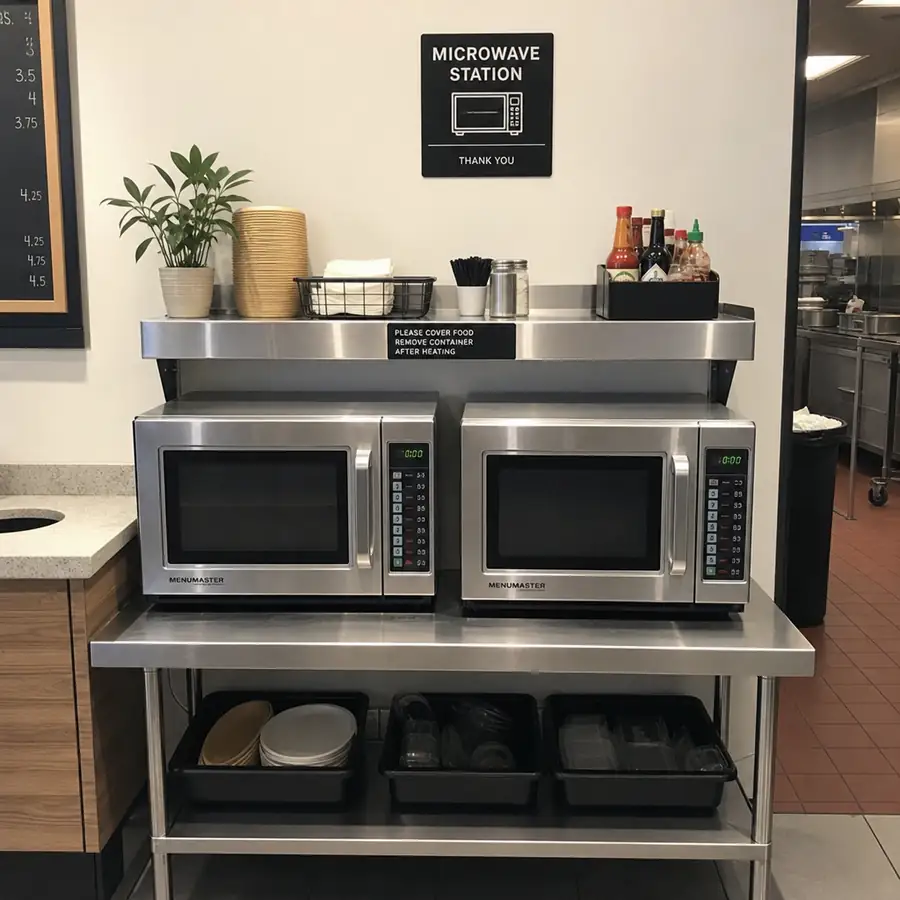
How does microwave wattage affect cooking speed?
Microwave wattage affects cooking speed and recovery, so compare commercial microwave options carefully before buying.
Microwave wattage affects how quickly energy is delivered to the food, so a higher output wattage can often heat suitable foods faster than a lower output wattage. However, wattage is not the only factor that determines results, and higher wattage is not automatically better for every menu item. The best power level is the one that heats the food efficiently while protecting quality, texture, moisture, and serving consistency.
There are two wattage numbers that buyers often confuse: input power and microwave output power. Input power is the amount of electrical power the appliance draws from the outlet. Microwave output power is the amount of microwave energy delivered for cooking. These numbers differ because no appliance converts every bit of electrical energy into usable microwave energy; some energy is used by components such as the magnetron system, fan, light, controls, and normal heat loss.
That distinction matters when comparing models. A microwave with higher input power does not always produce output in the same proportion as another model. When you want to understand cooking performance, look for the rated microwave output power. When you want to understand electrical requirements, look for input power, voltage, amperage, and plug configuration.
The Midea 1134G1A commercial specification lists 1,100 W microwave output and 1,700 W power consumption. The Midea 2134G1A specification lists 2,100 W microwave output and describes a heavy-duty design using dual magnetrons; its cooking output is nearly twice the 1134G1A's rated microwave output, but that does not mean every food should simply be cooked for half the time.
Cooking time still depends on several practical factors:
- Food type: Liquids, dense starches, proteins, sauces, and frozen entrées absorb and distribute heat differently.
- Quantity: A larger portion usually needs more time than a smaller portion.
- Starting temperature: Frozen food, refrigerated food, and room-temperature food require different cycles.
- Container: Shape, depth, lid style, and microwave-safe material affect heating patterns.
- Recipe: Foods with layers, fillings, sauces, or uneven thickness may need lower power or standing time.
- Power setting: A lower power level may take longer but can improve control for delicate items.
- Stirring or rotation: Pausing to stir or rearrange food can improve final consistency.
Higher wattage is valuable when your menu rewards speed and the food can tolerate rapid energy delivery. It may be less ideal when a delicate sauce, pastry filling, or dense chilled product needs gentler heating to avoid hot spots, separation, drying, or overcooked edges. In those cases, a lower power level, multi-stage program, covered container, or standing time may produce a better serving result.
Choosing power levels for real menu requirements
Choosing power levels for real menu requirements keeps sauces, proteins, and plated meals from overheating on The Horeca Store Midea lineup.
The smartest way to use microwave power is to connect it to the menu, not to a single idea of "fast." For beverages, soups, and many sauces, higher power may be useful because moisture-rich foods respond well to microwave heating. For dense items, thick portions, or foods with sensitive textures, a staged approach may be better.
In a foodservice setting, start by grouping menu items by how they behave. A soup portion may need a different program from a breakfast sandwich, a frozen entrée, or a refrigerated side dish. Once items are grouped, test them using the containers and portion sizes your staff will actually use. Record the time, power level, and standing time that produce the best serving result.
A commercial unit with programmable menu items can then turn those tests into daily consistency. Instead of relying on memory, staff can press the correct program. If the model offers multi-stage cooking, one program may start stronger to build heat and then finish at a lower power level to reduce overheating. If it offers a multiple-portion setting, the team can adapt a base program when heating more than one portion.
For home users, the same principle applies on a smaller scale. If leftovers often come out with cold centers and hot edges, reduce the power and increase the time slightly. If frozen vegetables release water but stay cool in the middle, stir partway through. If rice dries out, add a small amount of moisture and cover it loosely. Efficiency is not only speed; it is getting the food right the first time.
Capacity and cavity design influence daily convenience
Capacity and cavity design influence daily convenience for hotel supplies, catering, and busy restaurant pass stations.
Capacity affects what you can heat without rearranging, tilting, or changing containers. A 30L home microwave can be useful for larger plates and family-sized portions, while a compact model may suit small kitchens or light reheating. In commercial kitchens, cavity size becomes even more important because operators often use standardized containers and need fast loading.
Commercial Midea models such as the 1134G1A and 2134G1A list 1.2 cu. ft. cavities, a size intended to accommodate larger service items than many small household units. The 1134G1A specification describes a large cavity and stainless steel interior, while the 2134G1A specification describes a large 1.2 cu. ft. cavity and heavy-duty service design.
The interior design also affects cleaning. A home unit with a midea microwave turntable may require removing and washing the glass tray. That is simple enough in most households and helps with everyday spills. In commercial units, a flat stainless interior, cleanable splatter shield, or air-intake filter on applicable models can make routine cleaning more practical during repeated use.
A good cavity is not just large on paper. It should fit the containers you actually use, allow enough clearance for safe handling, and support the cleaning routine your kitchen can maintain.
Smarter habits that improve microwave results
Smarter habits that improve microwave results include covered reheating, correct power levels, and microwave-safe tableware.
Even the right microwave works better when users follow good habits. Small changes can reduce uneven heating, prevent mess, and save time over the long run. These habits are useful for both home and commercial kitchens.
Try the following:
- Use microwave-safe containers. Choose containers that are designed for microwave use and suited to the food's temperature and moisture.
- Spread food evenly. A shallow, even layer usually heats more predictably than a tall mound.
- Cover when appropriate. A loose microwave-safe cover can hold moisture, reduce splatter, and improve heating.
- Stir or rearrange. For soups, sauces, rice, pasta, and mixed dishes, stirring helps distribute heat.
- Let food stand. Standing time allows heat to continue moving through the food after the timer ends.
- Use lower power when needed. Lower settings can be more efficient when they prevent overcooking and rework.
- Clean spills quickly. Dried food absorbs heat, causes odors, and makes later cleaning harder.
- Keep vents and filters clear. On models with air-intake filtration, maintain the filter according to the product instructions.
These steps sound simple, but they are the difference between using a microwave as a blunt tool and using it as a controlled cooking appliance.
Cleaning and maintenance protect performance
Cleaning and maintenance protect performance so a commercial microwave keeps pace during peak service.
A microwave that is easy to clean is more likely to be cleaned correctly. In home kitchens, that means wiping the interior after splatters, washing the turntable, and keeping the door seal area free from buildup. In foodservice settings, cleaning is also about protecting speed, hygiene, airflow, and staff confidence.
Stainless-steel interiors on applicable commercial models are valuable because they can handle frequent wipe-downs and support a cleaner-looking workspace. Cleanable ceiling splatter shields and air-intake filters, where included, help operators manage the mess and airflow challenges that come with repeated cooking. These components should not be treated as optional extras; they are part of keeping the appliance ready for service.
Stackability on certain commercial models can also improve maintenance planning. If two compatible units are stacked, a team may increase throughput without spreading equipment across more counter space. However, stacked installation should always follow the manufacturer's guidance, including clearance and compatibility requirements.
Home, office, and foodservice use cases
Home, office, and foodservice use cases call for different wattage, durability, and hotel refrigerator or refrigeration support nearby.
A Midea microwave can serve very different users depending on the model. The same broad category includes simple household reheating, space-saving over-the-range installations, larger digital units, and commercial microwaves for demanding workflows.
For a family kitchen, the strongest priorities are usually convenience, capacity, finish, and everyday ease. A midea 30l digital microwave - silver may appeal to households that want a clean look and enough room for common dishes. If a retailer advertises payment options with wording such as midea 30l digital microwave happypay or midea 30l digital microwave - silver pay off, compare the payment terms separately from the appliance features.
For an office pantry, reliability and simplicity matter. Users may not read detailed instructions, so clear controls, easy cleaning, and appropriate capacity are important. A turntable model can work well when the main tasks are reheating lunches, drinks, and snacks.
For a café, concession stand, hotel pantry, convenience store, or quick-service kitchen, the choice becomes more operational. A midea commercial microwave with programmable settings, multi-stage cooking, and a larger stainless cavity can help staff move faster while protecting consistency. In that setting, the microwave is part of the service line, not just a convenience appliance.
Common mistakes that reduce microwave efficiency
Common mistakes that reduce microwave efficiency include oversized cavities, ignored ventilation, and skipping staff training on power levels.
Many microwave frustrations come from mismatching the appliance or settings to the job. Avoiding these mistakes can improve results without buying anything new.
Common issues include:
- Using full power for everything: Some foods need slower heating to protect texture.
- Ignoring output wattage: Input power and output power are not the same measurement.
- Overfilling containers: Thick, deep portions heat less evenly and may require stirring.
- Skipping standing time: Food may continue equalizing after the cycle ends.
- Choosing capacity by exterior size only: Interior dimensions and usable cavity shape matter.
- Assuming all models share all features: Commercial, over-the-range, and home digital models differ.
- Neglecting cleaning: Food buildup can cause odors, smoke, and inconsistent user experience.
- Buying only for peak wattage: The best unit is the one that fits your menu, space, and workflow.
The most efficient microwave setup is usually the one that feels easy to use correctly. When controls, capacity, power, and cleaning all fit the job, fewer mistakes happen during busy moments.
A practical way to decide before buying
A practical way to decide before buying is to match Midea commercial microwave features to volume, then review restaurant equipment financing if needed.
Before choosing a Midea microwave, write down the five foods or tasks it will handle most often. Then identify the largest container you need to use, the number of cycles you expect per day, and whether multiple people will operate it. This gives you a practical buying brief instead of a vague feature wish list.
If you are buying for home, compare capacity, finish, turntable design, control layout, and installation style. If you are buying for foodservice, compare duty level, output wattage, programmable capacity, power levels, cavity size, stainless interior, cleaning features, electrical requirements, and whether stackability matters.
Finally, check the exact specification sheet or product listing for the model you are considering. Midea offers different microwave types for different use cases, and features vary by model. The best decision is the one based on your real workflow and the verified specifications of the unit in front of you.
Key takeaway
Key takeaway: choose the right commercial microwave oven for your workflow, then support it with food prep equipment, smallwares, and reliable refrigeration.
To Maximize Cooking Efficiency with Midea Microwave, start with the job your kitchen needs the appliance to do. A midea microwave turntable can support everyday home reheating, a midea over the range microwave can reclaim counter space, a midea 30l digital microwave - silver can offer practical household capacity, and a midea commercial microwave can support faster, more repeatable foodservice workflows.
Efficiency comes from the full system: wattage, power levels, programs, cavity design, cleaning access, and user habits. Choose the model that matches your food, space, and workload, then use thoughtful settings and maintenance routines to get consistent results every day.
Operators comparing reheating equipment often also review commercial microwave ovens, Midea options, a hotel room microwave, hotel supplies, an induction cooktop, commercial cooking equipment, food prep equipment, melamine dinnerware, undercounter refrigerator storage, a commercial freezer, used kitchen equipment, convection microwave vs conventional oven guidance, and restaurant equipment financing.