
A kitchen measurement conversion chart for restaurants gives cooks a shared reference for translating teaspoons, cups, quarts, ounces, and metric units. The tables below cover common cooking measurement conversions, explain when volume and weight must stay separate, and show how to adjust recipe quantities. Use them as a prep-station reference, then record approved conversions on your recipe cards.
What measurements belong on a restaurant kitchen conversion chart?
A restaurant kitchen conversion chart should include U.S. volume equivalents, metric volume conversions, weight conversions, and clearly labeled temperature conversions. Keep volume and weight in separate tables: cups and fluid ounces measure volume, while grams, pounds, and weight ounces measure mass. They are not interchangeable measurements.
Start with the units your recipes actually use. For a sauce station, prioritize cups through gallons; for pastry, give grams and kilograms more space. Keep specialized ingredient weights on recipe cards rather than suggesting that every ingredient has the same cup-to-gram conversion.
Use consistent abbreviations throughout your reference:
- tsp: teaspoon; tbsp: tablespoon.
- fl oz: fluid ounce, a volume measurement.
- oz: ounce by weight; lb: pound.
- mL: milliliter; L: liter.
- g: gram; kg: kilogram.
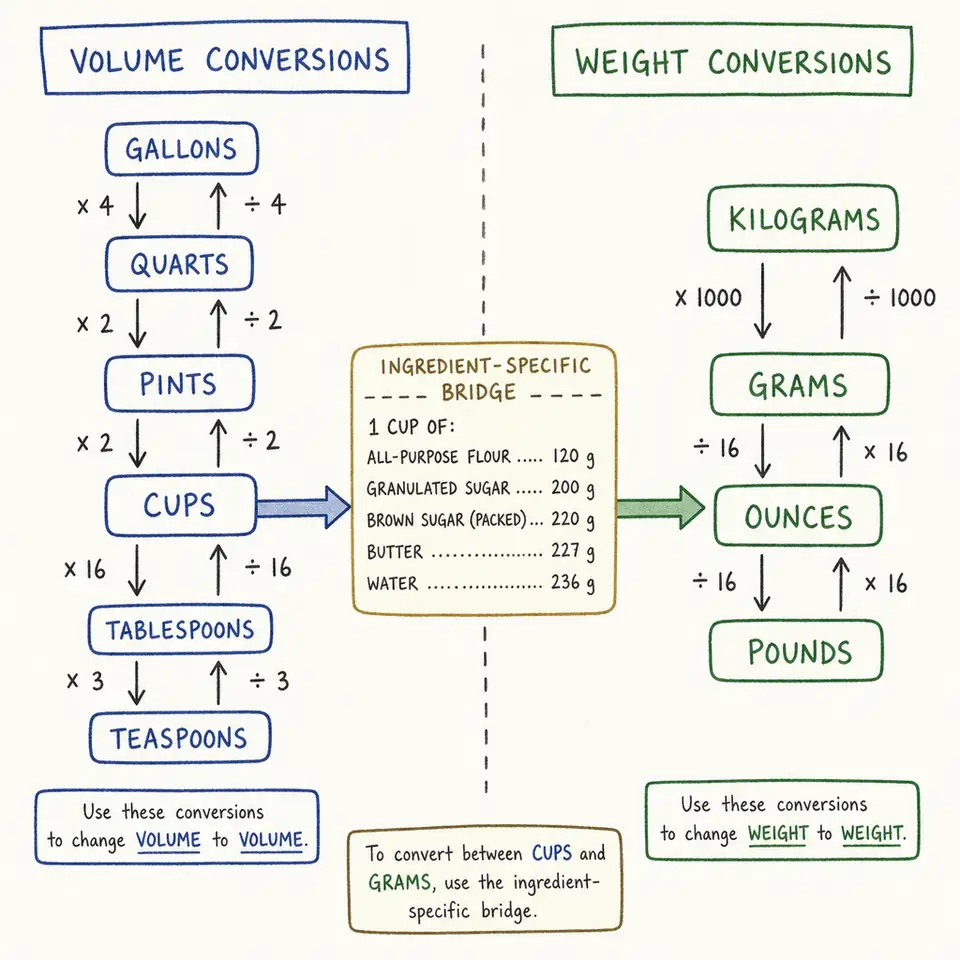
U.S. volume measurement conversion table
Use this measurement conversion table for recipes written in U.S. customary kitchen units. The relationships within the table are exact; metric equivalents appear separately so cooks can distinguish direct conversions from rounded values. Pints, quarts, and gallons here refer to U.S. liquid measures.
| Starting measurement | Equivalent |
|---|---|
| 1 tablespoon | 3 teaspoons |
| ⅛ cup | 2 tablespoons |
| ¼ cup | 4 tablespoons |
| ⅓ cup | 5 tablespoons + 1 teaspoon |
| ½ cup | 8 tablespoons |
| ⅔ cup | 10 tablespoons + 2 teaspoons |
| ¾ cup | 12 tablespoons |
| 1 cup | 16 tablespoons = 8 fluid ounces |
| 1 pint | 2 cups = 16 fluid ounces |
| 1 quart | 2 pints = 4 cups |
| 1 gallon | 4 quarts = 16 cups |
These equivalents follow USDA's household measurement reference.
For example, a recipe calling for ¾ cup of vinegar can also be written as 12 tablespoons. That does not mean measuring twelve spoonfuls is the best production method. Choose an appropriately sized measuring vessel, and use the chart to verify the quantity rather than adding unnecessary measuring steps.
When approving a recipe, write the preferred measurement once. Avoid leaving cooks to choose between several equivalent versions during service.
U.S.-to-metric volume conversions
The following values are U.S. customary volumes expressed in metric units, rounded for reference. They are not a separate set of metric measuring-cup standards. NIST's conversion factors provide the basis for these equivalents.
| U.S. volume | Approximate metric equivalent |
|---|---|
| 1 teaspoon | 4.93 mL |
| 1 tablespoon | 14.79 mL |
| 1 fluid ounce | 29.57 mL |
| ¼ cup | 59.15 mL |
| ½ cup | 118.29 mL |
| 1 cup | 236.59 mL |
| 1 pint | 473.18 mL |
| 1 quart | 946.35 mL |
| 1 gallon | 3.785 L |
Keep rounding consistent
For everyday cooking references, you may see a teaspoon rounded to 5 mL, a tablespoon to 15 mL, and a fluid ounce to 30 mL. Those are convenient approximations, not exact U.S. customary equivalents. Label them accordingly instead of mixing rounded and more precise values without explanation.
For production recipes, choose one conversion basis and document it. If you convert a batch to milliliters, calculate from the original quantity rather than repeatedly converting through rounded intermediate values. Round the final amount to a measurement your equipment can deliver, then test and approve the recipe.
Identify the recipe's measurement system
Check the source before converting an imported recipe. A U.S. customary cup is approximately 236.6 mL, while a metric cup used in Canadian food references is 250 mL. British Imperial and U.S. liquid measures also differ.
Add "U.S. customary" to the chart header. For recipes from other systems, preserve the original metric quantities when supplied rather than assuming familiar unit names have identical sizes.
Weight conversions for prep and portioning
Keep this weight table beside, not inside, the volume table. One pound contains exactly 16 weight ounces; the metric equivalents below are rounded from standard conversion factors. None of these rows describes fluid ounces.
| Weight | Equivalent |
|---|---|
| 1 ounce | Approximately 28.35 g |
| 4 ounces | Approximately 113.40 g |
| 8 ounces | Approximately 226.80 g |
| 1 pound | Approximately 453.59 g |
| 1 kilogram | 1,000 g |
| 1 kilogram | Approximately 2.205 lb |
For scale-based prep, specify whether the recipe quantity excludes the container. Place the empty container on the scale, tare it, and then add the ingredient. King Arthur Baking's measuring guidance uses this approach to weigh ingredients without including the vessel.
Make the selected unit visible on the recipe card. "Add 250" leaves a critical detail unstated; "add 250 g" gives the cook an actionable instruction. Before starting a batch, confirm that the scale display matches the recipe unit.
Cups cannot share one universal gram value
A cup-to-gram conversion depends on the ingredient and how it is measured. Flour is a useful example: scooping can compact it, so the same nominal cup can contain a different weight than a lightly filled cup. King Arthur Baking recommends weighing flour to avoid that variation.
For an existing volume-based recipe, establish an ingredient-specific standard:
- Follow the original method. Note whether the ingredient is sifted, packed, chopped, drained, or otherwise prepared before measuring.
- Weigh the measured ingredient. Exclude the container and record the ingredient's condition.
- Test the recipe using that weight. Check the finished result before approving the conversion.
- Update the master recipe. Keep the approved weight and method together.
Treat that result as a recipe standard, not a universal conversion for every ingredient or supplier.
How do you scale a restaurant recipe accurately?
To scale a restaurant recipe, divide the desired yield by the original yield, then multiply each ingredient quantity by that factor. Keep the yield units consistent: compare servings with servings, or finished weight with finished weight. This is the factor method described by the Institute of Child Nutrition.
Conversion factor = desired yield ÷ original yield
Suppose a recipe makes 24 portions and you need 60 portions of the same size. The conversion factor is 60 ÷ 24 = 2.5.
| Ingredient quantity in original recipe | Multiply by | New quantity |
|---|---|---|
| 2 quarts stock | 2.5 | 5 quarts |
| 12 ounces onions, by weight | 2.5 | 30 ounces, by weight |
| 2 tablespoons oil | 2.5 | 5 tablespoons |
These are illustrative calculations, not a complete or tested recipe. After calculating the quantities, rewrite them into practical units: 30 weight ounces can become 1 pound 14 ounces, for example.
Before approving the scaled version:
- Confirm portion size. Increasing the number of portions and increasing portion size are different changes.
- Keep units attached. Include "fl oz" or "oz by weight" wherever ambiguity is possible.
- Review the method. Decide whether the batch fits the intended equipment or should be split.
- Test the finished yield. Record the actual number of portions produced at the approved serving size.
Do not treat the multiplication factor as an instruction to multiply every process setting. Keep cooking time, equipment loading, and finishing instructions subject to a separate production review.
Temperature conversions belong in a separate block
Temperature conversion uses a formula rather than a simple volume or weight multiplier. To convert Fahrenheit to Celsius, subtract 32 and divide by 1.8. To convert Celsius to Fahrenheit, multiply by 1.8 and add 32.
| Fahrenheit | Celsius, rounded |
|---|---|
| 250°F | 121°C |
| 300°F | 149°C |
| 350°F | 177°C |
| 375°F | 191°C |
| 400°F | 204°C |
| 450°F | 232°C |
These values are calculated from NIST's temperature conversion formula and rounded to whole degrees.
Label this block "Temperature conversion only." It translates a temperature between scales; it does not establish a cooking instruction. Preserve the recipe's equipment and cooking-method notes alongside the converted setting, and use your separate approved procedures for food-safety requirements.
Build a printable reference your team can use
A kitchen measurement conversion chart printable should be readable at the station where decisions happen. Build a compact reference from the tables above, but do not shrink every explanation onto one crowded page. Keep the fuller guidance in your recipe manual and put the most-used equivalents on the station copy.
For a practical layout, arrange the cooking conversions chart in three zones: volume, weight, and temperature. Place a visible warning between volume and weight: "Fluid ounces are not weight ounces." That distinction is fundamental to using the chart correctly.
Before posting your conversion chart for kitchen measurements, check the following:
- System label: State that the volume chart uses U.S. customary measurements.
- Approximation labels: Identify rounded metric values instead of presenting them as exact.
- Readable units: Spell out unfamiliar abbreviations and distinguish tbsp from tsp.
- Useful placement: Put a copy near the relevant prep or weighing area, where staff can consult it without interrupting work.
- Document control: Add an approval date or version identifier and replace outdated copies together.
Keep ingredient-specific weights on a separate sheet if they make the main chart crowded. Include the ingredient name, preparation state, measuring method, and approved weight so the number retains its meaning.
Make conversions part of recipe control
Use the chart to resolve a calculation, then put the answer into the master recipe. Ask a second team member to review new conversions before the revised card reaches the station. This creates a clear checkpoint without asking every cook to repeat the same arithmetic.
For example, if a dressing recipe is converted from cups to milliliters, record the approved milliliter quantities together. Avoid a working card that alternates between the old and new systems without a reason. Keep the original version available for review, but identify which version staff should follow.
During training, have cooks demonstrate three tasks: distinguish fluid ounces from weight ounces, convert a common volume, and calculate a new batch quantity. Use your own recipes for the exercise so it connects directly to their work. Resolve disagreements in the reference documents, not through competing handwritten notes at the station.
The takeaway for restaurant teams
Use a shared conversion chart as a reference, not a substitute for a complete recipe. Keep volume separate from weight, label the measurement system, and distinguish rounded equivalents from exact relationships. Then transfer approved calculations into clear recipe cards so the next cook can follow the result without repeating the conversion.