
A well-planned kitchen starts with the right mix of kitchen essentials: storage, prep tools, cooking utensils, cookware, small appliances, and larger kitchen equipment. This Kitchen Essentials and Complete Kitchen Supplies Buying Guide helps you choose items that match your space, menu, volume, and budget, whether you cook at home or run a foodservice operation.
Kitchen supplies are the tools, containers, machines, and accessories that help you store food, prepare ingredients, cook, serve, clean, and stay organized. The best setup is not the biggest one. It is the one that keeps work fast, safe, clean, and repeatable.
What kitchen essentials do you really need?
You need reliable tools for five daily jobs: storing ingredients, preparing food, cooking, serving, and cleaning. Start with the items you use every day, then add special kitchen gadgets only when they solve a clear problem.
A basic home kitchen may need knives, cutting boards, pans, storage containers, mixing bowls, measuring tools, and a few small appliances. A restaurant, cafe, hotel, bar, QSR, food truck, or catering kitchen needs the same core items, but in stronger materials and larger capacities.
Think in workflow order:
- Kitchen storage: dry bins, food pans, airtight containers, labels, racks, and shelving.
- Food prep tools: knives, peelers, cutting boards, scales, mandolines, mixers, processors, and blenders.
- Cooking tools: pans, pots, sheet pans, tongs, spatulas, ladles, whisks, and thermometers.
- Kitchen equipment: ovens, ranges, refrigerators, freezers, dishwashers, fryers, prep tables, and holding units.
- Cleaning supplies: brushes, sanitizer-safe buckets, towels, mats, gloves, and waste bins.
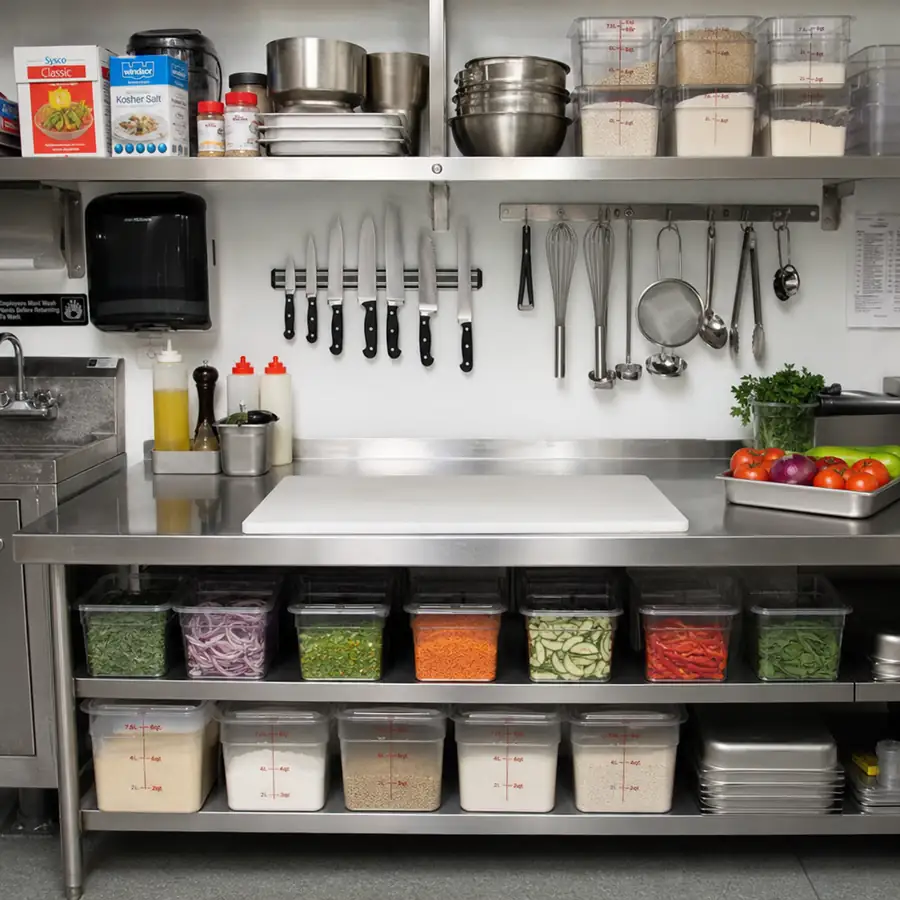
Main categories of kitchen supplies
Kitchen supplies fall into several clear groups. Each group supports a different task, so it helps to buy by function instead of buying random items.
Storage and organization
Kitchen storage keeps ingredients fresh, visible, and easy to reach. Good kitchen organization also cuts waste because staff can see what is on hand.
Use clear or labeled containers for dry goods, square containers for shelf space, and color-coded lids when you need quick sorting. Cambro CamSquares FreshPro containers, for example, are sold in two material options and seven sizes, from about 1.9 L to 20.8 L, so they suit small prep batches as well as bulk storage.
Prep and measuring tools
Food prep tools decide how fast and steady your output will be. For light use, simple hand tools may be enough. For high-volume work, processors, mixers, slicers, and scales save time and reduce uneven results.
Important items include chef knives, paring knives, bench scrapers, colanders, mixing bowls, portion scoops, digital scales, and measuring cups. In commercial kitchens, accurate portions protect food cost and keep dishes consistent.
Cookware and cooking utensils
Cooking utensils should match the heat, pan type, and menu. Stainless steel tools are strong. Silicone tools protect nonstick surfaces. Wood tools are gentle but need more care.
Core cookware includes stock pots, saute pans, saucepans, roasting pans, sheet pans, and nonstick pans. For restaurants and catering, choose heavier pans that can handle repeated use and fast temperature changes.
Countertop kitchen gadgets and appliances
Kitchen gadgets are useful when they save real time. Blenders, stand mixers, food processors, immersion blenders, rice cookers, and vacuum sealers can all be smart buys.
The key is to avoid buying tools for rare tasks. If a gadget replaces several manual steps every day, it earns its space. If it is used once a month, rent, share, or skip it.
Larger kitchen equipment
Kitchen equipment includes the large units that shape your cooking capacity. This can include refrigeration, ovens, fryers, griddles, ranges, ice machines, dishwashers, and holding cabinets.
For foodservice businesses, these items affect menu speed and revenue. A cafe may need a strong blender and undercounter refrigeration. A hotel kitchen may need combi ovens, bulk prep equipment, and large cold storage.
Features and specifications that matter
Specs are not just numbers. They affect speed, labor, safety, and total cost.
Capacity and size
Capacity tells you how much food a tool can handle at once. A 5-quart mixer suits small batches, while a larger bowl-lift mixer may be better for heavy dough or daily baking. KitchenAid lists stand mixer sizes from 3.5 to 8 quarts, which gives buyers options for small counters, home baking, and heavier use.
Size also affects storage and workflow. A large processor may be fast, but it can slow the kitchen if it blocks prep space. Measure counters, shelves, doorways, and wash sinks before buying.
Power and performance
Power matters most when a tool must handle dense or repeated tasks. A weak blender may struggle with frozen drinks. A light food processor may overheat in busy prep.
For example, the Robot-Coupe R 2 N is listed with a 3-quart cutter bowl and 1 HP power, making it a fit for many small commercial prep tasks. A high-output kitchen should compare bowl size, motor strength, duty cycle, and available discs before choosing a processor.
Material and build quality
Material affects life span, cleaning, and food safety. Stainless steel is common for professional culinary supplies because it is strong and easy to clean. Polycarbonate and polypropylene containers are light and practical, but each has different heat and impact traits.
For cutting boards, choose boards that can be cleaned well and separated by food type. Many kitchens use color coding to reduce cross-contact between raw meat, seafood, produce, and ready-to-eat food.
Configuration and placement
Configuration means how the item fits into the kitchen. A bowl-lift mixer needs different clearance than a tilt-head mixer. A reach-in refrigerator changes traffic flow. A wall shelf can free counter space.
In small kitchens, vertical storage is often more valuable than another gadget. In high-volume kitchens, a clear prep line can matter more than saving a few inches.
Technology and controls
Controls should be simple enough for daily staff use. Timers, speed settings, programmable cycles, and temperature displays can improve consistency.
Technology is useful only if staff can clean and use it under pressure. Choose clear controls, easy-to-read displays, and equipment with parts and service support.
Matching supplies to home and business use cases
Different kitchens need different setups. A good buying guide should connect real needs to the right tools.
For buyers comparing options at The Horeca Store, it helps to build a list by menu, daily covers, prep volume, and available space. That list makes it easier to choose between home-grade tools, commercial culinary supplies, and heavy-duty equipment.
Product examples and how to compare them
Specific models can help show how specs connect to use. Always confirm current availability, voltage, warranty, and local support before ordering.
These examples show the buying logic. A large container is useful only if it fits your shelf and sink. A powerful motor matters only if your menu needs heavy blending or dense prep.
Installation, cleaning, maintenance, and ownership cost
Buying the item is only the first cost. You also need to think about setup, cleaning time, parts, and support.
For installation, check power supply, plug type, ventilation, water lines, drainage, and clearances. Large equipment may need a trained installer. Even countertop items need safe placement away from sink splash and heat.
Cleaning should be fast and clear. Removable bowls, smooth surfaces, dishwasher-safe parts, and simple seals reduce labor. Avoid tools with many small parts unless they save enough prep time to justify the cleaning.
Maintenance includes sharpening knives, replacing gaskets, checking blades, cleaning vents, and inspecting cords. For business use, parts availability is a major buying factor. A cheaper machine can cost more if one broken lid, blade, or switch stops production.
Warranty and support also matter. Read what is covered, how long coverage lasts, and whether labor is included. Keep invoices, model numbers, and serial numbers in one place.
Total cost of ownership includes:
- Purchase price
- Delivery and installation
- Energy or water use
- Cleaning labor
- Replacement parts
- Downtime risk
- Staff training
- Warranty and service access
A simple kitchen supplies buying checklist
Use this checklist before you buy:
- List your menu or daily meals. Buy for real tasks, not imagined ones.
- Measure your space. Include counter depth, shelf height, sink size, and storage areas.
- Estimate batch size. Match bowl, pan, and container capacity to your usual volume.
- Check cleaning needs. If it is hard to clean, it may not get used.
- Choose durable materials. Pick stainless steel, strong plastics, or heavy cookware where wear is high.
- Plan kitchen organization. Group tools by task and store them near where they are used.
- Confirm parts and support. This is vital for commercial kitchen equipment.
- Buy in stages. Start with core kitchen essentials, then add special tools after demand is clear.
Common buying mistakes to avoid
Many buyers overspend on gadgets and underspend on basics. A sharp knife, stable cutting board, accurate scale, and well-fitted storage system often improve a kitchen more than a trendy appliance.
Another mistake is ignoring capacity. Too small means repeated batches. Too large means wasted space and harder cleaning.
Do not mix random containers and lids if you need speed. A matched kitchen storage system saves time every day. It also makes shelves neater and stock checks easier.
Frequently asked questions
1. What are the most important kitchen essentials for a beginner? Start with a chef knife, cutting board, saucepan, frying pan, mixing bowls, measuring tools, storage containers, tongs, spatula, and thermometer. Add appliances only after you know your cooking habits.
2. Which cooking tools should a restaurant buy first? A restaurant should start with durable cookware, portion tools, prep containers, knives, cutting boards, thermometers, and the core equipment needed for its menu. Refrigeration and safe storage should come before optional gadgets.
3. Are commercial kitchen gadgets worth it for home use? Sometimes. They are worth it if you cook often, batch prep, or need stronger performance. They may not be worth it if they are large, loud, hard to clean, or costly to repair.
4. How do I improve kitchen organization without remodeling? Use labeled containers, wall shelves, drawer dividers, hooks, and task-based zones. Keep prep tools near the prep area and cooking utensils near the range.
5. How often should kitchen supplies be replaced? Replace items when they become unsafe, hard to clean, warped, cracked, dull, or unreliable. In business kitchens, inspect high-use tools often and keep spare parts for key equipment.
Final buying guidance
The best Kitchen Essentials and Complete Kitchen Supplies Buying Guide is the one that starts with your real workflow. If you cook at home, choose versatile kitchen essentials that are easy to store and clean. If you run a cafe, bar, QSR, restaurant, hotel, food truck, or catering business, choose stronger tools with the right capacity, service support, and parts access.
Buy storage first if clutter and waste are your main problems. Buy better food prep tools if labor is slow. Buy larger kitchen equipment only when your menu, space, and volume prove the need. That approach keeps your kitchen practical, organized, and ready for daily work.