
Ice machine water filters treat incoming water to address specific problems, including sediment, chlorine taste, and mineral scale. Choosing the right system means matching its treatment capabilities, flow rate, and replacement cartridge to your machine - not simply finding a filter that fits. This article explains the main filter types, compatibility checks, and replacement practices that support reliable ice production.
What types of ice machine water filters do you need?
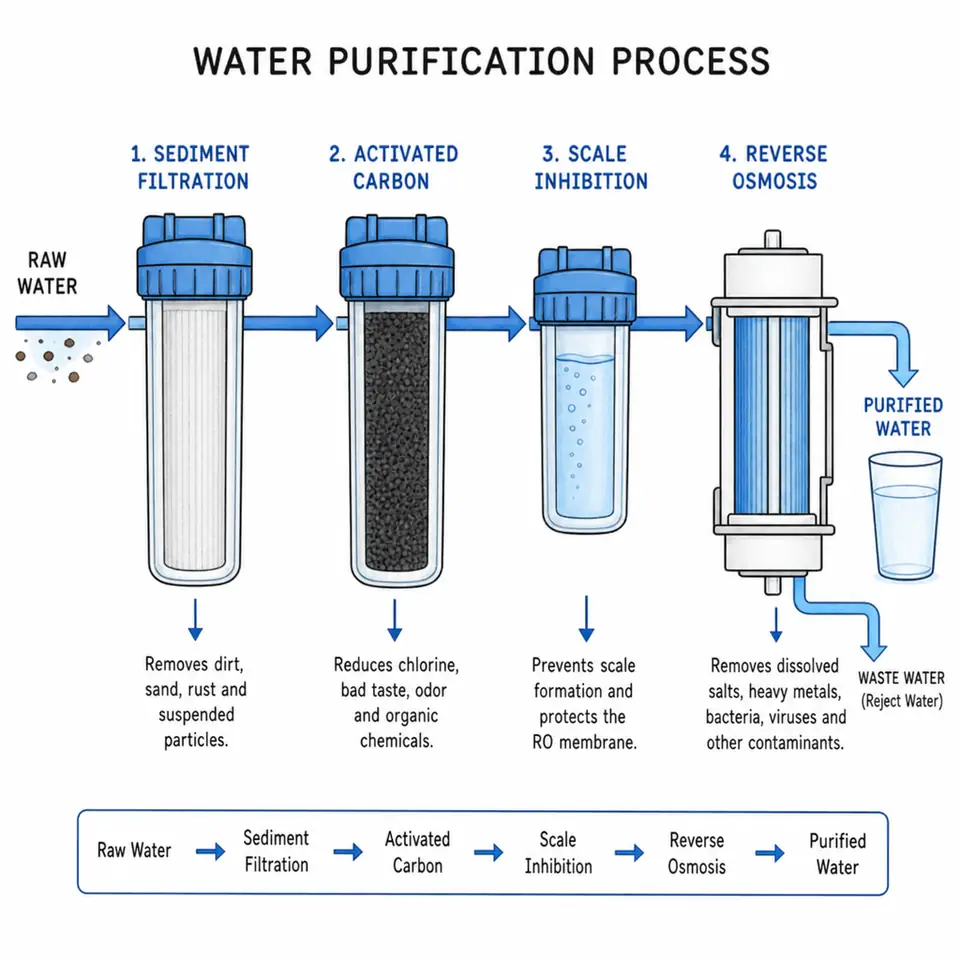
The right ice machine filters depend on the incoming water and the equipment's requirements. Sediment filtration targets particles, activated carbon addresses specified taste and odor concerns, and scale-control media helps limit mineral deposits. Some water filter systems combine these functions, while reverse osmosis provides a different level of treatment for dissolved solids. No single cartridge should be assumed to solve every water-quality problem.
Sediment filters protect the water pathway
Sediment filters capture suspended particles such as dirt and rust. Depending on their rating, they can help protect valves and fittings from debris that contributes to wear or plugging. They are useful where particle loading would otherwise burden a downstream treatment cartridge.
Check the particle-reduction specification rather than judging a filter by appearance. A sediment filter's job is different from chlorine reduction or dissolved-mineral treatment, so do not treat it as a complete answer to unpleasant taste or recurring scale. Match each treatment claim to the problem you need to address.
Activated carbon addresses taste and odor
Activated carbon is commonly used to reduce chlorine taste and odor in ice maker water. Combination cartridges may also provide sediment reduction and scale inhibition, giving operators several treatment functions within one system. Read the performance sheet to establish which functions are actually included.
Certification matters, but the specific claim matters just as much. NSF/ANSI 42 covers aesthetic reduction claims, while NSF/ANSI 53 addresses specified contaminants with health effects. Neither number means a filter removes everything; verify the exact certified reductions for the complete system.
Scale inhibition limits mineral buildup
Scale-inhibiting media helps prevent mineral deposits from accumulating inside equipment. It is intended to control scale formation, not to promise mineral-free water. Some ice-machine cartridges combine this treatment with carbon and particle filtration, while separate feeder systems provide additional scale-control treatment.
If scale keeps returning, ask a qualified water-treatment professional to compare the incoming water with the machine's requirements. Avoid repeatedly replacing a taste-and-odor cartridge while expecting a function its specifications do not include. Treatment selection should follow the identified problem, rather than the broad label "water filter."
Reverse osmosis requires equipment-specific planning
Reverse osmosis, or RO, can reduce dissolved solids and may be appropriate where ordinary cartridge filtration does not address the water chemistry. However, it is not an automatic upgrade for every ice machine. Treatment capacity and the machine's response to low-mineral water both need attention.
Some Manitowoc models, for example, have specific settings for low-TDS water because mineral content affects water-level sensing. That makes manufacturer approval and correct setup essential before adding RO. Check your model's documentation rather than applying instructions from another machine.
Compatibility is more than cartridge size
A replacement ice maker filter must be suitable for both the installed filtration system and the ice machine it serves. Matching the cartridge's shape is only one check; treatment performance, operating limits, and water-delivery requirements also matter. Manufacturer guidance explicitly calls for verifying replacement suitability and sizing filtration to machine production.
Before comparing water filters for an ice machine, build a short equipment record. Photograph the machine identification plate, filter-head label, and existing cartridge label, then keep those images with the manuals. When shopping through The Horeca Store, use this record as your comparison checklist rather than relying on a product photo alone.
Match the cartridge to the installed system
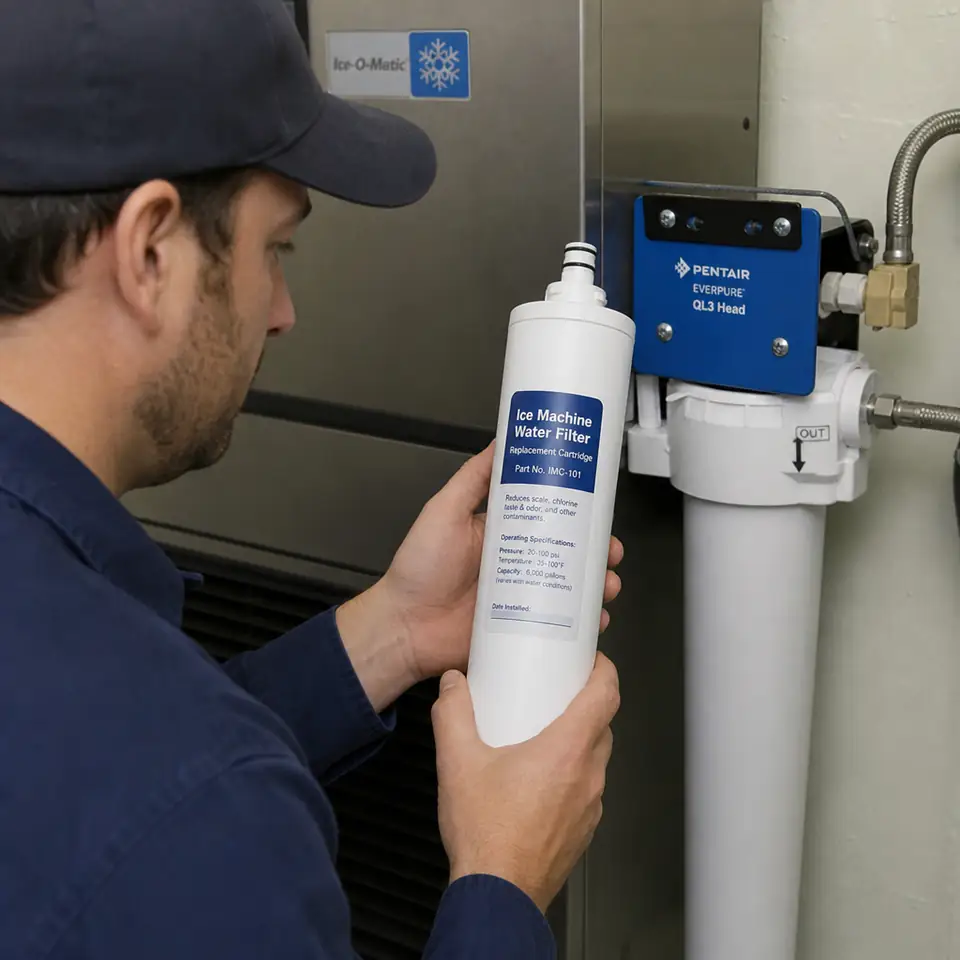
Confirm the approved replacement part number and the system models listed on its specification sheet. For example, Pentair's CTOS-20 documentation names the FXI systems in which the cartridge is used. This is stronger evidence of compatibility than similar dimensions or a general description such as "commercial ice filter."
Also check installation space and service access. A cartridge may require clearance below the head for removal, even when the installed assembly fits comfortably on the wall. Leave enough room to perform the replacement procedure without forcing the cartridge or disturbing surrounding plumbing.
Check flow, capacity, and operating limits
Flow rate describes how quickly a system can deliver treated water; capacity describes its rated treatment volume. These are different specifications, so a high-capacity cartridge is not automatically the right choice for the machine's water-delivery needs. Check both figures alongside permitted pressure and temperature conditions.
Use this pre-purchase checklist:
- Machine requirements: Confirm that the proposed filtration meets the equipment's production requirements.
- Replacement identification: Match the cartridge to the documented filter system, not merely its brand.
- Treatment claims: Verify sediment, chlorine, scale, or other reductions individually.
- Operating conditions: Compare supply pressure and temperature with both sets of specifications.
- Service access: Allow the clearance required for cartridge removal and replacement.
Keep installation requirements model-specific. For example, manufacturer manuals identify separate ice-making and condenser-water connections on certain water-cooled machines. Do not assume every water line should be treated or connected in the same way; have the installer follow the relevant plumbing diagram.
When should you replace an ice machine filter?
Replace an ice machine filter at the manufacturer's specified time interval, when its rated capacity is reached, or when replacement is required because flow has become restricted. There is no dependable universal schedule for every cartridge and installation. Water quality, usage, and the particular treatment media influence the service plan.
For example, Pentair specifies a regular six-month preventive replacement program for its CTOS-20 cartridge, with replacement when capacity is reached or flow becomes too slow. Its separate 2SR-BW scale-inhibitor feeder has a one-year preventive replacement program. These examples show why "change every six months" should not replace reading the actual cartridge instructions.
Build a service record around the installed filter
Record the installation date, cartridge part number, stated capacity, and next scheduled replacement date. Add the reason for each change, particularly when a cartridge is replaced earlier than planned. This gives the next person responsible for ice machine maintenance a useful starting point instead of an unlabeled filter and a guess.
A practical log can include:
- Installation and replacement dates, plus the person completing the work.
- The exact cartridge model and quantity replaced.
- Water-meter readings, if the system provides them.
- Observed flow changes and any reported taste concerns.
- Related cleaning, descaling, or technician visits.
Use the log to prompt investigation, not to override manufacturer limits. If filters repeatedly require early replacement, ask a service professional to review water conditions and system selection. A product's stated service interval is still subject to its capacity and operating instructions.
Replace cartridges without skipping the instructions
The safest replacement procedure is the one supplied for your exact filter head and cartridge. Isolation, pressure relief, cartridge engagement, and flushing can differ between systems. Hoshizaki and Pentair both provide product-specific installation or replacement instructions, so avoid borrowing a procedure solely because another filter looks similar.
Use the following sequence as a planning checklist, not a substitute for the manual:
- Confirm the replacement. Check the part number and gather the applicable instructions before interrupting production.
- Prepare the equipment. Follow the specified machine shutdown, water-isolation, and pressure-relief procedure.
- Remove the old cartridge. Use the documented release method and support the assembly as instructed.
- Install the new cartridge. Follow the specified alignment and locking procedure without improvising connections.
- Flush as directed. Use the required flow and duration for that particular cartridge, following the specified routing.
- Check and document. Complete the prescribed restart checks, look for leaks, and label the replacement date.
Do not invent a standard flushing time. Pentair's 2SR-BW instructions, for instance, specify a particular flushing duration, while other cartridges have their own requirements. Keep the instructions available at the service location so a routine change does not depend on someone remembering the previous procedure.
Filtration and cleaning do different jobs
Replacing a water filter does not replace cleaning, descaling, or sanitizing the ice machine. Filtration treats incoming water; manufacturer cleaning procedures address the machine's water system and relevant ice-contact areas. Hoshizaki publishes separate cleaning and sanitizing instructions with model-specific procedures, chemicals, and operating steps.
Maintain separate calendar entries for filter replacement and machine cleaning, even when you schedule them during the same service visit. This makes it harder for one completed task to be mistaken for a full maintenance service. Keep the applicable procedure attached to each entry, especially when several machine models operate at one location.
Standard filtration is also not permission to use an unsafe water supply. Hoshizaki's filter guidance warns against use with microbiologically unsafe water, or water of unknown quality, without adequate disinfection. If water safety is in question, follow the relevant manufacturer and public-health instructions rather than assuming a new cartridge resolves it.
Compare long-term service needs before buying
Make the purchase decision around the complete service plan, not just the initial cartridge price. NSF recommends considering ongoing replacement-filter costs when budgeting for treatment. Manufacturer specifications also identify replacement intervals, capacities, and access requirements that affect how the system will be maintained.
Prepare a comparison worksheet with these fields:
- Exact system and replacement-cartridge model numbers.
- Documented treatment claims and any relevant certification listings.
- Rated capacity, flow rate, pressure, and temperature limits.
- Manufacturer replacement schedule and flushing requirements.
- Required service clearance and the number of cartridges to maintain.
Leave any unverified field blank until you have the supporting documentation. This prevents an attractive headline feature from hiding a missing compatibility detail. It also gives the purchaser, installer, and maintenance team a shared record of what was selected and why.
When evaluating options from The Horeca Store, keep that worksheet beside the machine manual. Ask for clarification wherever the product documentation does not establish compatibility. The goal is a supported match - not simply a cartridge that appears interchangeable.
Choose treatment that matches the machine
Start with the incoming water, verify the treatment claims, and confirm the filter's compatibility and delivery specifications. Then follow the cartridge's replacement instructions while maintaining a separate cleaning and sanitizing routine. Those checks provide a stronger foundation for ice machine care than choosing by appearance, a broad filtration claim, or a calendar reminder alone.