
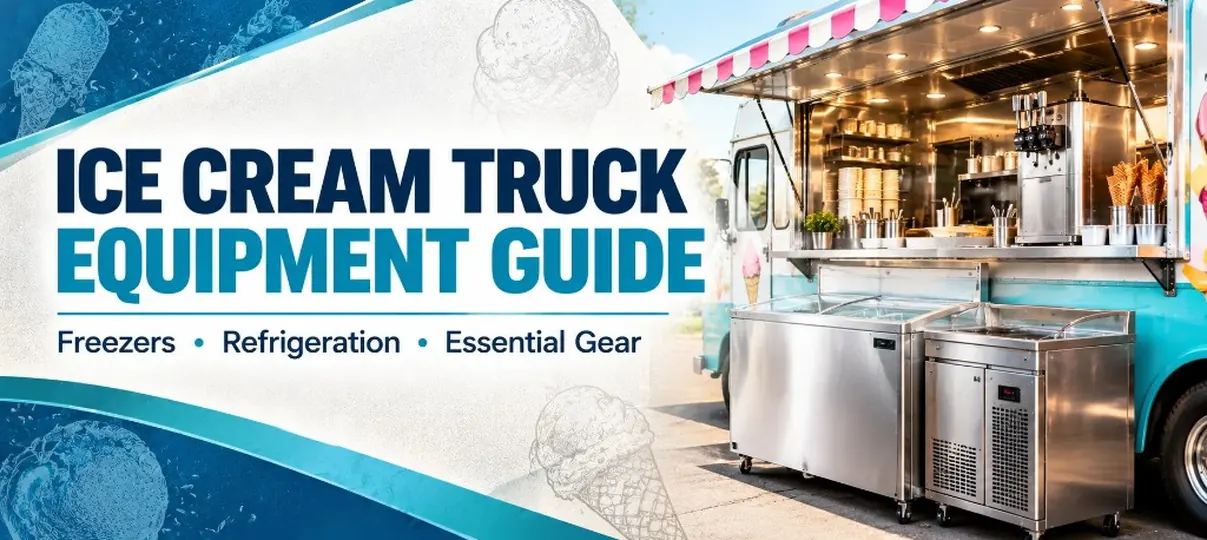
An ice cream truck needs refrigeration matched to its menu, reliable power, cleanable work areas, and serving tools that fit the available space. This ice cream truck equipment and refrigeration guide explains how to plan those systems together rather than buy appliances individually. Use it to build a practical equipment list, evaluate suppliers, and prepare questions for your installer and local health department.
What equipment does an ice cream truck need?
An ice cream truck needs equipment for storing its products, serving customers, powering appliances, and supporting its approved cleaning procedures. Start by separating your menu into prepackaged treats, scooped ice cream, and soft serve. Then ask your local regulator which refrigeration, sinks, water systems, and sanitation provisions apply to that operation before ordering equipment; mobile-food requirements depend on the jurisdiction and activities involved.
Build your initial purchasing plan around these service models:
- Prepackaged treats: Prioritize freezer storage, organized product access, temperature monitoring, and a payment station. Ask whether your limited handling changes the required support facilities.
- Scooped ice cream: Plan a dipping cabinet, backup frozen storage, scoops, protected serving supplies, topping containers, and an approved utensil-cleaning arrangement.
- Soft serve: Include a dispensing machine, storage for replacement mix, machine-cleaning supplies, and the electrical and ventilation provisions specified for that model.
- Mixed menu: Draw the complete layout before combining equipment. Give every added product a storage location, preparation area, and cleanup procedure.
Treat this as a planning framework, not a universal permit checklist. Submit the menu and proposed layout together so reviewers can evaluate how the truck will actually operate.
Build an ice cream truck equipment list around workflow
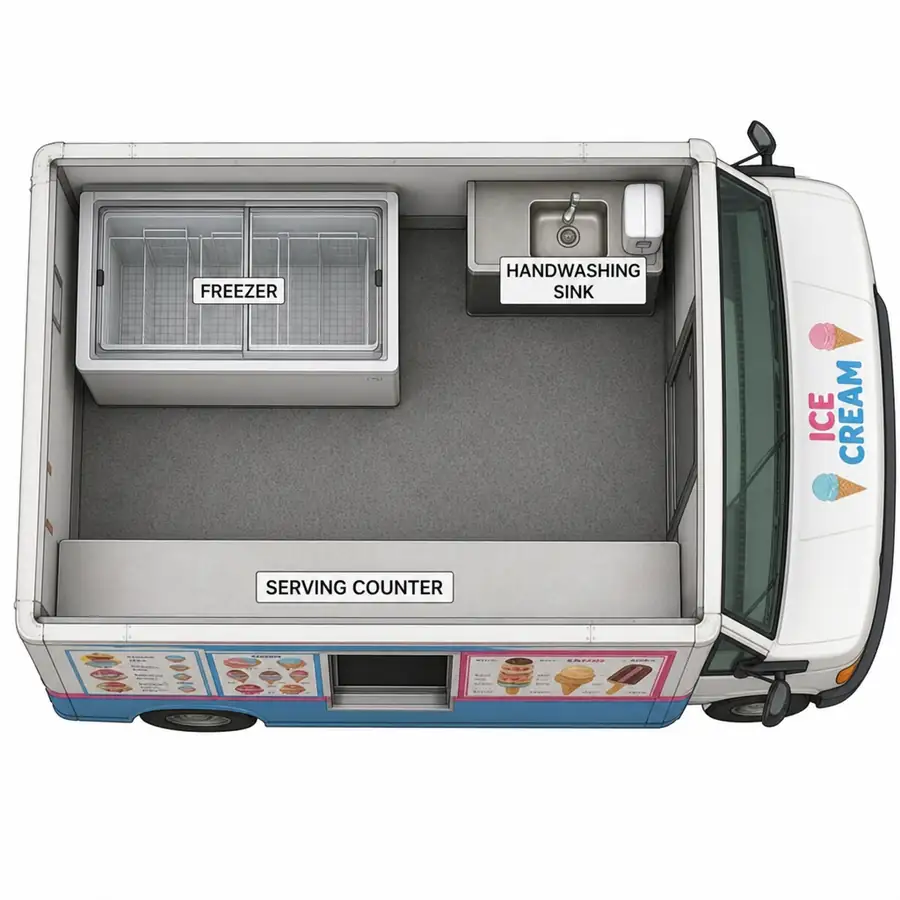
Organize your ice cream truck equipment list by task rather than by supplier category. For each item, record its dimensions, loaded weight, utility connections, installation clearances, and cleaning access. Leave a separate column for approval status so an attractive quotation does not become an accidental purchase commitment.
Next, sketch an order from payment through handoff. Mark where the employee stands, which doors open, and where used tools go. Revise the layout if a freezer lid blocks the serving window or routine cleaning requires moving another appliance.
How should you choose ice cream truck refrigeration?
Choose refrigeration by the product requirements, expected operating conditions, available utilities, and installation instructions-not cabinet volume alone. Frozen products must remain frozen, while foods requiring refrigerated temperature control generally need cold holding at 41°F or below under the cited mobile-food guidance. Confirm the rules adopted locally and follow product storage instructions; 41°F is not a frozen-dessert storage target.
Separate storage from serving needs
Compare reserve storage and active service as two different jobs. Ask the freezer supplier to recommend settings for your specific packaged products, tubs, or mix, and request written operating guidance. Avoid choosing one temperature simply because another operator uses it.
For a scooping menu, ask whether the proposed dipping cabinet is intended for service, overnight storage, or both. For packaged products, bring sample cartons to check basket fit and usable capacity. Make the supplier explain any restrictions rather than assuming that every commercial freezer suits a vehicle installation.
Check installation conditions and monitoring
Request the manufacturer's ambient operating limits, ventilation requirements, electrical specifications, and mobile-use approval in writing. Refrigeration should be installed and operated according to manufacturer instructions, and temperature monitoring belongs in the equipment plan. Mobile-food guidance also calls for thermometers in refrigeration units.
Ask your installer how staff will inspect the condenser, clean accessible components, and reach the unit for service. Specify a temperature-check routine before departure and during the shift. Include a response plan for an abnormal reading so employees know whom to contact and when to stop selling affected products.
Choose soft serve equipment for the whole operation
Soft serve equipment needs more than a countertop footprint. Review electrical supply, ventilation, mix handling, and model-specific cleaning procedures before comparing flavor counts. Taylor advises buyers to use the equipment data label for exact electrical specifications and the individual operator manual for cleaning instructions.
Ask for a demonstration using your intended mix and serving size. Rather than accepting a headline output figure, discuss repeated orders during a rush, refill procedures, and the time staff need for cleaning. Make that demonstration part of your evaluation checklist.
Compare these details carefully:
- Mix delivery: Gravity-fed and pump-equipped machines use different delivery systems. Ask the supplier to demonstrate operation, disassembly, and reassembly for the exact model.
- Cooling method: Air-cooled machines need space to release heat. Water-cooled models require suitable water and drainage connections or a compatible recirculating system.
- Installed footprint: Measure required clearance and access space, not just cabinet width.
- Cleaning schedule: Request the actual manual and review the full procedure with the person responsible for closing the truck.
Treat heat-treatment features as model-specific. For example, Taylor's C708 describes a daily heating-and-cooling cycle and its own disassembly interval; that does not establish a cleaning schedule for other machines. Confirm both the manufacturer's instructions and local acceptance before planning staffing around such a feature.
Match power planning to the complete equipment load
Have a qualified installer prepare a load schedule for all truck equipment operating together. Include refrigeration, dispensing equipment, lighting, water heating, pumps, and payment-device charging. Generator planning must distinguish running demand from starting demand; Honda's sizing guidance explains why total running watts alone can miss motor-starting requirements.
Request a written plan covering three operating situations: travel, parked service, and overnight storage. Identify which source powers refrigeration in each situation and how changeovers will be handled. Do not leave the overnight arrangement as a problem to solve after installation.
For battery proposals, ask for a runtime estimate based on your connected equipment and operating conditions. For generators, request confirmation that the chosen supply matches the appliances' required voltage and electrical configuration. Have the installer document connection procedures and any operating limitations.
Portable generator placement also needs a safety plan. CDC guidance calls for outdoor operation at least 20 feet from doors, windows, and vents to prevent carbon monoxide exposure. Do not assume that a portable generator can safely operate inside the truck or beside its serving window; have the installation and placement reviewed before use.
Make sanitation and ice cream tools part of the layout
Reserve room for cleaning before filling the truck with revenue-producing appliances. Food-truck guidance addresses handwashing, potable water, wastewater disposal, utensil washing, and sanitizer testing. Confirm your required arrangement with the local authority, including whether an approved commissary handles any part of the process.
For a scooping operation, discuss scoop handling between uses rather than improvising a container of standing water. For soft serve, review where removed parts will be washed and air-dried. Nebraska's guidance, for example, specifies washing, rinsing, sanitizing, and air-drying utensils, with sink compartments large enough for the equipment being washed.
Prepare an ice cream tools and supplies checklist for review:
- Scoops, spades, portioning tools, and protected storage for clean utensils.
- Food containers with suitable lids and clearly identified contents.
- Manufacturer-specified machine brushes, lubricants, and replacement seals.
- Appropriate cleaners, sanitizers, and matching concentration test supplies.
- Hand soap, paper towels, waste containers, and replacement consumables.
- Cups, cones, spoons, napkins, and dispensers positioned away from cleaning chemicals.
When evaluating equipment, check the certification for the exact model rather than relying on a seller's general description. NSF sanitation certification evaluates areas including sanitary construction, material safety, cleanability, and applicable performance requirements. Ask your regulator which certifications it accepts.
Evaluate equipment for sale beyond the sticker price
When browsing ice cream truck equipment for sale, compare complete proposals rather than isolated appliance prices. Request separate lines for delivery, installation, electrical work, mounting, commissioning, and staff instruction. Add anticipated maintenance and replacement consumables to your comparison worksheet without assuming that a lower purchase price means a lower overall cost.
Whether you are considering the horeca store or another supplier, send the same specification checklist to each seller. Ask for the exact model, installation documentation, certification information, warranty terms, and confirmation of suitability for the proposed use. Keep supplier promises in writing.
For used vending equipment, make inspection a purchase condition. Request clear photographs of identification plates, service records where available, and an operational demonstration. Ask a qualified technician to assess condition and identify missing parts before you commit.
Use these questions to make quotations comparable:
- What exactly is included? List baskets, lids, dispensing parts, mounting components, and accessories.
- Who will install and commission it? Identify responsibility for utility connections and startup checks.
- What support is available? Request the service contact, parts-ordering process, and written warranty coverage.
- What could prevent installation? Resolve access, utility, approval, and space issues before payment.
Select truck accessories that support service
Treat truck accessories as operational tools, not finishing touches. Consider menu visibility, protected packaging storage, task lighting, shelving, and a convenient payment position. Review secure mounting with the vehicle outfitter rather than relying on household storage solutions.
Also ask the outfitter to review loaded vehicle weight and weight distribution. Include equipment, water, stock, supplies, and people in that discussion. Leave enough access for staff to work and for technicians to service major components.
If considering an ice cream cart instead of a truck, use the same planning process at a smaller scale. Define its menu, replenishment method, power arrangement, cleaning support, and transport plan before selecting a cabinet. Ask the local authority how the proposed cart will be classified and approved; a smaller platform should not be treated as an automatic exemption.
Test the complete setup before your first route
Schedule a trial shift before committing to a busy event. Ask the installer to verify operation with the planned equipment running, then rehearse stocking, ordering, serving, and closing. Record any awkward reaches, blocked doors, unclear controls, or missing ice cream supplies while there is still time to revise the setup.
Create a short daily checklist covering temperature readings, available power, water and cleaning supplies, secured storage, and equipment faults. Assign responsibility for reporting problems and deciding when service must stop. Keep manuals and supplier contacts accessible to the person operating the truck.
The strongest equipment plan starts with a manageable menu and an approved layout. Choose refrigeration, utilities, serving tools, and sanitation provisions as one coordinated system, then test that system before taking it on the road.