
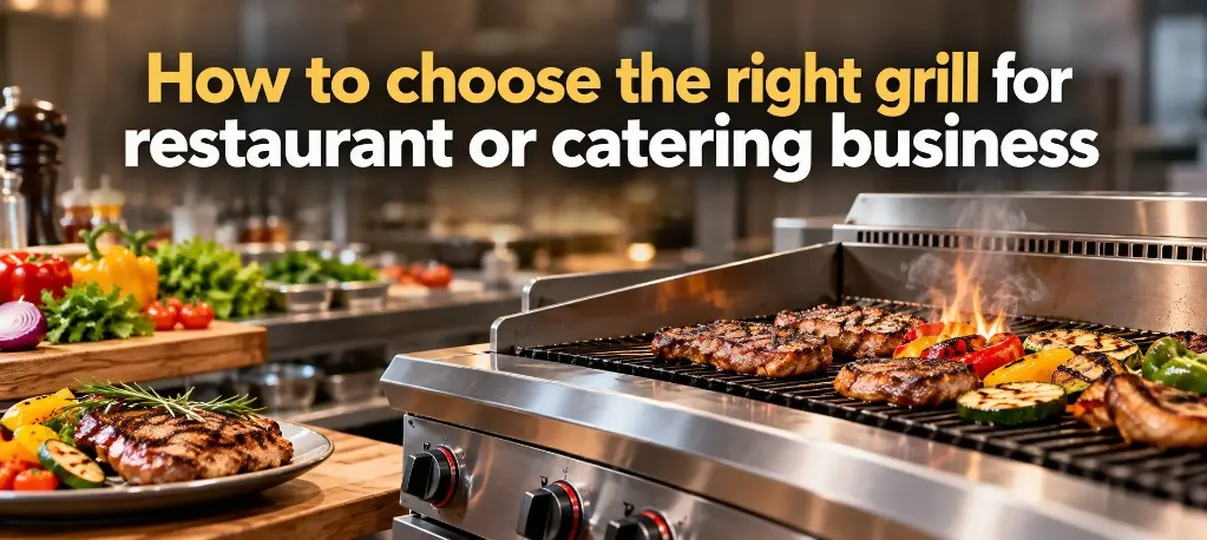
Choosing the right grill for a restaurant or catering business starts with three things: your menu, your volume, and your space. A steakhouse, burger concept, hotel kitchen, food truck, cafe, and mobile catering team all need different heat output, cooking surface, fuel type, ventilation, and cleaning routines.
In simple terms, a commercial grill is heavy-duty restaurant cooking equipment built to cook food quickly, safely, and repeatedly in a professional kitchen. It may be a charbroiler with grates, a flat-top griddle, a clamshell grill, an outdoor mobile grill, or a specialty unit designed for high-volume service.
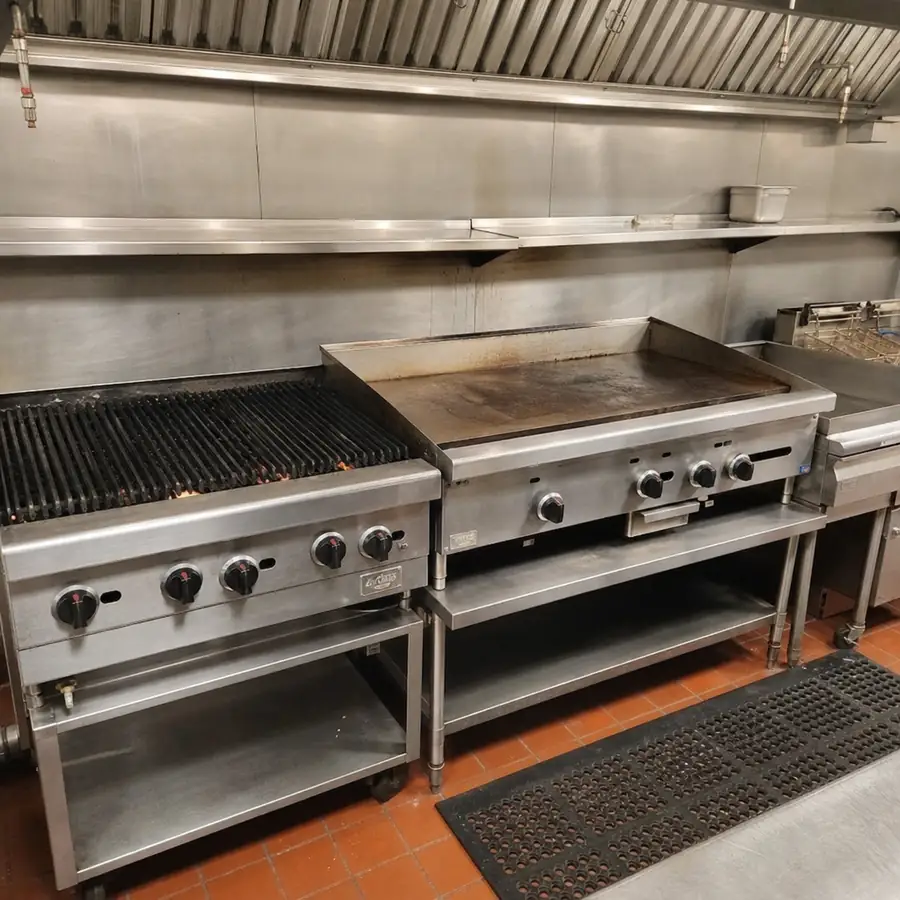
What grill does your restaurant or catering business really need?
A commercial gas range still sits beside the grill on most lines.
The best grill is the one that matches your daily production, not the one with the biggest nameplate. If your menu depends on grill marks, smoke-like flavor, steaks, kebabs, chicken, seafood, or vegetables, a charbroiler is usually the right starting point. If you cook burgers, eggs, pancakes, sandwiches, chopped proteins, or breakfast items, a griddle may serve you better.
For catering, mobility matters as much as cooking power. Outdoor event teams often need a mobile gas grill, a durable frame, large wheels, wind control, and simple grease handling. Crown Verity, for example, focuses on commercial outdoor grills and mobile grill packages for caterers and foodservice operators, including compact mobile models for smaller catering teams.
For chains and QSR kitchens, consistency matters most. A double-sided clamshell grill can cook from the top and bottom at once, helping teams repeat the same result with less guesswork. Garland's XPress Grill line, for example, is built around two-sided cooking and is available in multiple widths, gas or electric formats, and versions with or without Active Compression.
Main commercial grill types and where they fit
Commercial cooking equipment on that line includes more than the grill itself.
Commercial grills come in several forms. Each one solves a different kitchen problem.
Charbroilers
A salamander broiler finishes the same plate.
A charbroiler uses heated grates to sear food and create grill marks. It is a strong choice for steak restaurants, burger bars, hotels, pubs, BBQ menus, Mediterranean kitchens, and venues that want visible char lines.
Common options include:
- Radiant gas charbroilers: More predictable heat and easier daily cleaning than lava rock units.
- Lava rock charbroilers: A more traditional flame-grilled effect, but the rocks need rotation and replacement.
- Infrared charbroilers: Fast, intense heat for high-sear cooking.
- Electric charbroilers: Useful where gas is not practical, such as some high-rise or restricted sites.
Star Manufacturing lists radiant gas, lava rock gas, and electric charbroilers, and notes that radiant shields can protect burners while lava rocks hold drippings and need regular care.
Flat-top griddles
A gas griddle and an electric griddle solve different utility limits.
A griddle has a flat heated plate instead of open grates. It gives full contact with the food, which helps with burgers, eggs, bacon, pancakes, quesadillas, grilled sandwiches, fried rice, and chopped proteins.
This is often the most useful grill for cafes, breakfast spots, diners, QSRs, food trucks, and casual restaurants. ENERGY STAR says certified commercial griddles can include gas and electric, single- and double-sided models, and that certified models may offer benefits such as better temperature uniformity and higher production capacity.
Clamshell grills
A commercial fryer handles the fried side of the same menu.
A clamshell grill cooks from both sides. It is common in burger chains, sandwich shops, hotel breakfast lines, and fast-casual brands that need speed and repeatable cook times.
The main benefit is process control. Staff place the food, lower the platen, and follow a set program. This can reduce training gaps during busy shifts.
Outdoor and mobile catering grills
A bbq food truck and bbq accessories travel with the same crew.
Mobile grills are built for movement and outdoor service. They suit weddings, festivals, stadium events, hotel lawns, corporate catering, and pop-up foodservice.
Look for strong casters, handles, wind protection, grease trays, propane or natural gas options, and enough grill area for peak rush. Outdoor catering is hard on equipment, so a light domestic-style grill is rarely the right long-term choice.
Key specifications that affect daily service
A commercial range shares the gas line, so size the supply for both.
Specifications are not just technical details. They decide how fast you can serve, how easy the grill is to clean, and how much stress your team feels during peak hours.
Use this checklist when comparing restaurant cooking equipment:
- Cooking surface size: A small cafe may work with a compact countertop unit. A busy burger shop may need a wider griddle or several zones. More surface area helps with volume, but it also uses more space and energy.
- Fuel type: Gas gives strong heat and quick recovery. Electric can suit sites without gas lines or locations with stricter building limits. Propane is useful for mobile catering.
- Heat zones: Separate controls let you cook different foods at different temperatures. They also let you turn down unused sections in slower periods.
- BTU or electrical load: Higher input can support faster recovery, but it must match your utility supply, ventilation, and menu. Do not buy more power than your site can support.
- Plate or grate material: Cast iron grates hold heat well. Stainless parts can be easier to clean. Chrome griddle plates can reduce sticking and surface cleanup, but they need proper tools.
- Plate thickness: Thicker griddle plates often recover better after cold food is added. This matters for frozen burgers, breakfast rushes, and constant batch cooking.
- Countertop vs floor model: Countertop units save floor space and can sit on stands or equipment bases. Floor models usually suit higher volume and permanent cook lines.
- Grease management: Deep grease trays, splash guards, and easy-access pans reduce mess and help staff clean faster.
- Controls: Manual knobs are simple. Thermostatic or digital controls can improve consistency, especially with less experienced staff.
- Certifications and compliance: NSF certification helps confirm commercial food equipment meets sanitation requirements, while local authorities may also look at electrical, gas, fire, and hood rules.
Matching business types to grill choices
A countertop gas range can cover sauces while the grill stays on proteins.
Different food businesses should start with different grill choices.
A single-site restaurant may value menu flexibility. A multi-unit operation may value repeatable procedures. A caterer may value transport, setup speed, and parts that can handle rougher use.
Brand and model examples to consider
An induction range is the electric option when open flame is restricted.
Brands should be compared by category, service support, available parts, and fit for your menu. Do not choose by brand alone.
Vulcan is a common name in commercial kitchen equipment, with gas and electric griddles plus radiant and infrared charbroilers. Vulcan notes that its charbroilers support different grate styles, including round rod, waffle, and straight grate options, which can help match the grill surface to the menu.
Garland is worth reviewing for production griddles and double-sided clamshell grills. The XPress Grill is designed for two-sided cooking, and Garland lists 12-inch, 24-inch, and 36-inch formats with gas and electric choices.
Star Manufacturing offers gas and electric griddles, charbroilers, hot plates, and sandwich grills. Its griddle lines include different plate widths, plate materials, and thermostat styles, which helps buyers match equipment to light, medium, or heavy production.
Southbend offers commercial griddles and charbroilers as part of its wider cooking equipment range. This can be useful when a kitchen wants matching cooking equipment from one supplier or needs a full line with ranges, ovens, broilers, and grill sections.
Crown Verity is a strong category fit for outdoor catering and mobile grilling. Its product range focuses on professional outdoor cooking, which makes it relevant for events, hotels, resorts, and caterers that cook away from a fixed kitchen.
If you are sourcing through the horeca store or another foodservice equipment supplier, ask for a short list by menu, volume, available utilities, and local code needs rather than asking for "the best grill" in general.
Installation, ventilation, and safety planning
A commercial oven on the same line still needs its own hood clearance.
Installation should be planned before you buy. A grill that looks perfect on paper can become expensive if the gas line, electrical panel, hood, or floor space cannot support it.
Check these items early:
- Gas or electrical capacity: Confirm supply with a qualified installer.
- Ventilation: Grease, smoke, and heat often require a proper hood and fire system.
- Clearances: Follow the manufacturer's installation manual and local code.
- Floor and counter support: Heavy grills need stable stands or bases.
- Workflow: Place the grill near refrigeration, prep, plating, and holding areas.
NFPA 96 covers ventilation control and fire protection for commercial cooking operations, and it is widely used by people involved in design, installation, operation, and maintenance of commercial kitchen ventilation and fire suppression systems.
Cleaning, maintenance, parts, and support
A used gas griddle is only a bargain when the plate is still flat.
Cleaning is not a side issue. It affects food quality, fire risk, staff time, and equipment life.
For charbroilers, staff should brush grates, empty grease trays, clean radiants or lava rock areas as directed, and avoid blocking burners. Lava rock units need extra care because rocks collect grease and wear over time.
For griddles, use the right scraper and cleaning method for the plate. Chrome, steel, and polished surfaces may need different tools. Using the wrong abrasive can damage the surface and make sticking worse.
Before buying, ask:
- Are replacement grates, knobs, burners, elements, thermostats, and grease trays easy to order?
- Is local service available?
- What does the warranty cover?
- Are labor and travel included or only parts?
- Can staff clean it quickly between rush periods?
Total cost of ownership includes purchase price, installation, hood work, gas or electric upgrades, cleaning labor, energy use, downtime, replacement parts, and service calls. A cheaper grill can cost more over time if it slows production or is hard to maintain.
Buying decision guide
A commercial gas fryer and a pressure fryer stay off the grill surface.
Choose a charbroiler if your menu depends on grill marks, steaks, chicken, seafood, kebabs, burgers with a flame-grilled look, or vegetables with char. Pick radiant gas for easier daily control, lava rock for a more traditional flame effect, and infrared for intense searing.
Choose a flat-top griddle if you need one surface for breakfast, burgers, sandwiches, tortillas, chopped meats, and fast line cooking. This is often the safest first grill for cafes, diners, QSRs, food trucks, and small restaurants.
Choose a clamshell grill if speed and repeatability are more important than open-grill theater. It works well for chains, burger shops, and high-volume kitchens with set recipes.
Choose a mobile catering grill if you cook at events. Focus on wheels, frame strength, fuel setup, grease handling, wind control, and fast cleanup.
The simplest way to choose is to write down your top five menu items, peak covers per hour, available space, fuel source, and cleaning capacity. Then match the grill to the work it must do every day.
Frequently asked questions
1. What is the best grill for a new restaurant?
Steak knives still finish the plate the grill started.
For many new restaurants, a flat-top griddle is the most flexible first choice. It can handle breakfast, burgers, sandwiches, and many casual menu items. If your concept is built around steaks or char-grilled food, start with a charbroiler instead.
2. Is gas or electric better for commercial grilling?
A commercial electric range is the fallback when gas is not on site.
Gas is often preferred for high heat and fast recovery. Electric can be better where gas is not available or where the building setup favors electric equipment. The right answer depends on utilities, ventilation, menu, and local code.
3. What size grill do I need for catering?
A bbq trailer can carry the grill when the event is off site.
Base the size on your peak event volume, not your average day. A small caterer may use a compact mobile grill, while large events may need multiple grill zones or several units. Always leave space for holding, plating, and safe movement.
4. Do commercial grills need a hood?
Cook and hold ovens keep finished food hot after the grill pass.
Many indoor commercial grills need a hood because they create heat, grease, smoke, or vapor. Requirements vary by equipment type and local rules. Confirm with your installer, fire authority, and health department before purchase.
5. How often should a commercial grill be cleaned?
Fryer accessories are a different parts list from grates and grease trays.
Light cleaning should happen during and after each service. Deeper cleaning depends on volume, food type, and manufacturer instructions. Greasy menus and long service hours require more frequent cleaning than light-duty use.
Final takeaway
A high speed oven does not replace the grill, and rotisserie ovens do not either.
How to choose the right grill for restaurant or catering business comes down to fit. Match the grill to your menu, peak demand, fuel supply, space, ventilation, cleaning routine, and service support.
Buy the grill that helps your team cook the same food well every shift. That is usually more valuable than buying the largest, hottest, or most expensive unit on the list.