
Choosing cooking equipment for a small commercial kitchen starts with your menu, peak service demand, available space, and building services-not a supplier's catalog. Build your shortlist around the tasks you must perform, then check installation requirements, cleaning access, and ownership costs before buying. This approach gives you a practical way to compare appliances without filling a compact kitchen with equipment you rarely use.
What equipment does your small commercial kitchen actually need?
Your kitchen needs equipment that supports its complete production process: receiving, storage, preparation, cooking, holding, service, and cleaning. Start by mapping those tasks against your menu and expected busiest service, rather than copying another restaurant's equipment list. Treat the resulting list as a working brief to review with your kitchen designer, supplier, and local approval authorities.
For each menu item, record the cooking method, batch size, preparation steps, and equipment needed. Include less visible work such as washing mixing bowls, cooling prepared ingredients, and storing delivery containers. Those tasks deserve space in the plan, even when they do not generate sales directly.
For example, a hypothetical sandwich cafe might prioritize refrigerated preparation space, a contact grill, and an oven. A hypothetical soup-and-bowl operation might instead prioritize batch cooking, portioning, and a suitable cooling process. Use these examples as prompts, not universal shopping lists.
Divide potential purchases into three groups:
- Opening-day essentials: Equipment required to produce the launch menu and complete approved cleaning and storage procedures.
- Useful additions: Equipment that removes a demonstrated bottleneck or supports a planned menu expansion.
- Defer or eliminate: Single-purpose items with no clear workload, storage location, or measurable operational benefit.
Give every proposed purchase a named job. If you cannot explain when staff will use it, how they will clean it, and where it will live, leave it off the initial order.
Plan the layout before choosing individual models
Draw the kitchen to scale and place equipment according to the movement of food, staff, and dirty dishes. Measure doorways, delivery routes, ceiling restrictions, and the space needed to open appliance doors. Use manufacturer drawings to check operating and maintenance clearances, rather than relying on cabinet dimensions alone; refrigeration installation instructions, for example, specify airflow and clearance requirements.
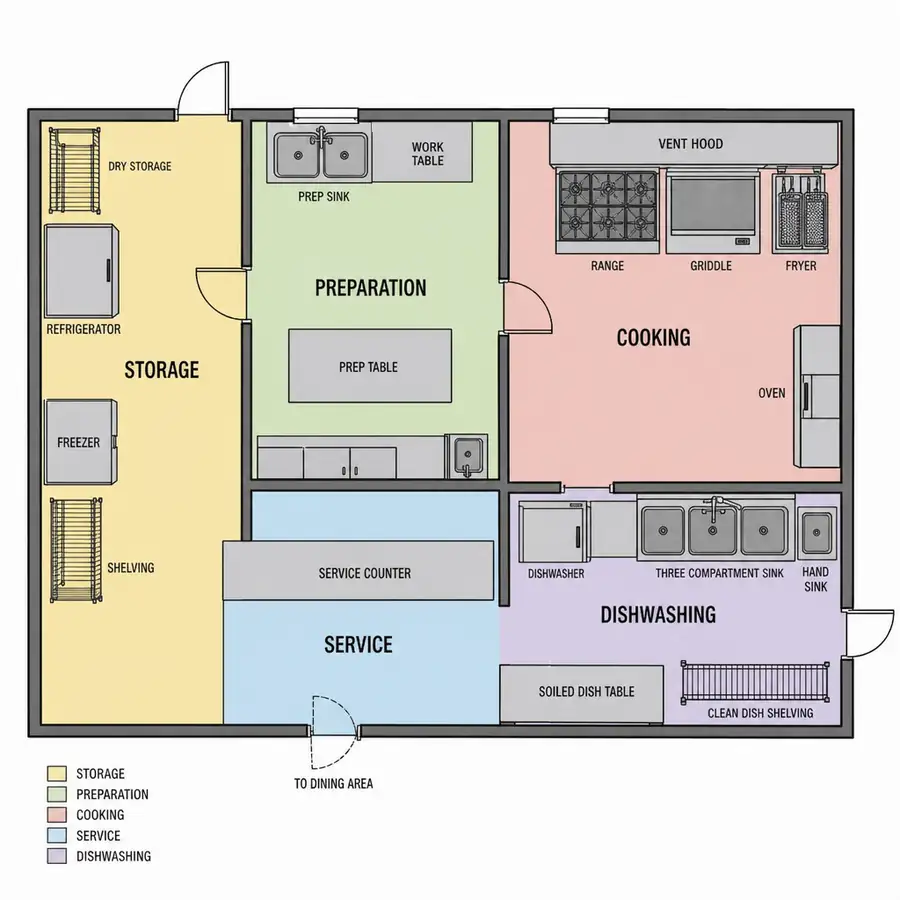
Run a paper service test before committing to the layout. Imagine one employee preparing ingredients, another cooking, and a third returning dirty utensils. Mark where their paths overlap, where an open oven door interrupts movement, and where someone must reach across another workstation.
Use this measurement checklist for each shortlisted appliance:
- Installed footprint: Include handles, connections, required clearances, and any separate accessories.
- Working envelope: Allow room for loading trays, removing baskets, opening drawers, and handling hot pans.
- Delivery access: Check the entire route from unloading point to final position.
- Service access: Identify how a technician will reach components without dismantling the kitchen.
- Storage impact: Assign space for attachments, cleaning tools, spare pans, and packaging.
Do not treat every empty surface as available equipment space. Reserve somewhere to set down deliveries, stage ingredients, and handle a tray safely. Ask staff to review the drawing before you approve it.
Which cooking appliances deserve your limited space?
Choose cooking appliances by matching their usable capacity, cooking methods, and operating requirements to your busiest realistic production period. Request a demonstration using representative food, pans, and batch sizes wherever possible. Compare the full sequence-loading, cooking, unloading, and cleaning-not just the advertised cooking time.
Match capacity to the actual service pattern
Write a short production scenario for your busiest period. Specify which dishes arrive together, which components share an appliance, and how frequently staff must reload it. Ask suppliers to demonstrate that workload rather than simply quoting maximum capacity.
For an oven, test your intended tray arrangement and product mix. For a griddle, check whether different foods require conflicting cooking conditions. For a fryer, ask how the model performs during repeated batches, not only its first batch from fully heated oil.
Make any spare capacity intentional. Identify the extra demand you want it to accommodate, then compare the space and installation consequences. Avoid buying a larger appliance solely because the price difference looks modest.
Evaluate multifunction equipment without creating dependence
A multifunction oven or versatile countertop unit deserves consideration when several menu tasks can share it. However, build a sample service schedule to confirm those tasks do not compete for the same machine at the same time. List the dishes affected if that appliance becomes unavailable.
Compare alternatives against the same menu scenario. Two simpler appliances may suit your workflow better than one complex unit-or the reverse. Let the demonstration, staff training needs, and service arrangements decide rather than the number of features on the brochure.
Choose refrigeration around inventory and preparation
Evaluate small commercial kitchen refrigeration equipment using your delivery schedule, ingredient quantities, container sizes, and preparation process. Ask the supplier to show how your actual inventory fits, including space needed for appropriate airflow. Follow the model's installation instructions for location, electrical supply, and ventilation clearances.
Consider these configurations as options to test against your layout:
- Undercounter refrigeration: Compare it where ingredients need to stay close to a workstation; check whether frequent bending and door opening suit the task.
- Refrigerated preparation tables: Assess these for assembly work, confirming that the pan arrangement matches your ingredients and service sequence.
- Upright reach-ins: Test shelf spacing with your actual containers rather than judging capacity from exterior size.
- Separate refrigerator and freezer units: Allocate space according to the stock you genuinely intend to hold, not an assumed equal split.
Bring container dimensions and a sample inventory list to the supplier discussion. Include delivery-day stock as well as ordinary service stock. Ask staff to simulate retrieving ingredients while another person works at the adjacent station.
If you cook food in advance, discuss cooling needs separately from cold storage. Do not assume a cabinet selected for holding refrigerated ingredients also meets your production process's cooling demands. The FDA Food Code addresses cooling, heating, and holding capacities, but your applicable requirements should be confirmed locally.
Confirm utilities, ventilation, and approvals before ordering
Arrange a site review before choosing between gas, conventional electric, and induction equipment. Have qualified installers check the proposed models against available electrical capacity, gas service, water, drainage, and installation instructions. Kitchen ventilation design also requires coordination between appliance selection, layout, exhaust, and makeup air.
Do not assume that an electric or countertop appliance is automatically exempt from exhaust requirements. Obtain a determination for the specific model, cooking process, and location from the relevant authority. Local requirements can address heat, steam, smoke, and grease as well as fuel type.
Confirm which sanitation certifications and equipment listings your jurisdiction accepts. NSF standards cover categories including commercial cooking and warewashing equipment, while state and local agencies oversee retail food establishments. A supplier's general assurance is not a substitute for checking the requirements that apply to your premises.
Request written installation quotations before issuing purchase orders. Include connections, commissioning, any required building work, and responsibility for approvals. Keep those quotations alongside the appliance specifications so the purchase decision reflects the installed system, not just the machine.
Select small appliances and tools for repeatable work
Apply the same scrutiny to small kitchen appliances as you do to the cooking line. For each mixer, blender, processor, or slicer, specify the food it will handle, the expected batch, the daily workload, and the cleaning routine. Ask the manufacturer to confirm that the proposed model and warranty suit that intended use.
Professional kitchen gadgets should earn their place through a clear task. Before adding one, ask an employee to explain the current method and identify the problem the gadget would solve. Consider a trial or demonstration before committing to something with multiple attachments or unfamiliar cleaning steps.
Organize commercial kitchen tools by workstation:
- Preparation: Select knives, boards, scales, bowls, and measuring tools around the recipes and portioning methods you use.
- Cooking: Match pans, trays, tongs, spatulas, and temperature-measuring tools to the selected appliances.
- Service and storage: Specify containers, lids, labels, utensils, and shelving that work together.
Include these restaurant kitchen supplies in the opening budget. Build the quantity list from a service simulation, including items temporarily unavailable during washing. Avoid buying assorted sizes without first deciding how they will be stored.
Compare the full cost, including cleaning and maintenance
Compare shortlisted equipment using total ownership cost rather than purchase price alone. Include installation, energy, water where relevant, maintenance, consumables, and likely service needs. ENERGY STAR recommends this life-cycle approach and provides product comparison and savings tools for commercial foodservice equipment.
For comparable models, request documented operating data and use assumptions that reflect your intended hours and workload. Check whether an eligible ENERGY STAR certified option is available, then investigate any applicable incentive before purchasing. Do not treat a general savings estimate as a guarantee for your kitchen.
Ask staff to demonstrate routine disassembly and cleaning during evaluation. Time the process for your own comparison, note the parts that need separate storage, and identify any specialist cleaning products. Request the maintenance schedule and replacement-part information before deciding.
For used equipment, arrange an independent inspection and request its service history. Confirm the model, serial number, condition, included accessories, and any warranty in writing. Compare the complete installation-and-repair quotation with the equivalent new option, rather than relying on the advertised discount.
How do you choose a dependable equipment supplier?
Choose a supplier that can document model suitability, delivery arrangements, warranty terms, and after-sales support-not simply offer the lowest quotation. Use the same written specification when requesting competing bids so you can compare like with like. Ask each bidder to identify exclusions and assumptions explicitly.
When researching small commercial kitchen equipment supply in the USA, narrow your search by service coverage and installation capability as well as product range. ENERGY STAR's dealer and distributor resources can help identify sellers of certified equipment, but you should still verify each supplier's responsibilities for your order.
Before paying a deposit, obtain answers to these questions:
- Who checks model specifications against the approved layout and site services?
- Does delivery include unloading, indoor placement, unpacking, and packaging removal?
- Who handles installation, commissioning, and staff orientation?
- What damage-reporting, return, and cancellation terms apply?
- Who performs warranty repairs, and what labor, travel, or parts exclusions apply?
Keep approved substitutions in writing. If a quoted model becomes unavailable, review the replacement's dimensions, connections, capacity, certifications, and warranty before accepting it. A similar-looking appliance should go through the same checks as the original selection.
Buy for the kitchen you will actually operate
Start with the menu, test the workflow, and buy against a written specification. Resolve layout, utility, approval, cleaning, and service questions before placing orders. Then revisit deferred purchases after opening, using staff feedback and observed bottlenecks to decide what deserves the next investment. A disciplined equipment list is more useful than a crowded kitchen.