
Choose an undercounter ice machine by matching its production, storage, dimensions, and installation requirements to your busiest service - not just the space beneath your counter. This page helps bar and cafe owners turn those requirements into a practical equipment shortlist. Prepare your measurements and service needs, then contact The Horeca Store to discuss your options.
Which undercounter ice maker fits your bar or cafe?
The right machine is one that supplies your required ice type, supports peak demand, and can be installed correctly in your available space. Compare daily production and bin storage separately, then check the manufacturer's installation manual before committing to a model. Manufacturer sizing guidance also recommends checking output at the air and water temperatures expected during peak use.
Start with the service problem you want to solve. Perhaps your bar team keeps leaving the drinks station to collect ice, or your cafe is adding iced beverages to a previously hot-drink-focused menu. Write down that situation before comparing equipment; it gives you a useful test for every feature on the shortlist.
Use these priorities to guide your enquiry:
- For an iced-drink cafe: Record cup sizes, iced orders during the busiest period, and refill requirements.
- For a cocktail bar: Include shaking, stirring, serving, and any separate bottle-chilling needs in your estimate.
- For a tight backbar: Measure the opening, door access, and utility positions before filtering by width.
- For a secondary station: Decide whether the machine must cover the whole business or only that station's demand.
Start with your service requirements, then compare equipment that meets them.
Size production and storage around your busiest service
Daily production describes how much ice a machine can make over a stated period; storage describes how much finished ice its bin holds. These are different specifications, and an integrated undercounter unit can have substantially less storage than its daily output. For example, Scotsman's published CU50 specifications list production and storage as separate figures.
Build your estimate from actual service rather than seat count alone. Review your busiest trading days, count ice-dependent orders, and include uses that never appear as a separate till item. Ask the team about repeat trips for ice, discarded ice, and event preparation so your brief reflects how the business really operates.
For a simple planning exercise, suppose you expect 120 iced drinks and measure an average of 8 ounces of ice per drink. That represents 60 pounds of serving ice before other uses or a contingency allowance. This is an illustrative calculation, not a recommended machine capacity: replace both assumptions with your own measurements.
Next, isolate the rush. If most of those drinks leave the counter in a short window, evaluate how much ice must already be available when that window begins. Ask for help checking the combination of starting bin stock and production during service, rather than assuming a daily rating guarantees immediate availability.
Finally, compare ratings under equivalent conditions. Manitowoc notes that surrounding air and incoming water temperatures affect production, so use the manufacturer's production chart for your expected environment. Leave a reasoned allowance for growth instead of selecting a machine that only just matches today's estimate.
Match the ice to the drinks you sell
Choose the ice format before narrowing the cabinet size. Manufacturers offer distinct formats, including hard crescent or square cubes, soft chewable cubelets, and specialty ice intended for cocktail presentation. Those differences make ice type a meaningful specification, not simply a cosmetic preference.
Bring your actual glasses, recipes, and serving method into the decision. Rather than choosing from a product photograph, request the ice dimensions and, where possible, assess a sample in your most frequently used glassware. Consider presentation, scoop handling, and whether one format can serve your whole menu.
Use a menu-led comparison:
- Cocktails and spirits: Consider hard, clear specialty cubes where appearance and slower melting are priorities; check that the specific shape fits your glassware.
- Chewable-ice drinks: Compare cubelet or nugget-style options when a soft texture is part of the intended experience.
- Mixed beverage menus: Trial the proposed ice in coffee, soft drinks, and cocktails rather than approving it for only one recipe.
- Specialty presentations: Decide whether occasional signature drinks justify a separate ice solution instead of dictating your main machine purchase.
Keep the comparison practical. A visually appealing cube should still pass your own recipe and workflow checks before it becomes the standard across your drinks menu.
Confirm the complete fit, not just cabinet width
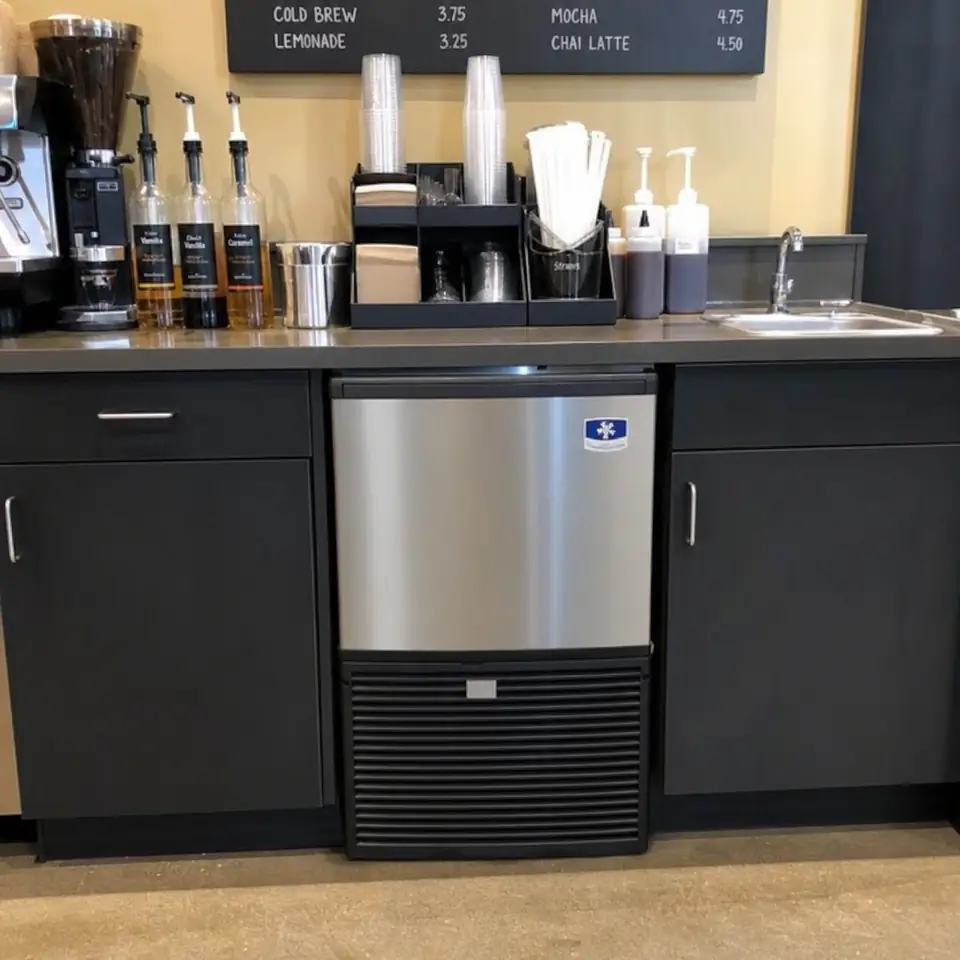
A 15 inch undercounter ice maker is a useful starting point for a narrow opening, but width alone cannot confirm suitability. Check the full cabinet dimensions, adjustable height, connection space, ventilation requirements, and access for maintenance. Manufacturer instructions can specify different clearances at the front, rear, top, and sides.
Measure the finished opening rather than relying on a drawing from an earlier renovation. Include flooring, countertop supports, trim, and anything projecting into the space. Photograph the opening from the front and inside so the installer can see restrictions that a width measurement would miss.
Create a short site record:
- Opening: Clear width, usable depth, and height from finished floor to the underside of the counter.
- Access: Delivery route, narrow doorways, and room to position or remove the appliance.
- Operation: Door travel, scoop access, and the staff position during service.
- Connections: Locations of the water supply, drain, electrical outlet, and any proposed filter.
- Surroundings: Nearby heat-producing equipment and anything that could obstruct the ventilation area.
If you started with a search such as "ice maker 15 undercounter," turn that search into a complete installation brief before choosing. Use "true undercounter ice maker" to mean equipment explicitly approved by its manufacturer for the intended built-in arrangement - not simply a small appliance that appears to fit.
Plan ice maker installation before ordering
Treat ice maker installation as part of the purchase decision. Drainage, water connections, electrical requirements, and site conditions need to match the selected model's instructions. Hoshizaki's installation guidance, for example, requires a level foundation, addresses connection space, and advises against locating the appliance beside high-heat equipment.
Drainage deserves an early check. A gravity-drain arrangement needs the specified route and slope; restrictions can cause water to back up into the bin. Where gravity drainage is unsuitable, a compatible pump arrangement may be an option, but its permitted rise and run are model-specific. Have the installer verify the proposed arrangement rather than assuming a nearby sink resolves it.
Before placing an order, ask your installer to confirm:
- Water supply: The required connection, pressure range, shutoff access, and any suitable treatment.
- Drainage: Gravity or approved pump configuration, discharge location, and applicable installation requirements.
- Electrical supply: The model's voltage, connection method, and circuit requirements.
- Ventilation: The exact clearances and unobstructed airflow specified for that cabinet.
- Commissioning: Who will connect, level, check, and hand over the machine.
Request these checks against the exact model number, not a similar-looking unit. Keep the installation manual with your purchasing documents and ask for clarification wherever the equipment specification and site plan do not agree.
Compare compact alternatives against the same job
Do not treat a portable ice maker, countertop ice maker, and built-in commercial machine as interchangeable simply because each produces ice. Compare the exact models for your intended use, available utilities, operating requirements, and warranty terms. Ask the supplier to confirm commercial suitability in writing rather than inferring it from appearance or product naming.
A compact ice maker may be on your shortlist because floor space is scarce. Before choosing one, define what "compact" must achieve: preserving counter preparation space, fitting a particular opening, or supplying a small secondary drinks station. That distinction helps prevent a size-led purchase from becoming a workflow compromise.
Use the same comparison fields for every candidate:
| Equipment option | Check before shortlisting |
|---|---|
| Undercounter ice machine | Built-in approval, usable bin access, production, storage, and installation requirements |
| Countertop ice maker | Counter footprint, water arrangement, storage capacity, and suitability for the proposed service |
| Portable ice maker | Refill procedure, handling requirements, permitted use, and performance against your measured demand |
| Undercounter fridge with ice maker | Separate refrigeration and ice specifications, accessible storage, and whether both functions meet your brief |
The best ice makers for your business are the ones that pass your requirements - not necessarily the machines with the largest headline output. Keep unsuitable options out of the final price comparison, even if their purchase price is attractive.
Make cleaning and ownership costs part of the shortlist
Ask to see the cleaning procedure before you buy. Manitowoc's NEO instructions distinguish descaling from sanitizing and require a detailed procedure at least every six months for the covered equipment. Follow the selected machine's own schedule, approved products, and instructions rather than borrowing a routine from another model.
Water treatment also needs a specific conversation. Scotsman's guidance explains that suspended particles and dissolved minerals are different issues, and that mineral deposits can require scale removal. Ask which treatment suits your water and machine; do not assume a basic particle filter addresses every water-quality concern.
When reviewing ownership, request a written breakdown covering:
- Equipment and delivery, with a clear statement of what is included.
- Installation work and any changes to existing utilities or cabinetry.
- Required accessories, including compatible drainage or filtration components.
- Cleaning supplies, replacement filters, and planned servicing.
- Warranty coverage, exclusions, and the process for obtaining service.
Give cleaning access the same attention as loading access. Ask who will remove the specified parts, where those parts will be cleaned, and when the task will fit into your trading schedule. A clear maintenance plan belongs in the purchasing decision, not on a list of jobs to solve after delivery.
Bring a decision-ready brief to The Horeca Store
Make your next step a focused equipment enquiry rather than a request for the smallest or cheapest machine. Share your service pattern, measured space, preferred ice format, and installation information. Ask for the exact specification sheet and installation manual for every proposed model so you can compare like with like.
Your enquiry should include:
- Business type, opening hours, and the busiest service window.
- Estimated daily ice demand and the amount needed during the rush.
- Preferred ice type, typical drinks, and glass or cup sizes.
- Opening dimensions, access photographs, and utility locations.
- Whether the machine will serve the whole venue or a secondary station.
- Target budget and required delivery timing, with installation priced separately where appropriate.
Before approving a purchase, check that the proposed model answers each point in your brief. Resolve any uncertainty about drainage, fit, production conditions, or included accessories while changes are still straightforward. Keep the agreed specification and scope together for a clearer handover to your installer.
Contact The Horeca Store with your measurements and service requirements to discuss a suitable undercounter ice machine.