
Choosing a commercial display refrigerator starts with matching the equipment to your products, available space, and daily service demands - not simply picking an attractive cabinet. This article explains how to compare food compatibility, usable capacity, installation requirements, energy consumption, and ownership costs. Whether you are evaluating options from The Horeca Store or another supplier, use these checks to build a shortlist before requesting a quote.
How do you choose the right commercial display refrigerator?
Choose a commercial display refrigerator by defining what you will store, confirming the model is approved for that use, and checking its fit against your busiest trading conditions. Then compare usable shelving, installation requirements, documented energy consumption, and service support. Treat appearance as an important merchandising decision, but not a substitute for suitable refrigeration performance.
Start with a buying brief rather than a product search. Write down your products, package dimensions, expected display quantities, restocking schedule, and proposed installation location. Give every supplier the same information so their recommendations answer the same operational problem.
Use these priorities to narrow the field:
- Product suitability: Request written confirmation that the model supports the food or drinks you intend to display.
- Working capacity: Plan around the quantity needed between realistic restocking opportunities.
- Site compatibility: Compare the installation manual with your available space and electrical supply.
- Customer access: Check how people will browse, open doors, and reach products.
- Ownership costs: Request energy data, warranty terms, and maintenance information before comparing prices.
If a model fails a nonnegotiable requirement, remove it from consideration. A lower purchase price does not resolve an unsuitable application.
Match the commercial cooler to your menu
Avoid treating every glass-front cabinet as interchangeable. For example, a manufacturer's merchandiser specification may restrict its listing to packaged or bottled products; that does not establish suitability for exposed food or every other application. Check the exact model documentation rather than relying on the general label "commercial cooler."
Prepare a product list before speaking with a supplier. Separate bottled drinks, dairy beverages, packaged sandwiches, desserts, and any unpackaged items. Include the manufacturer's storage instructions for each product so the recommended equipment can be assessed against actual requirements.
For foods requiring temperature control for safety, the FDA Food Code generally specifies cold holding at 41°F or below, with defined exceptions. Los Angeles County also provides local inspection guidance covering food holding and refrigeration. Confirm the requirements applicable to your operation with the responsible health authority before purchasing.
Ask whether the proposed unit is intended to hold already-chilled stock or handle your planned loading process. Do not assume a display fridge can cool a large delivery of warm products quickly enough for your operation. Get the manufacturer's loading instructions and design your receiving routine around them.
What size display fridge does your business need?
Your display fridge should hold the stock needed between planned refills while leaving the clearances required by its loading instructions. Determine that capacity from your actual packages and shelf layout, not advertised volume alone. The Department of Energy advises selecting appropriately sized equipment because oversizing increases purchase costs and energy losses.
Build a sample shelf plan using your tallest bottle, widest meal container, and most awkward package. Ask for internal dimensions, shelf dimensions, shelf adjustment intervals, and load limits. A cabinet that looks spacious in a photograph still needs to accommodate your particular assortment.
For a café, you might plan separate shelf areas for bottled drinks, milk-based beverages, and packaged lunches. Decide how many front-facing selections you want and how much stock should sit behind each one. Then ask the supplier to verify that arrangement against the model's loading restrictions.
Plan for replenishment, not just opening stock
Write down who will refill the cabinet and when. If staff cannot leave service during the lunch rush, assess capacity against that entire period rather than the opening display. If frequent replenishment is practical, compare a smaller unit with a larger alternative instead of automatically choosing maximum capacity.
Include realistic seasonal needs, but distinguish confirmed demand from hoped-for growth. Ask yourself which products genuinely need display space and which can remain in separate approved storage. This keeps the purchase focused on the cabinet's actual job.
Check the installation space before ordering
Measure the full delivery route as well as the final location. Record doorway openings, corridors, turns, elevators, and any steps between unloading and installation. Ask for shipping dimensions separately from installed dimensions, and clarify who is responsible for unpacking and positioning the cabinet.
Create a site worksheet covering:
- Installed footprint: Width, depth, and height, including handles, hinges, legs, or casters.
- Operating clearances: The ventilation and service spaces specified for the exact model.
- Door movement: Room for full opening without obstructing the intended customer route.
- Electrical requirements: Voltage, frequency, plug configuration, and circuit requirements from the specification sheet.
- Environmental limits: The manufacturer's permitted ambient temperature, humidity, and location conditions.
Do not borrow clearance figures from a similar-looking commercial fridge. Manufacturers publish model-specific installation documents, and requirements can differ substantially. True Manufacturing, for example, provides separate manuals for different refrigeration families.
Flag nearby cooking equipment, sunny windows, entrance doors, and ventilation outlets when discussing placement. One manufacturer's open-air merchandiser manual explicitly restricts exposure to sunlight and drafts and specifies ambient operating limits. That illustrates why a suitable location must be checked against the chosen model - not assumed from cabinet size.
Choose doors and shelving around the shopping experience
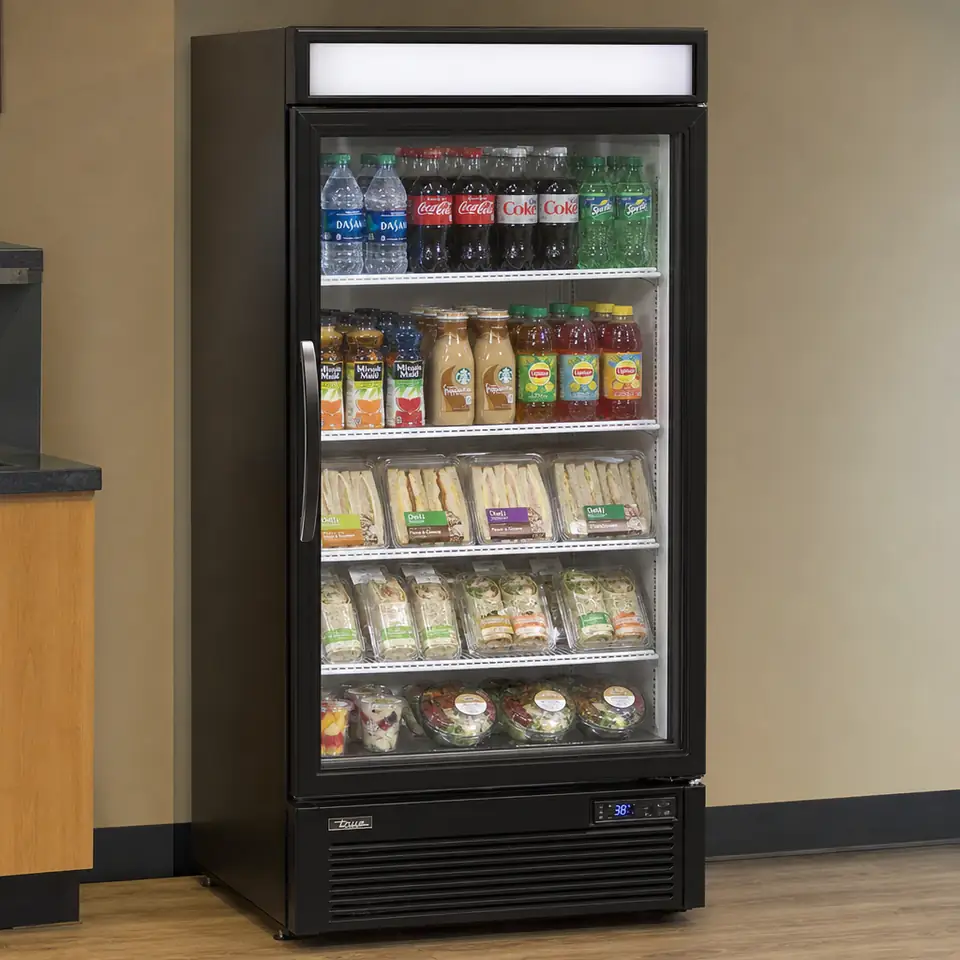
Evaluate a glass door fridge from the customer's position. Can someone identify the products and read prices without opening the door? Try the proposed layout with real packaging, then check visibility from the normal approach direction rather than directly in front of the cabinet.
Compare door configurations using a floor-plan mock-up. Mark the swing of a hinged door with tape and check whether it conflicts with queues, adjacent equipment, or staff movement. For sliding doors, test whether the accessible opening suits your largest products and restocking method.
Closed refrigerated merchandisers use substantially less energy than open merchandisers, according to Department of Energy purchasing guidance. Open access may still be part of your merchandising plan, but compare its documented operating requirements and energy use before deciding.
Ask for a demonstration of shelf adjustment, door closing, lighting, and price-label placement. If you display both tall bottles and shallow food containers, request a proposed shelf arrangement for that mixed assortment. Prioritize an easy-to-shop layout over a photograph showing a perfectly uniform product range you will not actually sell.
Compare energy use and total ownership cost
Use documented energy consumption to compare like-for-like models. ENERGY STAR maintains commercial refrigeration buying resources and a product finder for certified equipment. Verify the exact model rather than assuming every refrigerator from the same manufacturer carries the same certification.
Request the test basis behind published energy figures, especially when comparing different capacities or cabinet formats. A smaller countertop unit and a large upright retail refrigerator are not equivalent purchases simply because both have glass doors. First establish that each candidate can perform the same required job.
For an initial budget estimate, use:
Estimated annual electricity cost = published daily kWh × operating days per year × electricity rate per kWh.
Treat this as a planning calculation, not a guaranteed bill. Ask the supplier how the published test conditions compare with your proposed installation and loading pattern.
Compare the full purchase package, including freight, delivery access, positioning, electrical work, and any separately priced accessories. Request an itemized quotation so a lower equipment price does not conceal excluded services. Then review warranty coverage alongside those upfront costs, rather than treating warranty length as the only measure of value.
How can you verify quality and service support?
Verify quality by checking the exact model's certification, construction details, cleaning access, warranty, and repair arrangements. NSF explains that food-equipment sanitation certification evaluates areas including hygienic design, material safety, and applicable performance requirements. Ask your local authority which certifications and listings are acceptable for the intended application.
Distinguish sanitation certification from electrical safety certification. They address different concerns, and a recognizable mark should not replace checking what the specific certification covers. NSF provides separate guidance on electrical safety testing for commercial refrigeration equipment.
Before ordering, request written answers to these questions:
- Who handles repairs? Identify the service contact and confirm coverage for your installation address.
- What does the warranty include? Separate parts, labor, compressor coverage, travel charges, and exclusions.
- What maintenance is required? Obtain the cleaning schedule and identify tasks requiring a technician.
- Which parts are replaceable? Ask about gaskets, shelves, lights, and controls for the exact model.
- What happens after delivery? Clarify inspection procedures, damage reporting, commissioning, and returns.
Where possible, inspect a sample cabinet. Practice removing a shelf and accessing the areas staff must clean. Record any awkward steps and ask whether the supplied manual explains the procedure clearly; maintenance should be part of the buying discussion, not an afterthought.
Buying a small commercial display refrigerator near Hollywood, Los Angeles
If you are searching for a small commercial display refrigerator near Hollywood, Los Angeles, use location to refine delivery and service arrangements - not to replace the specification checks. Ask each seller whether the quoted model can be delivered to your exact address. Confirm inventory, dispatch timing, and delivery scope directly rather than relying on a search listing.
For a compact café, studio refreshment area, or neighborhood shop, prepare a photo of the proposed installation space and a measured floor plan. Share your product list and planned shelf arrangement with the supplier. This gives the discussion a firmer basis than simply requesting "a small fridge."
Check whether delivery means curbside drop-off or placement inside the premises. Explain stairs, restricted loading access, elevators, and building delivery rules before accepting a quote. Ask whether packaging removal and removal of existing equipment are included or separately available.
For a Hollywood food business, review equipment suitability with the relevant local authority before committing to a model. Los Angeles County's retail food inspection guidance provides a starting point for understanding local food-facility expectations, but it does not replace review of your specific operation.
Make the final choice with a written comparison
Build a shortlist of models that satisfy your nonnegotiable requirements, then compare them on one worksheet. Include approved use, package fit, installed dimensions, clearances, electrical requirements, energy data, delivered price, and service terms. Mark unanswered items clearly instead of filling gaps with assumptions.
Before payment, request the final specification sheet, installation manual, warranty, and itemized quotation. Match the model number across every document, including any relevant suffixes. Keep those documents with your delivery and maintenance records so staff have a consistent reference after installation.
When discussing options with The Horeca Store, share that worksheet and ask for written confirmation of unresolved details. Choose the commercial refrigerator that fits your products, premises, and operating routine - not merely the most attractive listing. A documented purchase decision gives you a clearer path from browsing to installation.