
How Much Does It Cost to Start a Dessert Food Truck?
If you're asking how much does it cost to start a dessert food truck, the honest answer is: it depends on your vehicle, menu, and local rules-but you can absolutely build a reliable startup budget with the right line items. Starting a dessert food truck can be more affordable than opening a full restaurant, but it is still a serious business investment. A realistic dessert food truck startup cost often includes the truck or trailer, dessert equipment, permits, insurance, branding, ingredients, labor, commissary access, and enough cash to operate before sales become steady. Broad estimates often land anywhere from about $40,000 to $200,000 depending on the vehicle, build-out, city requirements, and concept, so the smartest first step is building a local, itemized budget instead of relying on one national average.
What is the realistic dessert food truck cost?
A realistic dessert food truck cost depends on whether you choose a dessert trailer, ice cream truck, or full dessert food truck build.
For many first-time operators, a practical dessert food truck cost may fall somewhere in the middle of the broader range, but the right number depends on what you sell and how you serve it. A shaved ice cart, cupcake trailer, mobile bakery truck, and made-to-order churro truck all have different equipment, health department, power, storage, and staffing needs. The question is not only "How Much Does It Cost to Start a Dessert Food Truck?" but also "What kind of mobile dessert business am I actually building?"
A truck that only serves pre-packaged or commissary-prepared desserts may need less cooking equipment than a truck frying dough, baking on board, or holding frozen products all day. On the other hand, frozen desserts can demand dependable cold holding, generators, backup storage, and careful temperature control. Those details can shift food truck pricing more than the dessert category itself.
Where does the food truck investment go?
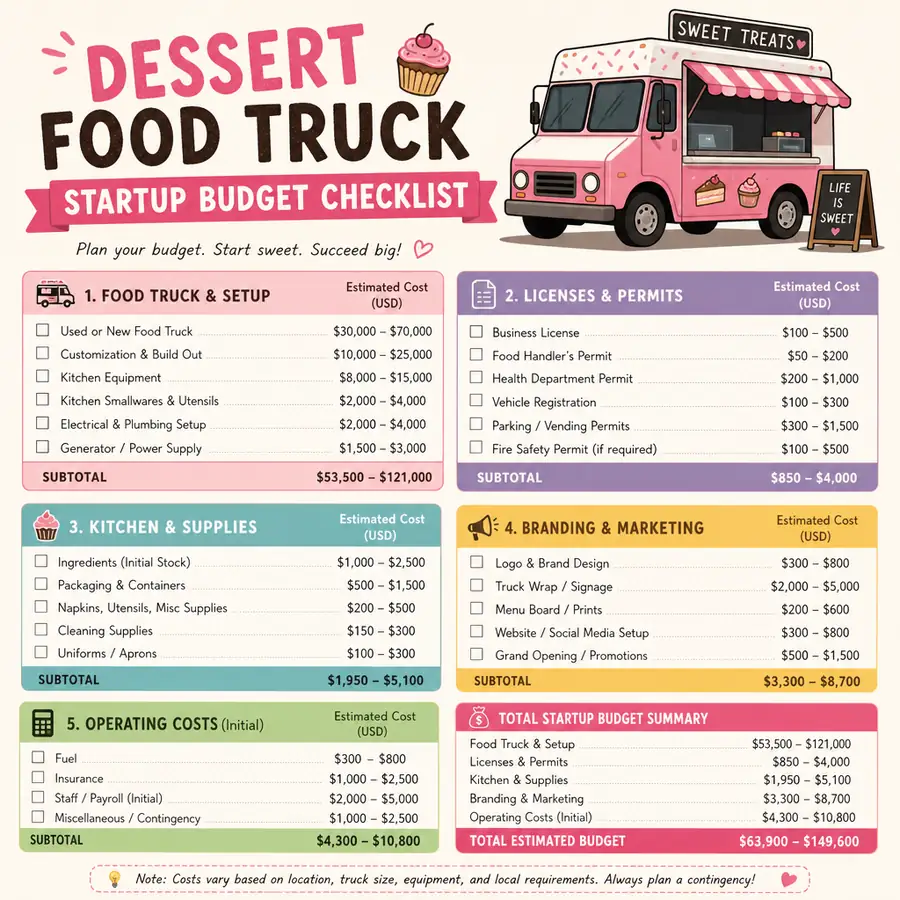
Food truck investment usually splits between the vehicle, dessert food truck equipment, permits, and working capital before opening day.
Your food truck investment usually goes into two big buckets: startup costs and operating costs. Startup costs are the expenses required to open, while operating costs are the recurring food truck expenses that keep the business running after launch. The truck may feel like the main purchase, but it is only one part of the total startup budget.
The truck, dessert trailer, or cart
Compare a dessert trailer versus a full food truck on The Horeca Store before locking in your dessert food truck for sale budget.
The vehicle is usually the largest single line item. Industry startup guides commonly place truck and equipment costs in a wide range because a used truck, custom new truck, trailer, or cart can all produce very different budgets. One small-business food truck report lists total startup costs from $40,000 to $200,000, while another guide notes that a used truck may start around $30,000 and a new fully equipped unit can reach about $150,000.
If you're comparing a dessert trailer (or dessert food trailer) versus a full truck, remember to budget for the full package: towing vehicle needs, power, water setup, storage, and whether your commissary or vending locations allow that format. Some operators lower dessert truck startup costs by starting with a trailer, then upgrading later as bookings grow.
When you shop for a dessert food truck for sale, avoid choosing the cheapest unit first. Choose the simplest unit that can legally and safely support your menu and pass inspection. Retrofitting plumbing, ventilation, electrical systems, propane lines, fire suppression, or refrigeration can turn a "deal" into an expensive project. If you buy used, budget for repairs immediately, not someday.
Dessert food truck equipment and smallwares
Dessert food truck equipment lists often start with commercial refrigeration, ice machines, and restaurant smallwares sized to your menu.
Your dessert food truck equipment list depends heavily on your menu. Ice cream, gelato, milkshakes, mini donuts, crepes, waffles, cupcakes, cotton candy, and baked goods all require different setups. A simple cold-dessert concept may prioritize freezers and insulated storage, while a hot-dessert concept may require fryers, griddles, ovens, warmers, exhaust, and more energy.
Common commercial food truck equipment and supplies may include:
- Commercial refrigeration (refrigerators, refrigerated prep units) and commercial freezer space
- Ovens, fryers, griddles, warmers, or holding cabinets
- Ice machines, soft serve machine or ice cream equipment (if your concept requires it)
- Commercial blender or commercial mixer for batters, sauces, and beverage add-ons
- Food-preparation equipment (cutting boards, prep tables, portioning tools)
- Stainless-steel equipment for durability and easier cleaning in tight spaces
- Three-compartment sinks or handwashing sinks, depending on local rules
- Water tanks, pumps, wastewater tanks, and water heater equipment
- Generator, shore power setup, propane tanks, or battery support
- Restaurant smallwares: utensils, pans, scoops, trays, thermometers, gloves, and cleaning supplies
- POS system, card reader, receipt printer, and menu display materials
When you're building the initial equipment list for your food truck kitchen, it can help to use a single destination to research categories and compare specs (sizes, power requirements, and capacities). For example, The Horeca Store is a useful place to browse commercial refrigeration and freezer options that are commonly needed for a dessert truck-then you can match what you find to your menu, footprint, and local inspection requirements.
This is where menu discipline saves money. Every extra product can require another ingredient, tool, storage space, allergen control step, or preparation process. A tight menu is not only easier for customers to understand; it also protects your startup budget.
Permits, food truck licensing, and inspections
Permits and food truck licensing vary by city, so confirm health department rules before ordering commercial cooking equipment.
Permits vary widely by city, county, and state, so this is one of the hardest areas to estimate from a distance. A dessert food truck may need a business license, mobile food vendor permit, health department permit, food handler or food manager certifications, sales tax registration, fire inspection, vehicle registration, and permission for certain vending locations. Mobile food units may also be subject to food establishment rules, and the need for commissary or support services can depend on menu, operations, and onboard equipment.
Do not wait until the truck is purchased to ask about permits. Health departments may review your menu, floor plan, equipment, water system, storage, and commissary arrangement before approving the unit. If your concept includes dairy, frozen products, fried items, or baked goods prepared in advance, ask specifically how those items must be stored, transported, labeled, and served.
A useful approach is to call your local health department with a one-page concept summary. Include your menu, where food will be prepared, where the vehicle will be stored, how dishes and utensils will be washed, how cold and hot foods will be held, and where wastewater will be disposed of.
Commissary kitchen and storage costs
Commissary kitchen access can affect how much refrigeration and food prep equipment you need onboard the truck.
Many mobile food businesses need access to a commissary kitchen or approved servicing area. Even when most desserts are made on the truck, you may still need a legal place to prep ingredients, refill water, wash equipment, dispose of wastewater, store inventory, or park overnight. The FDA Food Code notes that local authorities may require commissary or support services based on the type of operation and available equipment.
This cost is easy to underestimate because it may not feel as exciting as buying a truck. However, it can affect your schedule every day. If the commissary is far away, you lose time and fuel. If storage is limited, you may make more frequent supply runs. If commercial freezer space is expensive or unavailable, your dessert menu may need to change.
Insurance, professional help, and setup costs
Insurance and setup costs sit alongside restaurant equipment financing decisions when you map startup cash needs.
Food truck insurance can include general liability, commercial auto coverage, property coverage, workers' compensation if you have employees, and event-specific coverage when required by venues. You may also spend money on legal setup, accounting, bookkeeping software, payroll tools, and tax support.
From a tax perspective, the IRS treats business startup costs as expenses incurred before operations begin, and certain startup and organizational costs may be deducted up to a limit while remaining costs may need to be amortized. Equipment and assets with a useful life beyond the year placed in service generally may be handled differently from ordinary operating expenses, so it is wise to ask a qualified tax professional how to track each category before you launch.
Branding, menu design, and launch marketing
Branding and menu design should align with the dessert concept you can actually execute with your ice cream equipment layout.
A dessert truck is a visual dessert food truck business. Customers often decide in seconds whether the truck looks fun, clean, and worth trying. That means your wrap, logo, menu board, packaging, uniforms, photos, and social media presence all matter.
You do not need to overspend on branding at the beginning, but you should avoid looking temporary or confusing. A clear name, readable menu, simple color palette, and strong product photos can help people understand your offer quickly. If you plan to work weddings, festivals, school events, or corporate bookings, your visual presentation may also influence whether organizers take you seriously.
A sample startup budget for planning (food truck startup costs 2026)
Because food truck pricing varies by market, this example is best used as a planning framework rather than a promise. In 2026, used vehicle prices, equipment lead times, and local compliance requirements can still swing quotes significantly-so build your numbers by calling vendors, requesting estimates, and checking local requirements.
A moderate dessert food truck budget may include:
- Vehicle or trailer purchase: the base unit, inspection, repairs, and any needed mechanical work.
- Build-out and equipment: refrigeration, hot or cold dessert equipment, sinks, storage, power, plumbing, and safety systems.
- Permits and licensing: local business registration, health permits, food safety certifications, fire inspections, and vending permissions.
- Commissary and storage: deposits, monthly access, freezer or dry storage, cleaning space, and approved parking.
- Initial inventory: ingredients, packaging, toppings, napkins, cups, cones, labels, and cleaning supplies.
- Insurance and professional services: insurance deposits, accounting, legal setup, bookkeeping, and payroll tools.
- Branding and launch: truck graphics, menu boards, photography, website basics, signage, and opening promotions.
- Working capital: cash reserves for fuel, repairs, restocking, payroll, event fees, and slow sales periods.
Working capital deserves special attention. A dessert truck may have strong weekends and slower weekdays, or great summer sales and softer cold-weather demand. If every dollar goes into the truck, a small repair, rainy event, or delayed permit can create pressure before the business has a chance to stabilize.
Ongoing food truck operating costs after opening
Ongoing food truck operating costs include ingredients, labor, fuel, commissary fees, and maintenance on refrigeration and smallwares.
The cost to start is only half the story. Once you open, monthly food truck operating costs determine whether the business can survive. These costs move with your schedule, menu, event calendar, and staffing plan.
Typical ongoing expenses include:
- Ingredients, toppings, mixes, dairy, flour, sugar, fruit, chocolate, and specialty items
- Packaging such as cups, cones, boxes, spoons, napkins, bags, and labels
- Fuel, propane, generator maintenance, and vehicle repairs
- Commissary rent, parking, storage, water service, and waste disposal
- Insurance premiums, permits, renewals, and inspection-related costs
- Event fees, booking commissions, or vending location fees
- Labor, payroll taxes, uniforms, and staff meals or drinks
- Payment processing fees, POS subscriptions, phone service, and bookkeeping
- Marketing, photography, website updates, social content, and seasonal promotions
Desserts can have attractive margins when recipes are controlled, but waste can quietly eat profit. Track your recipes, portion sizes, and spoilage from day one so your cost of goods sold doesn't drift upward.
Menu choices have a major impact on dessert truck startup costs
Menu choices drive whether you need a soft serve machine, commercial blender, commercial mixer, or extra commercial freezer space.
A dessert food truck is usually easier to budget when the menu is focused. Instead of offering every sweet item imaginable, choose a concept that customers can understand in one sentence. "Mini donuts and coffee," "premium ice cream sandwiches," or "fresh churros with dipping sauces" is easier to operate than a menu trying to cover cupcakes, smoothies, waffles, ice cream, and fried desserts at once.
A focused menu helps you:
- Buy fewer ingredients in larger, more predictable quantities
- Reduce storage pressure on the truck and at the commissary
- Train staff faster and maintain consistent quality
- Shorten service times during events
- Simplify allergen communication and cleaning procedures
- Improve food truck pricing because each item is easier to cost
Seasonality also matters. Frozen desserts may sell quickly in warm weather but need a plan for cooler months. Hot desserts, coffee pairings, cocoa, seasonal toppings, and catering packages can help smooth demand, but each addition should earn its place in the budget.
Comparing commercial equipment without overbuying
Comparing commercial equipment without overbuying keeps your dessert food truck startup cost closer to the lean end of the range.
Once you know your top-selling items (or your initial test menu), you can compare equipment more intelligently. Focus on capacity, footprint, electrical requirements, and cleanability-because in a tight food truck kitchen, a "great deal" that doesn't fit or can't run on your available power becomes expensive quickly.
If you want a straightforward way to compare categories like ice machines, commercial blenders, mixers, or ovens, you can use The Horeca Store as a research starting point to see common commercial options and specs-then confirm compatibility with your truck's power setup, ventilation needs, and your local inspector's requirements.
Smart ways to control startup costs (without cutting corners)
Smart startup cost control may mean buying a used worktop refrigerator or undercounter freezer instead of overbuilding day one.
Cutting costs does not mean cutting corners. It means spending where safety, compliance, and customer experience matter most while avoiding purchases that do not support the first version of the business.
Consider these practical moves:
- Start with a narrow menu. Add products after you know what sells and what your team can execute quickly.
- Price equipment from the menu backward. Do not buy a fryer, freezer, oven, or display case until you know exactly which items require it.
- Get local permit guidance early. A design that works in one city may need changes in another.
- Compare truck, trailer, and cart formats. The best format is the one that fits your menu, locations, towing ability, and legal requirements.
- Build repair money into the purchase budget. Used equipment and vehicles often need attention before they become dependable.
- Avoid over-customizing too soon. A beautiful build-out is less useful than a compliant, efficient layout with room to work.
- Track every pre-opening purchase. Good records make budgeting, tax preparation, and future financing conversations much easier.
Expanding your dessert truck's kitchen capabilities over time
As you learn what sells, you can reinvest in upgrades that increase speed, consistency, or menu range-without turning the operation into a complicated, high-waste build. Common expansion steps include adding more cold storage, improving prep flow, or upgrading smallwares so your team can keep up with event volume.
When you're ready to expand, looking at options for stainless-steel equipment, food-preparation equipment, and restaurant smallwares in one place (for example, The Horeca Store) can make it easier to plan a realistic upgrade list-then you can prioritize what actually improves throughput and reduces bottlenecks.
Break-even point: turning costs into a pricing plan
Break-even planning should include food truck investment payback, daily sales targets, and realistic dessert food truck cost assumptions.
Knowing the cost to start a food truck is useful, but a profitable plan comes from translating those numbers into weekly targets. To estimate your break-even point, list your fixed monthly costs (commissary, insurance, permits, minimum staffing, loan payments if any) and your variable costs (ingredients, packaging, processing fees, fuel). Then use your recipe costing and average ticket size to estimate how many transactions you need per shift to cover your costs.
The real answer: build a local budget and launch plan
Build a local budget and launch plan using itemized dessert food truck equipment, permits, and food truck startup cost line items.
National averages are helpful, but your final number will come from local quotes. Before signing a lease, buying a truck, or ordering equipment, create a budget with three versions: lean, realistic, and comfortable. The lean version shows the minimum to open legally. The realistic version includes repairs, reserves, and marketing. The comfortable version gives you more protection if sales take longer than expected.
If you are still early in the process of how to start a dessert food truck, begin with a simple spreadsheet and collect real numbers for your city. Call the health department, two commissaries, three insurance providers, equipment vendors, local event organizers, and truck builders or sellers. Within a week or two, your dessert food truck cost estimate will become much clearer.
Starting a dessert food truck can be a rewarding path for bakers, pastry makers, ice cream lovers, and creative food entrepreneurs. The strongest operators treat it as both a food business and a numbers business: plan the investment carefully, keep your first menu focused, protect your working capital, and let real costs guide the dream from idea to opening day.