

A standard U.S. half-barrel keg holds 15.5 gallons of beer-enough for about 165 twelve-ounce servings or 124 sixteen-ounce pints before dispensing losses. Smaller kegs hold less, and your actual yield depends on pour size, foam, and spills. This guide compares keg capacity, dimensions, and serving calculations so you can choose a size that fits both your plans and your equipment.
How many beers are in each keg size?
The number of beers in a keg depends on its volume and the size of each serving. A half barrel provides about 165 twelve-ounce beers, a quarter barrel about 82, and a sixth barrel about 55. Those are volume-based counts, not guaranteed numbers of drinks delivered through the tap.
Use the chart below as a starting point. Gallons and fluid ounces throughout this article use U.S. measurements; the pint column means sixteen fluid ounces of beer, rather than simply a glass labeled "pint." Serving counts are rounded down to whole, full-volume servings.
| Keg type | Keg volume | Approximate liters | 12-ounce servings | 16-ounce servings |
|---|---|---|---|---|
| Cornelius keg | 5 gallons | 18.9 | 53 | 40 |
| Sixth barrel, or sixtel | 5.16 gallons | 19.5 | 55 | 41 |
| Quarter barrel, or pony keg | 7.75 gallons | 29.3 | 82 | 62 |
| Slim quarter barrel | 7.75 gallons | 29.3 | 82 | 62 |
| Half barrel, or full-size keg | 15.5 gallons | 58.7 | 165 | 124 |
| European 50-liter keg | About 13.2 gallons | 50 | 140 | 105 |
These capacities describe common formats, but the supplier's stated fill volume should control your calculation. In particular, a liter-sized keg should not automatically be treated as an identically sized U.S. barrel fraction.
A useful takeaway: switching from twelve-ounce servings to sixteen-ounce servings reduces the count by one quarter. The keg has not changed; each drink simply uses more of its contents. For event planning, decide on the pour size before deciding whether a keg is large enough.
Understanding barrel keg sizes and names
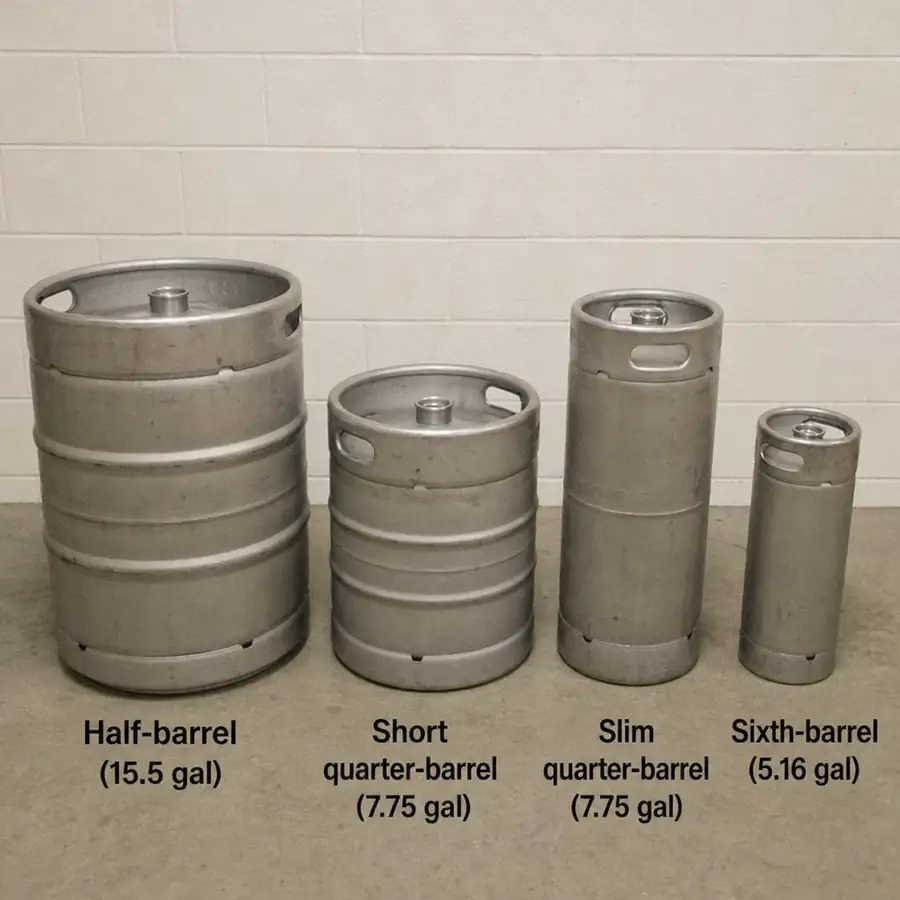
Keg names can make ordering more confusing than necessary. A "full-size keg" commonly means a half barrel, while a pony keg generally means a quarter barrel. A slim quarter holds the same amount as a short quarter barrel despite its different shape.
The safest ordering language combines the name with the capacity: "a 15.5-gallon half barrel" or "a 7.75-gallon slim quarter." This gives the seller something specific to confirm. It also avoids relying on informal terms such as "small keg" or "regular keg."
Think of capacity and shape as separate decisions. Capacity determines the theoretical serving count; shape determines how the container occupies your cooler. Two kegs with equal capacity can require very different storage layouts. Micro Matic's specifications also note that dimensions and weights vary among manufacturers and breweries, and not every beer comes in every configuration.
How do you calculate servings from keg volume?
To calculate servings, divide the keg's total fluid ounces by the ounces of beer in each pour. For a volume listed in U.S. gallons, multiply by 128 first. Round down if you need a count of complete servings, and then make a separate allowance for dispensing losses.
Formula: servings = keg gallons × 128 ÷ ounces per serving
For a 15.5-gallon half barrel, the starting volume is 1,984 fluid ounces. Here is how that translates into different serving sizes before losses:
- Eight-ounce pours: 1,984 ÷ 8 = 248 full servings.
- Twelve-ounce pours: 1,984 ÷ 12 = 165 full servings, with a little remaining.
- Sixteen-ounce pours: 1,984 ÷ 16 = 124 full servings.
- Twenty-ounce pours: 1,984 ÷ 20 = 99 full servings, with a little remaining.
For a keg labeled in liters, the same principle applies: divide its volume in milliliters by the serving size in milliliters. Keeping both sides of the calculation in the same unit avoids conversion mistakes. For example, a 50-liter keg contains 50,000 milliliters, which gives 100 theoretical servings at 500 milliliters each.
Glass capacity is not necessarily pour size
A sixteen-ounce glass does not establish that every drink contains sixteen ounces of liquid beer. Foam occupies space, and the intended serving may leave room below the rim. Manufacturer serving estimates can therefore use different assumptions; Anheuser-Busch's keg reference, for example, includes counts based on sixteen-ounce servings with a one-inch head.
For consistent planning, define the liquid pour you intend to serve. Do not compare a twelve-ounce can-equivalent count with a glass count that includes headspace and assume they measure the same thing. Ask which serving convention a supplier's estimate uses if the numbers look different.
Keg dimensions matter as much as capacity
Keg dimensions determine whether your purchase fits inside a kegerator, refrigerator, or chilled serving space. The figures below are approximate reference measurements, not universal manufacturing standards. Check the actual keg specifications before reserving equipment or arranging pickup.
| Keg type | Approximate height | Approximate diameter |
|---|---|---|
| Sixth barrel | 23.5 inches | 9.25 inches |
| Short quarter barrel | 14.8 inches | 17 inches |
| Slim quarter barrel | 23.3 inches | 11 inches |
| Half barrel | 23.3 inches | 17 inches |
The sixth-barrel measurements come from a specific GW Kent model; the other measurements are examples from Micro Matic's reference specifications. Differences between published charts are a reason to verify the container, not to assume your available clearance will be sufficient.
Leave room above the keg for its coupler and connected lines. As one concrete example, Kegco lists a half-barrel model at 23.25 inches tall but says its D coupler and beer line add 5.5 inches to the overall height. That extra space can decide whether a setup works.
Before choosing a keg, measure:
- Usable interior height: Include the installed tapping hardware, not just the bare keg.
- Floor width and depth: Check the narrowest usable space rather than the appliance's exterior dimensions.
- Access opening: Confirm that the keg can pass through the door or lid opening.
- Space for the complete setup: Account for lines and any gas cylinder stored inside.
Keg types and tapping compatibility
Keg capacity does not tell you which connector to use. Commercial keg valves require matching couplers, and different systems connect differently. Micro Matic recommends confirming the coupler system with the keg seller, distributor, or brewery rather than guessing from the beer's name.
Commercial kegs versus Cornelius kegs
A commercial sixth barrel and a five-gallon Cornelius keg are close in capacity, but they are not interchangeable hardware choices. GW Kent's sixth barrel uses a Sankey tapping valve, while Kegco's five-gallon Cornelius-style model uses ball-lock fittings and an opening lid. Confirm the connections as well as the volume when ordering.
Likewise, do not assume similar-looking commercial couplers are equivalent. Micro Matic identifies the S-system coupler as having a longer, narrower probe than the D system. Ask the seller to name the required system explicitly before collecting rental equipment.
How many kegs should you order for an event?
Estimate the total volume you expect to serve, then compare it with the available keg capacities. Start with the number of adults who expect to choose beer, your chosen serving size, and an event-specific serving estimate. Treat that estimate as a purchasing assumption-not a drinking target.
Here is a hypothetical calculation:
- Estimate demand: Suppose you plan for 40 beer servings altogether.
- Set the pour size: At twelve ounces each, that equals 480 fluid ounces.
- Compare capacities: A five-gallon keg contains 640 fluid ounces, leaving 160 ounces above that estimate before losses.
- Review the assumptions: Adjust for other drink options, uncertain attendance, and the likelihood of leftovers.
A larger example shows why pour size matters. Planning 120 twelve-ounce servings requires 1,440 fluid ounces. Planning 120 sixteen-ounce servings requires 1,920 fluid ounces-very close to a half barrel's 1,984-ounce theoretical capacity, with little room for waste.
If your calculation barely fits, reconsider the format rather than trusting a perfect yield. Ask about a smaller backup keg or packaged beer if flexibility is useful. Also consider splitting the order across styles instead of committing the entire volume to one choice.
Getting more usable servings from your keg
The serving chart describes beer inside the container, not beer successfully poured into glasses. Temperature, pressure, cleanliness, and pouring technique affect dispensing quality. The Brewers Association recommends cold storage around 38°F and warns that even modest warming can cause excessive foaming.
You do not need an invented universal waste percentage to plan sensibly. Instead, leave a practical margin and address the setup conditions that cause avoidable losses. A reliable pour is more useful than an optimistic serving estimate.
Keep the keg cold and pour consistently
Keep the keg cold before service and throughout the event. For temporary setups, Micro Matic advises surrounding the keg with ice in a tub or using a suitable keg jacket, while keeping it out of the sun. Follow the equipment instructions rather than relying on a chilled faucet to compensate for warm beer.
Use clean glassware, hold the glass at an angle to begin, and open the faucet fully rather than throttling it halfway. Bring the glass upright as it fills. Micro Matic's pouring guidance emphasizes these steps for controlled service and an appropriate foam head.
Match the dispensing method to your plans
An air-powered party pump is a same-day serving choice, not a way to preserve leftovers for later. Micro Matic advises finishing a party-pumped keg the same day for best flavor and warns that overpumping creates foam. Pump only enough to maintain a good flow.
For a refrigerated draft setup, follow the brewer's freshness guidance and the equipment's operating instructions. The Brewers Association notes that freshness windows vary by brewer. Do not assume every beer remains at its best for the same number of days after tapping.
Final checks before ordering
Before you commit, get these details confirmed together:
- Beer and fill volume: Identify the exact product and available keg capacity.
- Physical fit: Verify the keg dimensions with tapping hardware installed.
- Connections: Confirm the required coupler or disconnects.
- Cold storage: Decide how the keg will stay chilled before and during service.
- Collection and return: Ask about deposits, included equipment, and return arrangements.
The best keg is not automatically the largest one. Choose enough capacity for your realistic serving estimate, verify that it fits your equipment, and plan for consistent pours. That turns a theoretical beer count into a useful purchasing decision.