
A ghost kitchen needs the same operational discipline as a traditional restaurant, but the equipment plan is shaped around delivery speed, menu consistency, compact work zones, and packaging flow. What equipment do you need for a ghost kitchen? In most cases, the core setup includes refrigeration, food-preparation equipment, cooking equipment, storage, food holding, packaging, dishwashing and sanitation equipment, ventilation, safety equipment, and order-management technology. Order-management technology should include POS systems, printers, and kitchen screens so tickets reach the cooking line without delay.
A strong ghost kitchen equipment list should begin with your menu, not with a shopping cart. The right commercial kitchen gear depends on what you cook, how many orders you expect to produce, how much space you have, and whether you operate one delivery concept or several brands from the same kitchen.
What belongs on a ghost kitchen equipment list?
A ghost kitchen equipment list covers refrigeration, food prep equipment, a cooking line, holding cabinets, disposable packaging, and warewashing.
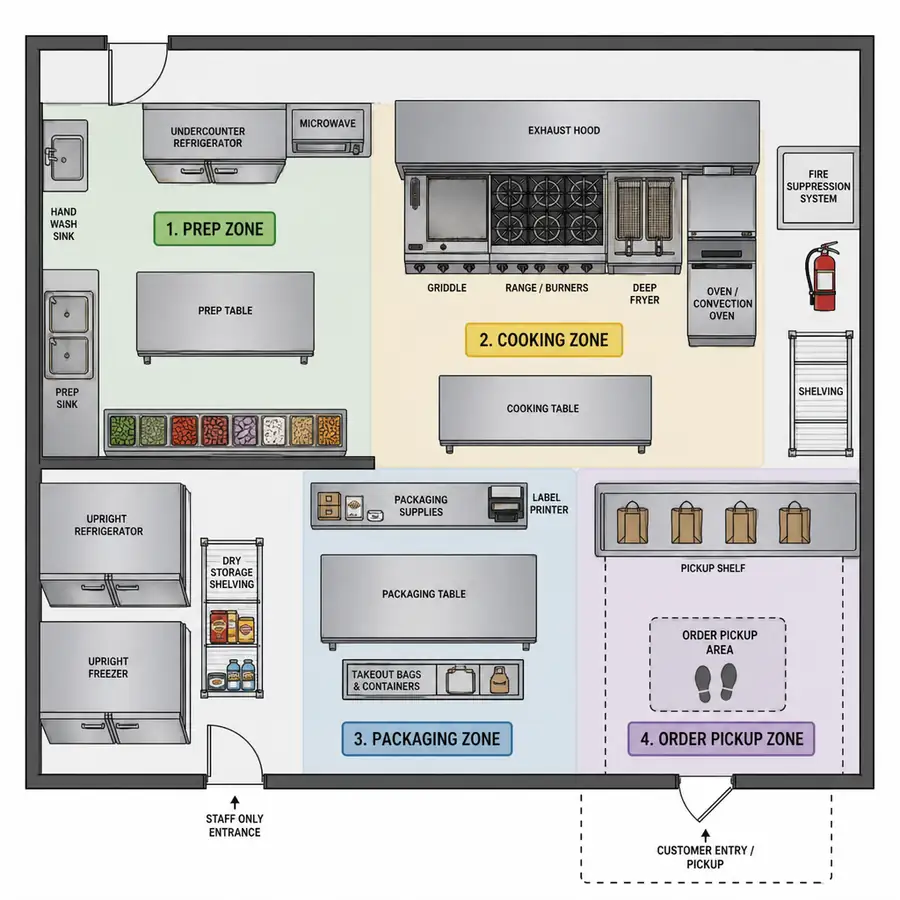
A complete ghost kitchen equipment list includes the tools required to receive ingredients, store them safely, prepare food efficiently, cook menu items consistently, hold orders at the right temperature, package meals for delivery, clean the workspace, and manage incoming digital orders. It is not simply a list of ovens and refrigerators. It is a working plan for how food moves from delivery dock to prep station to cooking line to packaging shelf.
For most operators, the equipment list falls into these essential categories:
- Refrigeration: reach-in refrigerators, freezers, undercounter units, prep tables, and cold storage for ingredients.
- Food prep equipment: worktables, cutting boards, slicers, mixers, processors, scales, and prep sinks.
- Cooking equipment: ranges, ovens, fryers, griddles, charbroilers, steamers, or specialty appliances based on the menu.
- Storage: dry shelving, ingredient bins, smallwares racks, wall shelves, and labeled containers.
- Food holding: hot holding cabinets, heat lamps, warming drawers, and insulated delivery staging systems.
- Packaging: containers, lids, bags, labels, tamper-evident seals, cup carriers, and packing stations.
- Dishwashing and sanitation: commercial sinks, dish machines, handwashing stations, chemical storage, and cleaning tools.
- Ventilation: hoods, exhaust systems, make-up air, grease filters, and fire suppression where required.
- Safety equipment: fire extinguishers, first-aid supplies, floor mats, signage, gloves, and temperature monitoring tools.
- Order-management technology: tablets, POS systems, kitchen display screens, printers, routers, and delivery platform integrations.
This structure helps you avoid two common mistakes: buying appliances before the workflow is clear, and forgetting the less glamorous equipment that keeps the kitchen legal, clean, and efficient. Refrigeration and cooking equipment often get the most attention, but packaging shelves, label printers, hand sinks, and food holding units can have just as much impact on daily service.
Start with the menu before choosing equipment
Start with the menu before choosing equipment so a burger restaurant equipment list, pizza restaurant equipment list, or rice cookers and a combi oven match the brand.
Your menu determines almost everything about the ghost kitchen setup. A pizza concept, a salad brand, a fried chicken kitchen, and a ramen delivery operation all need different equipment, different storage temperatures, different packaging, and different production rhythms. A generic restaurant equipment list can provide a useful starting point, but your final list should reflect the food you actually plan to sell.
Begin by breaking each menu item into its production steps. For example, a rice bowl concept may need rice cookers, refrigerated prep tables, hot holding for proteins, sauce bottles, portion scales, and microwave or combi oven support. A burger brand may need a griddle, refrigeration near the cook line, bun storage, fryers, heat lamps, and a fast packaging area. A dessert delivery concept may need mixers, sheet pans, cooling racks, display-style cold storage, and careful packaging to prevent damage in transit.
Operators planning a ghost kitchen can browse commercial equipment categories from suppliers such as The Horeca Store to compare equipment types and build an initial purchasing checklist. At this early stage, the goal is not to buy everything at once. The goal is to understand which equipment categories matter for your menu and which items are essential from day one.
A practical menu-based planning process includes:
- List every menu item. Include modifiers, sides, sauces, drinks, and add-ons.
- Map the preparation steps. Note what must be washed, cut, marinated, cooked, chilled, assembled, or held.
- Identify shared equipment. Look for appliances and prep tools that can support several items.
- Flag bottlenecks. Find steps that could slow down order production during peak delivery times.
- Match packaging to the food. Choose containers that protect texture, temperature, and presentation.
- Build the equipment list in phases. Separate essential opening items from equipment that can wait until volume grows.
This process turns the kitchen appliances guide into a real operating plan. Instead of asking, "What equipment does a kitchen usually have?" you ask, "What equipment does this menu need to produce accurate delivery orders quickly and safely?"
Refrigeration and cold storage
Refrigeration and cold storage should include reach-in refrigerators, reach-in freezers, undercounter refrigeration, and refrigerated prep tables.
Refrigeration is one of the most important kitchen equipment essentials because it protects ingredient quality, supports food safety, and keeps production moving. A ghost kitchen may not need a front-of-house dining area, but it still needs dependable cold storage for proteins, produce, dairy, sauces, desserts, and prepared components.
Common refrigeration choices include reach-in refrigerators, reach-in freezers, undercounter refrigeration, refrigerated prep tables, walk-in coolers, walk-in freezers, and blast chillers for certain production models. A small delivery-only kitchen may operate with reach-in units and refrigerated prep tables. A multi-brand ghost kitchen or commissary-style operation may need larger walk-in storage and more separated zones for raw and ready-to-eat foods.
When planning refrigeration, think about access as much as capacity. Ingredients used during service should be close to the line, while backup stock can sit in bulk storage. If cooks have to cross the kitchen every few minutes for cheese, sauces, produce, or proteins, the layout will slow down orders and increase traffic in tight spaces.
Important refrigeration considerations include:
- Menu volume: More orders usually require more prepped ingredients within arm's reach.
- Product separation: Raw meat, seafood, produce, dairy, and ready-to-eat items should be organized to reduce cross-contamination risk.
- Temperature monitoring: Thermometers and logs help staff verify that units are operating properly.
- Door traffic: Frequently opened units may need extra capacity or strategic placement.
- Maintenance access: Refrigeration units need space for cleaning, airflow, and service.
A good kitchen inventory list should include both the refrigeration equipment and the storage accessories that make it usable, such as food pans, lids, date labels, shelving, ingredient containers, and thermometers.
Food prep equipment and workstations
Food prep equipment and workstations need worktables, cutting boards, slicers, mixers, food processors, and kitchen equipment essentials within arm's reach.
Food prep equipment creates the foundation for consistent delivery orders. Prep work determines portion control, speed, food quality, and the amount of stress the line feels during peak hours. Even a small ghost kitchen needs enough table space, cutting tools, measuring tools, and holding containers to keep ingredients organized.
Core prep items often include stainless steel worktables, cutting boards, knives, mixing bowls, measuring cups, portion scoops, food scales, food processors, mixers, slicers, prep sinks, colanders, pans, and storage containers. Depending on the concept, you may also need dough mixers, vacuum sealers, rice washers, vegetable cutters, immersion blenders, or specialty prep tools.
The best prep layout supports a clear sequence: receive ingredients, store them, wash or trim them, portion them, label them, and move them into service storage. This sequence reduces confusion and helps staff know where every ingredient belongs. It also makes training easier because the station itself reinforces the process.
Prep equipment that protects consistency
Prep equipment that protects consistency includes cutting boards, slicers, mixers, and portion tools next to the prep tables.
Delivery customers expect the same experience each time they order. Portion scales, ladles, squeeze bottles, scoops, and measuring tools help your team build that consistency. Without them, food cost can drift, packaging can become messy, and customers may receive different portion sizes from one order to the next.
Food prep equipment should also support speed without sacrificing accuracy. For example, a vegetable-heavy menu may benefit from a processor or slicer, while a bakery-style menu may need mixers and sheet pan storage. The right equipment should reduce repetitive labor and help staff prepare enough product before rush periods.
Cooking equipment for the production line
Cooking equipment for the production line may include a griddle, fryers, charbroilers, a commercial range, and convection ovens under an exhaust hood.
Cooking equipment is the center of the ghost kitchen setup, but it should still be chosen according to the menu and available ventilation. A compact kitchen can produce strong volume when the cooking line is focused and uncluttered. A crowded line with too many appliances, however, can create heat, delays, and safety problems.
Typical cooking equipment includes commercial ranges, convection ovens, combi ovens, fryers, griddles, charbroilers, steamers, induction burners, rice cookers, microwaves, pasta cookers, salamanders, and specialty appliances. A fried food concept may depend heavily on fryers and dump stations. A roasted or baked menu may need convection ovens and sheet pan racks. A multi-concept kitchen may need flexible appliances that support several cooking methods.
When reviewing any kitchen appliances guide, pay attention to production capacity, recovery time, utility requirements, cleaning needs, and ventilation. A fryer that cannot recover heat quickly may slow down peak orders. An oven that is too small may force staff to batch food too early. A unit that is difficult to clean may become a burden after every shift.
Matching equipment to order flow
Matching equipment to order flow keeps the cooking line, heat lamps, and packaging station in one straight path.
Ghost kitchens live and die by order timing. The cooking line should allow staff to prepare different parts of the order so they finish together. Fries should not sit too long while a protein cooks, and hot entrées should not wait while cold sides are still being packed.
To improve flow, group equipment around production stages. Keep raw ingredients near the first cooking step, finishing tools near the plating or assembly zone, and hot holding close to packaging. If multiple brands share one line, assign zones by cooking method or by concept so staff do not compete for the same work surface.
Storage systems that keep the kitchen organized
Storage systems that keep the kitchen organized use sheet pans, smallwares, and labeled dry goods away from disposable packaging.
Storage is often underestimated in a restaurant equipment list, yet it affects speed, safety, and waste control every day. Ghost kitchens handle a large number of containers, lids, bags, labels, dry goods, cleaning supplies, and smallwares. Without clear storage, staff waste time searching for items or placing supplies wherever space appears.
A complete storage plan includes dry shelving, dunnage racks, ingredient bins, wall shelves, pan racks, smallwares organizers, chemical storage, packaging storage, and labeled areas for each product category. Heavy ingredients should be stored safely, frequently used items should be easy to reach, and chemicals should be separated from food and packaging.
Good storage also supports inventory control. If backup containers, sauces, dry goods, and packaging are visible and labeled, it is easier to reorder before supplies run out. This matters in a delivery-only operation because one missing container size or lid can disrupt the entire order process.
Useful storage habits include:
- Label shelves by category so staff return items to the same place.
- Use clear bins when visibility helps reduce over-ordering.
- Store packaging away from heat, moisture, and grease.
- Keep high-volume supplies near the packaging station.
- Use first-in, first-out rotation for ingredients with shelf-life limits.
- Separate cleaning chemicals from food, utensils, and disposable packaging.
Food holding and delivery staging
Food holding and delivery staging works when holding cabinets and heat lamps sit next to the pickup shelf.
Food holding equipment bridges the gap between cooking and courier pickup. In a dine-in restaurant, servers may carry plates directly to guests. In a ghost kitchen, orders must be assembled, checked, sealed, staged, and handed off to drivers or delivery partners. Holding equipment helps protect food temperature and quality during that short but critical window.
Hot holding cabinets, warming drawers, heat lamps, heated shelves, soup warmers, and insulated carriers can support different menu types. Cold holding may also be necessary for salads, desserts, drinks, and chilled add-ons. The goal is not to hold food longer than needed, but to prevent quality loss while the order is completed and collected.
Delivery staging should be easy to read at a glance. Orders can be organized by platform, pickup time, courier name, ticket number, or brand. If your kitchen runs multiple virtual brands, clear staging prevents a driver from receiving the wrong bag and reduces the chance of missing items.
Packaging equipment and supplies
Packaging equipment and supplies should include disposable packaging sized to the menu so lids, bags, and labels stay at the pack station.
Packaging is not an afterthought in a ghost kitchen. It is part of the customer experience and part of the operational workflow. The right packaging protects temperature, controls leaks, supports presentation, and helps food arrive as intended.
Your packaging station may include shelves, bagging counters, label printers, receipt printers, heat sealers, tamper-evident labels, portion cups, sauce containers, drink carriers, insulated bags, and organized bins for lids and containers. Packaging should be selected by food type. Crisp items need airflow, saucy items need leak resistance, and premium items may need stronger containers to preserve presentation.
A strong packaging process includes:
- Container matching: Pair each menu item with a container that fits its size, moisture, and temperature.
- Order verification: Use tickets, labels, or kitchen display screens to check every item before sealing.
- Tamper evidence: Seal bags or containers where appropriate to build customer confidence.
- Driver clarity: Label bags clearly so couriers can identify the correct order quickly.
- Supply tracking: Include packaging in the kitchen inventory list so shortages are caught early.
Packaging also affects food cost. Too many container types can create clutter and increase ordering complexity. Too few can damage food quality. The best approach is to standardize where possible while still protecting the specific needs of each menu item.
Dishwashing, sanitation, and cleaning equipment
Dishwashing, sanitation, and cleaning equipment should include a three-compartment sink and a commercial dishwasher sized to peak tickets.
A ghost kitchen may not wash customer plates, but it still creates plenty of dishes. Pans, utensils, cutting boards, mixing bowls, fryer baskets, sheet trays, storage containers, and prep tools all need a reliable cleaning system. Sanitation equipment protects food safety and keeps production from stalling.
Common dishwashing and sanitation equipment includes three-compartment sinks, commercial dish machines, hand sinks, mop sinks, drying racks, sanitizer test strips, cleaning chemicals, trash bins, grease containers, floor mats, brooms, brushes, squeegees, and disposable gloves. Local requirements vary, so operators should confirm what is required for their specific location and kitchen model.
Handwashing stations deserve special attention. They should be accessible, stocked, and separate from food prep sinks. If staff have to walk too far or move around active cooking areas to wash hands, compliance becomes harder during busy periods.
Cleaning tools should have assigned storage. A messy chemical shelf or poorly placed mop bucket can create safety issues and slow down closing tasks. Build cleaning into the equipment plan from the beginning rather than treating it as a final purchase.
Ventilation, utilities, and safety equipment
Ventilation, utilities, and safety equipment start with an exhaust hood matched to fryers, a griddle, and a commercial range.
Ventilation is essential for kitchens that use heat, grease, smoke, steam, or gas equipment. The exact system depends on the cooking equipment, building conditions, and local code requirements. Hoods, exhaust fans, make-up air, grease filters, ductwork, and fire suppression systems may all be part of the setup.
Before buying cooking equipment, confirm what the space can support. Some appliances require specific gas, electric, water, drainage, or ventilation connections. If the utilities are not available, installation can become expensive or impractical. This is one reason operators should plan the equipment list alongside contractors, landlords, designers, or local authorities when needed.
Safety equipment is also part of the core ghost kitchen equipment list. Fire extinguishers, first-aid kits, non-slip mats, wet floor signs, cut-resistant gloves, oven mitts, aprons, temperature probes, and emergency lighting all support a safer workplace. These items may not generate revenue directly, but they help protect staff, ingredients, and the business.
Order-management technology
Order-management technology connects the kitchen to customers, delivery platforms, and internal production. In a ghost kitchen, the screen is often the front door. If orders are missed, duplicated, delayed, or routed to the wrong station, the customer experience suffers.
A basic technology setup may include tablets, a point-of-sale system, kitchen display screens, receipt printers, label printers, routers, stable internet, charging stations, and delivery platform integrations. More complex operations may use order aggregation software, inventory tools, menu management systems, and reporting dashboards.
Technology should support the way the kitchen actually works. A single-brand kitchen may need a simple display and printer setup. A multi-brand ghost kitchen may need separate prep views, production routing, and packaging labels that identify the correct brand. The more concepts you operate, the more important clear order routing becomes.
Technology checklist for delivery operations
Use this checklist when planning the digital side of the kitchen:
- Reliable internet with backup options where possible.
- Enough screens or printers for prep, cooking, and packaging stations.
- Clear ticket formatting with item names, modifiers, and customer notes.
- Label printing for bags, drinks, sauces, or high-volume items.
- Charging and mounting solutions for tablets.
- Staff procedures for paused menus, out-of-stock items, refunds, and remakes.
- Regular menu checks across delivery platforms.
The equipment itself matters, but the process around it matters just as much. Staff should know who accepts orders, who updates item availability, who checks completed bags, and who communicates delays.
How do you build a practical purchasing checklist?
Build a practical purchasing checklist around refrigeration, food prep equipment, the cooking line, and restaurant equipment financing if you phase the buy.
Build a practical purchasing checklist by separating essential opening equipment from helpful upgrades, then validating every item against your menu, space, utilities, workflow, and budget. A good checklist should be specific enough to guide purchasing, but flexible enough to change after site planning, code review, and vendor discussions.
Start with broad categories, then narrow each one into specific items. For example, "refrigeration" becomes one reach-in freezer, two refrigerated prep tables, and labeled food pans if that is what your menu requires. "Packaging" becomes exact container sizes, lid types, bags, labels, and staging shelves. This level of detail helps prevent gaps.
A useful checklist structure includes:
- Must-have equipment: Items required to open and produce the core menu safely.
- Menu-specific equipment: Tools that only apply to certain recipes or brands.
- Compliance-related equipment: Sinks, ventilation, fire safety, sanitation, and other required items.
- Workflow equipment: Shelving, carts, racks, printers, and holding systems that improve speed.
- Backup items: Extra smallwares, thermometers, cords, printer paper, labels, and critical spare parts.
- Future upgrades: Equipment that becomes useful after sales volume grows.
Operators can also use a commercial equipment catalog such as The Horeca Store when researching refrigeration, cooking, food-preparation, ice, beverage, and other equipment categories. Comparing categories in one place can make it easier to spot missing items and refine a preliminary list before speaking with installers or suppliers.
Common setup mistakes to avoid
Common setup mistakes to avoid include undersizing warewashing or skipping holding cabinets until opening week.
Many ghost kitchen problems come from planning the equipment list in isolation. Appliances may look good individually, but the full setup can fail if the line is crowded, packaging is too far away, or refrigeration is not placed where staff need it. The equipment must work as a system.
Common mistakes include:
- Buying before mapping workflow. This can lead to poor placement, duplicate tools, or missing essentials.
- Ignoring packaging volume. Delivery kitchens use large amounts of containers, bags, labels, and lids.
- Underestimating cold storage. Prep-heavy menus often need more refrigeration than expected.
- Forgetting food holding. Orders can lose quality quickly if there is no organized staging area.
- Choosing residential-style equipment. Commercial kitchens typically need equipment designed for frequent use and foodservice conditions.
- Overloading the menu. Too many menu items can require too many appliances, ingredients, and containers.
- Neglecting cleaning flow. Dish areas, trash zones, and mop sinks need room to function.
- Skipping utility checks. Gas, electric, water, drainage, and ventilation must match the equipment plan.
Avoiding these mistakes can save time and reduce stress during opening. More importantly, it can make the kitchen easier to operate once orders start coming in.
A sample ghost kitchen equipment list
A sample ghost kitchen equipment list covers reach-in refrigerators, a griddle, fryers, prep tables, disposable packaging, and a three-compartment sink.
The exact list will change by concept, but the following sample gives you a practical starting point. Use it as a planning framework, not as a fixed purchase order.
Refrigeration and cold storage
- Reach-in refrigerator
- Reach-in freezer
- Refrigerated prep table
- Undercounter refrigerator where space is limited
- Food pans, lids, and date labels
- Thermometers and temperature logs
- Shelving for walk-in or dry-adjacent storage if applicable
Food preparation
- Stainless steel worktables
- Cutting boards and knife sets
- Mixing bowls and measuring tools
- Food scales and portion scoops
- Food processor, mixer, or slicer based on menu needs
- Prep sink if required by the operation
- Sheet pans, hotel pans, and storage containers
Cooking line
- Range, oven, fryer, griddle, charbroiler, steamer, or combi oven based on menu
- Microwave or speed oven if appropriate
- Rice cooker, pasta cooker, or specialty appliance for specific concepts
- Cooking utensils, tongs, spatulas, ladles, and pans
- Oil filtration or grease handling tools if frying
Storage, holding, and packaging
- Dry storage shelving
- Ingredient bins
- Dunnage racks
- Hot holding cabinet or warming shelf
- Heat lamps or warming drawers if needed
- Packaging counter or staging shelf
- Delivery containers, lids, bags, labels, and seals
- Receipt printer and label printer supplies
Cleaning, safety, and technology
- Three-compartment sink or dish machine as required
- Hand sinks with soap and paper towels
- Mop sink, cleaning tools, and chemical storage
- Trash and recycling bins
- Fire extinguishers and first-aid kit
- Non-slip mats and wet floor signs
- POS system, tablets, kitchen display screens, printers, and internet equipment
This sample list should be adjusted after reviewing your space, menu, expected order volume, and local requirements. It is better to create a lean, accurate opening setup than to fill the kitchen with equipment that staff rarely use.
Final planning tips for a stronger setup
Final planning tips for a stronger setup: source the ghost kitchen equipment list from The Horeca Store, then compare how to choose a restaurant deep fryer and commercial dishwashers for restaurants.
A ghost kitchen works best when every piece of equipment supports the path from ingredient storage to delivery handoff. Start with the menu, map the workflow, confirm utilities, plan sanitation, and build a kitchen inventory list that includes smallwares, packaging, technology, and safety supplies alongside major appliances.
The most useful ghost kitchen equipment list is not the longest one. It is the one that helps your team cook consistently, pack accurately, clean efficiently, and keep orders moving during peak demand. Treat your equipment plan as an operating tool, not just a purchasing document.
As you refine your restaurant equipment list, review each item through a practical lens: does it improve speed, safety, consistency, quality, or order accuracy? If the answer is unclear, pause before buying. For early research, The Horeca Store can be a useful resource for exploring commercial kitchen equipment categories and creating a preliminary equipment checklist before you finalize specifications with the right professionals and suppliers.