
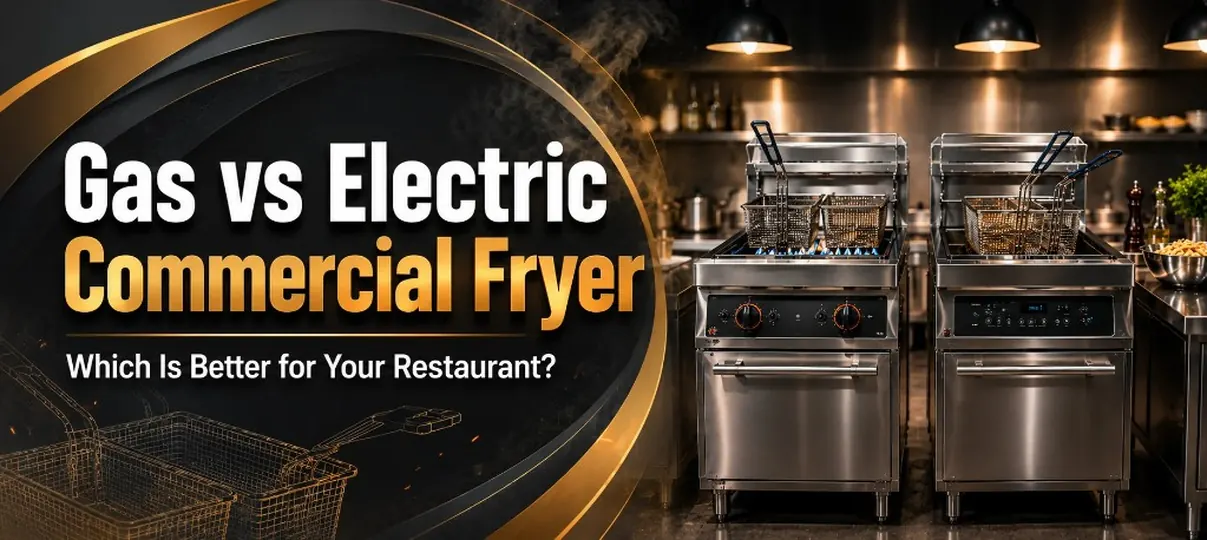
Choosing between a gas and electric commercial fryer comes down to capacity, recovery speed, utility access, ventilation, menu style, and long-term operating costs. A commercial gas fryer is often favored for high-volume kitchens that need fast heat recovery, while a commercial electric fryer can be a strong choice for smaller footprints, precise temperature control, and locations without gas service. This guide gives you a practical deep fryer comparison so you can choose equipment that fits your restaurant instead of buying on price or habit alone.
Which commercial fryer is better for your restaurant?
Pair the fryer with ranges, griddles, and refrigeration so the hot line can keep pace.
The better fryer is the one that matches your menu volume, kitchen infrastructure, and labor workflow. If your restaurant fries continuously through lunch and dinner rushes, a gas commercial deep fryer may be better because it can deliver strong heat output and rebound quickly after cold or frozen food drops into the oil. If your operation needs compact equipment, easier installation in some settings, or more stable temperature control for moderate batches, a commercial electric fryer may be the smarter fit.
A fryer is not just a hot oil tank. It affects food consistency, ticket times, utility bills, ventilation planning, staff safety, oil life, and cleaning routines. Restaurants comparing commercial kitchen fryers should look beyond the purchase price and consider the total working environment: how often the fryer runs, what food it cooks, where it will be installed, and how easily the team can maintain it.
The Horeca Store is a useful destination for operators researching commercial kitchen equipment because it lets buyers think through fryer types alongside other restaurant equipment needs. That matters because a fryer decision rarely stands alone; it usually connects to hood space, prep flow, refrigeration, holding equipment, and the rest of the cookline.
The core difference between gas and electric fryers
Also plan reach-in refrigerators and walk-in freezers for the frozen product that hits the oil.
Gas fryers burn natural gas or propane to heat the oil through burners, tubes, or heat exchangers. Electric fryers use heating elements, often immersed in or positioned around the fry pot, to transfer heat directly into the oil. Both can produce excellent fried food, but they behave differently during installation, peak service, and maintenance.
A commercial gas fryer is commonly evaluated by BTU input, fry pot capacity, recovery time, and whether the kitchen has the proper gas line and exhaust hood. Gas models are often associated with heavy-volume restaurant fryer applications because higher heat output can help the oil recover after large food loads. This is especially important for frozen fries, breaded chicken, seafood, and appetizer-heavy menus.
A commercial electric fryer is often evaluated by voltage, phase, wattage, oil capacity, element design, and available electrical service. Electric models can be attractive in kitchens where gas is unavailable, expensive to install, or impractical. Many operators also like the way electric elements can maintain steady temperatures for repeatable batches.
Neither choice is automatically "best." A fryer that is perfect for a burger restaurant may be wrong for a café, ghost kitchen, hotel pantry, school cafeteria, concession stand, or high-output chicken shop. The right commercial fryer comparison begins with how your kitchen actually works.
Side-by-side deep fryer comparison
A side-by-side comparison should include prep tables and stainless steel work tables beside the fryer.
Use this practical comparison as a quick screening tool before you move into model selection.
A commercial gas fryer is often a good fit when:
A high-output line may also include charbroilers and convection ovens under the same hood.
- You fry continuously during peak periods.
- Your menu includes large batches of frozen products.
- Fast oil temperature recovery is a priority.
- Your site already has adequate gas service.
- You have proper ventilation and exhaust hood capacity.
- Your cookline is built around high-output hot-side equipment.
- Utility pricing makes gas more cost-effective in your area.
A commercial electric fryer is often a good fit when:
Compact kitchens often add an undercounter refrigerator and ice machines near the fry station.
- Your kitchen has limited or no gas access.
- You need a compact countertop or smaller floor model.
- You fry moderate batches rather than nonstop volume.
- Temperature precision and consistency matter more than raw output.
- Your electrical service can support the required voltage and phase.
- You operate in a smaller café, bar, food truck, kiosk, or secondary prep area.
- Installation simplicity may reduce project complexity.
Key tradeoffs to compare before buying:
Tradeoffs also include commercial kitchen supplies and cutting boards for breading and plating.
- Heat recovery: Gas often performs well in high-volume cooking, while electric can be highly stable for controlled batches.
- Installation: Gas requires gas supply and ventilation planning; electric requires sufficient electrical capacity.
- Footprint: Electric countertop fryers can save space, while larger gas fryers often anchor a full cookline.
- Operating cost: Utility rates vary, so calculate based on local gas and electricity pricing.
- Maintenance: Gas burners, tubes, and ignition systems require different care than electric elements and controls.
- Menu flexibility: Both can fry fries, chicken, seafood, and appetizers, but batch size and speed should drive the decision.
This kind of deep fryer comparison helps you avoid a common mistake: buying the fryer that looks powerful on paper but does not match your actual service pattern.
Heat recovery, output, and food quality
Heat recovery matters next to combi ovens when the menu mixes fried and roasted items.
Heat recovery is the fryer's ability to return oil to the target temperature after food is added. When cold or frozen products enter hot oil, the temperature drops. If the fryer cannot recover quickly, food may absorb more oil, cook unevenly, or leave the kitchen with a softer texture than intended.
For high-volume restaurants, recovery time can directly affect ticket speed. A busy kitchen dropping basket after basket of fries, wings, tenders, or onion rings needs a fryer that can maintain service pace. This is where a commercial gas fryer can be compelling, especially when the gas line, BTU rating, and fry pot design support continuous output.
Electric fryers can also produce crisp, consistent food, particularly when the batch sizes are appropriate. Because electric elements can deliver direct heat transfer, they may hold stable temperatures well for measured loads. The key is not to overload the basket or expect a small electric fryer to behave like a large floor-standing unit during rush periods.
Oil temperature consistency also affects product color and texture. If the oil runs too cool, fried food can taste heavy. If it runs too hot, coatings may brown before the interior cooks properly. For any fryer type, staff training, basket loading, thermostat accuracy, and oil management all influence the final plate.
Installation and kitchen infrastructure
Installation planning should leave room for a walk-in refrigerator and an exhaust hood.
The best commercial fryers are not only the ones with strong specifications. They are the ones your building can safely and efficiently support. Before choosing gas or electric, confirm the infrastructure around the fryer.
Gas fryer installation factors
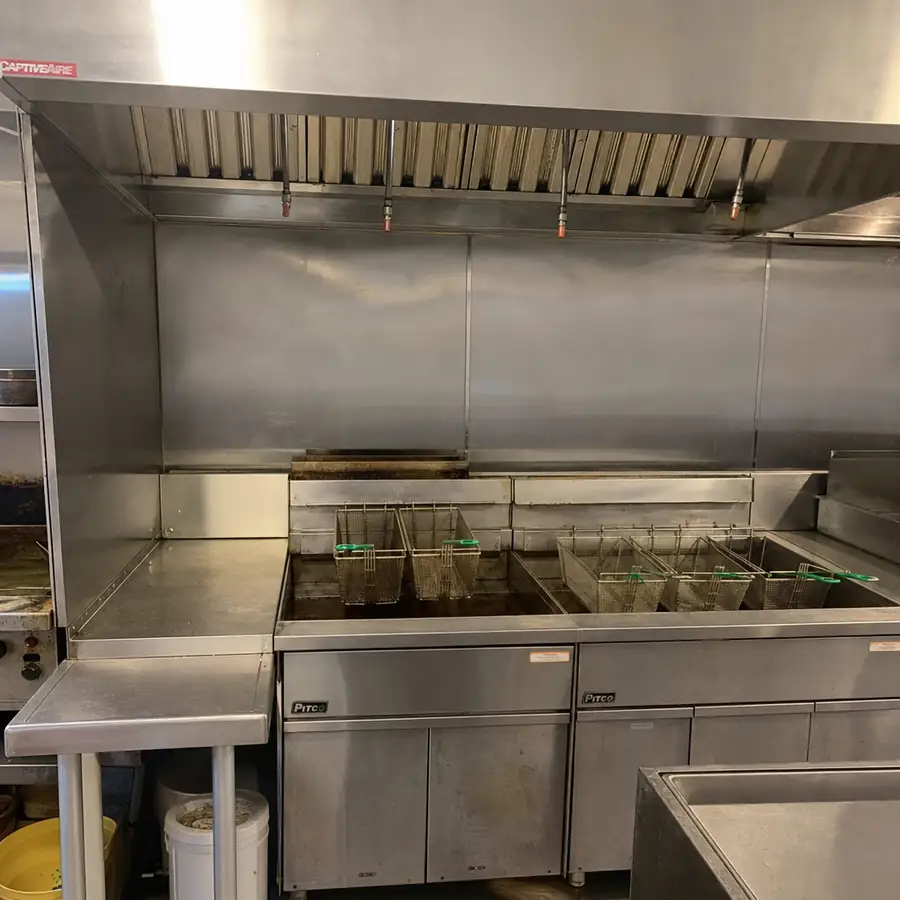
A gas fryer needs a proper natural gas or propane connection, compatible pressure, safe clearances, and ventilation. Many full-size gas fryers also require placement under an exhaust hood because frying produces heat, grease-laden vapors, and odor. Depending on your jurisdiction and kitchen design, fire suppression and code compliance may also influence where the fryer can sit.
Gas equipment can be powerful, but installation should be planned carefully. If a site lacks the correct gas service, the cost and complexity of adding it can change the buying decision. Operators should also consider make-up air, hood capacity, and how the fryer fits into the hot line.
Electric fryer installation factors
A commercial electric fryer may look simpler, but it still needs the correct power supply. Larger models may require specific voltage, amperage, and phase, so operators should verify electrical capacity before ordering. A fryer that cannot be supported by the panel or outlet is not a bargain; it is a project delay.
Electric fryers may be especially useful where gas is not available or where smaller frying stations are needed. Countertop models can support cafés, bars, concession menus, or backup frying tasks. Still, the kitchen must account for heat, grease, cleaning access, and safe workflow around the unit.
What should you check before choosing a commercial fryer?
Check restaurant equipment financing if the fryer, hood, and refrigeration land in one opening budget.
Before choosing a fryer, check your menu volume, available utilities, hood space, oil capacity needs, cleaning expectations, and staff workflow. A fryer that fits these conditions will usually perform better than one selected only by brand, price, or appearance. Use the checklist below to narrow your options before comparing individual models.
Commercial fryer buying checklist:
Use the checklist with a commercial kitchen layout so baskets, oil, and staff do not block the aisle.
- Menu demand: List every fried item and estimate peak-hour portions.
- Batch size: Decide whether you need small, frequent drops or large-volume baskets.
- Oil capacity: Match the fry pot size to your production needs without oversizing unnecessarily.
- Recovery speed: Consider how quickly oil must rebound during rush periods.
- Utility access: Confirm gas type or electrical requirements before purchase.
- Ventilation: Check exhaust hood space, fire suppression, and local code needs.
- Footprint: Measure the cookline, aisle clearance, landing space, and service access.
- Cleaning: Look for drain valves, removable baskets, accessible components, and smooth surfaces.
- Oil filtration: Decide whether built-in or external oil filtration makes sense for your volume.
- Future growth: Choose equipment that supports realistic expansion without wasting space today.
This checklist is also helpful when browsing restaurant equipment through The Horeca Store, because it gives you a clear framework for comparing commercial kitchen fryers instead of clicking through options without a plan.
Operating costs and oil management
Operating cost belongs in the restaurant kitchen equipment cost plan, not only the fryer invoice.
The operating cost of a fryer includes more than gas or electricity. Oil usage, labor, downtime, cleaning supplies, ventilation impact, and replacement parts all contribute to the real cost of ownership. A low purchase price can become expensive if the fryer slows service, burns oil quickly, or is difficult for staff to clean.
Utility costs depend on local rates and usage patterns. In some areas, gas may be less expensive for high-volume cooking. In others, electricity may be competitive, especially for moderate use or where gas installation would be costly. Rather than relying on a general rule, compare the expected run time, recovery demands, and local utility prices.
Oil management is just as important. Fryer oil breaks down from heat, food particles, breading, salt, moisture, and time. Good filtration routines can extend oil life, improve flavor consistency, and reduce waste. Whether you choose gas or electric, consider how your team will skim, filter, drain, refill, and clean the fryer during normal operations.
Oil care practices that improve fryer performance:
Oil care is easier when smallwares for filtering and skimming are stored at the station.
- Skim crumbs and floating debris regularly.
- Avoid overloading baskets, which stresses the oil and slows recovery.
- Filter oil on a schedule that matches cooking volume.
- Keep salt and seasoning away from the fry pot whenever possible.
- Cover oil when the fryer is not in use, if appropriate for your operation.
- Train staff to recognize dark, smoking, foaming, or off-smelling oil.
- Clean the cold zone, fry pot, baskets, and surrounding surfaces consistently.
A fryer with good oil filtration features may cost more upfront, but it can support better food quality and smoother daily routines in busy kitchens.
Safety, ventilation, and staff workflow
Safety planning includes a three-compartment sink for utensils that touch raw batter and oil.
Commercial frying involves hot oil, heavy baskets, grease vapor, and fast movement on the cookline. Safety should shape the buying decision just as much as output. The right fryer should give staff enough working room, clear controls, stable basket support, and safe access for draining and cleaning.
Ventilation is central to both gas and electric frying. Gas fryers may have combustion-related ventilation needs in addition to grease and heat removal. Electric fryers still produce heat and grease-laden vapor, so they should not be treated as ventilation-free equipment unless a specific approved setup says otherwise.
Workflow matters during the rush. Staff need nearby freezer or prep access, landing space for cooked products, a place for seasoning, and a safe path for moving baskets without crossing clean prep zones. A fryer placed awkwardly can create bottlenecks, spills, and inconsistent food even if the equipment itself is high quality.
Practical workflow questions to ask:
Workflow questions should cover food preparation equipment used to bread, portion, and stage product.
- Can staff load and unload baskets without twisting or reaching across other equipment?
- Is there enough space for draining, seasoning, and plating?
- Are raw and cooked products separated clearly?
- Can oil be filtered or drained without blocking the cookline?
- Are controls easy to see and adjust during service?
- Is the fryer close enough to holding equipment for quick transfer?
These details are easy to overlook, but they shape how the fryer performs in real service.
How do you decide between gas and electric for your menu?
Read how to choose a restaurant deep fryer before you lock the fuel type.
Decide by matching fryer type to your highest-pressure use case, not your quietest day. If the fryer must keep up with nonstop fries, wings, chicken, or seafood during peak periods, prioritize recovery, capacity, oil filtration, and ventilation. If the fryer supports a lighter menu or secondary station, a commercial electric fryer may provide the control and footprint you need without overbuilding the line.
Choose gas when volume is the main driver
A commercial gas fryer often makes sense for restaurants where fried food is central to revenue. Think quick-service restaurants, pubs with heavy appetizer sales, chicken concepts, fish-and-chip menus, diners, and high-volume institutional kitchens. The priority is keeping oil hot and tickets moving when large cold loads hit the fry pot.
Gas may also make sense when the kitchen already has the right infrastructure. If gas lines, hood space, and fire suppression are already in place, the installation path may be straightforward. In that case, the decision shifts toward size, capacity, BTU output, drain design, and filtration options.
Choose electric when control, space, or access matters most
A commercial electric fryer can be a smart option for smaller restaurants, cafés, kiosks, bars, food trucks, and kitchens with limited gas access. It can also work well as a supplemental fryer for gluten-free items, desserts, appetizers, or specialty products that should not share oil with the main fry station. For moderate loads, electric models can deliver consistent results with a smaller footprint.
Electric may also simplify planning in certain locations, but only if the electrical service is adequate. Always confirm requirements before buying. A countertop fryer that seems compact still needs safe placement, cleaning access, and ventilation planning.
Common mistakes when buying commercial kitchen fryers
Many fryer problems begin before the first batch is cooked. Operators often focus on the initial equipment price and overlook capacity, recovery, cleaning, and installation. Avoiding these mistakes can save money and reduce frustration later.
Mistakes to avoid:
- Buying too small and forcing staff to overload baskets.
- Buying too large and wasting oil, space, and energy.
- Ignoring hood space, gas connections, or electrical requirements.
- Choosing a fryer without considering oil filtration and cleaning routines.
- Comparing only purchase price instead of total operating cost.
- Forgetting landing space for cooked food and safe basket handling.
- Using one fryer for incompatible foods that transfer flavor or allergens.
- Assuming all "commercial" fryers are suitable for heavy restaurant use.
A thoughtful commercial fryer comparison should include how the fryer will behave on your busiest shift, not just whether it can cook a test batch in ideal conditions.
A simple decision framework
If you are still deciding, work through this short framework with your chef, facilities lead, or equipment supplier.
Start with the menu: Identify whether fried food is a core category or a side function. Core categories usually justify larger, more durable equipment with better recovery and filtration.
Match the peak load: Estimate the busiest hour, not the average hour. A fryer that performs only during slow periods will create delays when the dining room is full.
Confirm utilities and code needs: Check gas, electric, exhaust hood, fire suppression, and clearance requirements before comparing models. Infrastructure can determine what is practical.
Plan the cookline: Map where frozen product, breading, baskets, dump station, seasoning, and holding will sit. Good placement reduces labor stress and improves consistency.
Compare ownership costs: Include oil, utilities, cleaning time, maintenance, and expected volume. The best commercial fryers support profitable service, not just good specs.
Shop with a defined requirement list: Once you know your capacity, utility, and workflow needs, it becomes easier to evaluate options from suppliers such as The Horeca Store and choose commercial kitchen equipment that fits the operation.
Final recommendation
For high-volume frying and continuous peak demand, a commercial gas fryer is often the stronger choice when the building supports it. For smaller spaces, moderate production, specialty frying, or kitchens without practical gas access, a commercial electric fryer can be more suitable. The right answer in a gas vs electric commercial fryer decision is not universal; it depends on your menu, utilities, ventilation, staff workflow, and growth plans.
Before buying, document your peak-hour volume, check installation requirements, and decide how your team will manage oil filtration and cleaning. When those pieces are clear, the fryer decision becomes much easier: choose the unit that keeps food consistent, service moving, staff safe, and the kitchen efficient.