
A fried chicken truck needs more than a fryer: your equipment plan must cover cold storage, preparation, cooking, sanitation, fire protection, and service. This fried chicken food truck equipment checklist helps you organize those purchases around your menu and workflow. Use it to prepare a purchasing list, then confirm the layout and equipment requirements with your local health and fire authorities before ordering.
What equipment does a fried chicken food truck need?
A fried chicken food truck needs commercial frying equipment, refrigeration, separate raw and cooked food handling tools, temperature monitoring, handwashing and warewashing facilities, approved utilities, and appropriate fire protection. Packaging, secure storage, cleaning supplies, and an order-management system complete the operating setup. Treat this as a planning framework rather than a universal permit checklist: food safety rules are adopted and enforced by individual jurisdictions.
Start your mobile kitchen equipment list with these categories:
Mark each item as required for opening, menu-dependent, or future upgrade. For example, ask whether your proposed frozen menu items require onboard freezer storage rather than automatically buying a freezer. Keep the initial plan focused on what you will actually prepare and sell.
How should you choose the right fryer?
Choose a fryer by testing how it handles your chicken recipe, batch size, and busiest service period-not simply by comparing tank capacity. Ask suppliers for suitable models, utility requirements, cleaning procedures, and a demonstration using a comparable product. Manufacturer training materials treat temperature recovery and filtration as operating considerations, so include both in your evaluation.
Match the fryer to your menu
Write down whether you will sell bone-in pieces, wings, tenders, sandwiches, or a combination. Then ask the manufacturer to confirm suitable batch loads, basket arrangements, and cooking procedures for each product. If considering a pressure fryer, request a separate review of its operating instructions, training needs, and installation requirements rather than treating it as interchangeable with an open fryer.
Build your comparison around practical questions:
- Batch performance: Can the proposed fryer handle your planned portions during a realistic service test?
- Menu overlap: Will chicken and sides compete for the same frying space?
- Installation: Will the model fit the approved layout, utilities, and fire-protection arrangement?
- Cleaning access: Can staff reach the drain, filter components, and surrounding surfaces?
- Support: Who will service the unit, and which replacement parts should you keep available?
Ask for written answers and model-specific documentation before committing. A successful cooking demonstration should be followed by an installation review, not treated as approval for the truck itself.
Include oil management in the purchase
Plan for skimmers, compatible filtration supplies, protective equipment specified by the manufacturer, and a suitable used-oil handling arrangement. Filtration removes accumulated crumbs and impurities, but the equipment and procedure depend on the fryer. Follow its manual rather than improvising with containers or adopting another operator's schedule.
Refrigeration and temperature-control essentials
Plan refrigeration around the food you expect to carry between approved restocking opportunities. List raw chicken, marinades, prepared sides, sauces requiring refrigeration, and any other temperature-controlled ingredients. Use that inventory to discuss cabinet size and shelf layout with your equipment supplier and reviewing authority.
Keep raw chicken and its juices separate from cooked food and ready-to-eat ingredients. Use covered, leak-resistant containers and an arrangement that prevents drips onto other products. CDC guidance also calls for separate cutting boards and a food thermometer to verify chicken reaches 165°F internally.
Include these monitoring and storage items:
- Refrigerator thermometers for checking cabinet conditions.
- A suitable probe thermometer, plus a backup and calibration supplies.
- Covered food-grade containers that fit the proposed shelves.
- Labels and a temperature-recording method suited to your procedures.
As a planning reference, the FDA's 2022 model Food Code specifies cold holding at 41°F or below and hot holding at 135°F or above for applicable foods. Confirm the rules your jurisdiction enforces, including any proposed cooling or reheating process. Do not assume a storage refrigerator is suitable for cooling large batches of cooked food.
Preparation stations and chicken cooking tools
Sketch a preparation sequence before choosing the worktable: refrigerated storage, raw chicken preparation, breading, frying, then cooked-food assembly. Ask your reviewer to assess how that sequence separates raw ingredients from ready-to-eat food. CDC's chicken guidance emphasizes preventing cross-contamination through separate surfaces and proper cleaning.
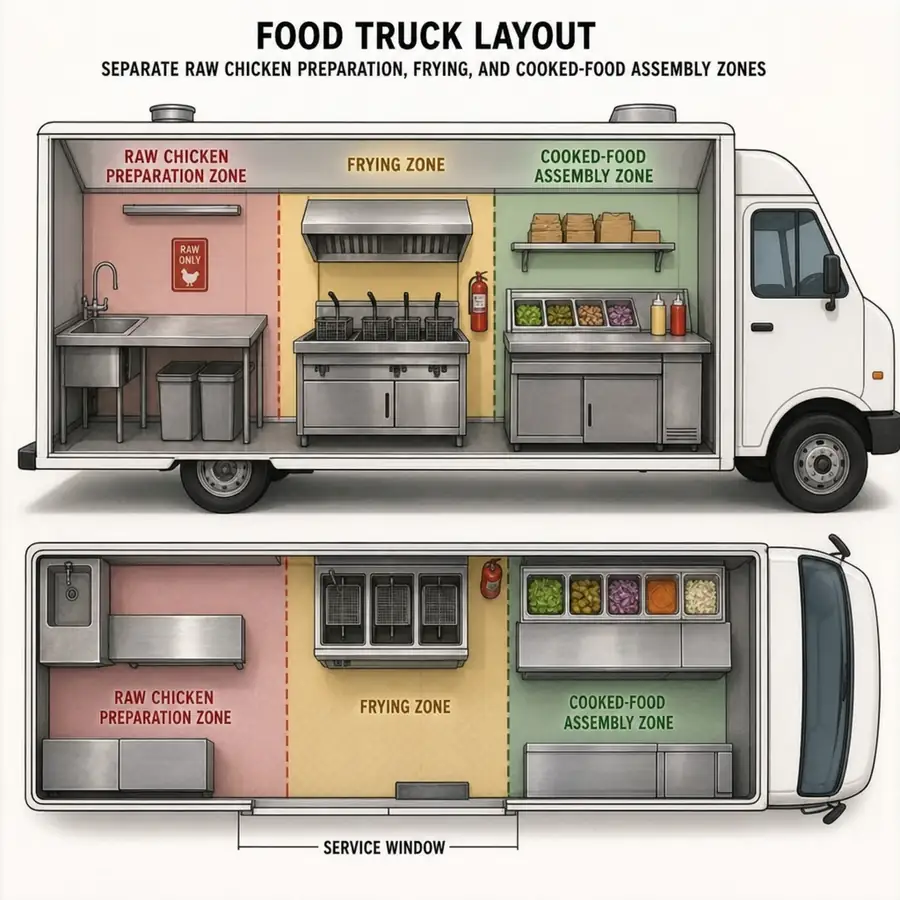
For your chicken cooking tools, consider:
- Breading pans or lidded containers: Specify sizes that fit both the work surface and storage area.
- Portion scales and measuring tools: Include them in recipe testing and portion planning.
- Separate tongs and cutting boards: Assign tools to raw preparation and cooked-food service.
- Sheet pans and racks: Identify separate uses for raw product staging and finished food.
- Timers and probe thermometers: Build both cooking-time tracking and temperature verification into the station.
Color coding can support your separation system, but train employees on the actual assignments rather than relying on color alone. Keep clean utensils accessible without reaching across raw chicken preparation. Verify the complete arrangement during a mock service, including where used utensils go before washing.
Handwashing, warewashing, and cleaning supplies
Include sanitation infrastructure in the first layout draft, not whatever space remains after the appliances. Mobile food guidance addresses accessible handwashing, suitable water supplies, utensil cleaning, waste handling, and chemical storage. Exact sink configurations and water capacities require local confirmation.
Your sanitation planning list should cover:
- A dedicated handwashing sink with soap, disposable towels, and required signage.
- A locally approved warewashing arrangement sized for your utensils and pans.
- Potable-water storage, pump, water heater, and suitable supply connections.
- Wastewater storage and an approved disposal arrangement.
- Approved sanitizer, matching concentration test strips, detergent, and cleaning tools.
- Labeled chemical storage separated from food and single-use supplies.
Have the reviewing authority confirm the specifications rather than copying another truck's setup.
Before finalizing purchases, compare your largest basket, pan, and cutting board with the proposed washing facilities. Ask where clean items will air-dry and where dirty equipment will wait without obstructing food preparation. Also document where you will refill water and dispose of wastewater, grease, and garbage; those arrangements belong in the operating plan.
Ventilation and fire protection belong in the initial design
Have a qualified installer and the local fire authority review the cooking line before you buy food truck appliances. NFPA guidance calls for fire-extinguishing protection for appliances producing grease-laden vapors, appropriate portable extinguishers, and employee training. Local requirements determine the approved installation and inspection process.
Ask for a coordinated proposal covering the hood, ductwork, exhaust, replacement air where required, automatic suppression, and fuel or power shutoffs. Include a Class K extinguisher for cooking-oil hazards and any additional extinguishers required locally. Confirm service access, inspection documentation, and cleaning responsibilities before accepting the installation.
Staff training should cover the suppression system, portable extinguishers, fuel shutoffs, and emergency notification. Keep exit routes and emergency controls accessible in the proposed layout. Review these points again whenever the cooking arrangement changes rather than assuming the original approval covers a different appliance configuration.
Power, fuel, and vehicle-fit checks
Create an equipment schedule listing each model's dimensions, weight, electrical demand, fuel type, and required clearances. Give it to the truck builder and qualified tradespeople for review. Ask them to verify the complete installation, including appliance securement and fuel connections, against the applicable requirements.
Use these questions during that review:
- Can the proposed power system support the equipment operating together?
- Where will approved fuel storage and accessible shutoffs be located?
- Can doors, drawers, and service panels open without blocking work or exits?
- What restraint system is needed for each appliance during travel?
- Where will generator exhaust discharge, and how will the public be kept clear?
Require documented answers rather than relying on a verbal assurance that everything fits. NFPA guidance addresses generator separation, refueling practices, fuel-system checks, and exhaust placement; these are safety decisions, not just convenience choices.
Service equipment and everyday food truck supplies
Make a separate ordering list for the food truck supplies used during each shift. Include chicken boxes, sandwich packaging, side containers, sauce cups, napkins, bags, labels, receipt paper, and replacement cleaning supplies. Then assign a storage location and reorder point to each item so the opening inventory becomes a repeatable purchasing routine.
Test packaging with the actual menu before placing a bulk order. Pack a representative meal, carry it for your expected takeaway period, and evaluate texture, leakage, portion fit, and ease of eating. Record the result alongside the packaging cost rather than choosing by appearance alone.
For order handling, consider a point-of-sale device, charging arrangement, receipt printer or kitchen display, and a backup method for recording orders. Rehearse who takes payment, who reads tickets, and who hands out completed meals. Keep packaging and other single-use items protected from contamination, and keep payment handling separate from raw chicken tasks in your workflow.
Purchase in stages and rehearse the complete setup
Organize food truck essentials into three purchasing stages: approved infrastructure, menu-critical equipment, and optional upgrades. Use this sequence to keep decisions tied to the operating plan. Hold off on a larger menu or extra appliances until you have tested the opening setup.
When comparing quotes from suppliers such as the horeca store, request model-specific documentation rather than relying only on product descriptions. Ask about dimensions, utility connections, included accessories, warranty terms, delivery arrangements, and service availability. Have your builder and reviewing authorities check the proposed models before you authorize substitutions.
Finish with a complete rehearsal:
- Load the planned inventory: Check container fit, storage assignments, and access.
- Run representative orders: Observe preparation, frying, assembly, payment, and pickup.
- Verify safety procedures: Practice temperature checks, utensil separation, and handwashing.
- Perform cleanup: Confirm washing, drying, oil handling, and waste arrangements.
- Revise the purchase list: Address missing tools or awkward steps before adding upgrades.
Use the rehearsal to test procedures as well as purchases, while retaining the required food-safety and manufacturer instructions.
Build around the workflow, not the shopping cart
Finalize your menu, get the layout reviewed, and purchase equipment that supports the entire shift-from refrigerated storage through cleanup. Use the checklist as a working document with model numbers, approval notes, and assigned responsibilities. The goal is a complete, workable kitchen, not the longest equipment list.