
Buying food truck supplies and equipment starts with your menu, available space, and service plan-not a catalog of appliances. This guide helps you build a practical purchasing list, compare equipment, and account for the small supplies that keep orders moving. Use it to separate opening-day essentials from upgrades that can wait. The Horeca Store carries the cooking line, cold storage, and service pieces this purchasing list covers.
What food truck supplies and equipment do you actually need?
Your purchasing list should cover cooking, refrigeration, food preparation, washing, storage, service, and safety, with each item tied to your operation. There is no universal shopping list: the FDA's mobile food establishment guidance bases equipment considerations on the menu and operating model and directs operators to their local regulatory authority for specific requirements.
Start by writing down every step required to produce each dish. For a wrap, that might include receiving ingredients, refrigerating fillings, chopping vegetables, cooking proteins, assembling orders, and packaging the finished meal. Assign equipment and supplies to those steps, then look for tools shared across several menu items.
Take a 360-degree view of the food truck supplies needed, including the less visible tasks: refilling soap, storing clean utensils, collecting wastewater, and replacing receipt paper. Build your first inventory around these categories:
Confirm requirements before committing to purchases
Before paying deposits, submit your menu, proposed layout, and equipment specifications to the relevant reviewing authorities. The FDA Food Code is a model used by jurisdictions, not a substitute for checking locally adopted rules. Its mobile guidance also recognizes that commissary or servicing-area needs depend on the operation and available facilities.
Ask about equipment acceptance, sink arrangements, water systems, food preparation locations, and plan-review documentation. Keep written responses with your supplier quotes so you can compare the proposed purchase against the reviewed plan.
Treat fire review as a separate purchasing checkpoint. NFPA's food truck safety guidance addresses cooking equipment, exhaust and suppression systems, propane, generators, and extinguishers. Ask the fire authority and qualified installer to confirm the arrangement before choosing appliances or modifying fuel systems.
Request an itemized installation scope. Specify who handles delivery, mounting, utility connections, testing, and any required inspections. Do not assume an equipment quote includes those services.
Build a layout around the way orders move
Sketch a working route from storage to preparation, cooking, assembly, and pickup. Then trace the return route for dirty utensils and waste. Use the drawing to identify where employees would cross paths or carry items through another workstation.
Measure more than the appliance footprint. Record doorway dimensions, handle projections, opening doors, service access, and manufacturer-required clearances. Ask the builder to check vehicle loading and equipment placement, including the planned load of water, ingredients, fuel, and staff.
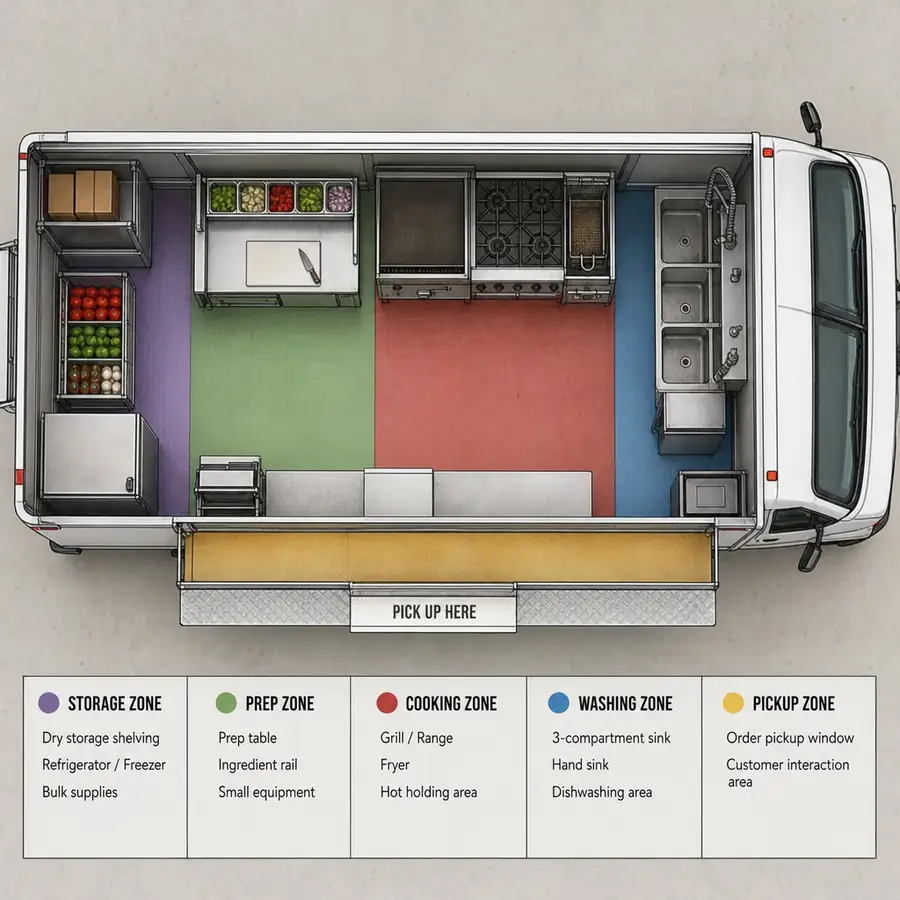
Before approving the layout, mark workstations with tape and rehearse several orders. Have one person assemble meals while another retrieves ingredients and packages orders. Note every awkward reach, blocked drawer, or repeated crossing, then revise the plan before installation.
Bring your actual pans, ingredient bins, and packaging samples to this rehearsal. A counter may appear generous until open containers and assembled orders occupy it. Decide where each item belongs during service and where it will be secured for travel.
Choose cooking equipment and refrigeration together
Evaluate the cooking line against the complete menu rather than buying one appliance per dish. For a proposed griddle menu, list every item that would compete for its surface during a rush. Ask suppliers to demonstrate representative batches and explain cleaning, recovery, and maintenance procedures.
Match capacity to the busiest service period
Build a hypothetical peak-order mix using your expected menu. Work through which components can cook together and which need separate space or timing. Use the exercise to identify a bottleneck before choosing a larger appliance-or adding another one.
Request manufacturer documentation for utility demand, installation conditions, and intended use. Have the installer evaluate the combined load rather than relying on individual appliance ratings alone. Include refrigeration, water heating, lighting, and payment equipment in that discussion.
Plan cold storage around ingredients and replenishment
Draft a storage map showing each ingredient in its intended container. Compare usable shelf space, access, and container fit rather than selecting a refrigerator only by its advertised volume. Ask the manufacturer whether the model suits the truck's expected operating environment.
When comparing eligible models, use ENERGY STAR certification as one efficiency screening tool. ENERGY STAR provides commercial refrigeration criteria and product resources; suitability, capacity, and installation still need separate evaluation.
Select food prep equipment that earns its space
Choose food prep equipment by task frequency, batch size, and where preparation will happen. If your operating plan places most chopping in an approved commissary, evaluate whether an onboard processor justifies its storage and cleaning needs. Keep the truck's list focused on the tasks you actually intend to perform there.
Consider the following starter list, adjusting quantities after a practice service:
- Knives and cutting boards: Assign them to specific preparation tasks and provide suitable storage.
- Scales and portion tools: Match them to recipe quantities and serving sizes you want staff to reproduce.
- Mixing bowls and food pans: Check that they fit the work surface, refrigeration, and washing arrangement.
- Lidded storage containers: Choose compatible sizes and establish a clear labeling system.
- Tongs, spatulas, ladles, and spoons: Count tools needed in active use, plus replacements during cleaning.
- Food thermometers: Choose appropriate instruments and include their use in staff procedures.
Ask to handle samples before placing a large order. Test whether lids close easily, utensils reach the bottom of containers, and stacked pans fit their designated shelf. Small compatibility checks belong in the purchasing process, not your first busy service.
What changes when buying vegan food truck supplies?
Buying vegan food truck supplies starts with the same task-based equipment planning, then adds ingredient separation and clear communication about preparation. Do not treat a vegan menu as an allergen-free menu: plant-based ingredients can include major allergens such as soy, wheat, sesame, peanuts, and tree nuts. FDA guidance emphasizes ingredient identification, staff awareness, and preventing allergen cross-contact.
Consider dedicated, clearly identified utensils, containers, and preparation areas where feasible. CDC recommends separate equipment and areas for preparing meals for customers with food allergies when feasible, alongside staff training. Equipment choices should support your actual procedures, not promises the kitchen cannot reliably fulfill.
For purchasing, map each recipe's preparation needs. A blended sauce, pressed sandwich, and fried item may call for different tools. Ask how each proposed appliance would be cleaned between recipes, and make ingredient information accessible to the people taking orders.
Include service supplies, sanitation, and catering needs
Plan the handoff as carefully as preparation. Order packaging samples and test them with your own menu before committing to cases. Check portion fit, lid closure, stacking, carrying comfort, and the food's condition after a realistic wait.
Create separate inventory groups for consumables, reusable tools, and cleaning products. Set a reorder point for each item based on planned service and supplier lead time. Assign a person to check quantities rather than assuming everyone will notice a shortage.
Your supply checklist should include:
- Customer handoff: Containers, compatible lids, bags, napkins, cutlery, and condiment packaging.
- Order management: A payment device, charging equipment, receipt supplies, and a documented outage procedure.
- Cleaning: Approved cleaning products, suitable sanitizer and test supplies, brushes, and wiping materials.
- Handwashing: Soap, paper towels, and replenishment stock for the approved setup.
- Waste handling: Suitable bins, liners, and a disposal plan for each waste stream.
Keep handwashing, warewashing, and food handling procedures aligned with the locally approved setup. Massachusetts' mobile food standards, for example, address cleaning and sanitizing food-contact equipment between specified tasks; use your own jurisdiction's requirements to finalize products and procedures.
For off-truck events, build a separate catering supplies list. Evaluate transport carriers, serving utensils, holding equipment, setup tables, and labels against the event menu and venue facilities. Confirm who supplies power, water, waste collection, and service equipment before accepting the booking.
Should you buy new or used food truck equipment?
Choose new or used food truck equipment item by item, based on documented condition, suitability, installation needs, and support. Set the same acceptance criteria for both options. A lower purchase price should not override a failed fit check or an unresolved requirement from your reviewing authority.
For used equipment, request model and serial numbers, manuals, service records where available, and a demonstration. Have a qualified technician assess condition before committing. For new equipment, verify warranty terms, service availability, delivery conditions, and any restrictions relevant to mobile installation.
Use one comparison sheet for every serious candidate:
Ask suppliers to put important assurances in writing. If a seller cannot provide the model documentation needed for review, pause the purchase. Resolve uncertainty before the equipment is delivered and installed.
Set a purchasing sequence and test the complete setup
Organize your budget around an operational truck, not just its largest appliances. List equipment, installation, smallwares, opening consumables, payment setup, and service support separately. Keep a contingency category without treating it as permission to leave known costs unquoted.
Use three purchasing stages:
- Required infrastructure: Finalize the reviewed layout, utilities, washing arrangements, refrigeration, and safety systems.
- Opening menu essentials: Buy the cooking equipment, prep tools, packaging, and service supplies needed for the initial menu.
- Optional upgrades: Defer equipment for untested menu extensions or services you have not committed to offering.
Before launch, rehearse a complete shift with the installed setup. Receive ingredients, load storage, prepare sample orders, take payments, package meals, and perform cleanup. Record missing tools, awkward steps, and replenishment needs, then update the inventory.
Repeat the rehearsal after significant layout or menu changes. Keep model numbers, manuals, service contacts, and maintenance instructions in an accessible equipment file. Give each recurring check a named owner so the purchasing plan becomes an operating routine.
Buy for the menu you can deliver well
The strongest buying plan connects every purchase to a task, a reviewed layout, and a realistic service process. Confirm requirements first, compare complete installed costs, and test the setup before opening. Start with equipment and supplies that support your launch menu; let actual operating experience guide the upgrades.