
A food trailer equipment checklist should cover cooking, refrigeration, sanitation, utilities, storage, and service-not just the appliances on your menu. Use this planning guide to turn your menu into an equipment list, organize the workspace, and prepare questions for suppliers and inspectors. Treat it as a working document, not a substitute for local approval.
What equipment do you need in a food trailer?
Build your list around the work your trailer will perform: receiving ingredients, storing food, preparing orders, cooking, serving, and cleaning. Include the supporting systems for each task, such as water, power, ventilation, and waste handling. FDA plan-review guidance recommends identifying equipment and utility systems on drawings before purchasing or construction, when changes are easier to make. Starting a food trailer business requires careful planning and the right equipment. You need a comprehensive checklist to ensure you have everything covered. From mobile food equipment to food truck supplies, each detail matters.
In this guide, we'll walk you through essential considerations for your food trailer equipment. We'll help you identify necessary items and streamline your planning process.
Don't forget to check out The Horeca Store for a wide range of catering trailer equipment and supplies to fit your needs.
Start with this checklist, then mark each item as essential, conditional, or unnecessary for your approved operation:
Add columns for model number, dimensions, utility demand, installed weight, approval status, and purchase status. Ask suppliers for specification sheets rather than relying on product photos. Keep those sheets together for your builder and plan reviewer.
Let the menu determine the equipment
Write down every step needed to produce each menu item, including work completed before the trailer opens. Separate commissary preparation from onboard preparation, and ask your health department which activities your proposed setup may perform. Mobile-food rules can address preparation methods, refrigeration, sinks, and commissary arrangements differently across jurisdictions.
For a proposed taco menu, map refrigerated ingredients, cooking, tortilla warming, assembly, and packaging. Then identify which tasks share a workstation and which require separate space. Use that map to question every purchase: does this appliance serve a core item, replace another tool, or support an occasional special?
Before choosing mobile food equipment, record:
- Expected service pattern: Made-to-order meals, batch cooking, catered service, or a combination.
- Preparation location: What happens onboard versus at an approved supporting kitchen.
- Inventory needs: Ingredients, beverages, packaging, and replenishment stock for one service.
- Crew responsibilities: Who cooks, assembles, takes payment, and handles cleaning.
- Menu flexibility: Which future items deserve planning space without buying equipment now.
Avoid designing around your busiest imaginable event. Instead, create a realistic opening menu and a separate expansion list. This gives suppliers a clearer brief and makes optional purchases easier to challenge.
Plan cooking, refrigeration, and holding together
Evaluate the entire path from stored ingredients to finished orders rather than shopping for appliances individually. Ask the plan reviewer how your proposed cooking, holding, cooling, and reheating methods affect equipment needs. The FDA Food Code treats these as distinct processes, with different temperature-control provisions.
Cooking equipment with a defined purpose
For each appliance, list the menu items it serves, the pans or utensils it needs, and the cleaning steps after service. Request its installation instructions, required clearances, fuel or electrical specifications, and ventilation information. Review the appliance and its supporting systems as one purchase decision rather than approving the appliance first and solving installation later.
Ask for a demonstration using food and batch sizes similar to your planned service. Watch loading, unloading, cleaning access, and how the operator reaches nearby tools. Record practical concerns before comparing quotes.
Refrigeration and temperature monitoring
Plan space for ingredients in their actual containers, not just the refrigerator's advertised capacity. Include a probe thermometer for checking food and appropriate thermometers for storage equipment. Under the FDA model Food Code, most time/temperature control for safety foods are cold-held at 41°F or below or hot-held at 135°F or above, with specified exceptions; confirm the rules adopted locally.
Do not assume a holding appliance is suitable for cooling or reheating. Describe those tasks explicitly during plan review, and get approval for the equipment and process you intend to use.
Build sanitation and water systems into the layout
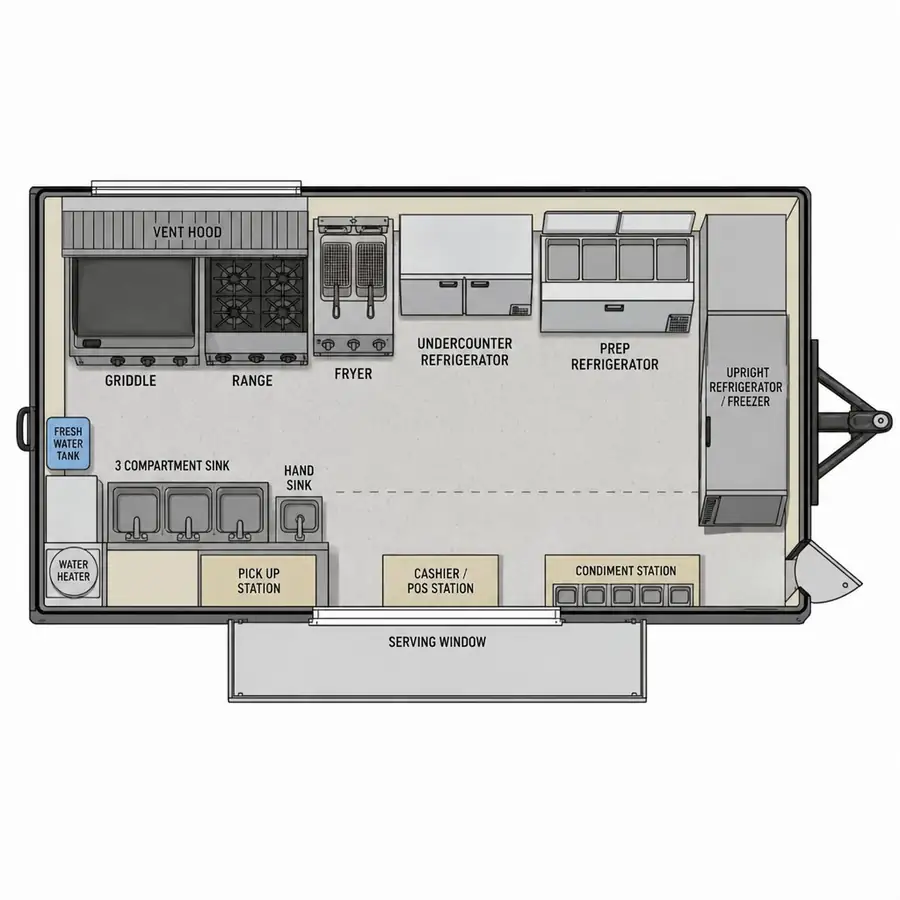
Confirm your sink arrangement before committing counter space to other equipment. Ask about a dedicated handwashing sink, warewashing facilities, any food-preparation sink, water-heater performance, and freshwater and wastewater capacity. Mobile-food checklists can specify these details, so a generic sink package is not proof that your trailer will qualify locally.
Prepare a sanitation checklist for the plan reviewer:
- Handwashing: Sink location, water supply, soap, disposable towels, and unobstructed access.
- Warewashing: Approved washing, rinsing, sanitizing, and air-drying arrangements for your utensils.
- Water supply: Potable-water tank, pump, heater, fill connection, and suitable food-grade hose.
- Wastewater: Tank capacity, plumbing connections, servicing access, and approved disposal arrangements.
- Cleaning supplies: Appropriate cleaners, sanitizer, matching test strips, wiping-cloth supplies, and separate chemical storage.
Use your largest washable utensil as a discussion point when reviewing sink dimensions. Include the space needed for dirty items and clean items, not just the sink itself. Massachusetts' mobile-food checklist, for example, addresses sink compartments, drainboards, handwashing supplies, and water systems together.
For finishes and equipment placement, request smooth, accessible, easily cleanable surfaces and review how workers will reach behind or beneath fixtures. A mobile-facility construction checklist from San Benito County specifically addresses cleanability and equipment spacing.
How should you plan power, propane, and ventilation?
Plan utilities from the specifications of the equipment you actually intend to install, then have qualified professionals review the complete system. Confirm available site power, generator arrangements, gas installation, exhaust, and required fire protection before ordering appliances. NFPA's food-truck safety guidance covers electrical equipment, fuel systems, exhaust, emergency procedures, and safe operation as connected safety concerns.
Create a utility schedule with one row per appliance. Ask your electrician to record voltage, current, startup demand where applicable, and which equipment may run simultaneously. Include refrigeration, water heating, lighting, ventilation, and payment equipment-not only cooking appliances.
For propane, arrange professional installation and ask the fire authority about cylinder mounting, protection, shutoffs, testing, and inspection documentation. NFPA guidance calls for accessible shutoffs, inspection of gas systems before use, and testing after specified installation or cylinder changes. Keep these tasks in your operating procedures rather than treating them as one-time build checks.
Submit your cooking lineup for a ventilation and fire-protection review. For example, Utah's inspection checklist addresses Type I hoods and automatic suppression for appliances producing grease vapors, plus appropriate portable extinguishers. Confirm your jurisdiction's requirements instead of applying another state's checklist as a universal rule.
Ask the reviewer to mark required service access and emergency controls directly on your drawing. Keep their locations visible when arranging storage. Do not let the final shelving plan undo the reviewed safety layout.
Give storage, service, and smallwares real space
Build a packing list alongside your appliance list. Include food pans and lids, utensils, cutting boards, portioning tools, labels, packaging, cleaning supplies, and employee belongings. Assign each item a storage location on your drawing rather than leaving "miscellaneous supplies" for later.
Organize food truck supplies by task:
- Preparation kit: Knives, boards, measuring tools, scales, mixing containers, and recipe references.
- Cooking kit: Suitable pans, tongs, spatulas, timers, thermometers, and appliance-specific tools.
- Serving kit: Trays, containers, bags, napkins, utensils, condiment containers, and order labels.
- Transaction kit: POS device, charger, receipt supplies if used, connectivity plan, and cash arrangements.
- Cleaning kit: Brushes, towels, gloves where needed, waste liners, and approved cleaning products.
For catering trailer equipment, add a separate event checklist. Evaluate covered transport containers, serving utensils, insulated carriers, beverage equipment, and any approved off-trailer service setup. Confirm with the organizer and relevant authorities what the event provides and what your operation must bring.
Test packaging with the actual menu before ordering a large quantity. Pack a complete order, carry it, and check whether staff can assemble it comfortably at the serving station. Treat that trial as part of equipment planning, not just branding.
Compare total installed cost and trailer fit
Request itemized quotes that distinguish equipment from delivery, installation, utility work, mounting, startup, and training. Ask what is excluded and who resolves compatibility problems between suppliers. Keep a separate allowance for smallwares, initial consumables, and changes identified during review.
For used equipment, request model and serial numbers, available service records, installation instructions, and a working demonstration. Have a qualified technician assess condition, and ask the plan reviewer whether the proposed unit is acceptable before purchasing. Avoid interpreting a seller's description of "commercial" as approval for your operation.
Have your trailer builder review the complete loaded configuration, including appliances, tanks, fuel, inventory, and supplies. Ask them to document compatibility with the trailer and tow vehicle using applicable manufacturer ratings. Do not make your own towing decision from empty trailer weight alone.
Finally, mark appliance footprints on the floor and rehearse a complete order with your planned crew. Open doors and drawers, carry packaging through the workspace, and simulate cleaning. Bring any proposed layout changes back to the relevant professionals before installation.
Complete a pre-opening equipment check
Before requesting final inspections, compare the completed trailer with the approved plans and equipment list. Keep model information, installation documents, operating procedures, and required service records together. FDA guidance emphasizes reviewing equipment locations and utility specifications as part of preventing design problems.
Run a practice service using this checklist:
- Start up: Check water, refrigeration, utilities, and equipment according to approved procedures.
- Prepare orders: Rehearse the menu with the intended crew, utensils, and packaging.
- Monitor: Record temperatures and note awkward reaches, missing supplies, or equipment concerns.
- Clean down: Practice washing, sanitizing, air-drying, waste handling, and shutdown.
- Prepare for travel: Follow manufacturer and professional guidance for securing equipment and supplies.
- Resolve issues: Assign each correction an owner and verify completion before opening.
Train staff on emergency shutdown and response, including fuel shutoffs where applicable. NFPA identifies emergency-response training as part of mobile cooking safety. Make sure employees can explain the procedure, not merely point to a document.
The takeaway: buy for a complete operation
Use your checklist to connect every purchase to a menu task, a storage location, and the systems that support it. Finalize the working plan with your reviewers and qualified installers before committing to major purchases. The goal is not the longest equipment list; it is a trailer your crew can operate, clean, restock, and prepare for the next service.