

Opening a bakery is exciting, but a great recipe alone is not enough to build a profitable, sustainable business. A strong bakery business plan turns your ideas into a practical roadmap: what you will sell, who you will serve, how you will operate, what it will cost, and how the business will make money.
Whether you are writing a bakery shop business plan for a neighborhood storefront, a business plan for a bakery café, or a plan for a wholesale production facility, the goal is the same: reduce guesswork and make better decisions before you invest heavily in equipment, inventory, staff, and marketing.
This guide walks through the essential components of a Bakery Business Plan, including concept development, market research, equipment planning, bakery financial projections, daily operations, and growth strategy.

Start With a Clear Executive Summary
The executive summary is the first section of your bakery business plan, but it is often easiest to write last. It gives readers a quick overview of the entire business and should be concise, specific, and persuasive.
A strong executive summary usually includes:
- Your bakery name and concept
- The type of bakery you plan to operate
- Your mission and brand positioning
- Your target customers
- Your main products
- Your location or planned service area
- Your competitive advantage
- Startup funding needs, if applicable
- Revenue goals and high-level bakery financial projections
- A brief summary of your bakery business strategy
If you are using a bakery business plan template, the executive summary may appear at the top. Treat it as a snapshot, not a full explanation. Investors, lenders, landlords, and partners should be able to read this section and understand what makes your bakery realistic and promising.
For example, instead of saying, “We will sell baked goods to local customers,” a stronger summary might explain that the bakery will specialize in premium sourdough breads and seasonal pastries for working professionals, families, and café partners within a specific neighborhood.
Define Your Bakery Concept and Business Model
Concept clarity guides bakery equipment choices, staffing, menu design, and commercial bakery equipment budgets.
Your bakery concept explains what kind of experience, products, and value you will offer. Your bakery business model explains how the business will generate revenue.
This section should answer several important questions:
- What type of bakery are you opening?
- Will customers buy in-store, online, by subscription, or through wholesale accounts?
- Will you produce everything on-site or use a commissary or production kitchen?
- Will you focus on everyday baked goods, premium artisan items, celebration cakes, pastries, or commercial production?
- Will revenue come from retail sales, catering, online orders, delivery, wholesale, classes, or events?
Common bakery business ideas include:
- Retail bakery selling bread, cookies, cakes, and pastries directly to customers
- Artisan bakery focused on handcrafted breads and premium ingredients
- Pastry shop offering delicate desserts, tarts, croissants, and specialty sweets
- Bakery café combining baked goods with coffee, tea, breakfast, or light lunch
- Custom cake business serving weddings, birthdays, and corporate events
- Wholesale bakery supplying restaurants, hotels, grocery stores, and cafés
- Home-based bakery operating under local cottage food rules where allowed
- Production bakery designed for higher-volume manufacturing and distribution
The clearer your concept, the easier it becomes to make decisions about bakery equipment, staffing, menu design, pricing, marketing, and location.
Understand How Bakery Business Plans Differ by Concept
Not every business plan for a bakery should look the same. A bakery business plan sample for a retail storefront may not be useful for a wholesale bakery or custom cake studio. Your plan should match your concept, sales channels, production requirements, and customer expectations.
Retail Bakeries
A retail bakery depends on foot traffic, local awareness, attractive displays, and consistent daily production. The plan should focus heavily on site selection, merchandising, customer service, daily sales forecasting, and a bakery marketing plan that brings people into the store.
Important considerations include:
- Storefront visibility
- Display cases and impulse purchases
- Morning and weekend traffic patterns
- Product freshness throughout the day
- Staffing for front-of-house and production
Artisan Bakeries
Artisan bakeries often compete on quality, craftsmanship, fermentation methods, local ingredients, and brand story. Their plans should emphasize product differentiation, premium pricing, production timing, ingredient sourcing, and customer education.
Key planning areas include:
- Long fermentation schedules
- Specialty flours and ingredient costs
- Skilled bakers
- Deck ovens or other specialized equipment
- Brand positioning around quality and authenticity
Pastry Shops
Pastry shops typically require precision, skilled labor, refrigeration, attractive displays, and careful production planning. A pastry shop business plan should include details on small-batch production, seasonal offerings, high-quality ingredients, and visual presentation.
Important areas include:
- Refrigerated display equipment
- Labor-intensive preparation
- Menu rotation
- Premium packaging
- Strong photography and social media marketing
Wholesale Bakeries
Wholesale bakeries sell to other businesses, so the plan should focus less on walk-in customers and more on production capacity, logistics, pricing contracts, delivery schedules, food safety documentation, and account management.
Key considerations include:
- Batch production efficiency
- Packaging and labeling
- Delivery vehicles or partners
- Large mixers, racks, ovens, and storage
- Consistent product specifications
- Payment terms and cash-flow management
Bakery Cafés
A bakery café combines bakery production with beverage and foodservice operations. This type of bakery operations plan should cover seating, service flow, coffee equipment, menu pairings, labor scheduling, and customer dwell time.
Planning priorities include:
- Café layout
- Beverage program
- Point-of-sale efficiency
- Seating turnover
- Food preparation beyond baked goods
- Health department requirements for expanded service
Custom Cake Businesses
A custom cake bakery depends on consultations, deposits, design work, delivery, and event timelines. The business plan should cover order management, pricing for labor and complexity, portfolio marketing, and production scheduling.
Important planning areas include:
- Design consultations
- Wedding and event partnerships
- Delivery logistics
- Ingredient and decoration inventory
- Pricing for time, skill, and customization
Home-Based Bakeries
A home-based bakery business plan should be simple but still structured. It must consider local rules, production limits, approved products, labeling, delivery or pickup policies, and how the owner will separate business finances from personal finances.
Important areas include:
- Cottage food law compliance, where applicable
- Limited storage and production capacity
- Online marketing
- Pre-order systems
- Low startup costs but limited scalability
Bakery Production Facilities
A production facility is designed for volume, consistency, and efficiency. The plan should focus on equipment layout, utilities, staff roles, ingredient receiving, inventory systems, quality control, safety procedures, and distribution.
Key considerations include:
- Commercial bakery equipment capacity
- Production line workflow
- Cold and dry storage
- Loading and receiving areas
- Standard operating procedures
- Food safety plans and traceability
Research Your Bakery Target Market
Your bakery target market is the specific group of customers most likely to buy from you. Trying to serve everyone often leads to a confusing brand and unfocused menu. Instead, define who your bakery is built for.
Consider customer groups such as:
- Busy professionals looking for breakfast and coffee
- Families buying birthday cakes, cookies, and weekend treats
- Health-conscious customers seeking gluten-free, vegan, or lower-sugar options
- Food enthusiasts interested in artisan bread and premium pastries
- Restaurants and cafés needing wholesale baked goods
- Event planners and couples looking for custom cakes or dessert tables
- Office managers ordering catering for meetings
A useful business plan for bakery example might include two or three customer personas. These are fictional profiles that represent your ideal customers.
For instance:
- “Morning Commuter Maria” buys coffee and a pastry before work three times a week.
- “Weekend Parent James” buys cupcakes, cookies, and birthday cakes for family events.
- “Café Owner Nina” needs reliable wholesale croissants and sandwich bread delivered early each morning.
Each persona should include basic details such as buying motivations, price sensitivity, preferred ordering method, and what problems your bakery solves for them.
Conduct Market Research and Competitor Analysis
Market research helps you understand whether there is enough demand for your bakery concept. Competitor analysis helps you identify opportunities to stand out.
Start by looking at:
- Nearby bakeries, cafés, grocery stores, restaurants, and dessert shops
- Their product selection and pricing
- Their customer reviews
- Their brand positioning
- Their hours of operation
- Their strengths and weaknesses
- Their online presence and delivery options
- Gaps in the local market
You do not need to copy competitors. Instead, study them to clarify your own position. If several bakeries already sell low-cost cupcakes, you might differentiate with premium celebration cakes, artisan bread, allergy-conscious products, or wholesale service.
Your competitor analysis should also consider indirect competition. A customer might choose a supermarket cake, a coffee shop muffin, a meal delivery dessert, or a homemade option instead of visiting your bakery.
Choose the Right Location and Site
Confirm the space supports commercial ovens, refrigeration equipment, dishwashing equipment, and ventilation upgrades.
Location can strongly affect sales, staffing, delivery efficiency, rent, build-out costs, and production capacity. The best site depends on your bakery business model.
A retail bakery may need high visibility, convenient parking, and steady pedestrian traffic. A wholesale bakery may prioritize loading access, production space, utilities, and lower rent over storefront visibility. A custom cake studio may need a consultation area and easy pickup access, but not necessarily a premium retail corner.
Evaluate potential bakery locations based on:
- Rent and lease terms
- Foot traffic and vehicle traffic
- Parking and public transportation
- Visibility and signage opportunities
- Nearby offices, schools, neighborhoods, or event venues
- Kitchen size and layout
- Ventilation and utility capacity
- Zoning and permitted use
- Delivery access
- Storage space
- Expansion potential
Before signing a lease, confirm whether the space can legally and physically support your bakery operations. Commercial ovens, refrigeration equipment, dishwashing areas, sinks, and ventilation may require upgrades. These improvements can significantly affect bakery startup costs.
Plan Your Bakery Menu and Product Selection
Your menu is the heart of your bakery, but it should also be operationally realistic. A long menu can look impressive, but it may create waste, slow production, increase ingredient costs, and complicate staffing.
A practical bakery menu should balance:
- Customer demand
- Profit potential
- Ingredient overlap
- Production time
- Shelf life
- Skill requirements
- Equipment requirements
- Storage needs
- Seasonal opportunities
Core bakery categories may include:
- Breads and rolls
- Cakes and cupcakes
- Cookies and bars
- Croissants and laminated pastries
- Muffins and scones
- Pies and tarts
- Donuts or fried bakery items
- Gluten-free or vegan products
- Savory baked goods
- Beverages for bakery cafés
- Custom cakes and event desserts
Start with a focused menu, then expand based on sales data and customer feedback. Each product should earn its place in the case or catalog.
Build a Pricing Strategy With Recipe Costing
Pricing is one of the most important parts of your bakery business strategy. If prices are too low, strong sales may still produce weak profits. If prices are too high without a clear value proposition, customers may hesitate.
Recipe costing helps you calculate the true cost of each item. For every product, estimate:
- Flour, sugar, butter, eggs, chocolate, fruit, fillings, and other ingredients
- Packaging
- Decorations or toppings
- Labor time
- Waste and trimming
- Utilities and overhead allocation
- Delivery or transaction costs, where applicable
Your selling price should account for ingredient cost, labor, overhead, market positioning, and desired bakery profit margin. Many bakeries monitor food cost percentage, but the right target varies by product type, concept, and operating model.
For example, a simple cookie may have low ingredient cost and strong margin, while a custom wedding cake may require many hours of skilled labor. A wholesale loaf may sell at a lower price than a retail loaf but can generate predictable volume.
Review pricing regularly as ingredient costs, wages, rent, and packaging expenses change.
Estimate Bakery Startup Costs Carefully
Budget for commercial ovens, mixers, refrigeration equipment, freezers, and food preparation equipment early.
Bakery startup costs vary widely based on location, bakery concept, production capacity, property condition, equipment choices, utility requirements, and local regulations. A small home-based bakery may require far less capital than a full bakery café or wholesale production facility.
When estimating startup costs, break expenses into clear categories instead of relying on one large guess.
Common startup cost categories include:
- Lease deposits and rent deposits
- Legal and accounting setup
- Architectural, engineering, or design fees
- Construction and build-out
- Plumbing, electrical, ventilation, and gas upgrades
- Bakery equipment
- Furniture, fixtures, and displays
- POS systems and technology
- Permits and licenses
- Ingredients and initial inventory
- Packaging and labels
- Smallwares and utensils
- Staff hiring and training
- Insurance
- Initial marketing and branding
- Signage
- Website and online ordering setup
- Utility deposits
- Cleaning supplies and sanitation products
- Working capital for the first several months
Working capital is especially important. Even after opening, you may need cash to cover payroll, rent, ingredients, loan payments, and utilities before sales become consistent.
When budgeting for bakery equipment, compare capacity, durability, warranty, utility requirements, and serviceability rather than focusing only on the lowest purchase price. Suppliers such as The Horeca Store can be useful when exploring commercial ovens, mixers, refrigeration equipment, freezers, food preparation equipment, display equipment, worktables, shelving, storage solutions, and other commercial bakery essentials.
Create Bakery Financial Projections
Bakery financial projections show whether your business model can realistically make money. They are also important if you plan to apply for financing, attract investors, or negotiate with landlords.
Key financial projections include:
- Startup cost estimate
- Monthly operating expenses
- Sales forecast
- Cost of goods sold
- Labor cost
- Gross profit
- Net profit
- Cash-flow projection
- Break-even analysis
- Funding requirements
Sales projections should be based on reasonable assumptions. For a retail bakery, you might estimate average daily customer count and average transaction value. For a wholesale bakery, you might estimate the number of accounts, average order size, and delivery frequency. For a custom cake business, you might estimate monthly orders by cake size, design complexity, and season.
Avoid overly optimistic projections. A realistic plan should include slow periods, ramp-up time, waste, refunds, staff training, and marketing costs.
Understand Operating Expenses
Operating expenses are the recurring costs required to keep the bakery running. These expenses directly affect pricing, cash flow, and profitability.
Common bakery operating expenses include:
- Rent or mortgage payments
- Payroll and payroll taxes
- Ingredients
- Packaging
- Utilities
- Insurance
- Marketing
- Repairs and maintenance
- Cleaning and sanitation supplies
- Software subscriptions
- POS fees and payment processing
- Delivery costs
- Waste disposal
- Accounting and professional services
- Loan payments
Track fixed and variable expenses separately. Fixed expenses, such as rent, stay relatively stable. Variable expenses, such as ingredients and packaging, rise and fall with sales volume. Understanding this difference helps you calculate break-even sales and make better decisions during slower months.
Calculate Break-Even Sales
Break-even analysis shows how much revenue you need to cover your costs before generating profit. It is a critical part of any business plan for bakery business owners because it connects pricing, sales volume, expenses, and margins.
To estimate break-even sales, you need to understand:
- Fixed monthly expenses
- Average selling price
- Average variable cost per sale
- Gross margin
- Expected sales volume
For example, if your rent, payroll, utilities, insurance, and other fixed expenses are high, you will need stronger sales to break even. If your menu has high ingredient costs or excessive waste, your break-even point rises.
Break-even analysis is not a one-time exercise. Revisit it whenever you change prices, add staff, expand your menu, purchase new equipment, or move into a larger space.
Plan Staffing and Management
A bakery depends on reliable people, clear roles, and consistent training. Even the best bakery business plan template will fail if it does not account for labor needs.
Depending on your concept, your team may include:
- Head baker
- Pastry chef
- Production bakers
- Cake decorators
- Prep staff
- Dishwashing and sanitation staff
- Front-of-house associates
- Baristas
- Delivery drivers
- Shift supervisors
- General manager
- Bookkeeper or administrative support
Your staffing plan should include responsibilities, scheduling needs, wage assumptions, training procedures, and management structure. Bakeries often start production early in the morning, so scheduling must reflect preparation, baking, cooling, decorating, packaging, and opening hours.
Labor planning should also account for owner workload. Many bakery owners underestimate how much time they will spend on purchasing, payroll, customer service, marketing, maintenance, and bookkeeping.
Manage Ingredients and Suppliers
Ingredient quality, availability, and cost have a direct impact on bakery consistency. Your business plan should explain how you will source, receive, store, and monitor ingredients.
Important supplier planning questions include:
- Which ingredients are essential to your menu?
- Will you use local, organic, specialty, or conventional suppliers?
- Do you need backup suppliers for key ingredients?
- What are minimum order quantities?
- How often will deliveries arrive?
- How will price changes be monitored?
- What storage conditions are required?
Common bakery ingredients such as flour, butter, eggs, sugar, yeast, cream, chocolate, nuts, and fruit can fluctuate in price and availability. Build flexibility into your menu and purchasing strategy where possible.
Control Inventory and Food Costs
Inventory control helps protect your margins and reduce waste. Without a system, ingredients can expire, products can be overproduced, and food costs can rise unnoticed.
A strong bakery operations plan should include:
- Par levels for key ingredients
- Receiving procedures
- Storage labeling
- First-in, first-out inventory rotation
- Waste tracking
- Daily production sheets
- Batch recipes
- Portion control
- Regular inventory counts
- Food cost reviews
Production planning is especially important because baked goods often have limited shelf life. Use sales history to estimate how much to produce each day. Track what sells out, what gets discounted, and what is wasted.
Include Licenses, Permits, Insurance, and Food Safety
Bakery requirements vary by location, concept, facility type, and products sold. Always check with local authorities before opening.
Your plan should address possible requirements such as:
- Business registration
- Food establishment permit
- Health department approval
- Sales tax registration
- Zoning approval
- Sign permits
- Fire inspection
- Building permits for renovations
- Certificate of occupancy
- Food handler or food manager certifications
- Cottage food compliance for home-based bakeries, where applicable
- Product labeling rules
- Insurance coverage
Insurance may include general liability, property insurance, workers’ compensation, commercial auto insurance, product liability, and business interruption coverage.
Food safety planning should include sanitation procedures, allergen management, temperature control, pest control, employee hygiene, cleaning schedules, and recall procedures where relevant.
Build a Bakery Marketing and Branding Strategy
Strong branding pairs with reliable bakery equipment and foodservice equipment that supports consistent quality.
Your bakery marketing ideas should connect your brand, products, customers, and sales channels. Marketing is not just about posting photos online; it is about creating consistent demand.
Start with brand basics:
- Bakery name
- Logo and visual identity
- Brand colors and packaging style
- Tone of voice
- Product photography style
- Storefront signage
- Customer experience
- Brand promise
Then create a bakery marketing plan that may include:
- Local search optimization
- Google Business Profile management
- Social media content
- Email marketing
- Loyalty programs
- Seasonal promotions
- Grand opening events
- Sampling campaigns
- Partnerships with local businesses
- Wedding vendor relationships
- Corporate catering outreach
- Community events
- Influencer or creator collaborations
- Referral incentives
For SEO, your website should clearly describe what you sell, where you operate, how to order, and what makes your bakery different. Product pages, catering pages, wedding cake galleries, and blog content can all help potential customers find you online.
Plan for Online Ordering and Delivery
Online ordering can increase convenience and expand your reach, but it also adds operational complexity. Your bakery business plan should explain what customers can order online, how far in advance they must order, how pickup or delivery works, and how orders flow into production.
Consider offering:
- Pre-orders for bread and pastries
- Custom cake inquiry forms
- Catering and office breakfast orders
- Holiday menus
- Subscription boxes
- Local delivery
- Third-party delivery where appropriate
Online ordering should be connected to production capacity. If your system accepts too many orders without limits, your team may become overwhelmed. Set cut-off times, pickup windows, order minimums, and delivery zones that match your workflow.
Choose POS Systems and Bakery Technology
Technology can help you manage sales, inventory, customer relationships, and reporting. At minimum, most bakeries need a reliable POS system that handles payments, product categories, taxes, tips, refunds, and sales reports.
Useful bakery technology may include:
- POS system
- Online ordering platform
- Inventory software
- Accounting software
- Scheduling software
- Recipe costing tools
- Customer loyalty system
- Email marketing platform
- Kitchen display or order management tools
- Delivery management software
Choose systems that are easy for staff to use and compatible with your business model. A high-volume bakery café may need different features than a custom cake studio or wholesale bakery.
Create a Daily Production and Operational Workflow
Workflow planning should connect mixers, proofers, ovens, refrigeration, and smallwares in one efficient layout.
A bakery operations plan explains how work gets done every day. This section turns your concept into a repeatable system.
Map the full workflow from receiving ingredients to serving customers:
- Receive ingredients and packaging.
- Store items in dry, refrigerated, or frozen areas.
- Review production schedule and orders.
- Scale ingredients and prepare doughs, batters, fillings, and toppings.
- Mix, ferment, laminate, proof, bake, cool, decorate, or package products.
- Stock display cases or prepare wholesale and delivery orders.
- Serve customers or dispatch orders.
- Track waste, leftovers, and sold-out items.
- Clean, sanitize, and reset for the next day.
The workflow should reduce unnecessary movement and prevent bottlenecks. Ideally, ingredients move logically from storage to prep, production, baking, cooling, finishing, packaging, and service.
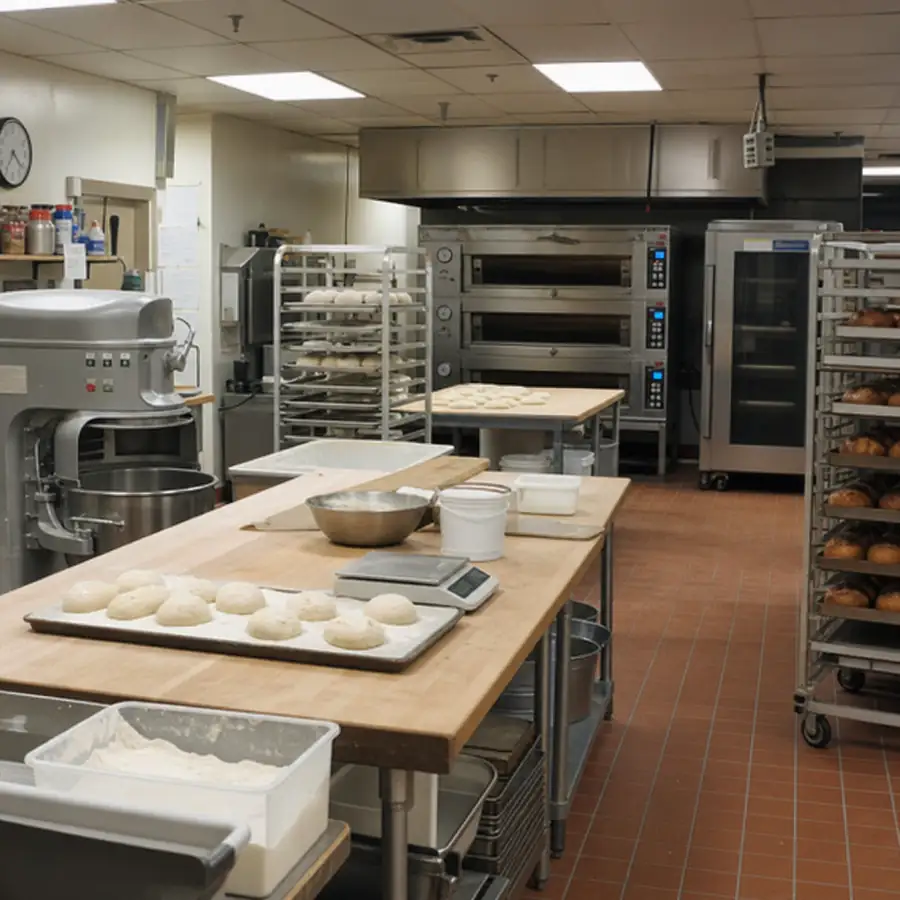
Plan Bakery Equipment Around Your Menu and Volume
Match deck ovens, convection ovens, planetary mixers, and prep tables to your daily production workflow.
Bakery equipment planning deserves its own section because equipment affects startup costs, production capacity, labor efficiency, product quality, and kitchen layout. The right equipment depends on your menu, production volume, kitchen size, workflow, utilities, and growth plans.
A bakery that produces sourdough bread may need deck ovens, proofers, large mixers, and bakery racks. A pastry shop may need convection ovens, refrigeration equipment, dough sheeters, prep tables, and refrigerated display cases. A custom cake studio may prioritize mixers, worktables, refrigeration, decorating tools, and storage. A wholesale bakery may need higher-capacity commercial bakery equipment built for repeated daily production.
Essential bakery equipment categories often include:
- Commercial ovens for baking bread, pastries, cakes, cookies, and other products
- Convection ovens for even airflow and versatile baking
- Deck ovens for artisan bread and hearth-style products
- Proofers or retarder proofers for dough fermentation control
- Commercial mixers, including planetary mixers and spiral mixers
- Dough sheeters for laminated doughs, croissants, puff pastry, and consistent rolling
- Food processors for fillings, toppings, chopping, and prep tasks
- Refrigerators for dairy, fillings, doughs, and finished products
- Freezers for ingredients, dough storage, and prepared items
- Prep tables and worktables for scaling, mixing, decorating, and packaging
- Display cases for merchandising retail products
- Refrigeration equipment for both production and customer-facing display
- Bakery racks and sheet pan racks for cooling, storage, and transport
- Sinks for handwashing, prep, and warewashing as required
- Shelving and storage equipment for ingredients, packaging, and smallwares
- Dishwashing equipment for sanitation and efficiency
- Bakery smallwares such as sheet pans, mixing bowls, scales, whisks, spatulas, piping bags, molds, cutters, proofing baskets, and measuring tools
Before purchasing, confirm your available utilities. Some ovens require specific electrical, gas, ventilation, or clearance conditions. Refrigeration and freezers need adequate space and airflow. Dishwashing equipment and sinks may require plumbing upgrades. Your local code requirements may also influence equipment choices.
Equipment should support your workflow, not interrupt it. Plan where ingredients are stored, where dough is mixed, where pans are loaded, where products cool, and where finished goods are displayed or packed. When setting up a professional bakery, The Horeca Store can be a convenient source for comparing equipment categories such as ovens, mixers, refrigeration, worktables, shelving, storage, and food preparation equipment.
Plan Cash Flow, Not Just Profit
A bakery can appear profitable on paper and still struggle with cash flow. Cash-flow planning tracks when money comes in and when money goes out.
Common cash-flow challenges include:
- Paying suppliers before customer payments arrive
- Seasonal sales swings
- Large holiday inventory purchases
- Equipment repairs
- Payroll timing
- Slow wholesale account payments
- Loan payments
- Delayed opening due to construction or permits
Create a monthly cash-flow forecast that includes expected sales, payment timing, rent, payroll, ingredients, utilities, taxes, insurance, marketing, debt payments, and owner draws. Keep a cash reserve whenever possible.
Wholesale bakeries and custom cake businesses should pay special attention to deposits and payment terms. Deposits can protect cash flow and reduce cancellation risk.
Manage Risk Before Problems Happen
Risk management helps you prepare for situations that could disrupt operations or profitability.
Common bakery risks include:
- Equipment breakdowns
- Ingredient shortages
- Food safety incidents
- Allergen mistakes
- Staff turnover
- Rising ingredient costs
- Construction delays
- Weak foot traffic
- Negative reviews
- Delivery problems
- Cash shortages
- Seasonal demand drops
Your plan should include prevention and response strategies. For example, maintain critical equipment, identify backup suppliers, train staff on allergen procedures, document recipes, build cash reserves, and monitor customer feedback.
Risk planning is not about expecting failure. It is about making the business more resilient.
Create a Bakery Startup Checklist
A bakery startup checklist can help you stay organized as opening day approaches. Your checklist may include:
- Finalize bakery concept and business model.
- Research target customers and competitors.
- Write the bakery business plan.
- Estimate startup costs and funding needs.
- Choose a location or production space.
- Confirm zoning and permit requirements.
- Design kitchen and customer areas.
- Select bakery equipment and smallwares.
- Build supplier relationships.
- Develop and test recipes.
- Cost recipes and set prices.
- Create branding, packaging, and signage.
- Set up POS and technology systems.
- Hire and train staff.
- Build website and online ordering.
- Create a launch marketing plan.
- Conduct test production.
- Schedule inspections.
- Plan soft opening and grand opening.
Use the checklist as a living document. As tasks become more specific, assign deadlines, budgets, and responsible people.
Develop a Growth and Expansion Strategy
Expansion may require higher-capacity commercial bakery equipment and food preparation equipment from The Horeca Store.
Your bakery business plan should not stop at opening day. It should also explain how the business can grow once operations are stable.
Possible growth strategies include:
- Adding new product lines
- Expanding wholesale accounts
- Offering catering
- Building a wedding cake program
- Launching online ordering
- Selling seasonal gift boxes
- Adding coffee or café service
- Opening a second location
- Moving into a larger production facility
- Creating subscription programs
- Partnering with restaurants or hotels
- Offering baking classes or events
Growth should be based on demand, profitability, and operational readiness. Expanding too quickly can strain cash flow, staff, equipment, and quality control. Before scaling, confirm that your current operations are profitable, documented, and repeatable.
If expansion requires more production capacity, revisit your equipment plan early. The Horeca Store can be helpful for bakery owners researching commercial bakery equipment and foodservice equipment that supports a larger menu, higher output, or a more efficient production layout.
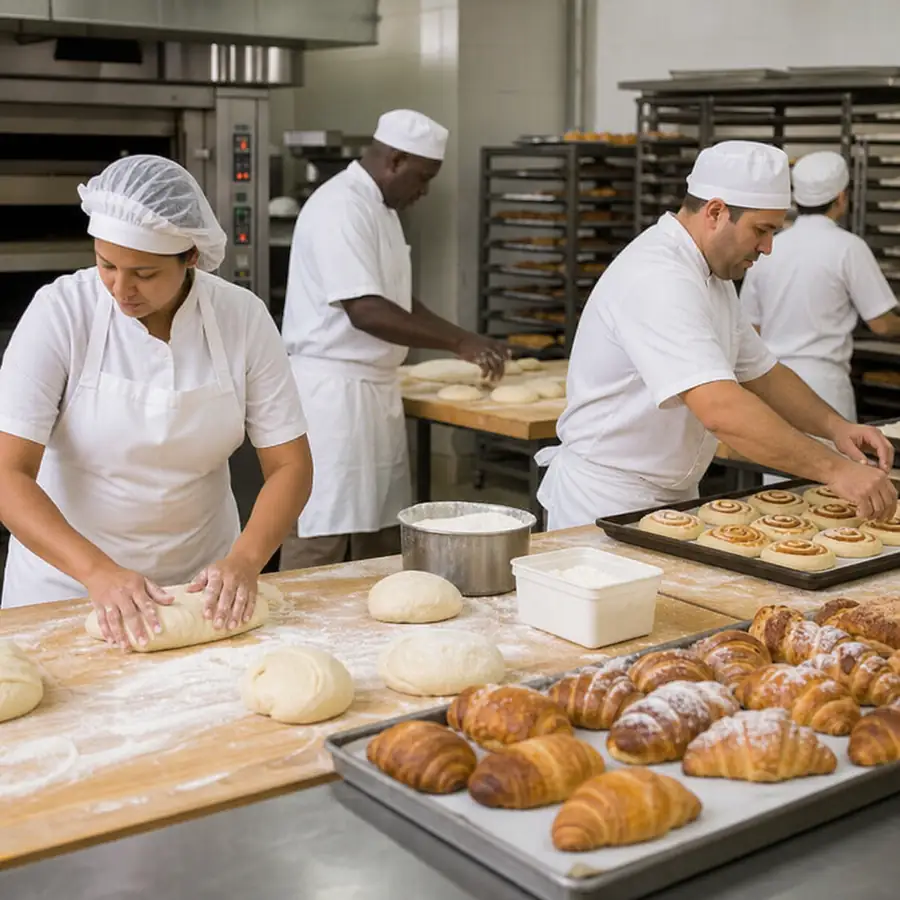
Common Mistakes to Avoid
Many bakery owners are passionate and talented, but planning mistakes can make the business harder than it needs to be.
Avoid these common issues:
- Creating a menu that is too large for the team and kitchen
- Underestimating build-out and equipment costs
- Forgetting working capital
- Pricing products without recipe costing
- Ignoring labor costs in custom orders
- Choosing a location based only on rent
- Buying equipment before finalizing the menu and workflow
- Relying only on social media instead of a complete marketing plan
- Failing to track waste and inventory
- Opening without clear production schedules
- Not planning for slow seasons
- Skipping written procedures and staff training
A thoughtful business plan helps you spot these issues early, when they are easier and less expensive to fix.
Bringing It All Together
A strong business plan for a bakery is both a strategic document and a practical operating guide. It explains your concept, customers, market position, menu, pricing, startup costs, equipment needs, staffing plan, daily workflow, marketing strategy, and financial outlook.
The best plans are specific enough to guide decisions but flexible enough to adapt as you learn from real customers. Start with a clear concept, validate demand, build realistic projections, and design operations around quality, consistency, and profitability.
Whether you are preparing a bakery business plan sample for your own use, adapting a bakery business plan template for a lender, or refining a bakery operations plan for expansion, the process forces you to think like both a baker and a business owner. That combination is what gives a bakery its best chance to grow from a good idea into a lasting business.