
A pizza food truck needs an oven, refrigeration, preparation space, sanitation equipment, reliable utilities, and tools for serving customers. The right setup depends on your pizza style, menu, preparation location, and available space-not simply how many appliances fit inside. This guide explains the essential equipment for a pizza food truck and how to build a practical purchasing list before committing to a layout.
What equipment does a pizza food truck need?
Build your initial equipment list around six functions: cooking, cold storage, preparation, cleaning, utilities, and service. Then match each item to your menu and proposed operating procedures. For an example of what reviewers may request, Washington's mobile food plan requirements include preparation steps, equipment specifications, a floor plan, plumbing details, and cleaning procedures.
Use this starter pizza equipment list as a planning worksheet, not a universal inspection checklist:
Ask your local health department and fire authority to review the proposed setup before construction or major purchases. Local requirements matter: the FDA Food Code is a model offered for adoption by jurisdictions, not a single nationwide food truck permit standard.
Start with the menu and working layout
Before choosing equipment sizes, write down your pizza diameter, crust style, topping selection, and whether you will sell whole pies, slices, or both. Decide which preparation tasks belong on the truck and which you propose to perform in an approved commissary. Include those decisions in your plan-review discussion rather than assuming an off-truck kitchen removes onboard requirements.
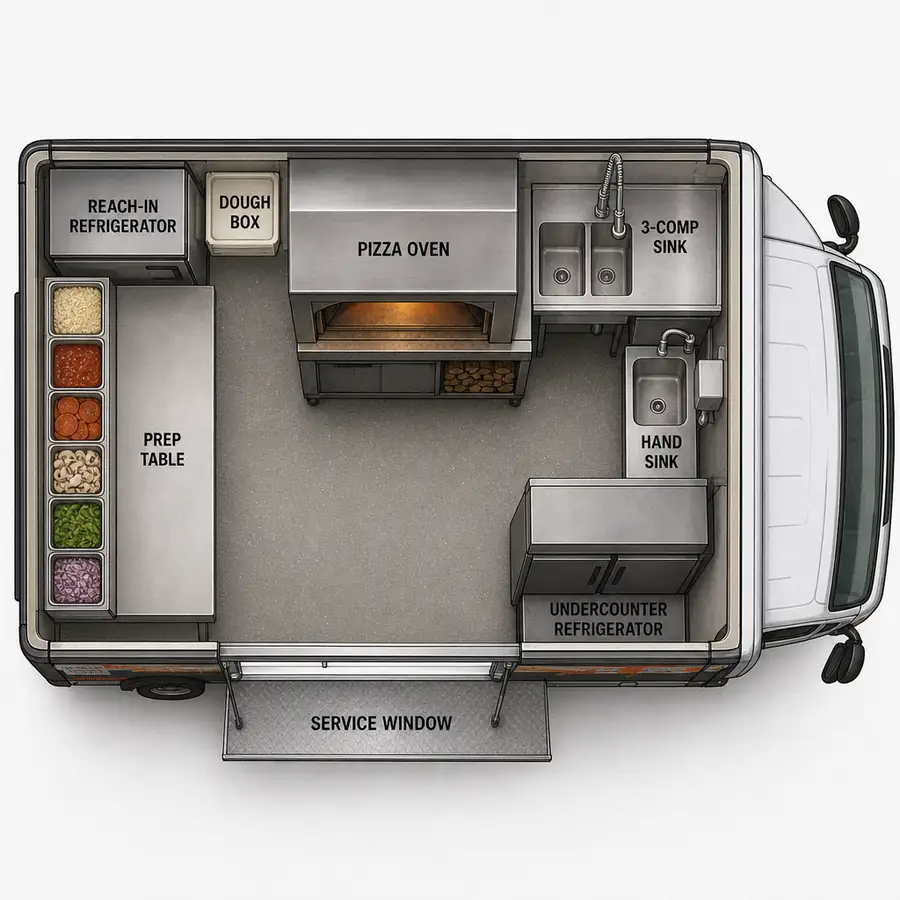
Sketch a proposed sequence: refrigerated storage, dough stretching, topping, baking, cutting, and customer handoff. Mark door swings, open drawers, oven access, sink access, and the space needed to handle a peel. Then rehearse the sequence with your intended crew before approving the drawing.
For example, ask one person to simulate stretching and topping while another loads imaginary pizzas and boxes finished orders. Watch for crossed paths and awkward reaches. Revise the layout before equipment locations become permanent.
Which pizza oven options suit your operation?
The best oven is the one that produces your intended pizza while fitting the truck's approved layout, utility supply, and installation requirements. Start with your product, then compare specific models rather than choosing by fuel type alone. Manufacturer ranges include electric deck ovens marketed for food trucks and conveyor ovens available in gas or electric versions.
Deck ovens
A deck oven is worth evaluating when your concept centers on baking directly on a heated deck. Marsal's countertop electric range, for example, uses baking stones and includes multiple configurations. Ask for a demonstration using your dough and toppings, and check whether the resulting bake matches your menu before selecting a model.
Measure the complete operating footprint, including the open door and your loading position. Request installation clearances and utility specifications in writing. Do not assume a countertop designation makes an oven suitable for your particular truck.
Conveyor ovens
Conveyor ovens move products through a baking chamber on a belt. Models such as Middleby Marshall's PS520 provide adjustable conveyor speed and bake time, with gas and electric versions available. When comparing them, account for the belt's full length and the space needed at both loading and unloading ends.
Test your busiest proposed order mix during a demonstration. Include different toppings and pizza sizes rather than evaluating only one ideal pie. Ask the supplier to explain cleaning access and routine maintenance before purchase.
Wood-fired and other solid-fuel setups
Treat a wood-fired concept as a complete installation decision, not just an oven purchase. Ask your fire authority about solid-fuel cooking, exhaust, fuel storage, ash handling, and required protection before ordering. Mobile cooking guidance specifically addresses solid-fuel hoods, fuel storage, generators, extinguishers, and carbon monoxide alarms.
Whichever oven you favor, request a realistic production demonstration. Record loading, baking, unloading, and recovery during repeated batches rather than relying on a headline capacity figure.
Refrigeration and preparation space deserve equal attention
Evaluate a refrigerated pizza prep table that combines a cutting board, topping rail, and refrigerated base. Check the actual configuration: manufacturers specify pan capacity and cutting-board arrangements, and these details differ by model. Bring measurements for your dough boxes and ingredient containers rather than judging capacity from exterior dimensions alone.
Build your proposed cold-storage allocation around dough, cheese, prepared toppings, sauces requiring refrigeration, and replenishment stock. Ask the equipment supplier to verify suitability for the installation conditions, particularly the proposed location near cooking equipment. Leave the manufacturer's required ventilation and service access unobstructed.
For foods requiring temperature control, the FDA Food Code generally specifies cold holding at 41°F or below, with stated exceptions. Include a suitable food thermometer and refrigeration temperature displays in your purchasing plan, and confirm the applicable local rules with your regulator.
Before approving a refrigerator, test the storage arrangement on paper. Count containers for a full service, identify where reserve ingredients will go, and plan how staff will replenish the topping rail without blocking the aisle.
Dough equipment and smallwares complete the production line
Decide whether mixing dough onboard is necessary before allocating space to a mixer. If you plan commissary production, document where mixing, portioning, storage, and transport will occur. Ask your reviewer to confirm that the proposed arrangement fits your permitted operation.
If you need a mixer, select it using the manufacturer's dough-capacity guidance, not bowl volume alone. Hobart's capacity guidance accounts for recipe characteristics such as absorption ratio, and its charts distinguish between different products. Give the supplier your actual recipe and intended batch weight.
Include these tools in your working inventory:
- Digital scales: Select capacities and resolution appropriate for ingredients, dough portions, and toppings.
- Dough boxes and lids: Verify stacking arrangements and refrigerator fit before buying a full set.
- Bench scrapers and dough cutters: Assign storage near the stretching station.
- Launching and turning peels: Check both oven compatibility and handling space inside the truck.
- Pans or screens: Purchase sizes suited to the pizza and baking method you have tested.
- Cutters, tongs, ladles, and portion tools: Match quantities to each station and your cleaning plan.
During a practice service, note which tools staff repeatedly share or search for. Add targeted duplicates instead of buying miscellaneous accessories without a defined use.
Water, sinks, and sanitation need a complete system
Plan sanitation as an interconnected system: sinks, potable water storage, wastewater storage, plumbing, water heating, soap, towels, and cleaning supplies. Requirements depend on location and operation. King County's mobile food guidance, for example, calls for detailed water-system drawings and specifies handwashing and warewashing provisions for its regulated units.
Ask your reviewer to confirm sink dimensions, water capacity, hot-water provision, and approved wastewater disposal. Check that your proposed warewashing arrangement can accommodate the utensils you intend to clean. Include access for filling, draining, inspection, and maintenance in the drawing rather than placing tanks wherever space remains.
Your sanitation shopping list should also cover detergent, an appropriate food-contact sanitizer, compatible concentration test strips, cleaning brushes, wiping-cloth containers, and protected chemical storage. The FDA Food Code addresses sanitizer concentration testing and the separation of toxic materials from food and equipment. Follow product directions and your approved cleaning procedures.
Coordinate power, ventilation, and fire protection
Have qualified installers evaluate the complete appliance schedule before selecting the electrical supply or fuel system. Give them manufacturer specifications for the oven, refrigerators, water heater, lighting, POS equipment, and any mixer. Ask them to document the approved connections and operating limitations.
Plan for temperature control during transport as well as service. Tacoma-Pierce County's mobile food guidance explicitly requires an approved power source to maintain hot and cold food temperatures while the unit is traveling. Discuss your intended route and service arrangements with your own regulator.
Fire protection must match the cooking installation. NFPA's food truck guidance covers permits, fuel systems, cooking operations, and portable extinguishers; confirm the applicable requirements with your fire authority. Do not select an extinguisher or ventilation arrangement solely from a generic shopping checklist.
Also request instructions for safely shutting down equipment and responding to an impaired exhaust or suppression system. Utah's fire marshal guidance, for example, prohibits operating cooking equipment when required exhaust or fire-extinguishing systems are nonoperational or impaired.
Service equipment and recurring food truck supplies
Give ordering, cutting, boxing, and collection their own place in the layout. Include a POS device, charging arrangements, an order display or ticket system, and protected packaging storage. Run a practice order from payment through handoff to check whether the service station has enough working room.
Build a replenishment list for recurring food truck supplies: pizza boxes, slice packaging if needed, napkins, labels, receipt rolls, cleaning products, and waste liners. Test packaging with your actual pizzas before placing a large order. Evaluate fit, handling, stacking, and the condition of the pizza after the expected takeaway journey.
Keep a clearly marked home for spare cutters, thermometers, and other tools your team identifies as essential during rehearsals. Add closing tasks to the station checklist so staff know what must be cleaned, restocked, charged, or reported before the next service.
Buy against specifications, not just a product photo
When comparing suppliers such as The Horeca Store, use your approved equipment schedule to narrow the search. Its catalog includes commercial ovens, refrigeration, prep tables, and kitchen supplies. Evaluate each shortlisted model individually rather than assuming every commercial appliance is suitable for mobile installation.
Before placing an order, request written confirmation of:
- Installation fit: Overall dimensions, weight, required clearances, door movement, and service access.
- Utility compatibility: Electrical requirements, fuel type, connections, and any supporting equipment.
- Operating suitability: Intended commercial use, proposed mobile installation, and relevant warranty terms.
- Support: Manuals, replacement parts, maintenance requirements, and available servicing.
- Delivered scope: Included accessories, stands, pans, connectors, and items you must source separately.
Prioritize food truck essentials that support the approved menu and safe operation. Keep optional appliances on a later purchasing list until a practice service reveals a specific need. Reserve budget for installation and supporting systems rather than allocating everything to the oven.
Build a complete working kitchen
Use your menu, layout rehearsal, supplier specifications, and local review process to finalize the food truck kitchen. Before buying, make sure every item has a defined task, an installation location, and a workable cleaning plan. Aim for a complete production line-not the longest equipment list-and revisit optional purchases after testing the setup with your intended crew.