
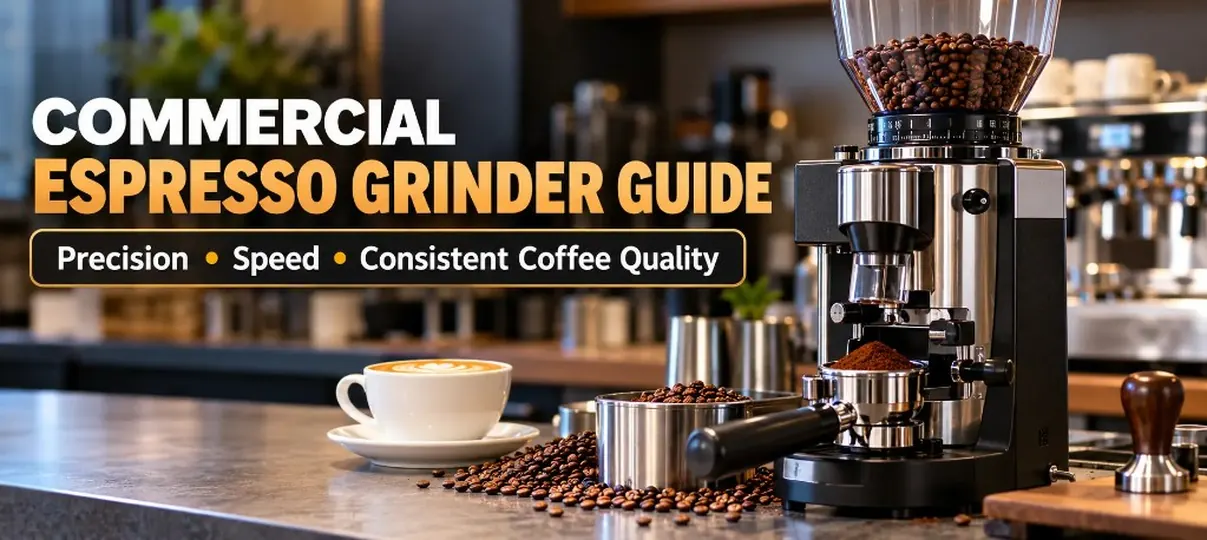
Choosing the right grinder for a busy coffee program is about speed, consistency, service flow, and long-term reliability. The best espresso grinders for cafes, restaurants and high-volume service are commercial machines with durable burrs, stable grind adjustment, adequate hopper capacity, cooling, and simple cleaning access.
An espresso grinder is a professional coffee grinder built to grind beans fine enough for espresso and to repeat that grind under pressure during service. Unlike light-duty home grinders, commercial coffee grinders are designed for repeated dosing, portafilter use, staff handoffs, and daily cleaning in cafes, hotels, bakeries, bars, QSR counters, catering setups, and food trucks.
What should a business look for in an espresso grinder?
A commercial coffee machine on the same counter still needs a grinder that can keep up.
A business should look for the grinder that protects espresso quality while keeping the line moving. That means choosing the right burr size, output speed, dose control, hopper size, power, cooling, footprint, and support network for the expected drink volume.
A small restaurant that serves espresso after dinner does not need the same grinder as a cafe pulling shots from open to close. A bakery with one house blend may value simple timed dosing. A specialty cafe may want grind-by-weight control, lower retention, and faster burrs for repeatable recipes.
Main types of professional espresso grinders
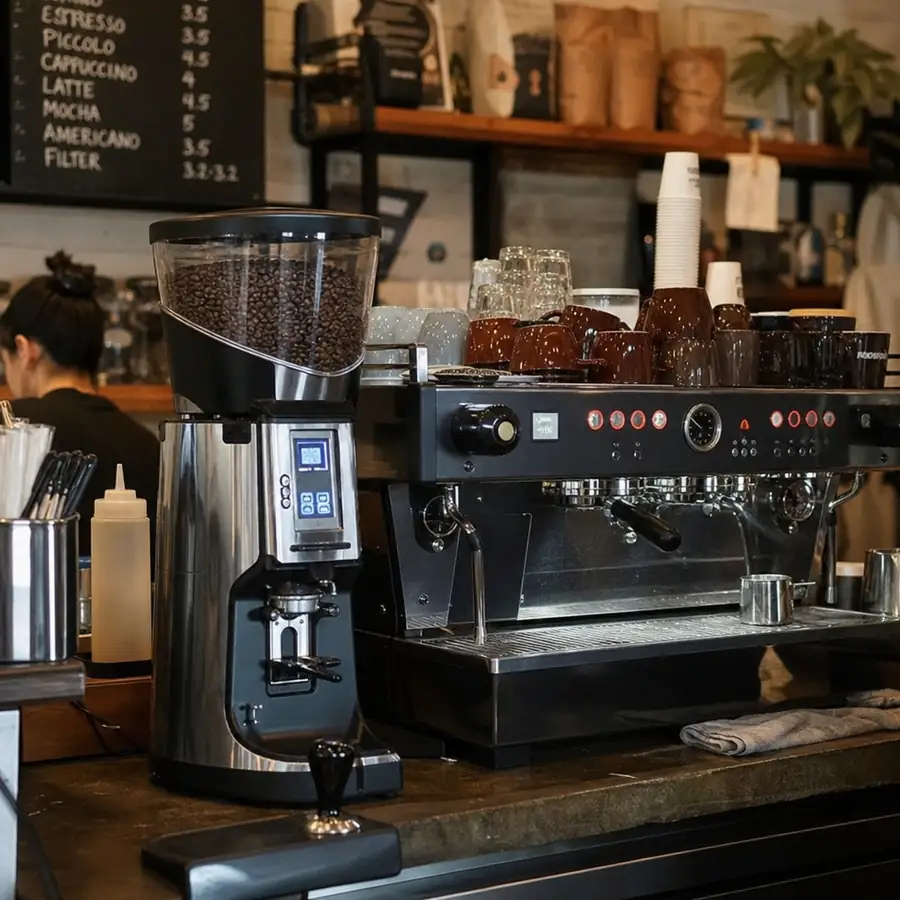
On-demand grinders are the everyday choice when the line is short.
Most professional espresso grinders fall into a few clear groups. The right choice depends on volume, menu, staff skill, and how many coffees you serve.
On-demand timed grinders
A coffee urn can cover batch coffee while this grinder stays on espresso.
Timed on-demand grinders dose coffee directly into the portafilter for a set number of seconds. They are common in cafes, restaurants, bars, and hotels because they are fast and easy to train.
Models such as the Mazzer Super Jolly V Pro and Fiorenzato F64 EVO Pro fit this category. The Super Jolly V Pro uses 64 mm flat burrs, a 1.1 kg hopper, stepless micrometric adjustment, and double fan cooling, which makes it a practical medium-output grinder for steady espresso service.
Grind-by-weight grinders
Coffee servers and warmers hold what this grinder just dosed.
Grind-by-weight grinders weigh each dose as it is ground. This reduces the need to weigh every portafilter separately and can improve speed during rush periods.
The Mahlkönig E65S GbW is a strong example. It uses 65 mm burrs, an active cooling system, Disc Distance Detection, and an approximate 1,200 g hopper, making it useful for cafes that want tight recipe control with less manual checking.
High-output grinders
Commercial automatic coffee machines are a different station from this espresso head.
High-output grinders are built for peak-hour espresso bars, drive-through service, hotels, and multi-station counters. They usually have larger burrs, stronger motors, bigger hoppers, and better heat control.
The Mahlkönig E80S, for example, has 80 mm burrs, active temperature management, high-speed performance, and an approximate 1,800 g hopper. Its product data lists average grinding capacity at about 7-8 g/s at 60 Hz, which suits high-volume espresso workflows.
Specialty and low-retention grinders
Milk frothers and steamers still depend on a steady grind for milk drinks.
Some high-quality grinders focus on taste clarity, lower waste, and cleaner workflow. These can suit specialty cafes, roasters, training labs, and premium restaurants.
The La Marzocco Swan uses 83 mm conical burrs, stepless adjustment, a 1.7 kg hopper, programmable dosing, and easy burr access from above and below. That cleaning access matters because staff can clean more often without disturbing burr alignment.
Features that change daily operations
Satellite coffee brewers cover the banquet pot while the grinder stays at the bar.
The specification sheet is not just technical detail. Each feature affects labor, speed, waste, drink quality, or service stress.
- Burr size and type: Larger burrs often grind faster and handle rushes better. Flat burrs are common for espresso clarity and repeatability. Conical burrs may suit operators who prefer their workflow, taste profile, or machine design.
- Motor power: More power helps the grinder stay steady under repeated use. It can also reduce slowdowns when grinding dense beans or lighter roasts.
- Cooling: Fans and active temperature systems help limit heat build-up. This matters when a grinder runs hard during breakfast, brunch, or commuter rushes.
- Hopper capacity: Larger hoppers reduce refill stops. Smaller hoppers can help low-volume shops keep beans fresher during slower shifts.
- Dose control: Timed dosing is simple. Grind-by-weight dosing adds control and can reduce training gaps.
- Grind adjustment: Stepless micrometric adjustment lets baristas make small recipe changes. This helps when humidity, roast age, or bean changes affect extraction.
- Footprint and height: Tall hoppers may not fit under shelves. Measure counter depth, width, and clearance before buying.
- Noise level: Quieter grinders improve guest comfort in small restaurants, hotel lobbies, bakeries, and open bars.
- Display and controls: Clear screens help new staff dose correctly. Shot counters can also support usage tracking and maintenance planning.
The operational impact is simple: a grinder that is too slow creates a bottleneck, while a grinder that is too complex can create training problems. The best espresso grinders are the ones your team can use well every day.
Matching grinder options to business types
A coffee truck needs the same dose control, just in a smaller footprint.
Different venues need different cafe coffee equipment. A grinder should fit the pace of the business, not just the look of the counter.
If you run one house espresso all day, a single strong on-demand grinder may be enough. If you offer decaf, guest roasts, or single-origin espresso, plan for a second grinder. Switching beans in one hopper during service wastes coffee and slows staff down.
Notable brands and model comparisons
A new cafe owner should read dose and burr notes before chasing the biggest hopper.
Espresso grinder reviews often focus on taste, but buyers should also compare capacity, workflow, and support. The models below show how different commercial options serve different needs.
The best espresso grinders are not always the largest ones. A high-output grinder can be excellent in a busy cafe but excessive for a small bar. A medium-output grinder can be ideal when espresso is important but not the main revenue driver.
Installation, cleaning, maintenance, and support
Coffee carafes show the shot the grinder just made.
Before installation, confirm voltage, plug type, counter space, and shelf clearance. Also check that the grinder sits near the espresso machine without blocking tamping, steaming, or order handoff.
Cleaning should be part of the daily routine. Staff should brush the chute area, wipe the hopper, purge stale grounds when needed, and follow the manufacturer's cleaning instructions. Easy burr access saves time and makes cleaning more likely to happen.
Maintenance affects total cost of ownership. Burrs wear over time, and worn burrs can slow grinding, increase heat, and make dialing in harder. Ask about burr replacement, parts availability, local service, warranty terms, and support before purchase.
Accessories matter too. Espresso machine accessories such as tampers, distribution tools, knock boxes, dosing cups, scales, portafilter funnels, and cleaning brushes help the grinder perform in a complete workflow. A supplier such as the horeca store can be useful when comparing grinders alongside the wider counter setup.
Common buying questions
A breakfast food truck still needs a grinder that doses before the window opens.
How many grinders does a cafe need?
An in-room coffee maker does not replace the lobby grinder.
Most cafes need at least one main espresso grinder. Add a second grinder if you serve decaf, a guest espresso, or a separate roast for milk drinks. This keeps service faster and avoids waste from bean changes.
Are larger burrs always better?
Liquid coffee dispensers are for batch service, not for this burr set.
No. Larger burrs can improve speed and heat control, but they also increase size and cost. Choose larger burrs when volume demands them, not just because they look more professional.
Is grind-by-weight worth it?
A milk cooler beside the bar keeps pitchers cold while the dose stays exact.
It can be worth it for cafes that value dose accuracy and faster training. If your team already weighs every dose, grind-by-weight may reduce steps. If volume is low, a good timed grinder may be enough.
What grinder suits a restaurant?
Bar equipment around the espresso well should leave room for the grinder and tamper.
A restaurant often does well with a medium-output timed grinder. It should be simple, quiet, durable, and easy to clean. The Mazzer Super Jolly V Pro style of grinder is a common fit for this kind of service.
What affects total cost of ownership?
A used coffee machine is a separate budget choice from a new grinder.
TCO includes purchase price, burrs, cleaning supplies, downtime, service calls, parts, training, and waste. A cheaper grinder can cost more if it slows staff or needs frequent repair.
Final buying guidance
Hotel supplies and glass coffee mugs are a different order from the grinder.
If you run a high-volume cafe, hotel, or QSR counter, choose a grinder with large burrs, strong cooling, and high output, such as the Mahlkönig E80S class. If you want tighter dose control and easier recipe repeatability, choose a grind-by-weight option such as the Mahlkönig E65S GbW.
If you run a restaurant, bakery, or bar with steady but moderate espresso demand, choose a durable timed on-demand grinder such as the Mazzer Super Jolly V Pro or Fiorenzato F64 EVO Pro. If you want premium workflow, larger burrs, and design-led equipment, compare options such as the Ceado E37S or La Marzocco Swan.
If your team is new, choose simple controls and easy cleaning. If your service is fast and unforgiving, choose capacity and cooling first. If espresso quality is central to your brand, buy the grinder as carefully as you buy the espresso machine.