
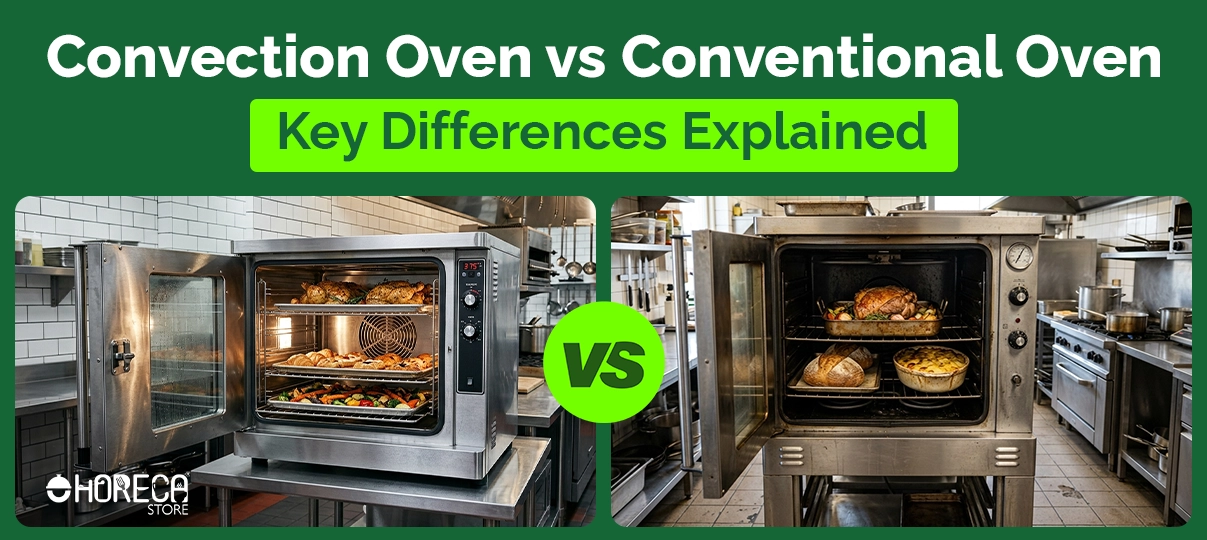
You’ve seen that "Convection" button on your oven for years, but you’ve probably never pressed it because you don't want to ruin dinner. Most home cooks stick to the standard "Bake" setting simply because it feels safer, leaving the more advanced features untouched. However, avoiding that switch means missing out on the secret to perfectly crisp roast chicken and avoiding the dreaded soggy bottom on your pizza.
That button matters because of the limitations of how a standard oven operates. In a conventional setup, heat radiates from the bottom element and slowly drifts upward, creating pockets of stagnant air. This "static heat" is notorious for creating hot spots and cold corners, which is exactly why you often find yourself frantically rotating pans halfway through baking to keep the back row of cookies from burning while the front row remains doughy.
Convection ovens solve this frustration with a deceptively simple addition: a fan and an exhaust system. Instead of allowing heat to drift lazily, hot air circulation technology forces warmth into every corner of the oven cavity. It acts like a high-powered blow-dryer for your food, ensuring that the heat distribution on the top rack matches the temperature on the bottom rack perfectly.
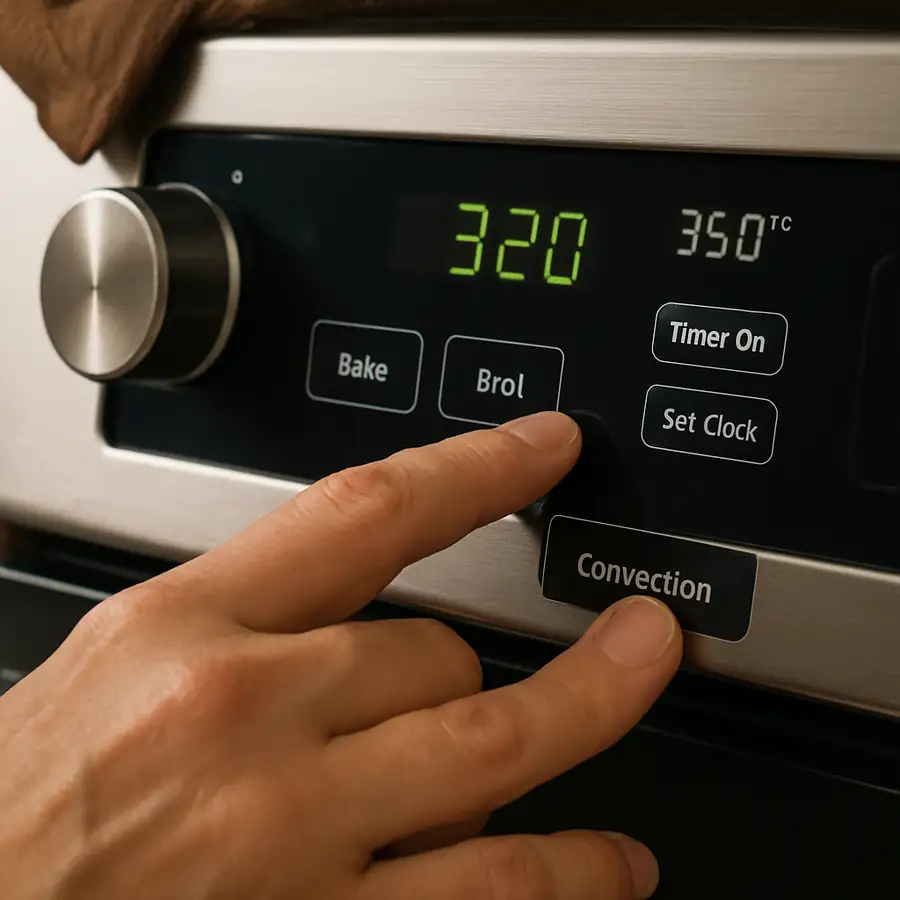
Meteorologists often explain this phenomenon using the concept of wind chill, and culinary experts apply the exact same physics to your kitchen. Just as a 30-degree day feels significantly colder when the wind is blowing because the air strips away your body heat, a convection fan makes the oven "feel" hotter to your food. By blowing hot air directly onto the surface of a roast, the oven strips away the insulating layer of cooler air surrounding the meat, cooking it faster and more evenly.
The battle of Convection Oven vs Conventional Oven isn't just about appliance terminology; it is about taking control of your results. Once you master how airflow changes the way food cooks, you can finally stop guessing, stop rotating your pans, and start baking with absolute confidence.
Why Your Oven 'Feels' Hotter: The Science of the Wind Chill Effect
Think about standing outside on a cold, blustery day. If the thermometer reads 30 degrees but the wind is howling, you freeze much faster than you would in still air because the wind strips away your body heat. This familiar "wind chill" concept is the secret behind why convection ovens cook faster, only the physics are working in reverse. By moving air around, the oven makes 350°F "feel" significantly hotter to a roast chicken than it actually is, turning standard temperature into an active cooking force.
When you place a tray of room-temperature broccoli into a standard oven, it doesn't just immediately absorb the oven's full heat. A microscopic "aura" of cooler air and moisture naturally forms around the food, acting like a protective thermal blanket. In a still oven, this invisible insulation slows down the cooking process because the heat has to fight through that stagnant layer before it can actually start roasting your dinner.
Hot air circulation technology acts like a hair dryer for your food, constantly blowing that cool barrier away. The fan forces fresh, searing heat directly against the surface of the ingredients, ensuring that the energy transfer is efficient and relentless. This direct exposure triggers rapid physical changes that static heat struggles to achieve:
- Rapid Evaporation: The moving air whisks away surface moisture instantly, preventing the "steaming" effect that leads to soggy bottoms.
- Accelerated Browning: Sugars and fats caramelize much faster (a process known as the Maillard reaction), creating that deep golden crust.
- Efficient Heat Transfer: Without the cool insulation layer, heat penetrates to the center of the food more quickly, reducing overall cook time.
Essentially, the convection setting works harder so you don't have to wait as long. However, this aggressive approach isn't always the answer, especially for delicate batters that need a gentler touch. Knowing when to keep the fan off requires looking at the distinct differences between radiant heat vs forced air cooking in traditional setups.
Radiant Heat and Static Air: The Limitations of Conventional Ovens
Switching off the convection setting returns you to a conventional setup that relies entirely on radiant heat. Picture an old-fashioned radiator in a draft-free room; the heat source warms the air slowly, radiating outward without any force pushing it around. In your kitchen, this usually involves a heating element at the bottom of the unit transferring energy through still, "static" air. While this passive method eventually gets the job done, the lack of movement allows the air to hang stagnant around your baking dish rather than actively engaging with it.
Physics naturally dictates that hot air rises, creating significant temperature stratification inside the metal box. Without a mechanical system to stir the atmosphere, intense heat collects near the ceiling while cooler pockets linger near the floor, creating "dead zones" where food cooks sluggishly. This separation explains why a tray of cookies on the top rack often burns before the bottom tray has even set. You aren't battling a bad recipe; you are fighting against the natural tendency of static air to settle into invisible layers of different temperatures.
Compensating for these inconsistencies requires constant vigilance and the dreaded "baker's shuffle." To achieve even heat distribution in baking, you are forced to manually interrupt the process by opening the door to rotate pans or swap racks halfway through the cook time.
The Convection Advantage: How a Simple Fan Eliminates Hot Spots
Pressing that convection button transforms your oven from a passive box into an active cooking tool. It applies the wind chill principle directly to your food. Convection uses the fan to blow hot air and strip away the cool insulation around your food, transferring heat faster and more intensely than still air ever could.
Instead of heat lazily rising to the ceiling, the fan creates a consistent vortex that reaches every corner of the oven cavity. This movement is the secret to successful multi-rack cooking and even heat distribution in baking. In a standard setup, placing a large turkey on the bottom rack blocks heat from reaching the casserole above it, leaving you with one burnt dish and one that is undercooked. With fan-assisted oven benefits, the air circulates around obstacles, ensuring the cookies on the bottom rack bake at the exact same rate as the ones on the top. You can finally say goodbye to the anxiety of opening the oven door every ten minutes just to rotate your pans.
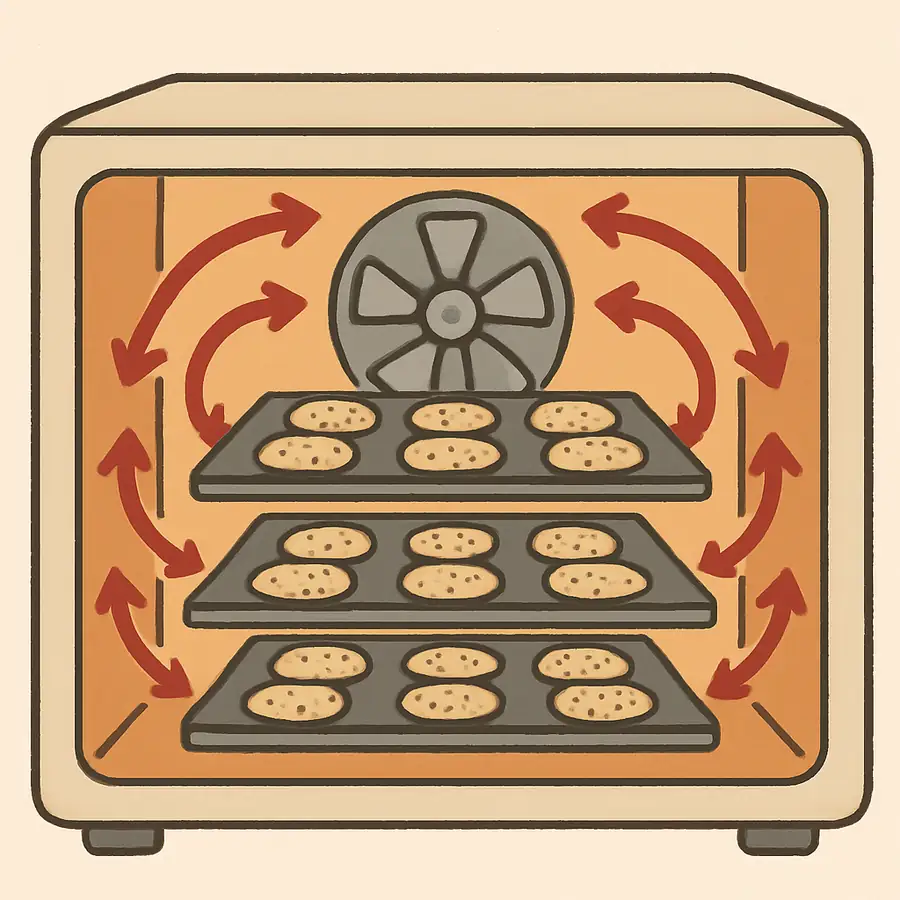
Beyond just better browning, this active airflow actually saves you money and time. Because the hot air is constantly scrubbing the surface of your food, energy transfer is significantly more efficient. The heating element doesn't need to work as hard to maintain the target temperature since the heat isn't getting trapped in dead zones near the ceiling. This increased energy efficiency of convection ovens means your Sunday roast finishes faster, and your kitchen stays cooler since you aren't fighting physics to get the job done.
However, this increased intensity comes with a slight learning curve that trips up many first-time users. Because the heat is being applied so much more effectively, using your grandmother’s standard baking times and temperatures will likely lead to burnt crusts and raw centers. To harness this power without ruining dinner, you need a simple conversion method to adapt your favorite recipes to this high-speed environment.
Mastering the 25/25 Rule: The Foolproof Conversion Formula
Since the fan creates such an intense heating environment, treating your convection setting like a standard oven is a recipe for disaster. If you stick to the temperature written on the back of a frozen lasagna box, you will likely end up with a burnt top layer and a frozen center. To harness the power of convection oven temperature conversion without ruining dinner, you need a safety buffer that accounts for that extra efficiency. This buffer is best remembered as the "25/25 Rule."
The first half of the solution is the "Temperature Rule": always lower your oven’s setting by 25°F compared to what the recipe requests. Think of this as an exchange rate; 325°F with a fan generates roughly the same cooking power as 350°F in still air. Reducing baking temperature by 25 degrees prevents the outside of your food from drying out or scorching before the heat has time to penetrate the middle. While some modern ovens have an "auto-convert" feature that does this for you, doing it manually ensures you are always in control.
Time is the second variable you must adjust, because even at a lower temperature, your food will cook faster. This leads to the "Time Rule": check your food 25% sooner than the recipe suggests. This doesn't mean the food is definitely done at that mark, but it serves as a critical checkpoint to prevent overcooking. If a roast usually takes an hour, how to adjust cooking times for convection simply means taking a peek at the 45-minute mark.
Here is a quick "Cheat Sheet" for common cooking scenarios:
| Standard Recipe Temp | Set Convection Oven To | Standard Cook Time | Check Convection At | | :--- | :--- | :--- | :--- | | 350°F (Cookies/Cakes) | 325°F | 12 Minutes | 9 Minutes | | 400°F (Roasted Veggies) | 375°F | 40 Minutes | 30 Minutes | | 425°F (Pizza/Chicken) | 400°F | 60 Minutes | 45 Minutes |
While these numbers provide a solid starting point, they work best as guidelines rather than rigid laws. Every appliance has its own personality, and some fans blow more aggressively than others. The math gets you in the ballpark, ensuring you aren't scorching your cookies, but it is always safer to underestimate the time rather than overestimate it. You can always add five more minutes, but you can’t un-burn a biscuit.
Trusting your senses is the final step in this process, regardless of what the calculation says. Because convection dries the surface of food quickly, rely on visual cues like golden-brown edges or the smell of roasting vegetables to tell you when a dish is ready. If the timer hasn't gone off but the chicken looks perfect and the juices run clear, trust your eyes over the math and pull it out immediately.
Armed with this simple formula, you can confidently adapt almost any standard recipe in your collection. You no longer need to hunt for specialized "convection-only" cookbooks; you just need to do a quick mental calculation before hitting "Start." Now that you know how to control the heat, it’s time to look at the specific dishes that benefit most from this airflow, transforming from good to restaurant-quality.
Golden Chicken and Crispy Broccoli: The Top 5 Foods Built for Convection
Now that you have the math down, the real fun begins with texture. Convection isn't just about speed; it is essentially a "dryness engine." By constantly sweeping away the invisible cloud of steam that naturally rises off cooking food, the fan allows surfaces to dry out and brown much faster than they would in still air. This rapid surface drying is the secret ingredient for achieving restaurant-quality finishes in your home kitchen.
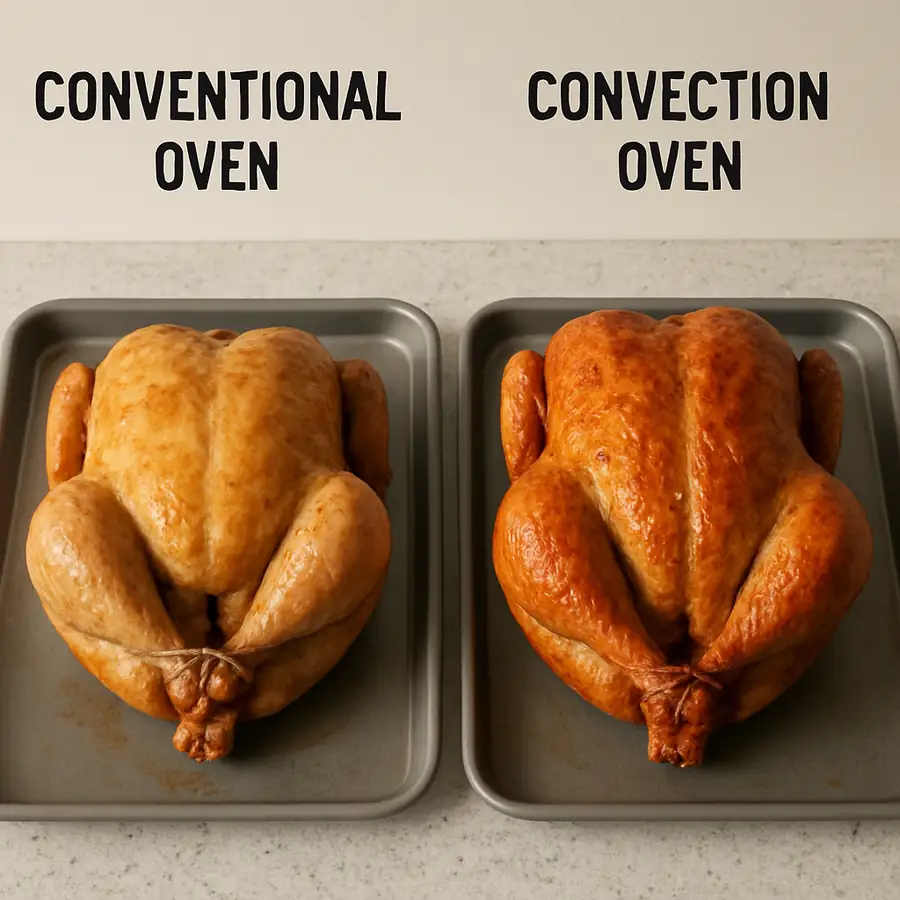
Large cuts of meat illustrate this advantage perfectly. When you roast a bird in a standard oven, humidity hangs around the skin, which can accidentally steam the meat rather than sear it. In contrast, the best foods for convection roasting get blasted with moving dry heat, rendering the fat quickly and creating that shatteringly crisp skin while keeping the juices locked inside. You get the browning of a high-heat sear without overcooking the center.
Vegetables undergo a similar transformation under the fan. Broccoli, Brussels sprouts, and potatoes often turn mushy in a standard oven because they sit in a pocket of their own moisture. The circulating air wicks that dampness away immediately, allowing the natural sugars to caramelize. If you love roasted veggies with charred, crunchy edges rather than soft, steamed textures, this setting is the only way to cook them.
Even your dessert game changes when you add air movement. Baking cookies in a convection oven solves the notorious "hot spot" problem, meaning you can load up three racks at once without worrying about burnt bottoms on the lower tray. Additionally, pastries that rely on cold butter for lift—like biscuits, scones, or pie crusts—rise higher because the rapid heat turns the water in the butter into steam before the dough has a chance to settle.
To get the most out of your appliance immediately, start with these distinct fan-assisted oven benefits winners:
- Whole Roasted Chicken: For skin that crackles instead of stretches.
- Roasted Root Vegetables: Potatoes and carrots get sweeter and crispier edges.
- Flaky Biscuits & Scones: Expect a higher rise and better distinct layers.
- Toasted Nuts: Achieving even browning without needing constant stirring.
- Multi-Rack Cookies: Bake three dozen at once with consistent results across every tray.
However, this aggressive airflow isn't perfect for everything. Just as a strong wind can be too much for a house of cards, the convection fan can be disastrous for delicate batters that need a gentle, humid touch to rise properly.
When the Fan is Your Foe: 3 Delicate Foods to Keep in Conventional Mode
While that powerful airflow works wonders for roast chicken, it acts like a leaf blower against liquid batters that are trying to set. If you are making a soufflé, a flan, or a light custard, the circulating air can physically push the liquid sideways, resulting in a dessert that looks like the Leaning Tower of Pisa. This is the primary reason to switch back to the standard mode: when to use conventional oven setting becomes critical for anything that starts as a loose liquid and needs to rise straight up without physical disturbance.
For standard cakes and quick breads, the problem isn't just the wind speed, but how quickly the surface dries out. Remember that convection is efficient at removing moisture, which is great for crispy skin but terrible for a banana bread that needs 60 minutes to bake. If the top of your loaf forms a hard crust within the first 15 minutes, the raw batter inside still needs to expand as it heats up. Since the new crust acts like a rigid lid that won't stretch, the rising dough eventually bursts through the weakest point, leaving you with a cracked, volcanic-looking top and a dense, undercooked center.
Gentle, radiant heat provides the stable environment required for these "set-and-rise" recipes. Angel food cakes and sponge cakes, which rely on whipped egg whites for their structure, are particularly vulnerable because their internal air bubbles are incredibly fragile until they lock into place. By keeping the fan off, you allow the heat to slowly penetrate the pan from the bottom up, giving the batter time to climb the sides and stabilize before the top browns. In the context of convection oven vs conventional oven, the old-fashioned still air wins every time you need a flat, fluffy lift rather than a crispy exterior.
Recognizing these limitations prevents heartbreak in the baking aisle, but knowing when to unleash that fan is where the excitement returns. You might have noticed that the "crispy, fast, and dry" description of convection cooking sounds suspiciously similar to another popular countertop appliance. It turns out that the technology inside your wall oven is nearly identical to the basket device sitting next to your toaster, leading many cooks to wonder if they really need both.
Convection vs. Air Fryers: Are They Actually the Same Thing?
If you suspect that "Air Frying" is just a catchy marketing term for a technology you already own, you are absolutely right. The mechanism inside that trendy countertop basket is simply how convection ovens work, only shrunk down to the size of a coffee maker. Both appliances rely on the exact same pairing of a standard heating element and a fan to circulate hot air around your food. The dirty secret of the appliance aisle is that an air fryer is essentially just a miniature convection oven that has been rebranded for the modern kitchen.
The real convection vs air fryer difference comes down to physics and scale. Think of it like the difference between a gentle breeze in a large auditorium and a high-powered wind tunnel. Because the air fryer’s cooking chamber is so small, the fan can cycle hot air over your french fries much faster than your large wall oven can move air around a roasting pan. This high-velocity, concentrated heat creates that signature "fried" crunch in minutes rather than hours, purely because the heat source is inches away from the food rather than feet away.
You don't necessarily need to toss your countertop gadget, however, because that size advantage works both ways. While the air fryer wins on speed for a single batch of wings, your full-sized convection oven is superior when you need to roast vegetables for the whole family without cooking in multiple batches. The wall oven offers capacity, but to get it to perform closer to an air fryer's intensity, you need to understand one final nuance in oven design. Some manufacturers just bolt a fan onto the back wall, while others install a hidden "third element" that changes the game completely.
True Convection vs. Fan-Forced: What's the Third Element?
Not every appliance labeled "convection" actually performs the same task, which can lead to confusing results even when you follow a recipe perfectly. Many budget-friendly models use a system simply known as "fan-forced" or "fan-assisted" heating. In these ovens, a fan on the back wall circulates the heat generated by the standard burner at the bottom of the oven. While this is an improvement over still air, it has a flaw: if the bottom burner cycles off to regulate temperature, the fan may briefly circulate cooler air, resulting in uneven browning.
"True Convection"—often marketed as "European Convection"—solves this problem by adding a third heating element wrapped directly around the fan itself. Instead of just pushing existing heat around, this system actively heats the air before blowing it into the oven cavity. This distinction is critical for how convection ovens work effectively; because the air blowing onto your food is consistently hot, you can bake three racks of cookies simultaneously without the bottom tray burning while the top tray stays raw.
If you aren't sure which system is sitting in your kitchen, you can usually identify a true convection vs fan-forced model with a quick visual inspection:
- Check the Back Wall: Look through the oven window at the fan. If you can see a metal heating coil circling the fan blades, you likely have True Convection.
- Read the Fine Print: Check your user manual or the oven's faceplate for specific terms like "European Convection," "True Convection," or "Third-Element Convection."
- Look for Multiple Modes: High-end models often have separate settings for "Convection Bake" (uses the third element) and "Convection Roast" (toggles between elements for searing).
Knowing your specific hardware is the final piece of the puzzle before you start cooking. Now that you know exactly what your machine can handle, you can apply a simple strategy to get the best results for tonight's dinner.
Your 3-Step Strategy for Choosing the Right Oven Setting Tonight
That intimidating fan setting on your dashboard no longer needs to be a source of kitchen anxiety. You have moved past seeing your appliance as just a generic hot box and can now view it as a versatile tool for precision cooking. Instead of hoping for the best and accepting soggy crusts or uneven browning, you now understand that controlled air movement is often the secret ingredient missing from your favorite dishes. Grasping these mechanics isn't just about physics; it is about taking full control of the final texture of your dinner.
Choosing the right setting for tonight's meal now takes only a few seconds. Ask yourself what you want the final result to look like before you preheat. If you are aiming for crispy skin on a roast chicken, deeply caramelized vegetables, or three racks of cookies that all need to bake evenly, reach for the convection setting to circulate that heat. Conversely, if you are preparing a delicate soufflé, a custodial cake, or quick bread where the batter needs to rise slowly and undisturbed, stick to the static radiant heat of the conventional mode. This simple pause to define your texture goals ensures you are working with your oven rather than fighting against it.
When you do decide to engage the fan, the convection oven temperature conversion doesn't require complex mental math. Rely on the 25/25 rule as your permanent safety net: simply lower the temperature by 25 degrees and check your food 25 percent sooner than the recipe suggests. This consistent adjustment accounts for the "wind chill" efficiency of the moving air, preventing the common mistake of burning the exterior while the center remains raw.
Mastering your kitchen technology transforms you from an accidental cook into an intentional one. You are no longer at the mercy of random hot spots or guessing games regarding bake times. By knowing exactly when to engage the fan and how to adjust your temperature, you guarantee that your efforts result in the golden-brown finish you pictured. Go ahead and press that button with confidence, knowing that you finally have the upper hand on your heat.
Buy Commercial Ovens from The Horeca Store
Selecting the right commercial oven is crucial for improving kitchen productivity and delivering consistently high-quality food. The Horeca Store offers a wide range of commercial convection ovens and conventional ovens designed for restaurants, cafés, hotels, bakeries, cloud kitchens, and catering businesses. Our collection includes durable, high-performance ovens that provide reliable temperature control, efficient cooking, and long-lasting performance in demanding commercial environments.
At The Horeca Store, we are committed to supplying premium commercial kitchen equipment that helps foodservice businesses operate more efficiently. Whether you're looking for a compact countertop oven or a heavy-duty commercial baking solution, our expert team can help you choose the right model based on your menu, production capacity, and kitchen space. Explore our range of commercial ovens to find the perfect solution for enhancing food quality, reducing cooking time, and supporting your business growth.