
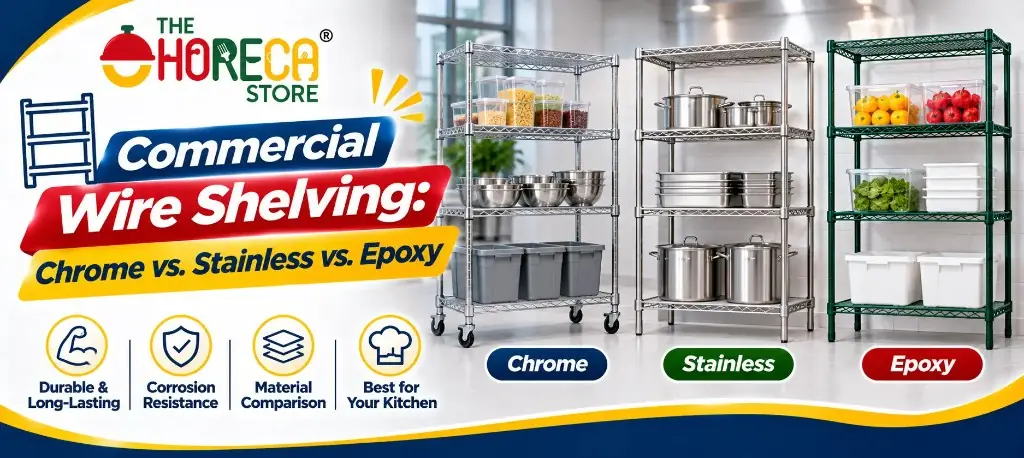
Chrome, stainless steel, and epoxy-coated commercial wire shelving serve different storage environments: chrome suits dry spaces, while appropriately specified stainless and epoxy options handle moisture-prone applications. The right choice depends on exposure, cleaning practices, and product specifications - not appearance alone. This comparison explains where each option belongs and what to check before buying.
When preparing to discuss commercial shelving solutions with The Horeca Store, start with your storage conditions and inventory. A clear brief makes it easier to compare suitable products rather than similar-looking racks.
Which commercial wire shelving finish fits your space?
Choose chrome for reliably dry storage, wet-environment-rated epoxy for damp or refrigerated storage, and appropriately specified stainless steel for demanding moisture and cleaning conditions. These are starting points, not universal approvals: the exact product must suit its location and maintenance routine.
| Option | Typical application | Main consideration |
|---|---|---|
| Chrome-plated steel | Dry stockrooms and retail displays | Keep away from persistent moisture |
| Stainless steel | Wet storage and demanding sanitation environments | Verify steel grade and chemical compatibility |
| Epoxy-coated steel | Coolers and humid storage, when appropriately rated | Protect and inspect the coating |
Manufacturer guidance distinguishes these applications because corrosion resistance varies with the material or protective finish. Do not assume every shiny shelf is stainless steel or every colored shelf is approved for refrigeration.
Before selecting a finish, describe the shelf's actual location. A dry storeroom and the space beside a dishwasher should not automatically receive the same specification.
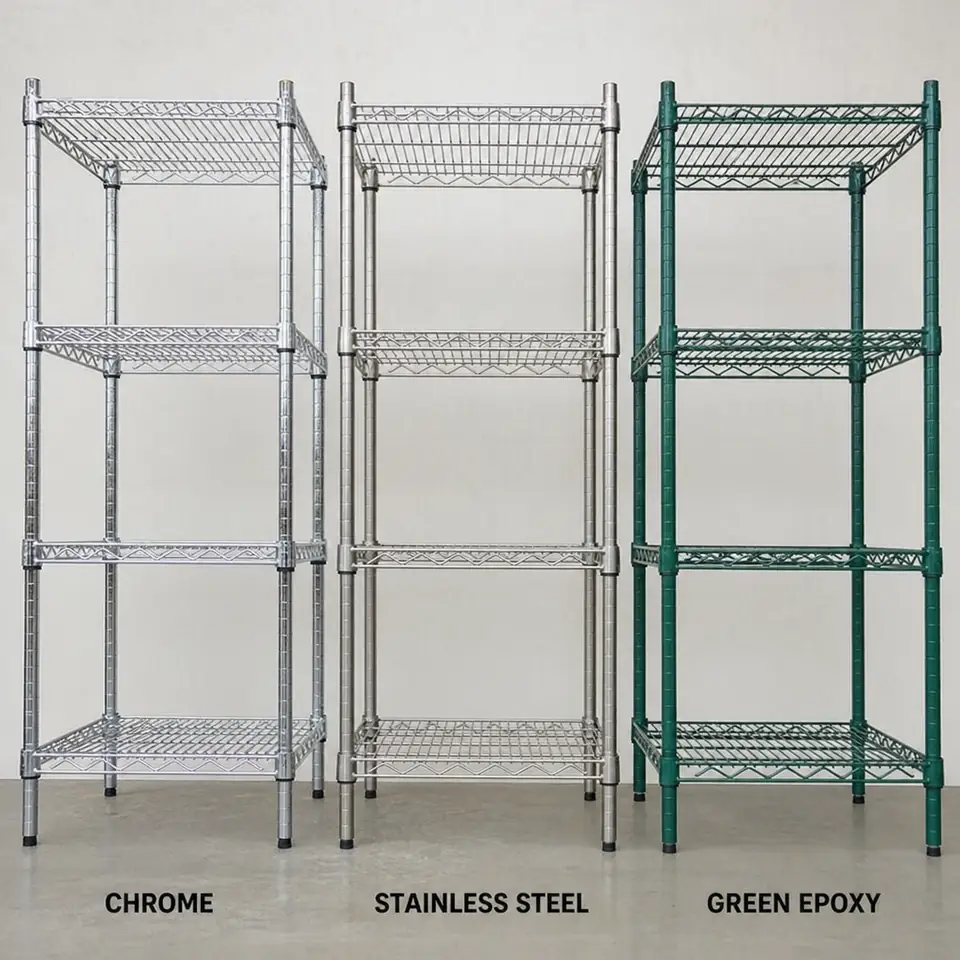
Chrome shelving for dry storage and visible displays
Chrome wire shelving typically uses chrome-plated carbon steel. Its bright appearance makes it a practical candidate for retail display shelving, while manufacturers also recommend it for dry stockrooms and warehouse storage. Persistent humidity, condensation, and washdowns are outside its intended use.
For a commercial wire shelving rack holding packaged merchandise, paper supplies, or sealed pantry goods, chrome can be a sensible starting point. First confirm that the room remains dry throughout normal operation - not just during a quiet inspection. Manufacturers caution that moisture and cleaning chemicals can lead to premature corrosion.
Consider these questions during a site walk:
- Does nearby equipment release steam toward the rack?
- Could floor cleaning regularly splash the lower shelves?
- Will staff place damp containers directly onto the wire?
- Might the rack later move into refrigerated storage?
If any answer is yes, investigate a moisture-rated alternative before choosing chrome. That is more useful than relying on the finish's appearance.
Stainless steel for demanding conditions
Stainless steel is an alloy rather than ordinary steel protected only by an external coating. Its corrosion resistance comes from a naturally forming, chromium-rich passive film. That distinction explains why stainless shelving deserves consideration where moisture exposure makes plated steel unsuitable.
However, "stainless" does not mean immune to corrosion. Grade, exposure, surface condition, and cleaning practices matter; aggressive chemical conditions can compromise its protective film. Request the stated steel grade and application guidance rather than treating every stainless product as interchangeable.
For example, Type 304 appears in commercial shelving specifications for wet-environment applications, but the complete unit still needs appropriate documentation. Stainless shelves do not automatically establish the suitability of every post, caster, or accessory. Check the assembled configuration you intend to order.
When comparing stainless metal storage shelves, ask the supplier to identify the construction of major components. Keep those details with the quotation so purchasing staff can compare equivalent specifications instead of relying on broad product names.
Epoxy shelving balances moisture protection and coating care
Epoxy-coated shelving uses a protective resin coating over a steel substrate, often with an underlying plated layer. Suitable systems offer better moisture resistance than standard chrome shelving, making them candidates for coolers, humid stockrooms, and other damp spaces. Performance depends on the manufacturer's coating system and intended application.
The important limitation is coating integrity. Scratches, chips, and wear can expose the underlying metal, so a rack that receives frequent impacts deserves inspection. Coating quality and application processes differ; "epoxy" alone is not a complete performance specification.
Before buying, request confirmation of:
- Environmental suitability: Explicit approval for the planned wet, refrigerated, or freezer application.
- Cleaning compatibility: Permitted products and methods for the specific coating.
- Warranty conditions: Covered corrosion, exclusions, and required maintenance.
- Damage procedures: Manufacturer guidance on inspection, repair, or replacement.
Use those answers to compare products. Color can help distinguish storage zones, but it should never replace documented suitability as the deciding factor.
What matters most for commercial kitchen shelving?
For wire shelving for commercial kitchens, match the exact unit to its storage environment and verify its certification listing. NSF listings distinguish shelving acceptable for dry storage from products listed for broader environmental use. An NSF logo alone does not establish that a rack belongs in a cooler or wet zone.
Divide the kitchen into separate purchasing zones rather than ordering one finish everywhere. Manufacturer guidance identifies chrome for dry storage and appropriately rated epoxy or stainless options for wet areas and refrigeration. This zone-based approach connects each purchase to its actual exposure.
Build a simple location schedule:
- Dry pantry: Record packaged goods, expected loads, and any nearby moisture sources.
- Walk-in storage: Specify refrigeration or freezer use explicitly in the purchase request.
- Dishwashing vicinity: Describe steam, splashes, and the cleaning routine.
- Mobile staging: Document where the unit travels, not just where it parks.
For each location, record the proposed model and supporting listing. Resolve unclear applications before ordering rather than assuming a finish name answers every suitability question.
Configure the rack around your inventory
A finish comparison is only part of the purchase. Commercial wire rack shelving also needs the right dimensions, loading capacity, and configuration. Manufacturer specifications treat shelf limits, total unit limits, and mobile limits separately, so compare complete commercial wire shelving units rather than finishes alone.
Check shelf and total-unit load ratings
Do not calculate capacity simply by multiplying shelf count by the maximum shelf rating. A manufacturer's total-unit limit may be lower, and shelf length can change the permitted load. Published ratings also depend on the specified configuration and loading conditions.
For heavy-duty shelving, prepare an inventory list showing the heaviest cases or containers, their quantities, and intended shelf positions. Ask the supplier to confirm suitability for that arrangement, especially where weight is concentrated. Manufacturer buying guidance explicitly identifies uneven or concentrated loading as a purchasing consideration.
Make adjustability useful
Adjustable wire shelves can accommodate changing container heights and merchandise. Some systems provide tool-free repositioning at defined increments, but adjustment methods are product-specific. Review the actual mechanism rather than assuming every wire rack adjusts the same way.
Measure your tallest regularly stocked package before deciding shelf spacing. Leave workable retrieval space instead of packing each level tightly. Sketch a shelf layout using actual products so the finished rack supports everyday access, not merely maximum theoretical storage.
Specify wheels as part of the system
Commercial wire shelving with wheels can support repositioning, and suitable casters may include brakes. However, mobile capacity differs from stationary capacity and must be checked for the complete assembly. Wheels are not an accessory to select independently of the rack's operating limits.
Measure doorways, turning areas, and the intended parking space. Describe thresholds and floor conditions to the supplier, then request a compatible caster specification. Verify overall height with wheels installed before approving the order.
Build cleaning and inspection into the purchase
Choose shelving that fits a cleaning routine your team can consistently perform. Stainless steel still requires appropriate care: industry guidance warns that abrasive cleaners and chloride-containing products can damage surfaces. Follow the shelving manufacturer's specific instructions rather than improvising with whatever cleaner is nearby.
For epoxy-coated wire shelving units, make coating inspection part of routine checks because exposed substrate can become vulnerable to corrosion. Record chips, scratches, and worn contact points, then follow the manufacturer's response guidance. Do not assume an improvised coating repair restores the original performance or certification.
Give the team a short maintenance record with fields for location, inspection date, observed damage, and action taken. Keep cleaning instructions accessible alongside it. This creates a practical handover between purchasing, operations, and whoever maintains the racks.
Which option offers the best long-term value?
The best-value option is the least costly complete system that meets the environment, load, and maintenance requirements - not necessarily the cheapest rack. Manufacturer guidance generally positions chrome as economical for dry storage, epoxy as a moisture-resistant alternative, and stainless as a higher-investment option. Actual quotations must establish the difference for comparable products.
Compare matching dimensions, shelf counts, capacities, and mobility. Otherwise, an apparently cheaper quotation may simply describe less storage or a different configuration. Include required accessories and delivery in your purchasing worksheet rather than comparing headline prices alone.
For larger storage rack systems, consider replacement access and future expansion in the evaluation. Ask how additional shelves or compatible components would be identified later. Keep warehouse shelving systems for heavy bulk handling separate from smaller hand-loaded storage requirements when preparing your brief.
Avoid assuming one premium finish must serve the entire building. Specify each zone first, then assess whether standardizing some components would make purchasing and maintenance easier.
A practical pre-purchase checklist
Before requesting a final quotation, assemble these details in one document:
- Location and exposure: Name the room, temperature conditions, moisture sources, and cleaning practices.
- Inventory: List package dimensions, expected quantities, and the heaviest individual items.
- Rack dimensions: Confirm available width, depth, height, and space needed for access.
- Configuration: Specify shelf count, planned spacing, stationary or mobile use, and any accessories.
- Supporting documents: Request the model specification, applicable certification listing, load limits, cleaning instructions, and warranty terms.
- Comparison basis: Ensure competing quotations describe equivalent assembled units, not individual shelves or incomplete kits.
Take photographs of the intended location and sketch the proposed layout. Include nearby doors, equipment, and cleaning access in the sketch. For mobile racks, add the route between working areas and the planned parking position.
Use this completed brief when discussing requirements with The Horeca Store. Ask for any unresolved suitability questions to be answered against the specific model documentation before making a purchasing decision.
Choose for the environment first
Chrome belongs in reliably dry spaces; appropriately rated epoxy and stainless options address wetter applications, with different maintenance considerations. After selecting the material, verify certification, loading limits, and the complete configuration.
The practical takeaway is simple: define where the rack will work, what it will hold, and how it will be cleaned. Use those requirements to narrow the options before comparing price or appearance.