
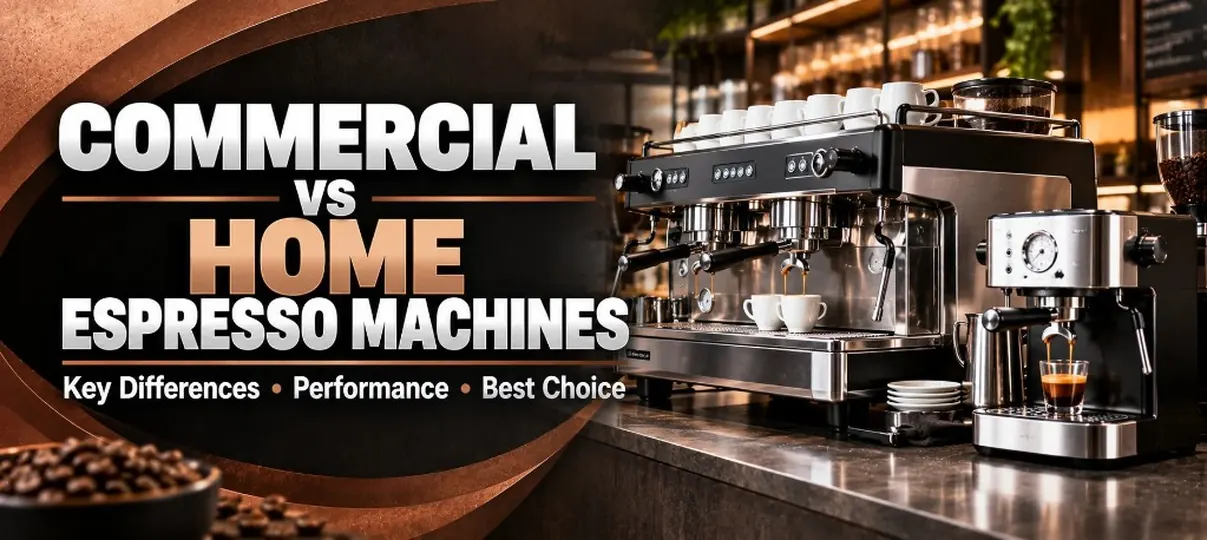
Commercial espresso machines prioritize sustained drink production and cafe workflow, while home machines prioritize equipment that fits everyday kitchen use. The distinction is not simply good coffee versus better coffee: sophisticated home models can share features such as dual boilers and precise temperature control with commercial equipment. This espresso machine guide explains how to compare capacity, installation, maintenance, and usability without buying more machine than you need.
What is the main difference between commercial and home espresso machines?
The main difference is the workload each machine is designed to support. Commercial machines provide the capacity and workflow features needed for repeated service, including configurations with multiple brewing groups. Home machines generally package espresso-making capabilities into a smaller, self-contained setup, although there is overlap between home and light-commercial equipment.
Think of the decision as a capacity problem rather than a prestige contest. Making breakfast coffee and handling a queue of customers are different jobs. Your comparison should start with how many drinks must be ready close together, not which machine looks most impressive.
The table below uses representative home and commercial designs rather than universal rules. Always verify the exact model: a high-end home machine can have features missing from another machine marketed for business use.
| Comparison point | Home-oriented design | Commercial-oriented design |
|---|---|---|
| Brewing layout | Typically one brewing group | Available with multiple brewing groups |
| Water supply | A reservoir can simplify placement | Installation may require a connected supply and drainage |
| Heating capacity | Sized around household use | Larger configurations support repeated production |
| Controls | May emphasize personal adjustment and convenience | May emphasize programmable dosing and service workflow |
| Installation | Kitchen-sized equipment is available | Larger machines can require more space and electrical capacity |
These differences appear in manufacturer specifications and installation documents; they should be checked together rather than treated as independent selling points.
Capacity matters most during the busiest stretch
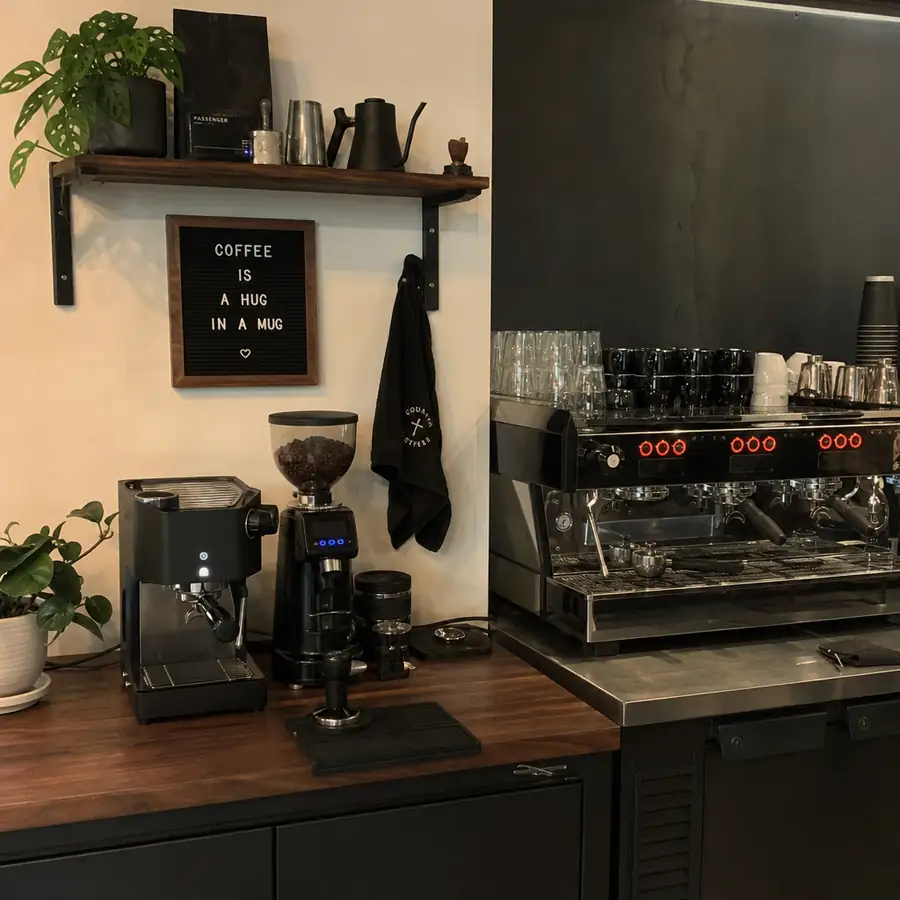
A commercial machine's advantages become easier to understand when several drinks need preparing together. Multiple group heads-the brewing assemblies where portafilters lock into place-provide separate brewing positions. Commercial configurations can also include substantial steam capacity and controls intended to simplify repeated preparation.
For a useful purchasing exercise, map your busiest realistic sequence. A household might need two cappuccinos before leaving for work. A small business might need to handle several milk drinks while another customer orders espresso. Those scenarios deserve different demonstrations, even if their total daily drink counts sound modest.
Ask a supplier to reproduce your intended sequence, including grinding, brewing, steaming, and cleanup. Watch for waiting between tasks rather than timing a single impressive shot. A machine that fits your routine should make the whole sequence manageable, not merely complete its easiest step quickly.
Avoid assuming that a group count guarantees a particular drinks-per-hour figure. Ask what conditions support any quoted output: drink size, milk preparation, staffing, and grinder setup should all be part of the discussion.
Heating systems explain much of the workflow
Among espresso machine types, heating architecture is more useful than a vague "professional" label. Dual-boiler designs, for example, separate espresso brewing from steam production, and this arrangement exists in both home and commercial equipment. The practical question is whether the specific machine supports the way you intend to alternate or combine those tasks.
Single-boiler and fast-heating designs
Some home machines use one boiler for brewing and steaming, requiring the user to follow a changeover sequence between modes. Other compact machines use fast-heating systems instead of a conventional stored-water boiler arrangement. Consult the operating instructions rather than assuming every small machine works the same way.
For your shortlist, ask three concrete questions: What must happen before steaming? What must happen before brewing again? Which parts need preheating? These reveal more about a morning routine than a headline warm-up claim alone.
Dual-boiler designs
Dual-boiler machines use separate boilers for espresso and steam, allowing simultaneous extraction and milk texturing on models designed for that operation. Breville's Dual Boiler is one home-oriented example; commercial machines also use separate boilers to support brewing and steam production. This makes dual boilers a workflow feature, not proof that a machine belongs exclusively in either category.
If you mostly drink straight espresso, give brewing control and usability more weight in your evaluation. If you regularly prepare several milk drinks together, make simultaneous brewing and steaming a specific demonstration requirement. Match the architecture to the task instead of treating the longest feature list as the winner.
Does a commercial machine make better espresso?
A commercial designation alone does not establish better espresso quality. Home equipment can offer dual boilers, temperature control, pre-infusion, and other sophisticated brewing features. Meanwhile, grind size and extraction technique still influence flavor, regardless of the machine's intended setting.
Separate two questions during your espresso machine comparison: how much control does the machine offer, and how well does the complete setup perform under your workload? Those questions prevent you from confusing production capacity with an automatic improvement in taste.
Do not overlook the grinder when assigning your budget. Grind size affects extraction and flow, so a machine purchase should leave room for a grinder capable of the adjustments your coffee requires. Learning to make those adjustments remains part of hands-on espresso preparation.
For a fair demonstration, request the same coffee and a clearly stated recipe across machines. Taste the espresso rather than judging only crema or presentation. Then repeat the comparison through the drink sequence you actually expect to make.
Installation can change the buying decision
Before comparing finishes or touchscreens, obtain the installation sheet. Manufacturer documents can specify electrical supply, water connections, drainage, equipment clearance, and filtration. Requirements vary by model, including within equipment families that offer reservoir and plumbed operation.
Space, power, and water access
Measure the entire station, not just the machine's footprint. Include space for the grinder, preparation tools, milk pitchers, and waste handling. Check whether filling a reservoir or accessing a service panel requires clearance that a cabinet or wall would block.
Electrical requirements deserve particular attention before ordering. Commercial configurations can have substantially different supply requirements from kitchen-oriented models; the product documentation, not appearance, determines what installation needs. Have a qualified installer assess compatibility rather than assuming an available outlet is suitable.
Water deserves the same care. Manufacturers may specify hardness, alkalinity, chloride, and other water parameters, alongside filtration requirements. Test the intended water supply against the machine's specifications before choosing treatment; "filtered" is not a sufficiently detailed purchasing specification.
Commercial suitability needs explicit confirmation
For business use, ask the supplier to identify the machine's intended application, certifications, and applicable warranty terms. Food-equipment sanitation certification addresses matters such as cleanability and hygienic design; it is not simply another claim about coffee quality. Confirm your proposed equipment with the relevant local authority before purchasing.
Do not treat "commercial-grade" as a complete answer. Request documentation for the exact model and configuration you plan to install. That is especially important when considering compact equipment positioned between home and light-commercial use.
Controls should match the people making coffee
Commercial and home categories do not tell you how much work the operator performs. Manufacturer ranges include semi-automatic, volumetric, and other control configurations, while fully automatic machines can prepare drinks from beans at the touch of a button. Choose the operating style separately from the capacity you require.
For hands-on preparation, evaluate how easily you can adjust the recipe and stop a shot. Programmable volumetric or weight-based stopping can support a repeatable workflow, but the available functions depend on the model and configuration. Check what is included rather than assuming every version offers identical automation.
For a shared kitchen or workplace, ask prospective users to try the controls. Can they find their preferred drink, understand the prompts, and complete the required cleanup? A useful interface is one the actual users can operate confidently, not necessarily the one with the largest screen.
Maintenance and support belong in the budget
Cleaning is part of espresso-machine ownership, not an optional finishing touch. Manufacturer guidance connects cleaning with taste, consistency, and machine function, and commercial equipment may include automated group-cleaning routines. Automation helps execute a process; it does not remove the need to supply cleaning products, follow instructions, and complete rinsing.
Before buying, ask the seller to walk through the exact maintenance schedule. Request separate explanations of routine user tasks and work intended for a technician. Avoid transferring a cleaning or descaling procedure from another machine without checking the manual.
Build your ownership estimate around these items:
- Installation: Obtain quotes for any required electrical, plumbing, drainage, or countertop work before committing.
- Water treatment: Include testing, the selected treatment system, and replacement consumables specified for it.
- Cleaning supplies: Identify approved products and the routines in which they are used.
- Service access: Ask who supports the machine locally, how appointments work, and which parts are stocked.
- Business continuity: Decide how you would serve customers if the machine were unavailable.
For used equipment, request service records and arrange an informed inspection. Ask the technician to assess its condition against your intended workload and installation. Compare the complete acquisition-and-repair estimate with supported alternatives, not merely the advertised purchase price.
Read espresso machine reviews through your own use case
The best espresso machines for different buyers will not necessarily share a design. Use espresso machine reviews to uncover practical limitations, then verify specifications and installation requirements with the manufacturer. Treat a review as evidence to examine, not a substitute for defining your needs.
A useful review-reading checklist includes:
- Testing context: Was the machine used for isolated drinks or a repeated sequence resembling yours?
- Complete setup: Which grinder, coffee, and recipe were used, and are those details disclosed?
- Workflow: Does the review show transitions between brewing, steaming, refilling, and cleaning?
- Ownership: Are service arrangements and maintenance demands discussed rather than assumed?
- Exact configuration: Does the reviewed version match the one available to you?
Be cautious when a comparison declares a winner without identifying the intended buyer. Someone seeking a quick morning drink and someone building a staffed coffee bar need different answers. Give the greatest weight to evidence that helps resolve your own constraints.
Choose for your routine, not the label
Start with your busiest drink sequence, available installation space, preferred operating style, and complete ownership budget. Turn those requirements into a shortlist, then request demonstrations and documentation for each candidate. This gives you a defensible choice without relying on "home" or "commercial" as a quality ranking.
The right machine is the one whose capabilities you will use and whose upkeep you can realistically support. Buy enough capacity for the job, preserve budget for the rest of the setup, and resist paying for a workload you do not have.