

A commercial salamander broiler applies intense overhead heat to broil food, brown toppings, and finish dishes before service. Choosing the right one means matching cooking capability, usable rack space, controls, and installation requirements to your menu-not simply buying the highest-powered unit. This guide helps you build a practical shortlist and identify the questions to resolve before ordering. The Horeca Store stocks the finishing pieces this buying guide compares.
What is a commercial salamander broiler used for?
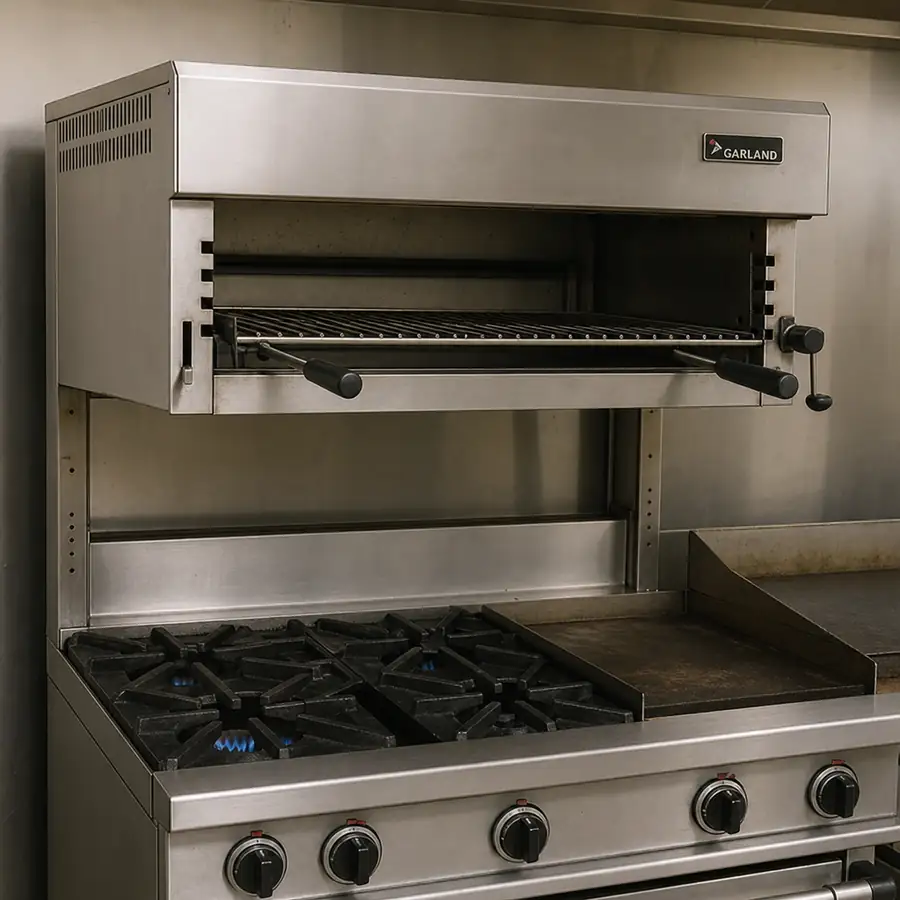
A commercial kitchen salamander broiler is used for top-down cooking and finishing, including melting cheese, browning breadcrumbs, glazing dishes, and broiling suitable foods. Unlike equipment designed only for light finishing, a salamander can offer the heat and adjustment needed for more demanding cooking tasks. Its suitability for your menu depends on the particular model and how you intend to use it.
Start your buying process with a task list rather than a product catalog. Separate dishes that need only surface browning from those you expect the appliance to cook. Then identify which tasks happen together during your busiest service.
For example, ask whether the unit must finish soup crocks while another cook broils an entree. Bring those dishes and their actual cookware into the evaluation. A demonstration built around your menu is more useful than watching an empty appliance heat up.
Choose the right category of broiler equipment
A salamander, cheesemelter, and upright commercial broiler serve overlapping but different purposes. Manufacturers distinguish salamanders as cooking and finishing appliances, cheesemelters as lighter finishing equipment, and upright broilers as options for larger broiling workloads. Compare intended applications before comparing purchase prices.
Use these categories to organize your search, not as substitutes for checking specifications. A product name alone should not decide whether a unit can handle your recipes. Request confirmation of the proposed applications and, where possible, test the actual model.
Should you choose a gas or electric salamander grill?
Choose gas or electric by confirming site compatibility first, then comparing cooking performance and operating needs. Gas salamanders are available for natural gas or propane, while electric models have specific voltage and phase requirements. Neither fuel label tells you enough about usable capacity, controls, or the quality of the finished dish.
Gas: confirm the complete supply requirements
For a gas model, have a qualified installer verify the specified gas type, supply capacity, pressure, connection, and installation arrangement. Do not assume that an existing connection is suitable simply because another appliance used it. Obtain the installation manual before ordering and ask the installer to review the exact model.
In your quote request, identify whether the site uses natural gas or propane. Ask the supplier to state which configuration will arrive and whether any manufacturer-approved conversion work is necessary. Keep that answer with the purchase documents rather than relying on a verbal assurance.
Electric: match more than the voltage
For an electric salamander, verify voltage, phase, electrical load, and connection requirements against the available service. Vulcan's electric salamander documentation, for example, calls for checking the electrical supply against the appliance rating plate before installation. Have a qualified electrician determine whether the proposed location can support the selected equipment.
Ask for a written description of any electrical work required. Include that work when comparing quotes, rather than treating it as an expense to investigate after delivery. Your shortlist should contain equipment you can install, not just equipment you can purchase.
Size the cooking area around real orders
Compare usable grid dimensions separately from exterior width. As one example, Vulcan lists a 27½-by-13-inch grid inside its nominally 36-inch electric salamander. That distinction matters when checking whether your pans, platters, or soup crocks will fit.
Create a simple capacity worksheet before requesting recommendations:
- Largest cookware: Record its full dimensions, including handles and projecting rims.
- Typical batch: Identify which dishes need finishing together for one table.
- Peak overlap: Note how many orders may require the broiler simultaneously.
- Tallest dish: Check the space needed for cookware and food at relevant rack positions.
- Loading movement: Allow for pulling out the rack and removing cookware safely.
Ask the supplier to demonstrate the proposed arrangement with comparable cookware. Look for a workable loading pattern, not merely proof that everything fits inside the opening. Also request a demonstration with a full representative batch, rather than a single item centered beneath the heat.
Avoid choosing extra width without a defined purpose. Instead, write down what the additional space would let your team do during service. That keeps the buying decision tied to an operating need.
Prioritize heat control and rack movement
Adjustable rack height changes the distance between food and the heat source, while separate heat controls can provide additional flexibility. Features vary: some salamanders offer multiple grid positions, independently controlled heating zones, and removable spillage pans. Compare the actual mechanism and control layout rather than counting features on a brochure.
During a demonstration, ask the cook who will use the appliance to adjust the rack, load cookware, and operate the controls. Check whether the rack positions suit both shallow dishes and taller containers. Include normal protective equipment in the trial so the handling assessment reflects service conditions.
Request evidence for broad performance claims. Instead of accepting "fast heating," ask to see the specified preheat procedure and a representative cooking test. Instead of accepting "even browning," inspect several items positioned across the usable cooking area.
Also ask how the controls behave when only part of the unit is needed. Record the manufacturer's recommended operating procedure for quieter periods. Do not assume that two control knobs make the cooking cavity into two completely isolated compartments.
Plan mounting and ventilation before ordering
Salamanders may support counter, wall, or range mounting, but the approved arrangement and required accessories are model-specific. Vulcan, for example, lists optional brackets, legs, and reinforced range-mount components for its gas infrared salamander. Verify compatibility between the appliance, mounting kit, supporting structure, and installation location.
Treat ventilation and clearances as installation decisions, not afterthoughts. Manufacturer manuals address ventilation, air supply, mounting, and clearance requirements; the selected appliance must also meet applicable local requirements. Have the installer and relevant local authority confirm the arrangement before you commit, rather than assuming an electric model avoids ventilation review.
Send the following information with your installation inquiry:
- The exact model number and current installation manual.
- A photograph and measurements of the proposed location.
- Details of the existing range, wall, counter, and ventilation system.
- Available gas or electrical service information.
- The intended menu and whether the appliance will cook or only finish food.
- A request to identify necessary accessories, approvals, and site work.
Walk through the proposed placement with your team as well. Ask where a cook will put a hot tray immediately after removing it, and whether another employee needs to pass through that space. Resolve those practical questions on the plan before equipment arrives.
Build cleaning and serviceability into the decision
Removable racks and collection pans are worth examining closely. Garland's salamander documentation describes removable rack and drain-pan components, while Vulcan's electric manual provides specific removal and cleaning procedures. Ask to see those parts removed and reinstalled during the demonstration.
Evaluate the whole task: reaching the component, lifting it out, carrying it to the washing area, and replacing it correctly. Have the person responsible for closing review the procedure. Ask the supplier to identify approved cleaning products and any surfaces or components requiring special treatment.
Before purchasing, request the service contact, parts documentation, and written warranty terms for the exact unit. Ask who will handle a fault and what information they need to arrange service. Keep model and serial-number records accessible; manufacturers use those details to identify equipment and replacement parts.
If considering used equipment, request an independent condition assessment and installation review before agreeing to buy. Make the inspection findings part of the comparison. Do not assign value to an undocumented promise that a unit "worked when removed."
Compare the complete installed cost
Build your own comparison around the amount required to put each shortlisted unit into service. Request itemized quotes so you can distinguish equipment pricing from accessories and site work. Keep any exclusions visible rather than burying them beneath a single total.
Ask each supplier or installer to address:
- Equipment and configuration: Exact model, fuel or electrical specification, and included components.
- Mounting: Required brackets, legs, shelves, reinforcement, and installation labor.
- Connections: Gas or electrical work identified during the site review.
- Ventilation review: Any proposed changes and who is responsible for confirming them.
- Delivery: Freight, unloading, positioning, and packaging removal.
- Startup: Commissioning, operating instructions, and staff orientation.
- Support: Warranty terms, service arrangements, and maintenance recommendations.
For running costs, ask for model-specific energy information and state how you expect to operate the appliance. Compare the same service pattern across candidates. Avoid assigning a payback period unless you have credible inputs for purchase costs, operating expenses, and the business benefit you expect.
Test salamander cooking before making the final choice
Use a menu trial to judge whether the shortlisted equipment delivers the result you need. Prepare a small test plan with your own recipes, cookware, portion sizes, and desired finish. Ask the supplier to record the setup and operating method so you can assess repeatability rather than one successful demonstration.
Include a delicate topping, a representative full batch, and any item you intend to cook rather than merely brown. Evaluate appearance, handling, and the complete preparation process. Ask your kitchen lead to identify what would need to change in the recipe or station workflow.
Use only cookware confirmed as broiler-safe, and follow the manufacturer's operating guidance. Establish rack positions, monitoring responsibilities, and safe loading procedures before regular use; intense overhead heat requires close attention. Make the manufacturer's cleaning and shutdown instructions part of staff training, too.
Buy for the job your kitchen needs done
The best purchase is the salamander that passes three tests: it produces your required finish, supports your peak workload, and fits an approved installation plan. Keep those tests ahead of headline power ratings or an attractive equipment-only price.
Before placing the order, obtain the exact specification sheet, installation review, itemized quote, and written support terms. Then confirm the choice with the people who will cook, clean, and maintain it. That turns a promising product into a considered kitchen investment.