
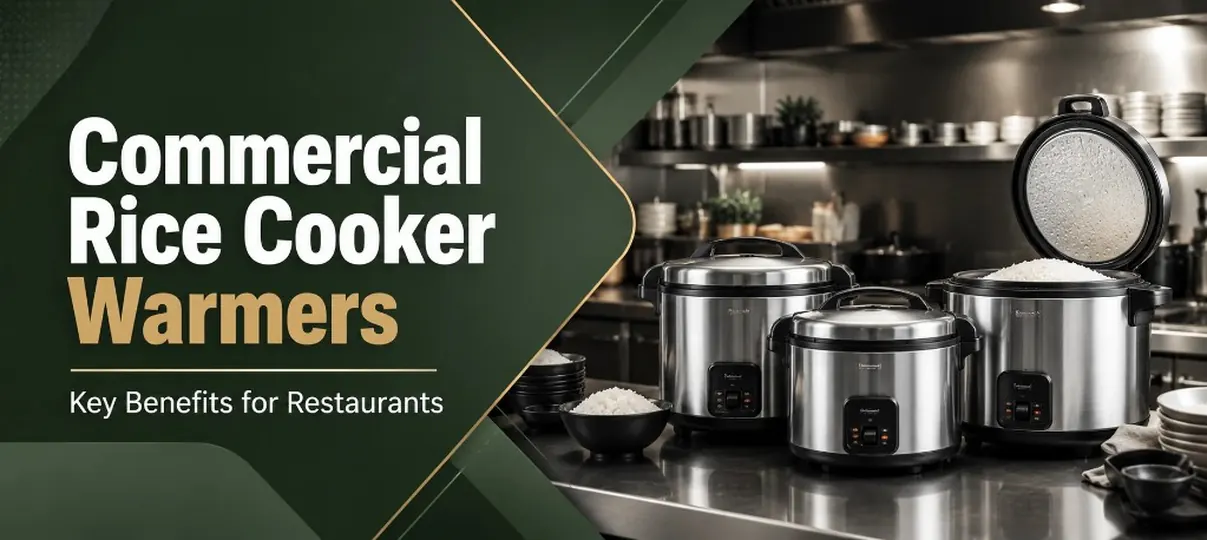
Benefits of Commercial Rice Cooker Warmers
A commercial rice warmer is not just a place to park cooked rice. In a busy kitchen, it separates cooking from holding, keeps service moving, and helps maintain rice at a safe serving temperature until staff need it. For restaurants, caterers, cafeterias, and high-volume foodservice teams, commercial rice cooker warmers can turn rice from a recurring bottleneck into a predictable part of the line.
Why add a warmer if you already have a rice cooker?
A dedicated rice warmer keeps cooked batches ready while your rice cooker starts the next load, which is why many kitchens shop commercial rice cooker warmers as a pair.
You add a warmer because a rice cooker and a rice warmer do different jobs. A cooker produces a batch, while a warmer holds that finished batch so the cooker can immediately start another one. That simple handoff can increase rice availability during peak service without crowding the kitchen with extra cookers or forcing staff to gamble on timing.
In many operations, rice demand does not arrive evenly. Lunch rush, dinner rush, delivery spikes, banquets, and buffet refills all create moments when one batch can disappear faster than expected. If the cooker is still cycling, the team has to wait. If the rice was cooked too early and held poorly, quality slips. Commercial rice warmers solve that middle problem by giving the kitchen a dedicated holding stage.
This matters most for concepts where rice is central to the menu: Asian restaurants, Malaysian restaurants, sushi bars, Korean barbecue operations, Indian restaurants, Mexican restaurants, Hawaiian plate lunch concepts, cafeterias, and catering teams. In those settings, rice is not a side detail. It is a core item that affects speed, plate consistency, and guest satisfaction.
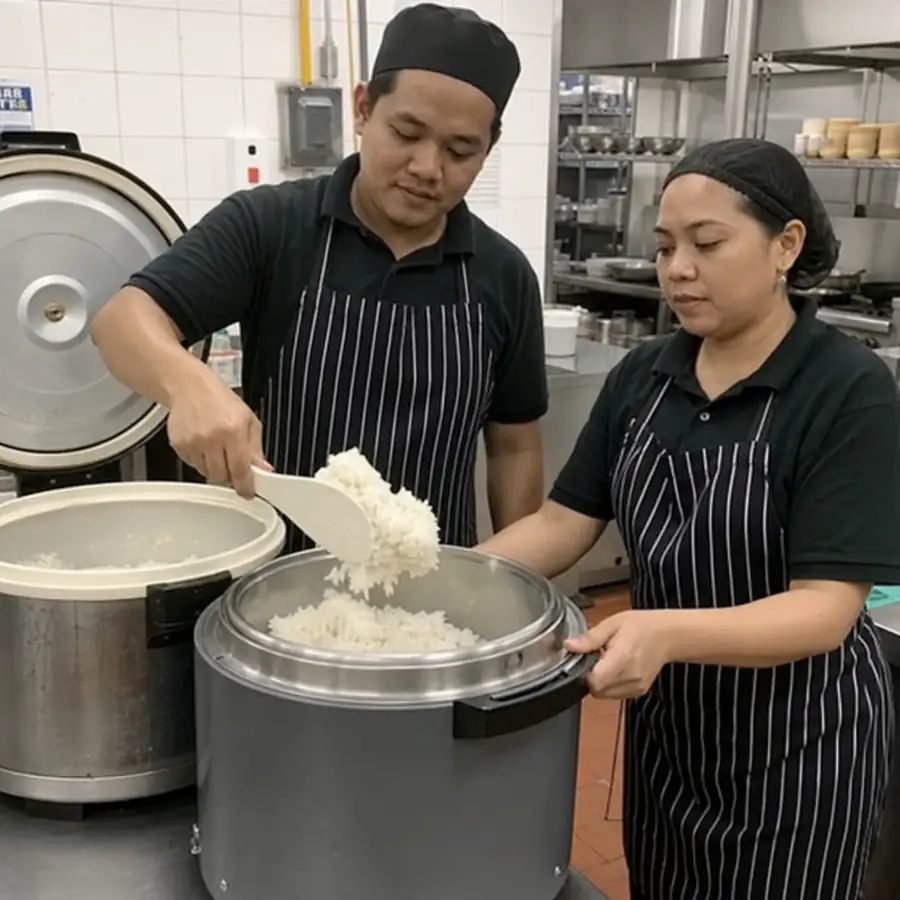
Rice holding is a workflow decision, not an afterthought
Treating rice holding as a workflow decision helps teams use professional rice cookers and restaurant rice warmers for their intended jobs.
When kitchens rely only on professional rice cookers, the equipment has to do two jobs at once: cook the next batch and hold the previous one. Cook-and-warm models can be useful, but they still tie up the vessel. If the unit is full of finished rice, it cannot start a new batch. If staff empty it too late, the next batch starts late. The whole line becomes dependent on a single cycle.
Adding standalone restaurant rice warmers changes the rhythm. Cooked rice moves out of the cooker and into the warmer. The cooker is cleaned or refilled quickly, then starts the next batch. The warmer becomes the service reservoir, giving the line access to rice while production continues in the background.
A simple workflow might look like this:
- Before service: Cook the first batch and transfer it to the warmer once it is fully cooked and fluffed.
- Early service: Start the next batch in the cooker while staff serve from the warmer.
- Peak demand: Refill the warmer as needed instead of waiting for a cooker to finish at the exact moment tickets are coming in.
- After the rush: Reduce batch size or stop production while the warmer covers remaining service.
That flow is easier to train, easier to monitor, and less stressful than asking staff to juggle several small cookers on shelves, counters, or prep tables.
Food safety depends on consistent hot holding
Consistent hot holding supports food safety goals and pairs well with other food warmers or a countertop food warmer on the line.
Cooked rice needs careful time and temperature control because starchy foods can support the growth of pathogens when they sit in unsafe conditions. The FDA Food Code lists hot holding for time/temperature control for safety foods at 135°F or above, while FDA consumer-facing buffet guidance advises using warmers capable of holding food at 140°F or warmer; operators should always follow local health code and their food safety plan.
Rice is often discussed in connection with Bacillus cereus, a bacterium associated with improperly cooled or held starchy foods. USDA-linked food safety guidance notes that reheating can kill many active bacterial cells but may not inactivate toxins that have already formed, which is why preventing unsafe holding conditions matters in the first place.
This is where commercial rice warmers provide a practical advantage over improvised holding. A purpose-built warmer is designed to maintain a stable hot environment for cooked rice, reducing the chance that rice sits too long in the danger zone during service. Staff still need to check temperatures, stir and manage rice correctly, and follow holding-time procedures, but the right equipment makes compliance more realistic during a busy shift.
How do commercial rice warmers protect rice quality?
Commercial rice warmers protect texture with steady heat, and operators often compare Rinnai, Hamilton Beach, and Zojirushi options when choosing capacity.
Commercial rice warmers protect rice quality by applying steady, controlled heat around the holding chamber instead of blasting rice from one small heat source. The goal is not to keep cooking the rice. The goal is to preserve moisture, texture, and serving temperature after the cooking cycle is complete.
Poor holding creates familiar problems. The bottom layer dries or scorches. The top layer cools. Corners become gummy while the center stays dense. Staff compensate by adding water, stirring too aggressively, or discarding more product than planned. Each workaround costs time and can make quality less consistent from plate to plate.
Well-designed commercial rice warmers are built for the texture demands of cooked rice. Depending on the model, they may use heat from the bottom, sides, or lid area to reduce cold spots and avoid overheating one layer. Lids help retain steam, while nonstick or easy-release inner pots support cleaner scooping and faster cleanup. The result is rice that stays closer to its intended texture through service.
This quality advantage matters for plain steamed rice, but it also helps with other starch-heavy menu items. With proper moisture control and food safety procedures, some kitchens use warmers to hold fried rice, seasoned rice, sticky rice, or rice blends for short service windows. The key is matching the warmer to the product and monitoring texture rather than assuming every starch behaves the same way.
Dedicated warmers help kitchens use space more intelligently
Dedicated warmers free cookers for production and keep stations clearer alongside other cooking equipment and food prep equipment.
At first, buying another piece of rice cooking equipment may sound like adding clutter. In practice, a dedicated warmer can reduce clutter because it replaces a messy collection of small cookers, consumer warmers, stockpots, hotel pans, and last-minute holding setups.
Consumer-grade equipment is rarely ideal in a commercial kitchen. It may not be built for repeated daily cycles, constant lid opening, high-volume scooping, or the rough pace of a production line. Even when consumer units appear cheaper upfront, they can create hidden costs through uneven holding, more frequent replacement, crowded counters, and staff time spent checking, moving, and troubleshooting rice.
Commercial rice warmers are different because they are designed around foodservice use. They typically offer larger capacities, sturdier construction, easier service access, and controls intended for repeated operation. Instead of spreading rice across multiple small units, the team can centralize holding in one or two dedicated stations.
Benefits for space and workflow include:
- Cleaner stations: Fewer cords, lids, and small appliances competing for counter space.
- Faster service: Staff know exactly where ready rice is held.
- Better batch control: Managers can plan production around warmer capacity instead of guessing from several small containers.
- Reduced equipment strain: Cookers cook, warmers hold, and each machine is used for its intended task.
- Simpler training: New staff learn one standard transfer, holding, and serving routine.
Cook-only, cook-and-warm, and standalone units each have a role
Cook-only, cook-and-warm, and standalone rice warmers each fit different menus, so match the unit to your restaurant equipment layout.
Not every kitchen needs the same setup. The right choice depends on volume, menu style, rush patterns, and how much rice must be ready at one time. Understanding the difference between unit types helps avoid buying too much equipment or expecting one machine to solve every problem.
Cook-only rice cookers
Cook-only units focus on producing batches. They are useful when a kitchen wants tight control over cooking and already has a reliable holding process. In a high-volume operation, cook-only units pair naturally with commercial rice warmers because each piece of equipment has a clear purpose.
Cook-and-warm rice cookers
Cook-and-warm units cook rice and then switch to a holding mode. They can be convenient for lower-volume operations or kitchens with more flexible service patterns. The limitation is capacity and availability. While the cooker is holding rice, it may not be available for the next batch, and that can become a problem during a rush.
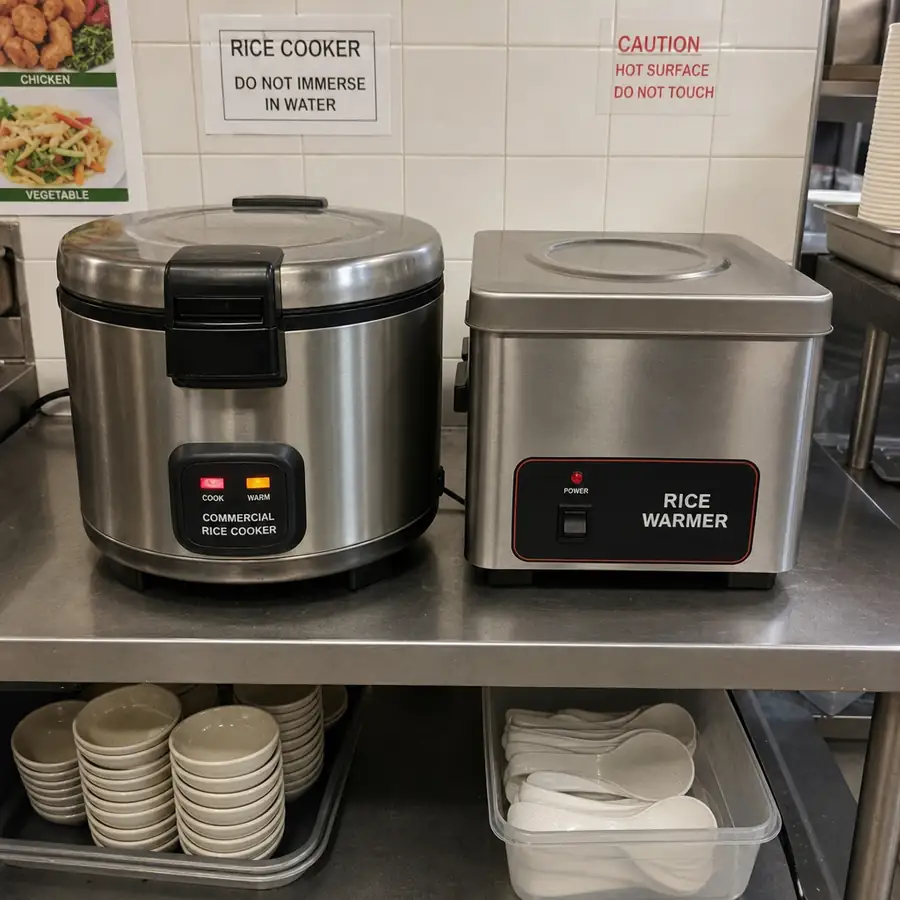
Standalone rice warmers
Standalone warmers are dedicated holding units. They do not replace industrial rice cookers; they support them. Their value is highest when rice must be cooked in repeated batches and served continuously over several hours.
For many restaurants, the strongest setup is a balanced system: one or more professional rice cookers sized for production, paired with commercial rice warmers sized for service.
Choosing the right capacity starts with your service pattern
Choosing capacity starts with rush patterns, menu mix, and how often staff refill a commercial rice warmer during peak service.
Capacity planning should begin with how rice moves through your kitchen, not just the largest batch you can cook. A warmer that is too small forces constant refills. A warmer that is too large may encourage overproduction, longer holding, and more waste. The best size supports your busiest realistic service period while still encouraging good batch rotation.
Start by observing a normal busy day. How much rice is cooked before service? How quickly is the first batch depleted? When does the second batch need to be ready? Do dine-in, takeout, and delivery orders peak at the same time? These questions help you match production to holding instead of relying on guesswork.
A practical planning checklist:
- Estimate peak rice demand: Focus on your busiest hour, not your whole day.
- Review cooker cycle time: Know how long each batch takes from rinsing and loading to finished rice.
- Set a refill rhythm: Plan when staff should transfer rice before the warmer gets too low.
- Avoid filling to the edge: Leave room for fluffing, scooping, and safe handling.
- Rotate batches clearly: Use first-in, first-out procedures so older rice is served before newer rice.
- Verify holding temperature: Use a food thermometer and follow local food safety rules.
- Build in cleaning time: Choose equipment that staff can empty, wash, and reset without slowing closing tasks.
This approach also helps determine whether you need one large warmer or multiple smaller warmers. One station may work well for a single service line. Multiple warmers can make sense when rice is served in separate areas, such as a buffet, prep line, and takeout station.
What are the operational cost advantages?
Operational cost advantages show up when cookers stop double-duty holding and commercial cooking equipment lasts longer under intended use.
The cost advantage comes from using the right tool for each stage of rice service. Instead of buying multiple cookers just to hold finished rice, a kitchen can use cookers for production and warmers for holding. That can reduce equipment duplication, improve staff efficiency, and lower the risk of waste from dried-out or poorly held rice.
Labor is a major part of the equation. When rice is unpredictable, staff spend time checking cooker cycles, moving pans, rescuing texture, and explaining delays to the line. A dedicated warmer creates a more dependable service point, which lets cooks focus on cooking and servers focus on guests.
Waste is another factor. Rice is inexpensive compared with proteins, but repeated waste still affects margins. More importantly, inconsistent rice can damage the meal experience. Guests may not mention rice when it is good, but they notice when it is dry, cold, mushy, or unavailable.
Commercial durability also matters. Equipment intended for foodservice is usually better suited to repeated opening, scooping, transport, and cleaning than consumer appliances. While purchase price is important, managers should also consider uptime, replacement frequency, staff frustration, and how easily the unit fits into daily procedures.
Warmers support faster, calmer peak service
Warmers support faster peak service, and many teams also plan pizza prep, a commercial griddle, or hot food display needs in the same remodel.
A good rice holding system does more than store food. It reduces decision fatigue. During a rush, staff should not have to ask whether rice is ready, where the backup batch is, or which cooker can be opened. The warmer becomes the answer.
That predictability helps across the operation. Line cooks can plate faster. Prep teams can schedule batches more confidently. Managers can see whether rice production is keeping pace. Delivery and takeout orders can move without waiting for the next cycle. In high-volume service, those small moments add up.
The benefit is especially clear when a restaurant grows. A process that worked with one small cooker may fall apart as order volume rises. Rather than stacking more consumer appliances into the same space, upgrading to industrial rice cookers and dedicated warmers creates a system that can scale with demand.
Features to look for in commercial rice cooker warmers
Look for durable lids, clear controls, and easy cleaning when comparing commercial rice cooker warmer models at The HORECA Store.
The best warmer is the one that fits your menu, staff habits, and kitchen layout. Still, several features are worth evaluating before buying.
Look for:
- Capacity that matches service: Choose based on peak holding needs, not occasional maximums.
- Consistent heat distribution: Designs that reduce hot and cold spots help preserve texture.
- A secure, moisture-retaining lid: Steam control is essential for rice quality.
- Durable inner pot materials: Easy-release surfaces can make scooping and cleaning more efficient.
- Simple controls: Staff should be able to operate the unit correctly without complicated steps.
- Easy cleaning access: Removable pots, smooth surfaces, and practical handles help with daily sanitation.
- Stable footprint: The unit should sit safely where staff can scoop without reaching awkwardly.
- Compatibility with workflow: Consider where cooked rice will transfer in and where service staff will scoop out.
Do not choose on capacity alone. A very large warmer in the wrong location can slow service. A compact warmer with excellent access may outperform a bigger unit that staff avoid because it is hard to reach, hard to clean, or constantly in the way.
Better rice service starts with a simple system
Better rice service starts with a simple cook-and-hold system plus kitchen equipment brands your staff can train on quickly.
Commercial rice warmers are most valuable when they are part of a complete rice production plan. The cooker makes fresh batches. The warmer protects temperature and texture. Staff follow clear transfer, rotation, and temperature-check procedures. Together, these habits create safer, faster, more consistent service.
For kitchens that serve rice all day, the payoff is practical: fewer delays, less equipment clutter, more predictable quality, and a smoother rush. Instead of asking one cooker to do everything, commercial rice cooker warmers give your team a dedicated holding solution built for the pace of professional foodservice.
Find Commercial Rice Cooker Warmers at The HORECA Store
Find commercial rice cooker warmers at The Horeca Store, or buy commercial kitchen equipment online with supporting smallwares and tableware.
For reliable commercial rice cooker warmers, The HORECA Store offers a wide selection of restaurant and foodservice equipment designed for professional kitchens. Whether you need a compact warmer for a small restaurant or a higher-capacity unit for a busy foodservice operation, choosing the right commercial rice cooker warmer can help maintain rice quality, improve serving efficiency, and keep food ready during peak hours.