
Commercial refrigerators provide cold storage for foodservice and retail operations, with designs intended for frequent access and demanding working environments. Choosing the right unit means matching its type, usable capacity, installation requirements, and operating costs to your business. If you're comparing options at The Horeca Store, start with what you need to store and how your team will access it - not simply the largest cabinet your budget allows.
Which type of commercial refrigerator does your business need?
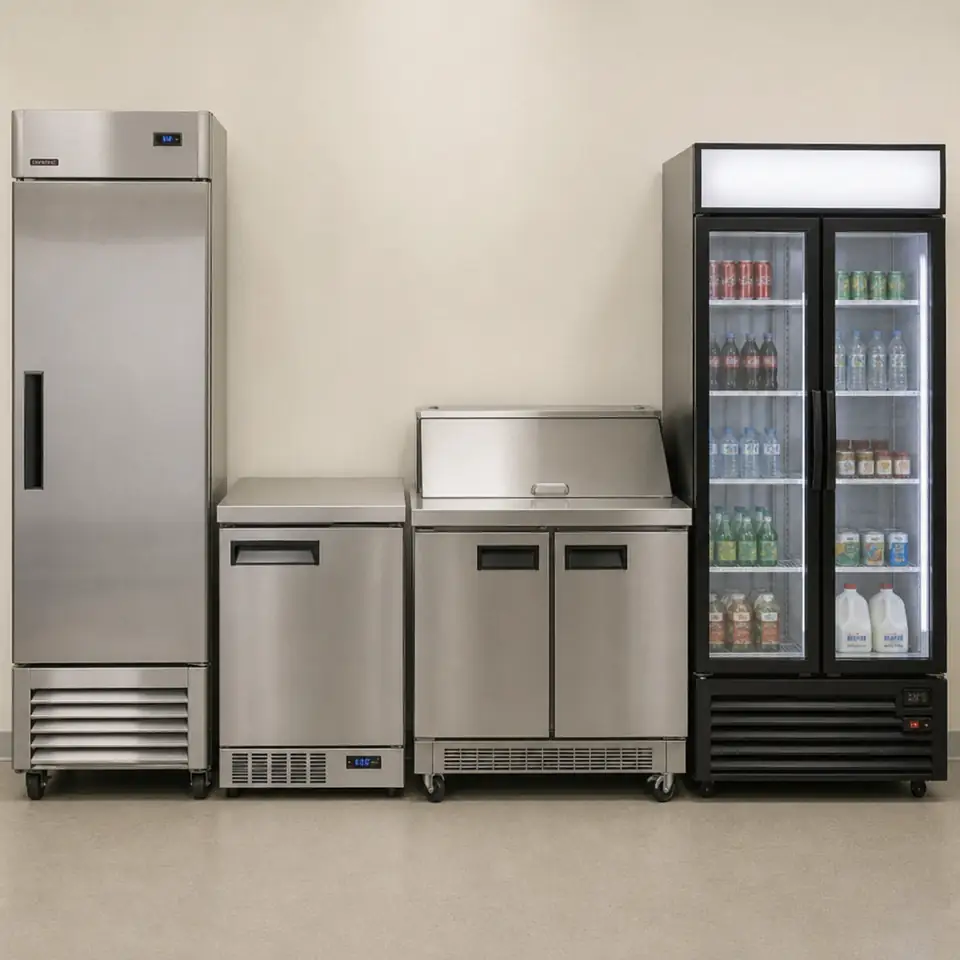
The right commercial refrigerator depends on its primary job: bulk ingredient storage, station-level access, food preparation, or product display. Reach-ins, undercounter units, prep tables, and merchandisers serve different purposes, so choose the format before comparing capacity or features. Commercial refrigeration categories include specialized storage, preparation, and display equipment rather than one interchangeable cabinet design.
Reach-in refrigerators for everyday storage
Reach-in refrigerators are upright cabinets accessed through front doors. They offer shelf-based storage, with solid-door and glass-door configurations available. For example, manufacturer specifications show reach-ins with adjustable shelving, self-closing doors, and exterior temperature displays, although these features should be verified for each model.
Consider a reach-in when your main need is organized ingredient storage rather than a refrigerated preparation surface. Before choosing one, sketch where dairy, produce, sauces, and prepared containers would go. Ask whether staff could remove the largest container without rearranging an entire shelf.
Undercounter refrigerators and prep tables
Undercounter refrigerators provide refrigerated storage beneath a counter, while prep tables combine storage with a food-preparation arrangement. Both belong to established commercial refrigeration categories, but their layouts and intended applications differ. Refrigerated prep tables may include ingredient-pan storage and lids, so compare the complete working configuration rather than cabinet width alone.
For a sandwich station, list the ingredients that must remain within reach during service. For a café counter, focus on the containers or cartons staff retrieve most often. Then check pan compatibility, access to lower storage, and whether opening a door would interrupt the person working beside it.
Display refrigerators and walk-in storage
Display refrigerators and beverage coolers are intended for merchandising or product access, while walk-in refrigerators provide a different storage format. These are separate equipment categories within commercial refrigeration standards; their suitability should be checked against the intended food and application. Do not assume a drinks display cabinet is approved for every restaurant storage task.
Use a display unit shortlist when customer visibility matters. Consider a walk-in assessment when your inventory plan calls for substantial bulk storage, but include the room layout and installation scope in that discussion. If a supplier uses the term "industrial refrigerators," ask for the exact equipment category, intended use, and installation requirements before comparing quotes.
What size commercial fridge should you buy?
Buy a commercial fridge that accommodates your busiest realistic inventory while fitting the available space and required installation clearances. External dimensions determine placement, but shelf dimensions and container compatibility determine whether the storage works for your menu. Avoid buying extra capacity without a purpose: the Department of Energy notes that oversizing increases initial cost and energy losses.
Cabinet dimensions are only the starting point
Door count gives a rough sense of scale, not a universal size. As an illustration, one manufacturer's reach-in range includes the following cabinet dimensions. These examples are not industry-wide standards, and the selected model's drawings and footnotes remain essential.
| Example configuration | Cabinet width | Cabinet depth | Listed cabinet height |
|---|---|---|---|
| One-door reach-in | 27 inches | 29½ inches | 78⅜ inches |
| Two-door reach-in | 54⅛ inches | 29½ inches | 78⅜ inches |
| Three-door reach-in | 78⅛ inches | 29½ inches | 78⅜ inches |
Treat these measurements as a reason to request a drawing, not permission to finalize a layout. Verify the installed height with the specified legs or casters, handle projections, door-opening space, and service access. Manufacturer installation guidance requires adequate ventilation clearances, which vary by model.
Build capacity around actual inventory
Instead of choosing by cubic feet alone, prepare a storage plan using your actual containers. Record the dimensions of sheet pans, ingredient bins, cartons, and covered food containers. Ask the supplier to confirm how those items fit on the proposed shelving.
Use this planning sequence:
- List peak stock: Include the largest delivery you expect to hold, not just an average day's inventory.
- Map container footprints: Note width, depth, height, and whether containers can be stacked appropriately.
- Assign storage zones: Plan separate locations for different ingredient groups and preparation stages.
- Allow for access: Check whether staff can retrieve products without repeatedly unloading shelves.
- Test future needs: Identify specific menu or delivery changes that would justify additional capacity.
For example, ask whether a proposed restaurant fridge can hold your delivery-day inventory and the prepared containers needed for evening service simultaneously. That is a more useful purchasing question than asking how many cubic feet a restaurant "usually" needs.
Temperature performance and food suitability come first
For U.S. foodservice operations, the FDA Food Code generally specifies cold holding of time/temperature control for safety foods at 41°F or below, with defined exceptions. The Food Code is a model code; confirm the requirements adopted by your local regulatory authority. Choose equipment suitable for the food you intend to hold, rather than relying only on its advertised thermostat range.
Ask how the unit is rated for its intended environment and application. Commercial refrigerators are designed and tested for conditions such as hot kitchens and frequent door openings, but that does not make every model appropriate for every location. Share the proposed placement and expected use with the supplier before ordering.
Sanitation suitability deserves a separate check. NSF/ANSI 7 addresses food protection and sanitation requirements for commercial refrigerators, freezers, and related equipment. Request the selected model's certification or listing details, verify its intended use, and confirm acceptance with the relevant local authority.
Also distinguish cold holding from your cooling process. If you need to cool cooked food, explain that requirement explicitly instead of assuming a storage refrigerator will meet it. Ask for equipment guidance and an approved process appropriate to your operation.
Features that affect everyday usability
A feature matters when it solves a specific operational problem. Rather than building a wish list from product descriptions, connect each option to a task: finding ingredients, loading deliveries, cleaning the cabinet, or accessing service components. This keeps the comparison focused on work your team actually performs.
Doors, shelves, and cleaning access
Solid doors offer better insulation and easier cleaning, while glass doors let staff see contents before opening the cabinet. Half-height doors can offer efficiency advantages, although they may affect storage flexibility. Choose the door arrangement around both access and the size of the products being stored.
Ask practical questions during your comparison:
- Can shelves be repositioned for your tallest covered containers?
- What load is each shelf rated to support?
- Can staff remove shelves and gaskets for cleaning as instructed?
- Does the door hinge arrangement suit the approach from the preparation area?
- Are replacement shelves, clips, hinges, and seals available for the exact model?
Request written answers where a feature affects your purchasing decision. A photograph may show the general layout, but it cannot confirm a shelf load rating or compatibility with your containers.
Installation and service access
Check the electrical requirements against the site before ordering. Manufacturer guidance may require a dedicated circuit, a grounded supply, and specific ventilation clearances; do not assume an existing outlet or cabinet opening is suitable. Have qualified professionals confirm the installation requirements for the selected model.
Measure the delivery route as carefully as the final position. Record doorway openings, narrow turns, elevator dimensions if relevant, and any access restrictions. Ask who is responsible for unloading, moving, positioning, and connecting the equipment so that the quote reflects the work you need.
Include maintenance access in the layout review. ENERGY STAR recommends keeping refrigeration coils clean and checking door seals, so the installation should not make those tasks unnecessarily difficult. Ask the installer to show your team the manufacturer-approved access points and care instructions.
Compare total ownership cost, not just purchase price
Evaluate each shortlisted unit using the same cost categories: purchase, delivery, installation, electricity, planned maintenance, and warranty coverage. Treat uncertain amounts as questions to resolve rather than filling them with optimistic assumptions. A lower equipment price is not enough information to establish the better purchase.
For eligible equipment, ENERGY STAR certification provides an energy-efficiency comparison point. Its commercial refrigerator guidance also distinguishes eligible refrigerators and freezers from excluded categories such as prep tables and walk-ins. Check the exact model and category rather than assuming every commercial cooling product can carry the same certification.
Where comparable rated daily electricity consumption is available, estimate annual electricity cost using:
Rated kWh per day × 365 × your electricity rate per kWh
Use that calculation as a comparison estimate, not a guaranteed bill. Ask whether the figures were measured under the same test method and whether accessories affect the quoted consumption. Keep the assumptions beside your calculation so another decision-maker can review them.
Read warranty terms just as closely. Ask what is covered for parts, labor, and the compressor; who provides service; and whether travel or diagnostic charges are included. Request clarification on installation conditions, maintenance obligations, and the process for reporting a fault before accepting the order.
A final buying checklist
Bring the same information to every supplier so you can compare proposals fairly. If you are discussing options with The Horeca Store, use a written requirements sheet rather than relying on a broad request for a "large commercial refrigerator." It should give the supplier enough detail to flag mismatches before purchase.
Before approving a quote, confirm:
- Application: Identify the foods, packaging, and storage or display task.
- Capacity: Check your peak inventory against the proposed shelf arrangement.
- Dimensions: Review the model drawing, installed height, door movement, and delivery route.
- Site requirements: Obtain written electrical, ventilation, and installation details.
- Suitability: Verify applicable listings and local approval requirements.
- Included equipment: Specify shelves, casters or legs, pan accessories, and any other quoted items.
- Service: Clarify warranty coverage, maintenance responsibilities, and repair arrangements.
- Delivery scope: Confirm unloading, positioning, connection, packaging removal, and old-unit removal where needed.
Keep the approved specification sheet with the purchase record. If a substitute model is proposed, repeat the checks instead of assuming the alternative has identical dimensions or requirements. Small specification differences deserve attention before the equipment reaches your doorway.
Choose refrigeration that fits the work
The best buying decision starts with a clear storage plan, not a cabinet size or promotional feature. Match the refrigerator type to its job, verify that your inventory fits, and resolve installation and support questions in writing. A focused shortlist makes it easier to choose cold storage that suits both your space and your team's daily routine.