
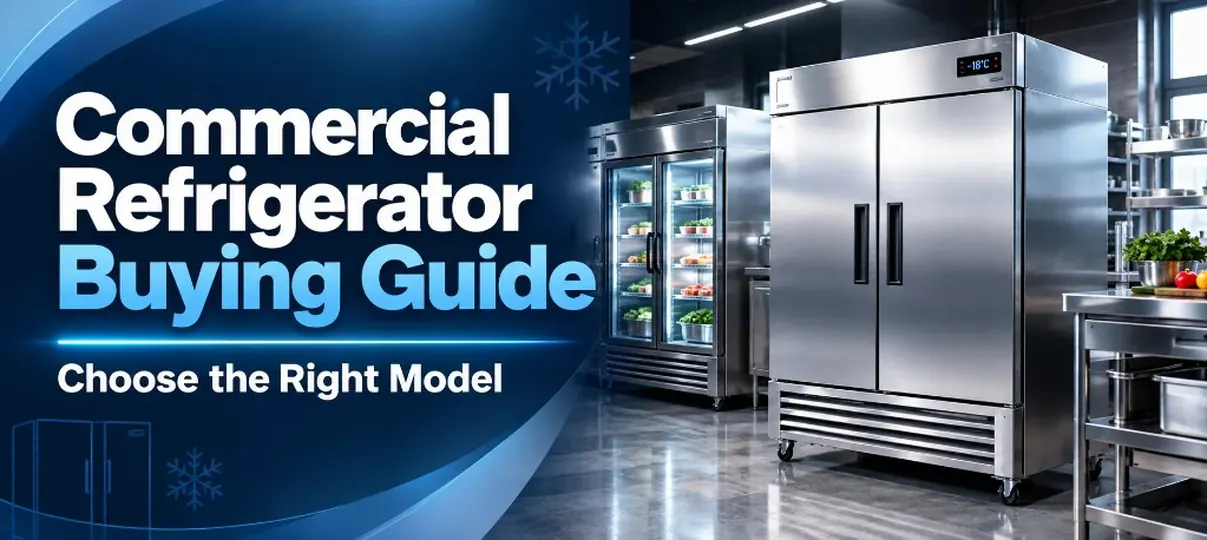
A commercial refrigerator is one of the most important pieces of commercial kitchen equipment because it protects food quality, supports safe cold food storage, and keeps service moving. This commercial refrigerator buying guide explains how to match a commercial fridge, commercial cooler, restaurant refrigerator, or commercial freezer to your menu, floor plan, storage capacity, and budget. Use it as a practical refrigerator purchase guide when choosing a cooler for a restaurant kitchen, cafe, bar, market, or foodservice operation.
What is a commercial refrigerator?
Common formats also include a chef base refrigerator, a worktop refrigerator, and a reach-in freezer.
A commercial refrigerator is refrigerated storage built for business use: frequent door openings, heavier loads, cleanable materials, and tighter temperature control than a typical home unit. In commercial refrigeration, the compressor, condenser, evaporator, insulation, doors, gaskets, and airflow system work together to keep ingredients within safe ranges during real service conditions.
Common formats include the reach-in refrigerator, undercounter refrigerator, prep refrigerator, sandwich prep table, back bar refrigerator, glass door refrigerator, solid door refrigerator, merchandiser, walk-in refrigerator, and commercial freezer. Some units are designed for restaurant storage in the back of house, while others display beverages or grab-and-go food to customers.
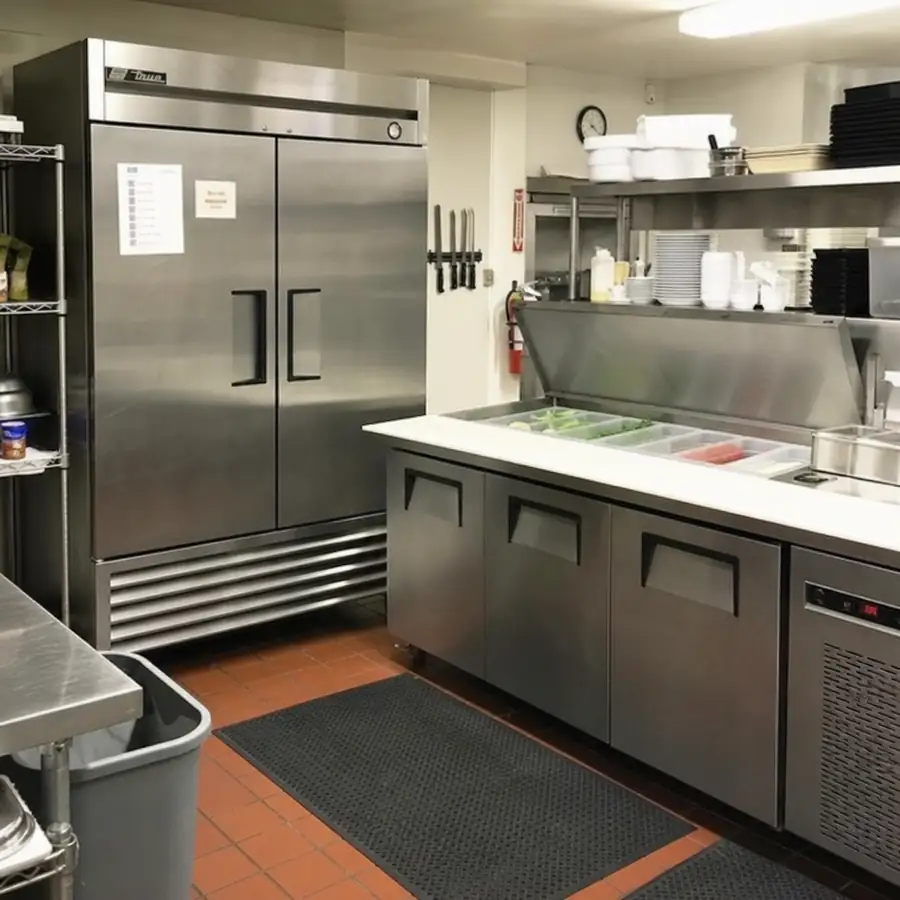
Who needs commercial refrigeration equipment?
Cafes often add a bottle cooler, and display service may call for a merchandiser refrigerator.
Commercial refrigeration equipment is for any business that stores perishable food, beverages, prepared items, or frozen inventory for sale or service. Restaurants need reliable cold holding near prep and cook lines. Cafes often need a compact commercial refrigerator for restaurants and cafes, especially for dairy, pastries, produce, and bottled drinks.
Bars usually benefit from a back bar refrigerator or commercial cooler with fast access and glass doors. Delis and sandwich shops often need a prep refrigerator or sandwich prep table so toppings stay cold while staff assemble orders. Grocery, convenience, and specialty retail businesses may prioritize display visibility, while caterers and institutions may need a walk-in refrigerator for bulk food storage.
If you are asking how to choose a restaurant refrigerator, start with workflow instead of brand. The best refrigerator for commercial kitchen use is the one that puts the right food at the right station without blocking aisles, overloading shelves, or forcing staff to walk across the kitchen during rush periods.
Specifications, capacity, and features that shape performance
Pair upright storage with a walk-in freezer when the menu holds both fresh and frozen product.
A useful commercial refrigerator size guide begins with peak demand, not average inventory. Ask, "what size commercial refrigerator do I need?" by listing what must be cold at the busiest point of the week, then leave breathing room for airflow. Overpacked refrigerated storage can reduce temperature consistency because cold air cannot circulate around pans, boxes, and containers.
For reach-ins, a single door commercial refrigerator can work for small cafes, bars, or backup storage. A two door commercial refrigerator is often a practical fit for busy restaurants that need separate categories of food storage. A three door commercial refrigerator is better suited to high-volume operations with enough kitchen space to open doors safely and maintain service flow.
Important specifications include:
- Commercial refrigerator storage capacity: Match cubic feet to menu volume, delivery schedule, and safe organization.
- Door configuration: Solid doors usually protect temperature better, while glass doors improve visibility and merchandising.
- Interior shelving: A commercial refrigerator with adjustable shelves makes it easier to store sheet pans, containers, cases, and tall bottles.
- Stainless steel construction: A stainless steel commercial refrigerator is easier to clean and better suited to heavy commercial kitchen use.
- Digital temperature control: Helps staff monitor setpoints quickly and spot temperature problems earlier.
- Forced-air cooling: Moves cold air through the cabinet for more even cooling and recovery after door openings.
- Self-closing doors and caster wheels: Reduce accidental warm-air exposure and make cleaning or service access easier.
- Energy efficiency: An energy efficient commercial refrigerator can reduce operating cost over time, especially when it runs all day.
Commercial refrigerator temperature requirements depend on your local code and the type of food stored, but U.S. food safety guidance commonly centers on keeping cold time/temperature-control foods at 41°F or below; always confirm your local health department's rule before purchase. The FDA Food Code is a model used by many jurisdictions, and FDA materials discuss the 41°F cold-holding framework for food safety.
What should you look for in a commercial refrigerator?
Tight lines should also be checked against an undercounter freezer and a pizza prep table.
What to look for in a commercial refrigerator comes down to fit, holding performance, cleanability, efficiency, serviceability, and long-term value. The purchase is not just about cubic feet; it affects food safety, labor speed, energy bills, spoilage risk, and whether technicians can maintain the unit without disrupting service.
When deciding how to choose a commercial refrigerator, compare the cabinet to your real operation. A reach in refrigerator near the line can reduce steps, but a rear-breathing unit may need more clearance than your layout allows. An undercounter refrigerator can save kitchen space, but its lower capacity may not support a high-volume station without frequent restocking.
Use these selection criteria when learning how to buy a commercial refrigerator:
- Start with the use case. Prep, bulk storage, beverage display, frozen storage, and grab-and-go retail all need different refrigeration equipment.
- Measure the full installation path. Check doorways, hallway turns, floor drains, ceiling height, power access, and door swing clearance.
- Check airflow requirements. Front-breathing equipment is useful in tight lines, while top-mounted systems may help keep components away from floor debris.
- Prioritize sanitation. NSF-certified equipment or equivalent sanitation listings can matter for inspection readiness and cleanability; NSF/ANSI 7 applies to commercial refrigerators and storage freezers.
- Review the refrigeration system. R290 refrigerant, a strong compressor, accessible condenser, and durable evaporator design all affect reliability.
- Think about operations. Poor temperature recovery can lead to waste, rejected prep, or emergency service calls during peak hours.
- Compare value, not just price. How much does a commercial refrigerator cost is less useful than asking what the delivered, installed, warrantied, and maintained equipment will cost over its working life.
The best commercial refrigerator for restaurants is usually the one that balances storage capacity, airflow, maintenance access, and workflow. The best commercial fridges are not always the largest or most expensive; they are the units that support your menu without wasting space or energy.
Comparison of commercial refrigerator options and evidence
Drink-heavy concepts should compare ice machines and bar refrigeration in the same plan.
Instead of a markdown table, use this comparison snapshot to weigh Product/Brand, Best For, Capacity/Volume, Key Feature, Price Tier, and Trade-off.
- True T-49-HC
- Best For: A commercial reach in refrigerator buying guide shortlist for busy kitchens needing a proven two-section reach-in.
- Capacity/Volume: Commonly listed as a 49 cu. ft. two-door reach-in with six shelves and cabinet dimensions around 54 1/8 in. W by 29 1/2 in. D by 78 3/8 in. H.
- Key Feature: Maintains cabinet temperatures of 33°F to 38°F and uses R290 hydrocarbon refrigerant, according to True's specification sheet.
- Price Tier: Premium.
- Trade-off: Strong brand recognition and construction usually come with a higher acquisition cost.
- Atosa MBF8005GR
- Best For: Operators seeking an energy efficient commercial refrigerator with value-oriented commercial specs.
- Capacity/Volume: ENERGY STAR lists the MBF8005GR as a vertical solid-door reach-in with 42.18 cu. ft. total volume, two solid doors, R290 refrigerant, and reported daily energy use of 2.06 kWh/day.
- Key Feature: Good fit for buyers comparing efficiency data across commercial refrigeration models.
- Price Tier: Value to mid-range.
- Trade-off: You may sacrifice some premium finish details or brand prestige to control upfront spend.
- Hoshizaki R2A-FS
- Best For: Hot or tight kitchens where front airflow and durable stainless construction matter.
- Capacity/Volume: Hoshizaki lists the R2A-FS at 55 in. W by 33.5 in. D by 79.5 in. H, with 50.37 cu. ft. interior storage capacity and six shelves.
- Key Feature: Ducted air distribution, digital control, temperature alarms, R290 refrigerant, casters, and a stated 7-year labor, parts, and compressor warranty.
- Price Tier: Premium.
- Trade-off: Larger depth and premium positioning may not suit very small layouts.
- Turbo Air M3R47-2-N
- Best For: Operators comparing ENERGY STAR-certified two-door reach-ins.
- Capacity/Volume: ENERGY STAR lists 42.8 cu. ft. total volume, 51.77 in. width, 30.71 in. depth, 77.95 in. height, and 2.18 kWh/day reported energy use.
- Key Feature: Certified model data supports side-by-side efficiency review.
- Price Tier: Mid-range.
- Trade-off: Confirm service access and parts availability in your area before buying.
- Atosa MBF8002GR commercial freezer
- Best For: Frozen storage when a commercial freezer is needed alongside a restaurant fridge.
- Capacity/Volume: Atosa lists this two-door reach-in freezer at 43.2 cu. ft., with six shelves, 4 in. casters, R290 refrigerant, and 51 3/4 in. by 31 3/4 in. by 81 3/8 in. exterior dimensions.
- Key Feature: ETL listed, ENERGY STAR-marked, and backed by Atosa's stated parts/labor and compressor warranty terms.
- Price Tier: Value to mid-range.
- Trade-off: Freezer capacity should be planned separately from refrigerated storage so frozen inventory does not crowd fresh prep.
ENERGY STAR says certified commercial refrigerators and freezers can reduce energy use compared with standard models, and its Product Finder lets buyers compare certified equipment. That makes certification a useful evidence point, not the only buying factor.
Commercial Refrigerator Buying Checklist
Use the checklist with a commercial kitchen layout so the cabinet, door swing, and aisle still work.
Use this commercial refrigerator buying guide for restaurants as a final filter before ordering.
- Business type and menu: A bakery, bar, deli, and full-service restaurant all need different cold food storage.
- Capacity at peak service: Size for deliveries, prep batches, and rush periods, not an empty Monday morning.
- Footprint and clearance: Confirm width, depth, height, door swing, caster height, ventilation, and service access.
- Temperature control: Choose digital temperature control, alarms, and strong recovery if doors open frequently.
- Door configuration: Pick solid doors for holding performance and glass doors for visibility or retail display.
- Shelving and organization: Adjustable shelves and durable interior shelving improve HACCP food storage practices.
- Materials and sanitation: Stainless steel construction and NSF-certified equipment support cleaning and inspection readiness.
- Energy efficiency: Compare ENERGY STAR listings, refrigerant type, and daily kWh when available.
- Warranty and service network: A longer warranty helps, but local technician familiarity can matter even more.
- Maintenance plan: Build refrigeration maintenance into operations with gasket checks, coil cleaning, and temperature logs.
FAQ: practical buyer questions
How do I choose the right commercial refrigerator for my restaurant?
Budget the cabinet inside the restaurant kitchen equipment cost, not as a standalone invoice.
Start with your menu, delivery frequency, and where staff need access during service. Then match the equipment type to the workflow: reach-in for back-of-house storage, undercounter for tight stations, prep table for assembly lines, and walk-in refrigerator for bulk volume.
Is a commercial fridge the same as a restaurant fridge?
A restaurant fridge is a type of commercial fridge used in foodservice. The broader category also includes merchandisers, bar coolers, prep units, and commercial refrigeration for cafes, markets, institutions, and catering kitchens.
What is the difference between a reach-in refrigerator and an undercounter refrigerator?
Higher volume sites often add a walk-in cooler beside the upright cabinet.
A reach-in refrigerator offers more upright refrigerated storage and is usually better for bulk ingredients. An undercounter refrigerator saves kitchen space and places ingredients near the workstation, but capacity is more limited.
How much refrigerator storage capacity should I plan for?
Use a commercial refrigerator storage capacity estimate based on peak inventory, not average stock. Leave space for airflow, labeling, pan separation, and safe organization so the unit can maintain temperature consistency.
What commercial refrigerator maintenance tips matter most?
Check door gaskets, keep the condenser area clean, verify temperature logs, avoid blocking airflow, and schedule professional refrigeration maintenance before small issues become downtime. Train staff to close doors fully and report frost, noise, water, or temperature drift.
Are glass door refrigerators good for restaurants?
A commercial merchandiser refrigerator is the display choice when guests need to see drinks at The Horeca Store.
A glass door refrigerator is useful when staff or customers need to see products quickly. For heavy back-of-house storage, a solid door refrigerator may offer better temperature stability and less light exposure.