
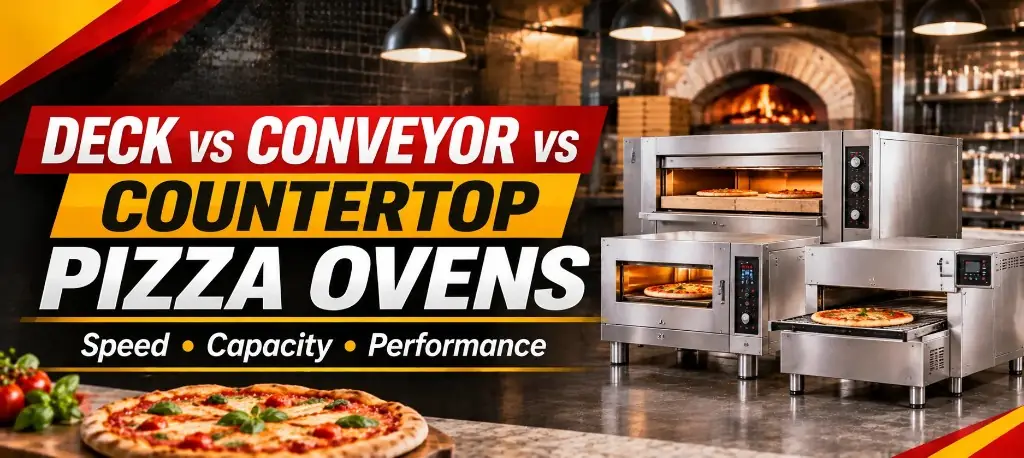
Commercial pizza ovens should match your pizza style, busiest service period, and kitchen layout - not simply your equipment budget. Deck ovens emphasize hands-on baking, conveyors support repeatable production, and countertop models offer a smaller installation format that can use either approach. This comparison explains the trade-offs and gives you a practical checklist for evaluating equipment before you buy.
What is the difference between deck, conveyor, and countertop pizza ovens?
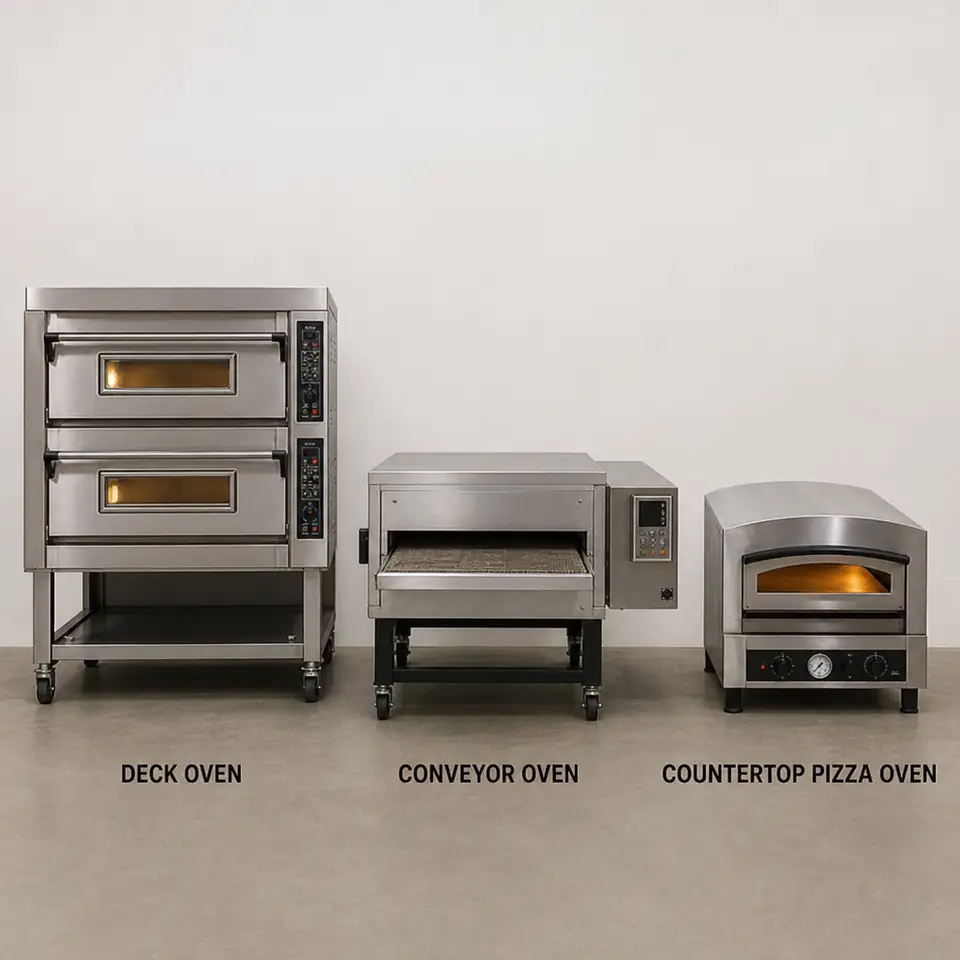
Deck and conveyor describe how an oven bakes and moves pizza; countertop describes where the equipment sits. A deck oven holds pizza in a stationary chamber, while a conveyor moves it through a heated chamber on a belt. Countertop pizza ovens can be compact deck ovens or conveyor models, so these categories overlap rather than represent three completely separate technologies.
That distinction matters when building your shortlist. Instead of asking whether a countertop oven is better than a deck oven, compare a countertop deck model with a larger deck model - or a compact conveyor with a full-size conveyor. Then evaluate the actual baking surface, utilities, and workflow.
| Option | Strong starting point for | Main consideration |
|---|---|---|
| Deck oven | Operations that want direct control over individual pizzas | Operator attention, usable deck space, and heat recovery |
| Conveyor oven | Kitchens prioritizing repeatable production | Belt loading, recipe settings, and space at both ends |
| Countertop format | Smaller installations or supplementary pizza stations | Actual capacity, counter suitability, and utility requirements |
Use these as screening criteria, not promises of performance. The final choice still needs a bake test using your own dough, toppings, and service conditions.
Deck ovens put the baker in control
In a deck oven, pizza can bake directly on the hearth or on an appropriate screen or pan. These methods produce different results, so the surface and recipe should be evaluated together. Bakers Pride, for example, distinguishes direct-deck, screen, and pan baking in its operating guidance rather than treating them as interchangeable techniques.
For a pizzeria that adjusts individual pies during baking, this stationary arrangement can be attractive. Include loading, checking, repositioning when necessary, and unloading in your equipment demonstration. You are testing whether your team can maintain the desired finish while managing several orders - not just whether one carefully watched pizza looks good.
Recovery deserves as much attention as temperature
A maximum temperature specification does not explain how an oven behaves through repeated loading. Manufacturer instructions address preheating and baking adjustments because the deck and chamber need appropriate preparation and management. Follow the specific model's procedure rather than assuming every deck oven warms up or responds identically.
During a demonstration, request consecutive batches. Compare the first pizza with later pizzas for bottom color, topping finish, and bake time. Also ask the operator to explain any adjustments between batches; that turns a product demonstration into a realistic training preview.
Conveyor ovens organize production around a repeatable process
A conveyor oven carries pizza through its baking chamber at a selected belt speed. Many commercial pizza conveyors use impingement, directing heated air toward the product. Models such as the Middleby Marshall PS520 combine conveyor operation with adjustable cooking controls in a countertop format.
The appeal is a defined process: prepare the pizza, load it correctly, and receive it at the discharge end. However, evaluate the complete station rather than the oven alone. Assign responsibility for unloading, cutting, boxing, and handling unexpected order surges during your trial.
Test the menu, not just the simplest pizza
Ask for separate tests of your most common pizza and your most challenging build. Include the actual crust thickness, topping quantities, and pans or screens you intend to use. Record the settings and finished result so that you can compare candidates fairly.
Pay attention to products sharing the belt. Ask whether different menu items work with one validated profile or require separate arrangements. Some models offer adjustable airflow or other controls, but available adjustments are model-specific; confirm them rather than assuming all conveyors provide identical flexibility.
Countertop ovens need a full installation check
Countertop does not mean one universal level of performance. Bakers Pride offers countertop deck models for different applications, while Middleby Marshall manufactures countertop conveyors. Choose the baking method first, then determine whether a compact format can meet your production needs.
A countertop oven is worth considering for a café introducing pizza, a supplementary station, or a menu with limited pizza demand. Treat those as use cases to test, not automatic matches. A compact footprint is only helpful if the equipment can bake your product at the pace you need.
Before selecting a location, check:
- Support and access: Confirm equipment weight, support requirements, and room for loading and cleaning.
- Electrical specifications: Verify voltage, phase, connection requirements, and available service with a qualified installer.
- Baking dimensions: Check usable deck or belt dimensions against your largest pizza and cookware.
- Working clearances: Include doors, conveyor extensions, required clearances, and service access.
Do not assume a countertop model plugs into an ordinary outlet. For example, the Bakers Pride P44 series includes commercial electrical configurations that require careful specification matching.
How much pizza oven capacity do you actually need?
Size your oven around peak demand using your actual pizza dimensions, bake profile, and loading pattern - not an isolated pizzas-per-hour claim. Usable capacity depends on chamber or belt dimensions, product spacing, cooking time, recovery, and operator speed. Manufacturer guidance specifically recommends accounting for these variables when estimating output.
Build a simple production brief before requesting recommendations:
- Describe the product. Record pizza diameters, crust styles, cookware, and typical topping loads.
- Map the rush. Use order records, where available, to identify concentrated demand rather than relying only on daily totals.
- Include other oven work. List flatbreads, sides, or other products that will compete for baking space.
- Run a timed trial. Measure finished, acceptable pizzas through repeated loading - not theoretical chamber occupancy.
- Test the handoff. Include cutting and packing so the demonstration reveals bottlenecks beyond baking.
For illustration, an oven holding four pizzas with an eight-minute bake has a theoretical output of 30 pizzas per hour before loading, unloading, or recovery allowances. That is arithmetic, not a performance forecast. Ask suppliers to explain exactly what assumptions sit behind their capacity figures.
Leave room in your decision for growth, but define what growth means. An additional service period may call for a different solution than a sharper dinner rush. Ask whether stacking or expansion is supported on the exact model rather than assuming you can add capacity later.
Installation and ownership costs belong in the comparison
Request an itemized installed-cost estimate instead of comparing equipment prices alone. Ask suppliers and installers to identify freight, unloading, positioning, utility connections, ventilation work, commissioning, and accessories separately. Mark exclusions clearly so a lower quote does not conceal a different scope.
Ventilation requires particular care. A ventless listing is not a blanket approval for every building, menu, or jurisdiction. Ovention's published guidance, for example, makes ventless acceptance dependent on the authority having jurisdiction and identifies restrictions involving certain raw fatty proteins. Confirm the proposed model and menu with the relevant local officials before purchasing.
For operating costs, request available manufacturer data and compare it against your expected schedule. Ask about warm-up procedures, idle operation, cleaning tasks, and scheduled servicing. Avoid declaring gas or electric universally cheaper without a site-specific comparison.
Local searches should lead to local verification
If you are searching for commercial pizza ovens for sale near Denver, CO, ask who will confirm site suitability, perform installation, and provide service after delivery. Apply the same checklist when comparing commercial pizza ovens for sale near Phoenix, AZ. Obtain written confirmation of delivery coverage and installation scope rather than interpreting a location-targeted listing as evidence of local stock or technicians.
Before contacting The Horeca Store or another equipment supplier, prepare your menu, floor plan, utility information, and target opening schedule. Ask for model-specific documents and a written list of what the quotation includes. This keeps the conversation focused on a workable installation rather than an attractive product photo.
Reading pizza oven reviews and comparing brands
Use pizza oven reviews to identify questions for your shortlist, not to substitute for testing. Look for reviewers who describe the exact model, pizza style, workload, and length of ownership. A review without that context gives you little basis for judging whether the same equipment suits your kitchen.
Separate observations about baking from comments about delivery or seller communication. Then note repeated questions worth investigating: access for cleaning, control usability, service arrangements, or performance during repeated batches. Ask the manufacturer or seller to address those points directly.
Compare pizza oven brands at model level. Bakers Pride's P44 series and Middleby Marshall's PS520 illustrate why the badge alone is insufficient: one is a countertop deck platform, while the other is a countertop conveyor platform. Their suitability depends on the baking process your operation needs.
For each finalist, request:
- Current documentation: Specification sheet, installation manual, operating manual, and applicable listings.
- Warranty terms: Written coverage, exclusions, registration requirements, and service procedures.
- Service information: The proposed service contact and confirmation that they support the exact model.
- Maintenance requirements: Cleaning procedures, access needs, and recommended servicing.
- A comparable demonstration: Your dough, your pizza sizes, and repeated batches under recorded settings.
The best pizza ovens for your shortlist are the ones that pass these checks - not simply the models with the most enthusiastic ratings.
Are used commercial pizza ovens worth considering?
Used commercial pizza ovens are worth considering when their verified condition, installation compatibility, and total acquisition cost meet your requirements. Treat a used listing as a candidate for inspection, not as proof of a bargain. Make a satisfactory professional assessment and operating demonstration part of your purchase conditions wherever possible.
When evaluating used commercial pizza ovens for sale, request a clear model and serial-number record, maintenance history, and photographs of identification plates. Ask what has been repaired or replaced and whether manuals and accessories are included. Clarify whether the seller offers any written warranty, return provision, or testing period.
Have a qualified technician inspect the equipment rather than attempting electrical or gas diagnostics yourself. For a conveyor, request checks of belt movement and associated components; Middleby Marshall's installation instructions explicitly call for smooth shaft rotation and free belt movement without rubbing. For a deck model, ask the technician to assess the baking surfaces, controls, and overall operating condition.
Finally, compare the complete used-equipment proposal with a new-equipment quotation. Include transport, inspection, necessary repairs, installation, and any missing components. Do not authorize a purchase until you understand both the initial outlay and the unresolved risks.
Choose the oven that fits your service
Start with the pizza you want to serve, prove the required output, and confirm the installation before committing. Keep your comparison grounded in identical test conditions and written specifications. Bring that evidence to The Horeca Store or your chosen supplier, and select the oven that fits your kitchen - not the other way around.