
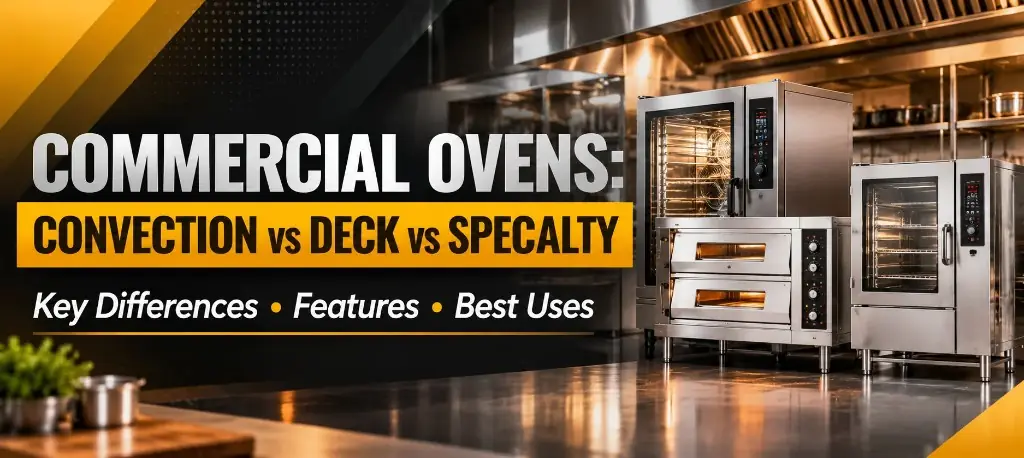
Commercial kitchen ovens serve different production needs: convection models emphasize circulating heat, deck ovens offer dedicated baking surfaces, and specialty ovens target particular cooking methods or service patterns. This comparison explains their practical differences, then outlines how to evaluate capacity, installation, operating costs, and controls. Use it to prepare a focused shortlist before discussing equipment with The Horeca Store or another supplier.
Which commercial oven types fit your menu?
Start with your food and production schedule, not a feature list. Consider convection for general baking and roasting, deck ovens when baking-surface control matters, and specialty models when steam, continuous production, or rapid finishing addresses a specific need. Manufacturers offer different configurations within each category, so treat these as starting points rather than guarantees of performance.
Before comparing specifications, write down your busiest production period. Include what goes into the oven, how much must come out, and which products need different temperatures. A kitchen producing breakfast pastries followed by lunch casseroles presents a different buying problem from one baking pizzas throughout dinner.
Use these priorities to organize your shortlist:
- General batch production: Investigate convection ovens and test your actual pan loads.
- Bread or pizza-focused baking: Compare deck configurations, baking surfaces, and heat controls.
- Steam and dry-heat cooking: Examine combi ovens and their installation requirements.
- Repeated products moving through service: Evaluate conveyor ovens around your loading and unloading workflow.
- Small orders finished on demand: Test rapid-cook equipment with your intended recipes.
These categories reflect the cooking methods described by manufacturers; suitability still requires a menu-specific demonstration.
Convection ovens for flexible batch cooking
Convection ovens use fan-driven airflow as part of their cooking process. Commercial models commonly support general baking and roasting, with controls ranging from manual thermostats and timers to programmable systems. Available airflow controls differ: Blodgett, for example, lists fan-speed selection and, on certain controls, pulsed fan operation intended to reduce batter rippling.
That makes airflow a practical buying consideration, not a minor specification. Ask for a demonstration using your most demanding product rather than accepting a successful test of something easy. If your menu includes delicate cakes alongside roasted foods, request both tests and record the settings required.
Pay particular attention to loading. Ask the demonstrator to use the trays, product spacing, and batch sizes your team expects to use. Judge the finished food across the load, including color, texture, and consistency, rather than checking only one convenient tray.
Controls deserve the same scrutiny. Have a staff member set a temperature, change a timer, and retrieve a saved program without coaching. A feature has limited practical value if the person working a busy shift cannot use it confidently.
Best-fit buying approach: Put convection near the top of your shortlist when general baking and roasting dominate your requirements, then verify its performance against your menu. Avoid assuming that every fan setting, rack arrangement, or recipe will transfer unchanged between models.
When is a deck oven the better choice?
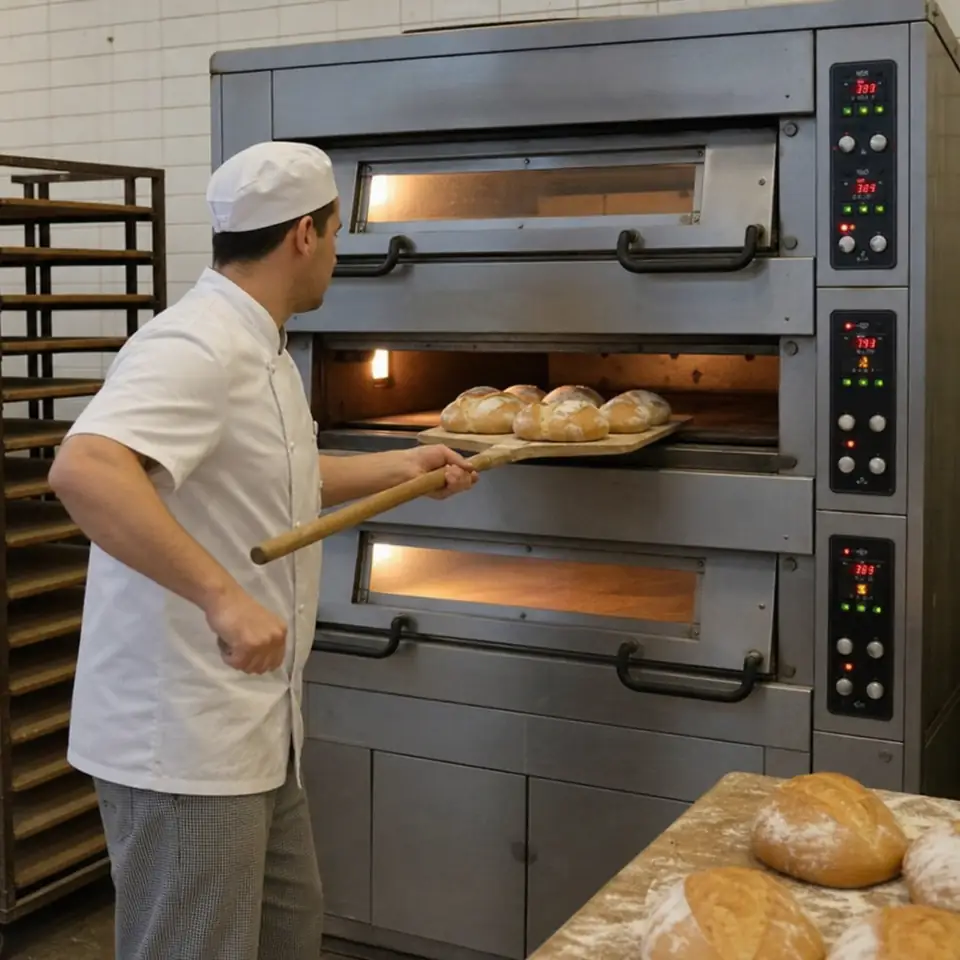
A deck oven deserves closer consideration when your baking process calls for a dedicated baking surface and control over heat above and below the product. Features vary, but Baxter's OV450W illustrates the category with a glazed stone surface, separately controlled top and bottom elements, and independently operated decks. Steam is included on that model, but you should confirm it rather than assume every deck oven provides it.
For a bread or pizza demonstration, focus on the relationship between the base and the top. Ask the demonstrator to adjust the oven toward your desired result, then explain which controls changed. This makes it easier to assess whether the equipment supports your recipe or merely produces an acceptable sample under unfamiliar conditions.
Evaluate the work around the oven, too. Plan where unbaked products wait, where the operator stands, and where finished food lands. Include peels, trays, racks, and handling space in the layout discussion instead of measuring only the cabinet.
Independent decks can be useful when you want separately controlled baking chambers; Baxter explicitly specifies independent operation for each deck on its OV450W. However, confirm the exact configuration, stacking arrangement, and required accessories on your quotation. Do not infer a complete installation package from a photograph of several stacked ovens.
Specialty ovens solve specific production problems
"Specialty" is a broad shopping category, not one cooking technology. Combi, conveyor, and rapid-cook ovens work differently, even when they appear in the same equipment search. Compare their cooking methods first, then decide which deserves a product demonstration.
Combi ovens combine steam and convection
A combi oven provides steam, convection, and combined steam-and-convection cooking modes. Depending on the model, operators can set parameters such as humidity, fan speed, cooking time, and core temperature. These controls create a different evaluation task from choosing a straightforward dry-heat oven.
Build the demonstration around several intended jobs rather than one impressive recipe. For example, ask to see your proposed roasting, vegetable, and baking processes, including the changeover between them. Record preparation, loading, cooking, unloading, and cleaning tasks so the comparison includes the whole workflow.
Before ordering, request written requirements for water, drainage, treatment, cleaning products, and maintenance. Have the installer review them against the site. Do not assume that selecting a compact cabinet makes the supporting installation equally simple.
Conveyor ovens emphasize repeatable product flow
Conveyor ovens move food through a heated chamber on a belt. Impingement versions direct high-velocity heated air toward products, and manufacturers offer controls for cooking time, temperature, and airflow on particular models. Some configurations also offer split belts with independently adjustable speeds.
Test the belt with your actual product dimensions and expected spacing. Watch the entrance and exit as closely as the food inside: identify who loads, who unloads, and where finished items go. Ask whether your proposed mix can share the same settings or requires separate production runs.
Include removable components in the demonstration. Middleby Marshall lists items such as crumb pans, air fingers, and conveyor assemblies among the removable cleaning parts on its PS638. Ask your team to review the applicable cleaning procedure before treating the oven as an easy operational fit.
Rapid-cook ovens target on-demand finishing
Rapid-cook ovens may combine high-speed air impingement with microwave assistance; the precise technology depends on the model. TurboChef distinguishes these from its impingement-only ovens and multicook configurations. Avoid treating "high-speed" as a single specification shared by every product.
Test your largest intended order as well as individual items. Include chilled or frozen starting conditions where relevant, and use the approved cookware specified for the equipment. Ask to see repeated orders so your evaluation reflects service rather than one isolated cooking cycle.
Treat ventless claims carefully. TurboChef states that ventless allowance depends on approval by the authority having jurisdiction and provides model-specific submittal information. Obtain confirmation for the exact oven, menu, and location before making a lease, layout, or ventilation decision.
How do you choose the right size and installation?
Choose capacity around production requirements, then verify that the proposed model can be installed and serviced in your space. The Department of Energy advises matching oven capacity to production needs because oversized equipment can increase purchase and operating costs. Its guidance also separates energy consumption into preheating, cooking, and idling, which makes your daily schedule relevant to sizing.
Use the following oven buying tips to turn a shortlist into a documented decision.
Measure usable production capacity
Ask how many of your pans or products fit under the demonstrated cooking conditions. Do not substitute the number of rack positions for a confirmed production result. Request a test that includes the spacing and product heights your recipes require.
Then build a simple production schedule. Include preheating, loading, cooking, unloading, cleaning, and any waiting between different recipes. Use your own measured or demonstrated times rather than estimating output from a brochure photograph.
Confirm the complete installation
Give the equipment specification sheet and installation manual to the appropriate installer before purchase. Ask for written confirmation of utility compatibility, ventilation requirements, clearances, and access. For equipment advertised as ventless, include local approval in that review rather than treating the product description as permission to install.
Your pre-purchase checklist should cover:
- Utilities: Confirm the specified fuel, electrical supply, and any water or drainage connections.
- Physical access: Measure the delivery route, doorways, turns, and final operating position.
- Working space: Plan door movement, loading, unloading, and safe tray landing areas.
- Installation scope: Identify who handles connections, commissioning, and required approvals.
- Service access: Ask where technicians must reach and what space must remain clear.
- Included equipment: List stands, stacking kits, trays, racks, and other quoted accessories.
Ask each responsible party to review the items within their scope. Keep those confirmations with the final quotation so unresolved installation work remains visible before payment.
Compare ownership costs, not just purchase prices
Request an itemized estimate covering equipment, delivery, installation, accessories, training, maintenance, and consumables. Separate confirmed costs from allowances. Where suppliers propose different configurations, ask them to explain what each quotation includes and excludes.
For energy comparisons, examine cooking efficiency and idle energy use rather than relying only on the appliance's input rating. ENERGY STAR evaluates eligible commercial ovens using cooking-efficiency and idle-energy criteria, with water-consumption requirements for applicable equipment. Use comparable test information where available, without assuming the same annual savings for every kitchen.
Read commercial oven reviews through your own requirements
Use commercial oven reviews to generate questions, not to outsource the decision. A reviewer's praise for controls or capacity is most useful when their products, loads, and service pattern resemble yours. Look for descriptions of testing conditions rather than accepting "fast," "consistent," or "easy to clean" without explanation.
Organize your comparison notes under four headings:
- Food results: Record texture, color, and consistency across the demonstrated load.
- Production: Note completed batches, changeovers, and the work required around each cycle.
- Daily operation: Assess control usability, cleaning procedures, and training needs.
- Support: Obtain written warranty terms, service arrangements, and maintenance requirements.
For any model reaching the final shortlist, request the exact model number, specification sheet, installation manual, and written quotation. Keep review observations separate from manufacturer specifications and your own test results. That distinction prevents an attractive anecdote from becoming an assumed product guarantee.
Choose the oven that earns its place
The best commercial ovens are the ones that meet your documented food, production, installation, and ownership requirements. Start with the cooking method, narrow the options through demonstrations, and resolve site requirements before committing.
When contacting The Horeca Store, bring your menu, peak production schedule, pan dimensions, available utilities, and installation questions. Ask for a specification-based comparison of suitable options, then use the same checklist to assess every proposal.