
Commercial meat slicers should be compared by workload, food compatibility, cutting capacity, safety, and cleaning access - not blade size alone. This article explains which specifications deserve attention and how to test them against your menu and prep routine. Whether you are evaluating options through The Horeca Store or another supplier, start with what your kitchen needs to slice, how often, and in what quantities.
Which commercial meat slicer fits your kitchen's workload?
The right slicer is one whose manufacturer-rated use matches your busiest realistic shift, including the foods you process and the length of each slicing session. Manufacturer selection guides distinguish between occasional slicing and sustained use, and they may specify separate limits for meat and cheese. Treat those limits as model-specific rather than assuming every machine labeled "commercial" can handle continuous production.
Before comparing commercial kitchen equipment, write a short operating brief:
- Menu: List the meats, cheeses, and other approved foods you intend to slice.
- Volume: Record typical batches and your busiest prep period, not just daily averages.
- Workflow: Separate made-to-order slicing from advance batch preparation.
- Product dimensions: Measure your largest intended items before they are portioned.
- Staffing: Identify who will operate, clean, and inspect the machine.
Use that brief to eliminate unsuitable models before comparing extras. For example, ask whether a candidate can complete your largest batch within its stated operating limits. If a supplier cannot document the answer, keep that uncertainty visible rather than treating it as a confirmed capability.
Allow for planned menu changes, too. Buying for an undefined future can waste budget, but ignoring an imminent increase in production makes the comparison incomplete.
Manual and automatic operation serve different workflows
Manual and automatic deli slicers differ principally in how the carriage moves during slicing. Manufacturers offer manual models for operator-controlled work and automatic models with powered carriage movement; some automatic machines also provide adjustable stroke speeds and lengths. Compare the actual functions rather than relying on the word "automatic."
For made-to-order service, evaluate how easily an operator can load a product, set thickness, complete a small order, and stop safely. For batch preparation, ask the demonstrator to show the automatic cycle, its adjustments, and how the machine handles the end of a product. These are different purchasing tests, even when the same food is involved.
| Operating need | What to compare |
|---|---|
| Small orders throughout service | Control placement, carriage movement, and adjustment clarity |
| Repeated preparation batches | Automatic carriage functions and approved operating duration |
| Different product lengths | Available stroke adjustments and loading capacity |
| Frequent operator changes | Training requirements and ease of identifying settings |
Do not budget on the assumption that automatic means unattended. Ask what supervision the manufacturer requires, and account for loading, collecting slices, cleaning, and changeovers when estimating labor. Automatic movement does not remove the need for guards or trained operation.
Blade diameter, cutting capacity, and thickness control
Blade diameter and cutting capacity are separate specifications. A selection sheet may list the knife diameter alongside maximum round-product diameter, rectangular-product dimensions, and maximum slice thickness. Check all of them: a prominent blade measurement does not, by itself, confirm that your largest roast or deli loaf will fit.
Bring your product measurements to the comparison. Ask the supplier to confirm how the food sits on the carriage and whether the holder can secure it throughout the approved cutting process. Avoid planning around a fit that requires improvised handling or removal of protective components. Guards must remain in place during operation.
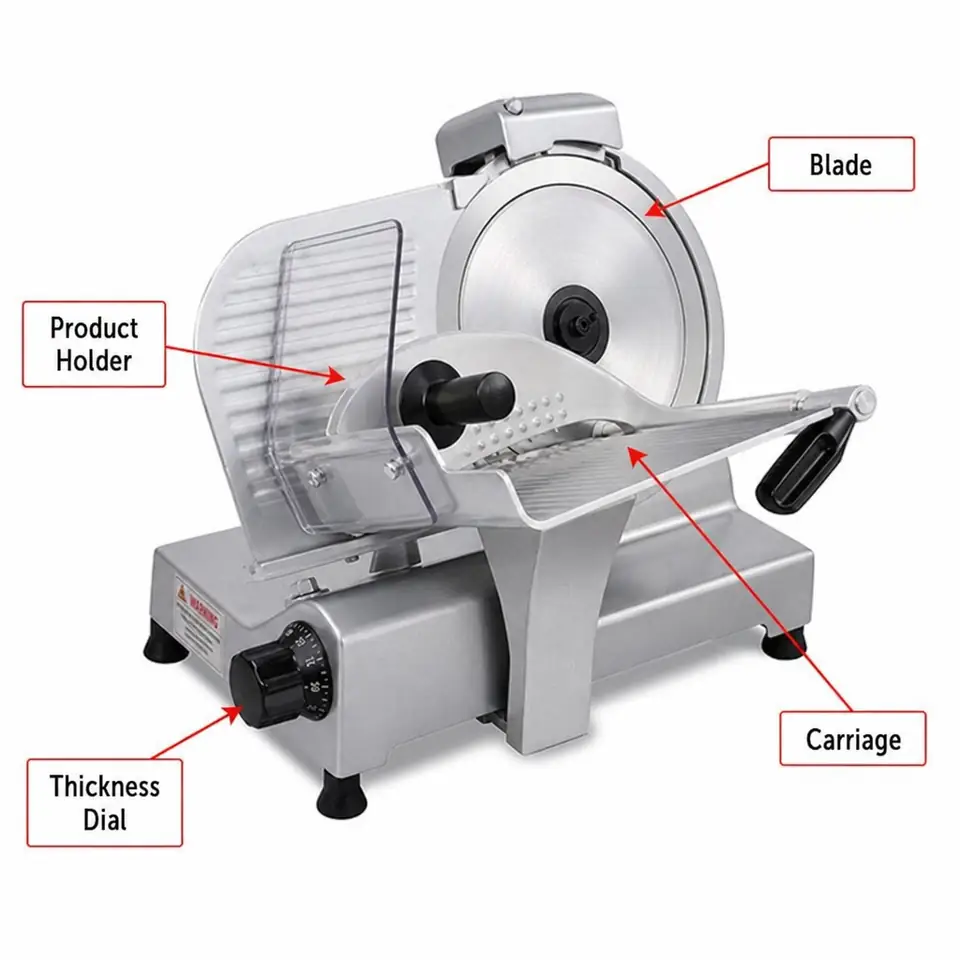
Thickness deserves a practical demonstration rather than a glance at the dial. Request samples at your thinnest intended setting and at a thicker menu setting. Examine complete slices from more than one part of the demonstration, and decide in advance what tearing, unevenness, or presentation defects would be unacceptable.
If portion weight matters, weigh the samples as part of your trial. Some commercial slicers incorporate a scale, but compare that feature against your existing weighing process before paying for additional functionality. Integrated weighing is available on specific models, not an assumed standard feature.
Motor ratings and food compatibility need context
Read horsepower alongside the manufacturer's stated applications and operating limits. Selection guides compare motor ratings with slicing duration, cheese suitability, blade diameter, and capacity; those details belong together in your evaluation. Avoid choosing on the largest motor number while leaving the intended workload unverified.
Cheese warrants an explicit conversation. Ask how much cheese the exact model is approved to slice and whether a particular blade or configuration is recommended. Manufacturers distinguish between machines suited to limited cheese preparation and those intended for more demanding use.
Frozen products require the same care. Do not assume a standard deli machine can process them because it appears powerful: Globe identifies dedicated frozen-meat configurations with serrated knives. Confirm the permitted product condition in the exact model's documentation before including frozen slicing in your purchasing plan.
Also ask what maintenance the drive system requires. Request the service schedule and replacement-part information rather than treating a belt-driven or gear-driven label as a complete quality verdict.
How can you judge cleaning access before buying?
Judge cleaning access by watching the complete manufacturer-approved disassembly, cleaning, inspection, and reassembly process. Look beyond whether a tray detaches: the FDA identifies seals, gaskets, seams, guards, and other areas where food debris can accumulate or cleaning access can deteriorate. A polished exterior is not enough to assess sanitation design.
Ask the demonstrator to explain each step while the machine is safely isolated. Note which tools are required, which parts must be handled, and where removed components will be washed. Request the written procedure so your team can assess it after the demonstration rather than relying on memory.
Use this inspection checklist:
- Hidden surfaces: Ask to see the areas behind removable covers and guards.
- Seals and seams: Inspect for gaps, damaged material, or places that are difficult to examine.
- Blade handling: Confirm whether removal is permitted and which protective tool is required.
- Cleaning compatibility: Verify approved chemicals and which components, if any, are dishwasher-safe.
- Reassembly: Have the demonstrator show how correct positioning is checked before use.
These details are model-dependent. For example, certain Hobart slicers offer removable knives, removal tools, tilting carriages, and dishwasher-safe components; those features should not be assumed across all machines.
Include inspection and replacement of worn seals in your ownership discussion. The FDA notes that seal and gasket life varies with use, foods, and cleaning practices, making ongoing condition checks important after purchase.
Safety features must support trained operation
Compare blade guards, food holders, control placement, and available interlocks. OSHA identifies proper guarding and feeding attachments as important protections against contact with slicer blades. Hand tools and pushing devices supplement required guarding; they do not replace it.
Ask for a demonstration of any advertised interlock. Depending on the model, these may restrict operation when components are incorrectly positioned or prevent automatic restart after power is restored. Verify the exact configuration on the quotation because safety-related functions can differ within a product range.
Your operating plan should also address safe shutdown and cleaning. OSHA advises turning off and unplugging slicers before disassembly and cleaning, following manufacturer instructions, and never bypassing guards. Where guards are removed for servicing or cleaning, appropriate hazardous-energy controls are essential; the applicable procedure must address unexpected startup.
Treat training as part of commissioning, not something to improvise during the first busy shift. Ask who provides instruction, which written materials are included, and how your kitchen will confirm that operators understand the specific machine.
Counter space, electrical supply, and everyday handling
Check the complete installation requirements before approving a purchase. Request the current specification sheet and installation instructions for the exact model, including dimensions, machine weight, electrical requirements, and any required clearances. Have your facilities team confirm suitability rather than assuming the existing outlet and counter are adequate.
Mark the proposed location on the counter and walk through the intended workflow. Allow for loading food, collecting slices, operating the carriage, reaching controls, and removing components for cleaning. Ask the supplier to verify the layout against the manufacturer's requirements.
Include these questions in your site review:
- Can staff reach the controls without awkward stretching?
- Is there a suitable nearby area for trays and finished portions?
- Can removed components reach the designated washing area conveniently?
- Will the slicer obstruct adjacent preparation tasks or access routes?
- Can service personnel access the machine as required?
Do not leave placement until delivery day. Resolving installation questions before ordering gives you a chance to reject a poor fit without reorganizing the kitchen around it.
What should you look for in meat slicer reviews?
Use meat slicer reviews to identify questions worth investigating, then verify the answers against current manufacturer documentation and a demonstration. Prioritize reviews that identify the exact model, foods processed, workload, and ownership period. A recommendation without that context gives you little basis for judging relevance to your kitchen.
Search results for "meat slicers commercial" or "best meat slicers" are starting points, not purchasing specifications. Build your shortlist around documented requirements instead of rankings alone. If a review praises effortless cleaning, ask to see the procedure; if it criticizes performance, check whether the described application matches the machine's approved use.
Look especially for information you can follow up on:
- Whether the reviewer describes made-to-order or batch work.
- Whether the food and batch sizes resemble yours.
- Whether cleaning comments cover full disassembly and reassembly.
- Whether service complaints identify the issue and resolution.
Keep observations separate from conclusions. One account can prompt a useful supplier question without proving that every unit will behave the same way. Give more weight to an answer you can document for the exact machine being quoted.
Compare ownership costs before the final decision
Ask for an itemized quotation rather than comparing equipment prices alone. Include delivery, any installation work, required accessories, training, and the maintenance items identified in the manual. Request separate pricing for optional features so you can judge whether they solve a genuine operating need.
Have the supplier clarify warranty coverage in writing. Ask about parts, labor, travel charges, exclusions, service arrangements, and the process for reporting a fault. Also request availability information for blades, sharpening components, seals, and other model-specific replacement parts.
For your internal comparison, use the same assumptions for every candidate. Estimate operating and cleaning labor from your own demonstration or trial, and avoid accepting an undocumented payback claim. Record unresolved questions beside the price so an inexpensive but uncertain option does not appear fully comparable to a documented one.
When contacting The Horeca Store, share your workload brief and request matching model documentation. Ask for confirmation of food compatibility, installation needs, included accessories, and service terms before committing.
The strongest choice is the slicer that satisfies your documented requirements without unnecessary complexity. Confirm the workload, test the intended foods, examine cleaning access, and settle support questions first. Then choose on verified suitability - not the most impressive headline specification.