
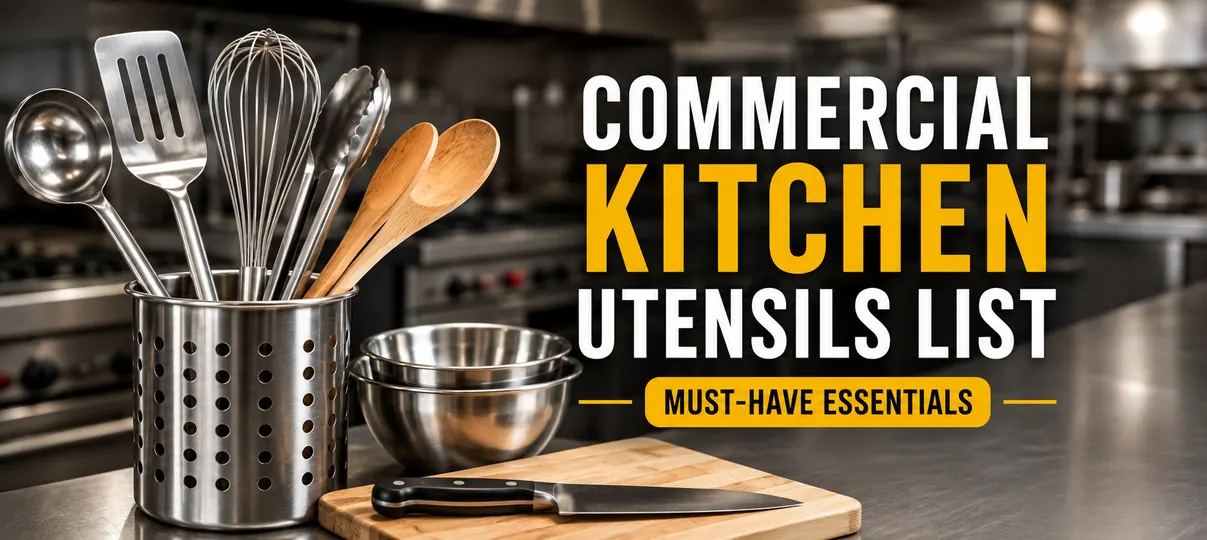
Outfitting a professional kitchen is about more than buying tools. The right utensils help your team prep faster, cook more consistently, reduce waste, and keep service moving when the rush hits. Whether you’re opening a restaurant, upgrading a catering kitchen, building a café prep station, or auditing your current setup, this commercial kitchen utensils list will help you cover the daily essentials.
Use it as a practical checklist alongside your larger cooking equipment list. Equipment like ovens, ranges, refrigerators, fryers, and mixers may get the spotlight, but utensils are what your staff touches hundreds of times per shift. Choosing durable, food-safe, easy-to-clean tools can make a major difference in workflow and food quality.
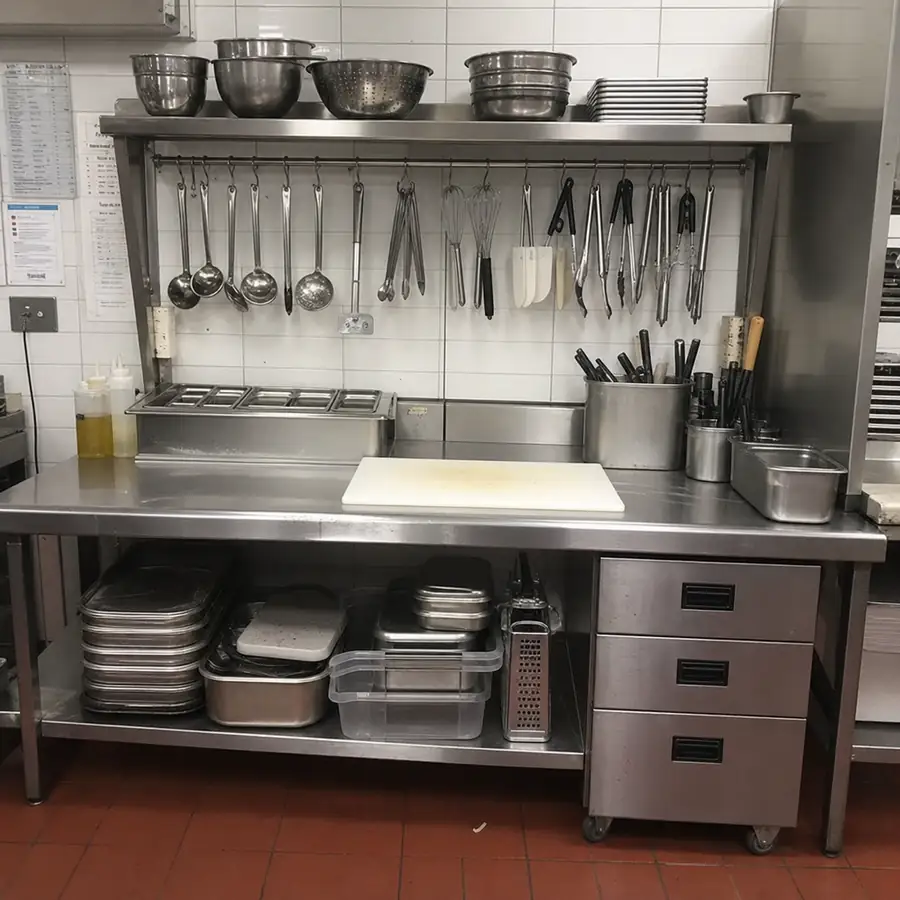
1. Chef’s Knives
A high-quality chef’s knife is one of the most important essential kitchen items in any commercial kitchen. It handles chopping, slicing, mincing, portioning, and general prep work.
For commercial use, prioritize:
- Comfortable handles that reduce hand fatigue
- Full-tang or heavy-duty construction
- Stainless steel or high-carbon stainless steel blades
- Multiple sizes for different prep tasks
- Easy sharpening and maintenance
A typical kitchen should keep several chef’s knives available so prep cooks are not waiting on tools during peak production.
2. Paring Knives
Paring knives are small but indispensable. They are used for peeling, trimming, hulling, garnishing, deveining, and detailed cuts that require more control than a chef’s knife can provide.
They are especially useful for:
- Fruit and vegetable prep
- Garnish work
- Removing seeds and stems
- Detail trimming on proteins
- Small batch prep tasks
Because they are frequently used and easy to misplace, it is smart to stock more than you think you need.
3. Serrated Knives
A serrated knife is essential for cutting foods with firm exteriors and soft interiors. Bread is the obvious example, but serrated knives are also useful for tomatoes, cakes, pastries, sandwiches, and delicate baked goods.
Commercial kitchens often benefit from having both long bread knives and shorter serrated utility knives. Choose blades that can handle high-volume slicing without crushing product or tearing presentation pieces.
4. Boning and Fillet Knives
If your kitchen breaks down meat, poultry, or fish in-house, boning and fillet knives belong on your commercial kitchen utensils list. These knives provide the flexibility and precision needed for trimming around bones, removing skin, portioning proteins, and reducing waste.
Consider adding:
- Flexible fillet knives for fish
- Stiff boning knives for meat
- Curved boning knives for poultry and butchery
- Protective storage to preserve blade edges
Even if you buy pre-portioned proteins, these knives are helpful for touch-up trimming and portion control.
5. Cutting Boards
Color-coded cutting boards help maintain food safety standards during high-volume prep.
Cutting boards are core prep tools and critical for food safety. In most commercial environments, color-coded boards are used to reduce cross-contact between raw meats, seafood, produce, dairy, and ready-to-eat foods.
Look for boards that are:
- Durable and warp-resistant
- Dishwasher-safe or easy to sanitize
- Non-slip or compatible with board mats
- Available in multiple sizes
- Clearly color-coded if used for different food categories
Keep enough boards on hand so staff can swap them out quickly during service or prep without slowing down sanitation procedures.
6. Mixing Bowls
Mixing bowls are used constantly in commercial kitchens. They support prep, marinating, tossing salads, mixing batters, holding ingredients, proofing dough, and organizing mise en place.
Stainless steel mixing bowls are a common choice because they are durable, lightweight, stackable, and easy to clean. It is helpful to stock a full range of sizes, from small bowls for sauces and garnishes to large bowls for bulk prep.
For best workflow, choose bowls that nest neatly and can withstand frequent washing.
7. Measuring Cups and Measuring Spoons
Accurate measuring tools and food prep equipment keep recipes consistent across every shift.
Consistency matters in a commercial kitchen. Measuring cups and spoons help maintain recipe accuracy, control food costs, and train staff to follow standardized procedures.
Your kitchen should include:
- Dry measuring cups
- Liquid measuring cups
- Measuring spoon sets
- Heavy-duty commercial-grade options
- Clearly marked measurements that do not fade quickly
Even experienced cooks benefit from reliable measuring tools when scaling recipes or preparing sauces, dressings, batters, and baked goods.
8. Digital Scales
A digital scale is one of the most valuable tools for portion control and recipe consistency. It is especially important for bakeries, cafés, catering operations, ghost kitchens, and restaurants that rely on standardized plating.
Use scales for:
- Portioning proteins
- Weighing dough
- Measuring ingredients by weight
- Controlling packaging portions
- Reducing over-serving and food waste
Choose commercial scales with clear displays, tare functions, and weight capacities suited to your menu.
9. Whisks
Whisks are essential for blending, emulsifying, aerating, and smoothing mixtures. They are used for sauces, dressings, batters, eggs, creams, gravies, and more.
Stock different styles for different tasks:
- Balloon whisks for incorporating air
- French whisks for sauces and thick mixtures
- Flat whisks for shallow pans
- Mini whisks for small batches
- Heavy-duty whisks for high-volume prep
Durability is important because low-quality whisks can bend, break, or trap food in hard-to-clean areas.
10. Spatulas
Spatulas come in several types, and a well-equipped kitchen needs more than one. Rubber spatulas are useful for scraping bowls and folding ingredients, while turner spatulas handle flipping, lifting, and transferring foods on grills, griddles, and pans.
Essential spatula types include:
- Heat-resistant silicone spatulas
- Offset spatulas for plating and pastry work
- Fish spatulas for delicate proteins
- Metal turners for flat-top cooking
- Wide spatulas for burgers, pancakes, and sandwiches
Make sure heat-resistant spatulas are rated for the temperatures your kitchen uses.
11. Tongs
Tongs are among the most frequently used utensils in a busy kitchen. They function like an extension of the cook’s hand, helping with turning, tossing, plating, grilling, sautéing, and serving.
A commercial kitchen should stock tongs in multiple lengths:
- Short tongs for plating and precise handling
- Medium tongs for general cooking
- Long tongs for grills, fryers, and hot equipment
- Locking tongs for storage efficiency
- Color-coded tongs for allergen or food safety control
Because tongs wear out quickly in high-use kitchens, inspect them regularly for weak springs, loose hinges, or damaged tips.
12. Ladles
Ladles are necessary for soups, sauces, stews, stocks, gravies, batters, and portioned liquids. They help keep serving sizes consistent, which supports both presentation and cost control.
Consider stocking ladles in several capacities so staff can quickly portion different menu items. Clearly marked handles are helpful when recipes depend on exact serving amounts.
Stainless steel ladles are often the best fit for commercial kitchens because they resist staining, odors, and heat damage.
13. Serving Spoons
Large serving spoons support prep, cooking, plating, and buffet service. Solid spoons are good for stirring and serving foods with sauce, while perforated spoons help drain liquids.
Keep a mix of:
- Solid stainless steel spoons
- Slotted spoons
- Deep serving spoons
- Long-handled spoons for stockpots
- Heat-resistant spoons for nonstick cookware
These simple utensils are easy to overlook, but not having enough can slow down service and create cross-use issues between dishes.
14. Skimmers and Strainers
Skimmers and strainers are used for removing solids from liquids, draining fried items, rinsing ingredients, straining sauces, and clarifying stocks.
Common options include:
- Fine mesh strainers
- China caps
- Chinois strainers
- Spider skimmers
- Coarse strainers
- Colanders
A fine mesh strainer is useful for sauces and purées, while a spider skimmer works well for pasta, dumplings, blanched vegetables, and fried foods.
15. Colanders
Colanders are essential for draining pasta, washing produce, rinsing grains, and handling bulk prep. In a commercial setting, they need to be sturdy enough to support heavy loads without bending or cracking.
Choose colanders with:
- Strong handles
- Stable bases
- Large drainage holes for quick draining
- Stainless steel or commercial-grade plastic construction
- Multiple sizes for different prep volumes
Large colanders are especially helpful for catering, commissary kitchens, and high-volume prep operations.
16. Peelers
Vegetable peelers are small tools that save a lot of labor. They are used for potatoes, carrots, cucumbers, apples, citrus, chocolate curls, and decorative prep.
Stock several styles, such as:
- Straight peelers
- Y-peelers
- Serrated peelers
- Julienne peelers
- Heavy-duty peelers for root vegetables
Comfort matters. A sharp, ergonomic peeler reduces prep time and makes repetitive work easier on the hands.
17. Graters and Zesters
Graters and zesters add flexibility to prep stations. They are used for cheese, citrus zest, garlic, ginger, nutmeg, chocolate, vegetables, and garnishes.
Useful types include:
- Box graters for larger quantities
- Microplane-style zesters for citrus and spices
- Rotary graters for cheese service
- Coarse graters for vegetables
- Fine graters for delicate finishing work
Choose graters with stable grips and blades that hold up to repeated use.
18. Kitchen Shears
Commercial kitchen shears are versatile tools for trimming herbs, cutting poultry, opening food-safe packaging, portioning dough, snipping twine, and finishing prep tasks.
Look for shears that are:
- Heavy-duty
- Easy to sanitize
- Comfortable to grip
- Rust-resistant
- Designed to separate for cleaning if possible
To prevent contamination, keep separate shears for food prep and packaging tasks.
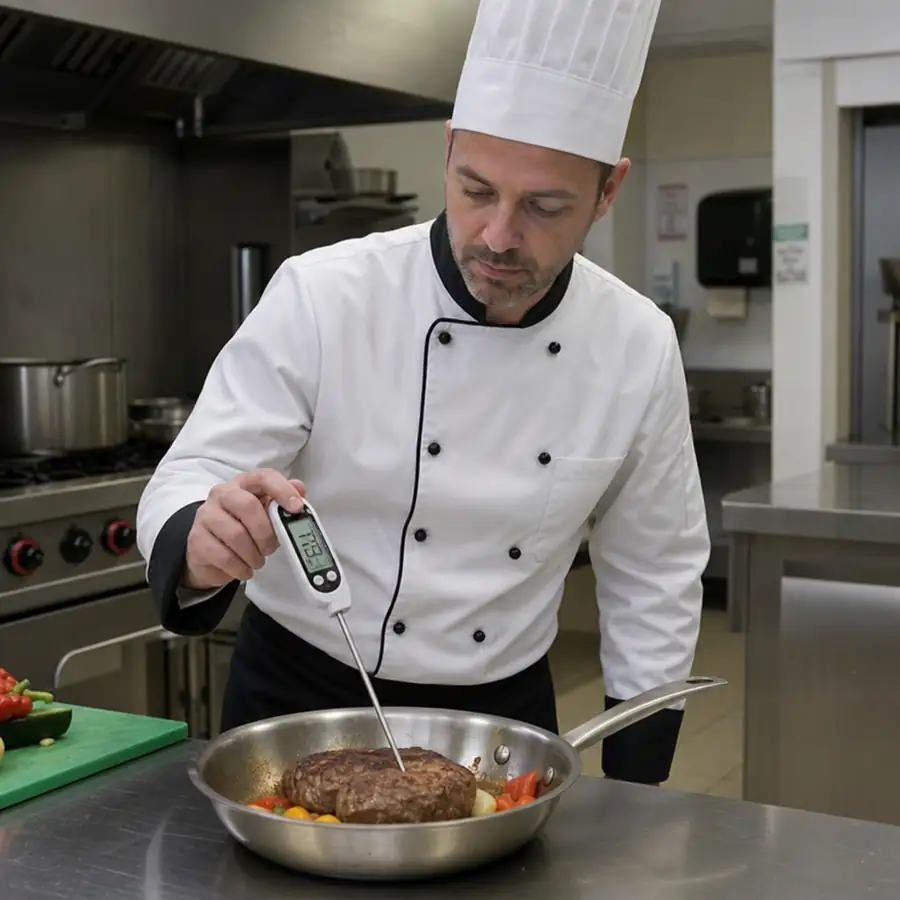
19. Thermometers
Food safety and consistency depend on accurate temperature checks. Thermometers are non-negotiable essential kitchen items for commercial food operations.
Important thermometer types include:
- Instant-read thermometers
- Probe thermometers
- Infrared thermometers
- Refrigerator and freezer thermometers
- Oven thermometers
Use thermometers to verify cooking temperatures, cooling procedures, holding temperatures, receiving temperatures, and equipment performance. Train staff to calibrate and sanitize thermometers properly.
20. Timers
Timers help prevent overcooking, support batch production, and keep multitasking cooks organized. Even if equipment has built-in timers, standalone kitchen timers are useful at prep stations, baking stations, and line positions.
Commercial kitchens may need multiple timers for:
- Baking
- Frying
- Roasting
- Proofing
- Cooling procedures
- Batch cooking
Choose timers that are loud enough for a busy kitchen and simple enough to use quickly during service.
21. Sheet Pans
Sheet pans are workhorses in commercial kitchens. They are used for roasting, baking, cooling, holding, organizing mise en place, transporting ingredients, and staging prepared foods.
Common sizes include full, half, and quarter sheet pans. A practical setup usually includes a mix of sizes so staff can handle everything from bulk roasting to small batch prep.
Pair sheet pans with:
- Pan liners
- Wire racks
- Pan covers
- Speed racks
- Silicone mats where appropriate
Heavy-gauge pans typically perform better and resist warping under repeated heating.
22. Hotel Pans and Food Pans
Hotel pans are essential for prep, storage, hot holding, cold holding, buffet service, and line organization. They are a key bridge between utensils and larger equipment because they work with prep tables, steam tables, reach-ins, and holding cabinets.
Stock multiple depths and sizes for:
- Sauces
- Proteins
- Vegetables
- Garnishes
- Batch prep
- Service line ingredients
Stainless steel pans are durable and heat-friendly, while clear food pans can be useful for cold storage and quick identification.
23. Storage Containers
Food storage containers support organization, food safety, inventory control, and prep efficiency. They are essential in walk-ins, reach-ins, dry storage, prep stations, and service lines.
A complete storage setup should include:
- Square containers for space efficiency
- Round containers for sauces and liquids
- Ingredient bins for bulk dry goods
- Lids that seal securely
- Labels and date markers
- Clear containers for visibility
Choose containers that stack well, resist staining, and are easy for staff to clean and store.
24. Squeeze Bottles
Squeeze bottles are useful for sauces, oils, dressings, syrups, garnishes, and plating details. They improve portion control and help cooks finish dishes quickly and consistently.
Use squeeze bottles for:
- Aioli
- Vinaigrettes
- Dessert sauces
- Oils
- Hot sauces
- Garnish purées
Label every bottle clearly. If bottles are used for allergens or specialty ingredients, make sure staff can identify them immediately.
25. Portion Scoops
Portion scoops help maintain consistency across prep and service. They are commonly used for cookie dough, mashed potatoes, rice, tuna salad, chicken salad, meatballs, batter, and side dishes.
Benefits include:
- Faster portioning
- Consistent plating
- Better food cost control
- Easier staff training
- Reduced waste
Color-coded handles or size markings can help staff choose the correct scoop quickly.
26. Pastry Brushes
Pastry brushes are not just for bakeries. They are useful for glazing, basting, oiling pans, applying butter, brushing sauces, and finishing grilled or roasted foods.
Silicone brushes are durable and easy to sanitize, while natural bristle brushes may provide a softer finish for delicate pastry tasks. Choose the type that best fits your menu and cleaning requirements.
27. Rolling Pins
If your kitchen prepares dough, pastry, tortillas, pasta, flatbreads, or desserts, rolling pins are essential. Commercial kitchens may use traditional handled rolling pins, French-style tapered pins, or specialized pins depending on the type of dough being prepared.
For high-volume operations, consider durability, sanitation, and storage. Wooden rolling pins are classic, but some kitchens prefer nonporous materials for easier cleaning.
28. Can Openers
A commercial-grade can opener is a must for kitchens that use canned tomatoes, beans, stocks, sauces, fruits, or bulk ingredients. Household-style openers are not built for heavy use and can become a bottleneck during prep.
Options include:
- Manual handheld can openers
- Table-mounted can openers
- Heavy-duty crank-style models
- Replacement blades for maintenance
Keep blades clean and sharp to reduce metal shavings and improve sanitation.
29. Mandolines and Slicers
Mandolines help produce fast, uniform slices for vegetables, fruits, garnishes, chips, and salads. They improve consistency and can reduce knife work when used properly.
Because mandolines are sharp, safety is critical. Always use hand guards, cut-resistant gloves, and clear training procedures.
For higher-volume slicing, a dedicated commercial slicer may belong on your broader cooking equipment list, especially for delis, sandwich shops, and kitchens that slice meats or cheeses in-house.
30. Turners and Grill Tools
Flat-top grills, charbroilers, and sauté stations require durable tools that can handle heat and pressure. Turners, grill scrapers, grill brushes, and long-handled utensils help cooks manage burgers, steaks, fish, eggs, pancakes, and grilled vegetables.
Key tools include:
- Heavy-duty grill spatulas
- Flexible fish turners
- Grill scrapers
- Long-handled forks where appropriate
- Grill brushes or approved cleaning tools
- Basting brushes and sauce mops
Choose tools with comfortable handles and heat resistance suitable for your line setup.
31. Fryer Baskets and Spider Skimmers
If fried foods are on the menu, fryer tools are essential. Fryer baskets, skimmers, tongs, and draining racks help maintain quality and safety.
A fryer station should have:
- Correctly sized fryer baskets
- Spider skimmers for loose items
- Heat-resistant tongs
- Drain pans or racks
- Salt or seasoning containers
- Oil-safe thermometers if needed
Inspect basket handles and mesh regularly. Damaged baskets can create safety hazards and slow down production.
32. Stockpot and Saucepan Utensils
Large stockpots and saucepans require long-handled tools that keep staff safely away from heat and steam. Standard spoons are often too short for deep pots.
Add these to your commercial kitchen utensils list:
- Long-handled spoons
- Long-handled ladles
- Paddle stirrers
- Large whisks
- Heat-resistant spatulas
- Pot forks where appropriate
These tools are especially important for soups, sauces, stocks, pasta, braises, and batch cooking.
33. Prep Containers and Mise en Place Cups
Small prep containers keep stations organized and service-ready. They are used for herbs, spices, garnishes, sauces, dressings, chopped vegetables, and finishing ingredients.
A good mise en place system helps staff:
- Work faster
- Reduce mistakes
- Keep stations cleaner
- Track ingredient levels
- Maintain consistent plating
Choose containers that are stackable, clear, and compatible with your refrigeration and prep line setup.
34. Cleaning and Sanitizing Utensils
Cleaning tools are part of any realistic list of essential kitchen items. Utensils are only useful if they can be kept sanitary and ready for service.
Important cleaning supplies include:
- Scrub brushes
- Dish brushes
- Approved cleaning pads
- Sanitizer buckets
- Spray bottles for approved solutions
- Squeegees
- Utility brushes for equipment details
Use color coding where helpful to separate food-contact cleaning tools from floor, restroom, or general utility tools.
35. Protective and Safety Tools
Safety tools protect staff and help keep the kitchen compliant with internal procedures. They should be easy to access and included in staff training.
Common safety essentials include:
- Cut-resistant gloves
- Heat-resistant gloves
- Oven mitts
- Aprons
- First aid supplies
- Knife guards
- Non-slip mats where appropriate
These items may not seem like utensils at first, but they are part of the daily tool system that keeps a commercial kitchen running safely.
How to Choose the Right Commercial Kitchen Utensils
Buying utensils for a commercial kitchen is different from buying tools for home use. Commercial utensils need to survive constant washing, high heat, heavy prep, and multiple users with different work styles.
When comparing options, focus on these factors.
Durability
Choose utensils designed for frequent use. Stainless steel, heavy-gauge aluminum, high-heat silicone, and commercial-grade plastics are often better choices than lightweight household tools.
Cleanability
Avoid tools with unnecessary seams, weak joints, or hard-to-clean crevices. Smooth surfaces and dishwasher-safe construction make sanitation easier.
Comfort
Ergonomic handles matter when staff use a tool for hours. Comfortable knives, peelers, tongs, and whisks can reduce fatigue and improve productivity.
Heat Resistance
Utensils used near ranges, fryers, grills, ovens, or steam tables must withstand heat. Check temperature ratings for silicone spatulas, brushes, tongs, and handled tools.
Storage Efficiency
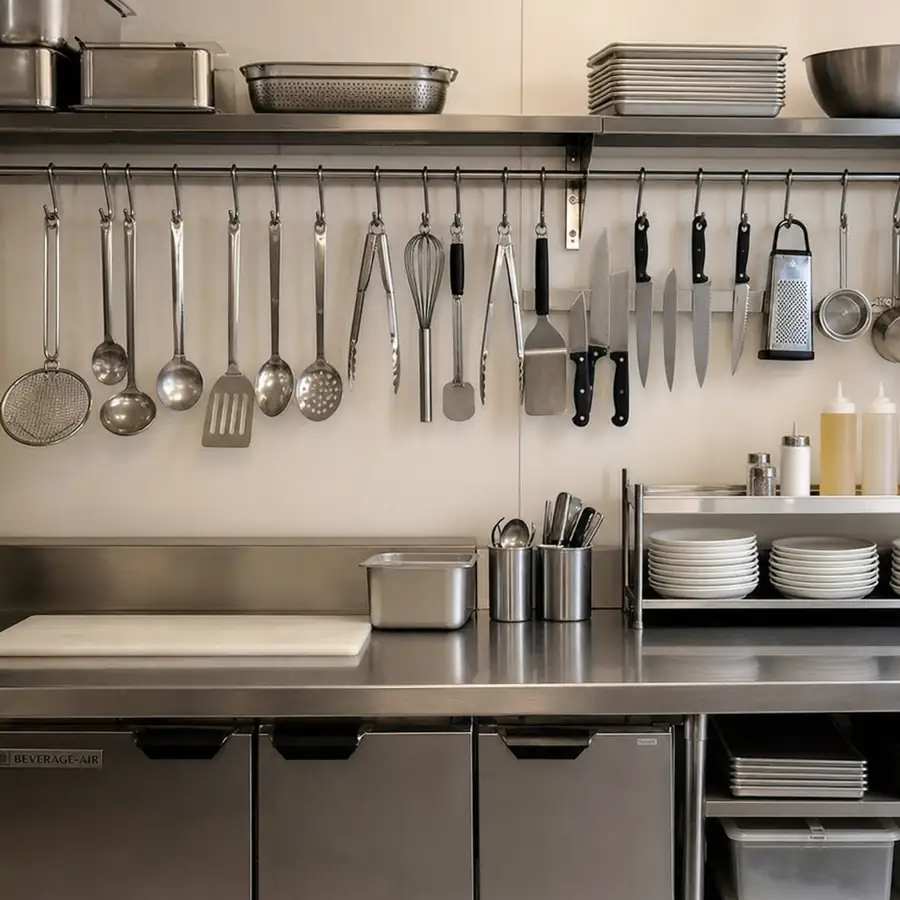
A cluttered kitchen slows everyone down. Choose utensils that hang, stack, nest, or fit neatly into station containers.
Menu Fit
Your menu should guide your buying decisions. A bakery needs more pastry tools. A steakhouse needs more grill tools. A catering company needs more transport-friendly pans, containers, and serving utensils.
Quick Starter Checklist for New Commercial Kitchens
If you are building your first purchasing plan, start with a balanced selection of general-purpose tools before adding specialty utensils.
A practical starter set includes:
- Chef’s knives, paring knives, serrated knives, and knife storage
- Color-coded cutting boards
- Mixing bowls in multiple sizes
- Measuring cups, spoons, and digital scales
- Whisks, spatulas, tongs, ladles, and serving spoons
- Strainers, colanders, peelers, graters, and shears
- Thermometers and timers
- Sheet pans, hotel pans, and wire racks
- Storage containers, squeeze bottles, and portion scoops
- Cleaning tools, sanitizer buckets, gloves, and heat protection
This starter set gives most kitchens the foundation they need for prep, cooking, storage, service, and sanitation.
Common Mistakes to Avoid
Even experienced operators can underestimate utensil planning. Avoid these common mistakes when creating your cooking equipment list.
Buying Too Few of the Basics
One pair of tongs or one cutting board is not enough for a busy kitchen. Stock backups for high-use items so staff are not forced to reuse tools without proper cleaning.
Choosing Household-Grade Tools
Home kitchen utensils usually are not built for commercial volume. They may warp, break, stain, or fail quickly under constant use.
Ignoring Replacement Needs
Utensils wear out. Blades dull, spatulas melt, tongs loosen, boards become deeply scored, and containers crack. Plan for routine replacements.
Forgetting Station-Specific Tools
Each station needs the right tools within reach. A sauté cook, prep cook, baker, grill cook, and pantry cook may all need different setups.
Skipping Labels and Organization
The best utensils will not help if staff cannot find them. Use labeled bins, wall racks, pegboards, drawer organizers, and consistent storage locations.
Final Thoughts
A complete commercial kitchen utensils list should support every part of your operation: prep, cooking, baking, plating, storage, service, cleaning, and safety. Start with the core essentials, then build around your menu, volume, kitchen layout, and staff workflow.
The right utensils may seem like small details, but they influence speed, consistency, sanitation, and food cost every day. When you invest in durable, practical tools and keep them organized, your kitchen becomes easier to run and better prepared for busy service.