
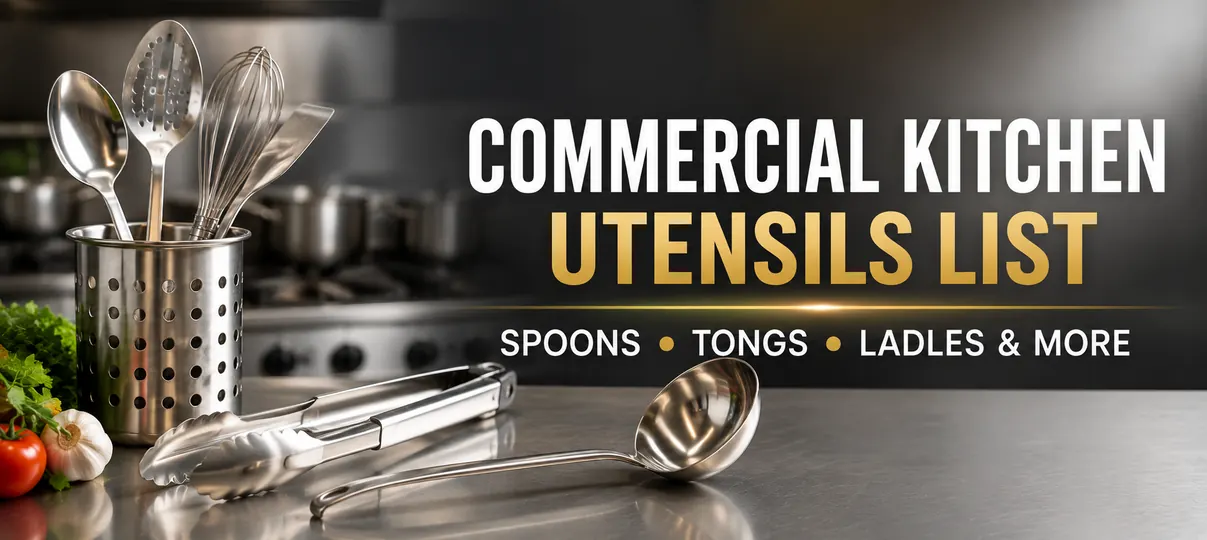
A restaurant kitchen runs on precision, speed, and consistency. While large appliances often get the most attention, the smaller tools are what keep prep lines moving, sauces smooth, proteins handled safely, and plates finished on time. A well-planned commercial kitchen utensils list helps chefs, owners, and kitchen managers stock the essentials without overbuying or missing the tools staff use every day.
Below is a practical restaurant utensils list focused on the commercial kitchen utensils most operations rely on-especially core restaurant kitchen utensils like spoons, tongs, and ladles-plus other smallwares that support prep, cooking, service, and sanitation. If you’re building out cooking utensils for restaurants from scratch, this can also serve as a starting point for your broader cooking equipment list and restaurant kitchen supplies planning.
1. Heavy-Duty Cooking Spoons
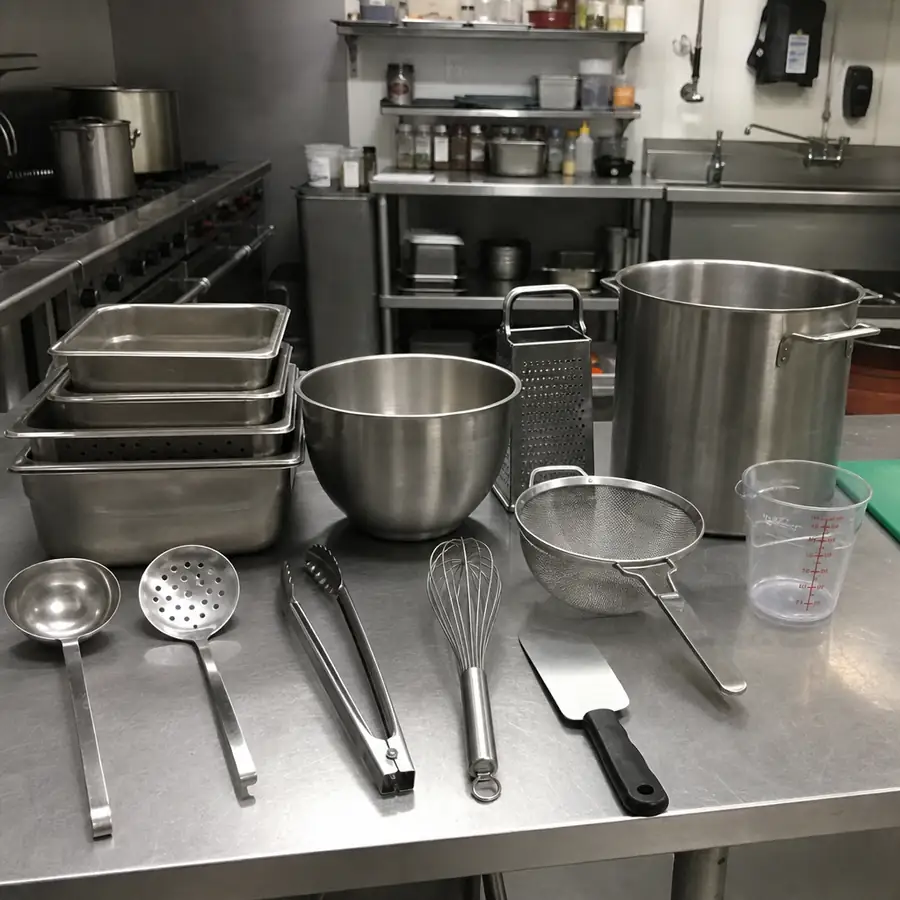
Pair serving spoons and tongs with other smallwares so the cookline and pass stay stocked.
Commercial spoons are some of the most frequently used tools in any professional kitchen. They are essential for stirring sauces, mixing soups, folding ingredients, basting proteins, and plating finished dishes.
For restaurant use, look for spoons that are durable, heat-resistant, and easy to clean. Stainless steel kitchen utensils are a common choice because they hold up well under repeated use and high temperatures.
Common types include:
- Solid serving spoons for stirring and portioning
- Slotted spoons for draining liquids from vegetables, pasta, or poached items
- Basting spoons for spooning butter, pan sauces, or cooking juices over food
- Perforated spoons for lifting foods from broth, oil, or water
- Long-handled spoons for deep stockpots and steam kettles
When building your cooking equipment list, include multiple sizes. A small spoon may work well for garnish or sauce finishing, while a long, heavy spoon is better for stockpots and bulk cooking.
2. Restaurant-Grade Tongs
Restaurant tongs are indispensable in commercial kitchens because they allow staff to grip, turn, toss, lift, and serve food safely. They also reduce direct hand contact, which supports food safety and efficient service.
Every restaurant should keep several types of tongs on hand:
- Utility tongs for general cooking and serving
- Locking tongs for compact storage
- Scalloped-edge tongs for firm grip on proteins and vegetables
- Silicone-tip tongs for nonstick pans or delicate surfaces
- Long grill tongs for broilers, grills, and high-heat stations
- Short plating tongs for precise finishing work
Tongs should feel comfortable in the hand, open and close smoothly, and have enough tension to grip food without crushing it. For high-volume restaurants, it is smart to stock backups because tongs are constantly in use across prep, hot line, cold line, and service areas.
3. Commercial Ladles
Commercial ladles are essential for portioning soups, sauces, stews, gravies, dressings, batters, and stocks. In restaurants, consistency matters, so different ladle sizes help control portions and food cost.
A complete commercial set may include:
- Small ladles for sauces and dressings
- Medium ladles for soups and sides
- Large ladles for bulk service
- Long-handled ladles for deep pots
- Spouted ladles for more controlled pouring
Choose sturdy handles that will not bend during heavy use. Stainless steel ladles are common because they are durable, easy to sanitize, and suitable for hot liquids. If your operation serves soup, curry, chili, gravy, or buffet items, ladles should be high on your commercial kitchen utensils list.
When you’re ready to replace worn tools or standardize your smallwares, restaurant operators often look for one reliable place to source essentials like commercial spoons, restaurant tongs, and ladles alongside other restaurant kitchen supplies. The Horeca Store is one convenient destination to browse commercial kitchen utensils and other foodservice equipment in one place.
4. Whisks for Mixing, Emulsifying, and Aerating
Whisks are core cooking supplies for sauces, batters, dressings, eggs, creams, and emulsions. The right whisk can make prep faster and improve texture.
Common whisk styles include:
- Balloon whisks for incorporating air into eggs or cream
- French whisks for sauces, custards, and dressings
- Flat whisks for deglazing pans and making roux-based sauces
- Piano whisks for lighter mixing tasks
- Heavy-duty whisks for thick batters and large-volume prep
For restaurant use, stock several sizes. Smaller whisks are useful for finishing sauces in pans, while larger whisks are better for mixing in large bowls or stockpots.
5. Spatulas and Turners
Spatulas and turners are used for flipping, lifting, scraping, spreading, and transferring food. They are especially important on flat tops, sauté stations, pastry stations, and prep lines.
Essential options include:
- Solid turners for burgers, fish, eggs, and pancakes
- Perforated turners for draining fat or liquid
- Offset spatulas for plating, pastries, and delicate lifting
- Rubber spatulas for scraping bowls and folding ingredients
- High-heat silicone spatulas for sauces and hot prep
- Grill spatulas for flat-top cooking
In a commercial setting, flimsy spatulas can slow down service or break under pressure. Choose tools with strong handles, heat-safe materials, and a comfortable grip.
6. Skimmers and Spiders
Skimmers and spider strainers are designed to lift food from hot liquids or oil while draining excess moisture or fat. They are especially useful in kitchens that prepare pasta, dumplings, fried foods, blanched vegetables, or poached items.
Useful styles include:
- Fine-mesh skimmers for removing foam or impurities from stocks
- Wire spider strainers for frying and blanching
- Flat skimmers for lifting delicate items
- Long-handled skimmers for deep fryers and large pots
These utensils improve safety by giving staff better control when working with hot liquids. They also help preserve food quality by preventing overcooking during removal.
7. Kitchen Knives and Cutting Tools
Keep kitchen knives, utility knives, and cutting boards with food prep equipment at each station.
No cooking equipment list is complete without knives. While knives may not be grouped with spoons, tongs, and ladles, they are essential utensils for prep efficiency and food consistency.
Core commercial kitchen knives include:
- Chef’s knives for general prep
- Paring knives for small, detailed cuts
- Serrated knives for bread, tomatoes, and delicate crusts
- Boning knives for meat and poultry
- Fillet knives for fish
- Cleavers for heavy-duty chopping
- Utility knives for flexible prep tasks
Restaurants should also include sharpening tools, honing rods, cut-resistant gloves, and safe storage options. Dull knives increase prep time and can create safety risks, so regular maintenance is important.
8. Peelers, Zesters, and Graters
Small prep utensils can make a major difference during busy service. Peelers, zesters, and graters are affordable tools that support consistent prep and garnish work.
Useful items include:
- Straight peelers for potatoes, carrots, and cucumbers
- Y-peelers for fast, ergonomic peeling
- Citrus zesters for garnishes and sauces
- Microplane-style graters for cheese, nutmeg, garlic, and citrus zest
- Box graters for larger-volume shredding
- Julienne peelers for vegetable garnishes
These tools are especially helpful in scratch kitchens, bakeries, bars, and restaurants with fresh garnish programs.
9. Measuring Cups and Measuring Spoons
Accurate measuring cups and measuring spoons sit beside mixing bowls on most restaurant prep tables.
Consistency is essential in professional foodservice. Measuring cups and spoons help standardize recipes, train staff, manage food cost, and deliver the same flavor every time.
A restaurant should stock:
- Dry measuring cups
- Liquid measuring cups
- Stainless steel measuring spoons
- Portion scoops
- Graduated containers
- Measuring pitchers
For high-volume kitchens, consider durable, clearly marked tools that can handle frequent washing. Measurements should be easy to read, even in a fast-paced environment.
10. Portion Scoops and Dishers
Portion scoops, sometimes called dishers, are important for consistency in prep and plating. They are commonly used for cookie dough, mashed potatoes, rice, vegetables, tuna salad, chicken salad, and controlled portions of side dishes.
Benefits include:
- More consistent serving sizes
- Better food cost control
- Faster plating
- Cleaner presentation
- Easier staff training
Dishers are often available in different sizes, so kitchens should select options based on menu needs. Color-coded handles can also help staff quickly identify the correct portion size.
11. Mixing Bowls
Mixing bowls are foundational cooking supplies for prep, baking, marinating, tossing, and holding ingredients. In commercial kitchens, bowls must withstand frequent use and cleaning.
Common options include:
- Stainless steel bowls for durability and general prep
- Glass bowls for visibility and certain prep tasks
- Plastic prep bowls for lightweight handling
- Non-slip bowls for mixing stability
- Large mixing bowls for bulk prep
Stainless steel is often preferred in restaurant environments because it is lightweight, durable, and easy to sanitize. Stock nesting bowls in multiple sizes to save space.
12. Colanders and Strainers
Colanders and strainers are necessary for draining, rinsing, sifting, and separating ingredients. They are especially important for pasta, produce, stocks, sauces, grains, and fried items.
Consider adding:
- Large colanders for pasta and vegetables
- Fine-mesh strainers for sauces and stocks
- China caps for soups and purees
- Chinois strainers for refined sauces
- Sifters for flour and dry ingredients
The right strainer improves texture and presentation. For example, a fine-mesh strainer can help create smooth sauces, while a large colander helps manage bulk pasta service.
13. Tasting Spoons
Tasting spoons are a small but important part of a professional kitchen. They help chefs check seasoning, temperature, and texture without cross-contamination.
Best practices include:
- Keep clean tasting spoons in an accessible container
- Use each spoon only once before washing
- Provide enough spoons for multiple stations
- Choose durable spoons that can be sanitized easily
A strong tasting process leads to better consistency. It also encourages cooks to adjust seasoning before food reaches the guest.
14. Serving Utensils for Plating and Service
Serving utensils bridge the gap between the kitchen and the dining room, buffet, catering line, or takeout station. They should be functional, durable, and appropriate for the style of service.
Common serving utensils include:
- Serving spoons
- Slotted serving spoons
- Serving forks
- Buffet tongs
- Pie servers
- Cake servers
- Pasta servers
- Sauce spoons
For buffet and catering operations, duplicate utensils are essential so staff can replace items quickly when they become messy or need cleaning.
15. Pasta Forks and Pasta Servers
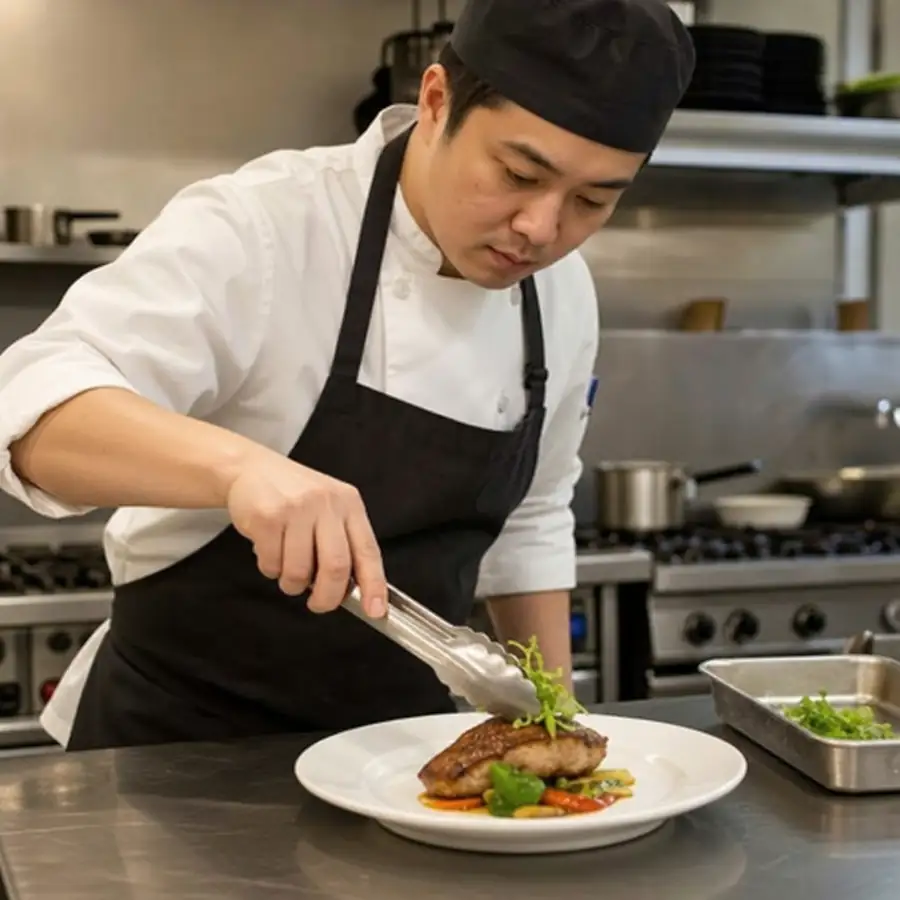
Restaurants that serve pasta should include pasta forks or pasta servers on their utensil list. These tools are designed to lift, portion, and plate noodles more easily than standard spoons or tongs.
They are useful for:
- Spaghetti
- Linguine
- Fettuccine
- Noodle dishes
- Pasta salads
- Buffet pasta service
For sauté stations, many cooks use tongs for pasta, but pasta forks are still valuable for service lines, buffets, and prep areas.
16. Grill and Broiler Tools
High-heat stations need utensils that can handle intense temperatures and heavy foods. Grill tools should be long enough to protect staff from heat while still offering good control.
Add these to your commercial kitchen setup:
- Long-handled tongs
- Grill spatulas
- Meat forks
- Grill scrapers
- Basting brushes
- Heat-resistant gloves
- Grill brushes or cleaning tools
These utensils support speed and safety during grilling, broiling, and flat-top cooking. They also help maintain clean cooking surfaces throughout service.
17. Basting Brushes and Pastry Brushes
Brushes are used for applying butter, oil, glaze, marinade, egg wash, sauces, and finishing touches. They are common in bakeries, pizzerias, grills, and general restaurant kitchens.
Common types include:
- Silicone basting brushes for sauces and marinades
- Pastry brushes for egg wash and delicate bakery work
- Wide brushes for larger surfaces
- Narrow brushes for detail work
Brushes should be easy to clean and appropriate for the temperature of the task. For food safety, many kitchens separate brushes by use, such as one set for raw proteins and another for baked goods.
18. Scrapers, Bench Knives, and Dough Cutters
Scrapers and bench knives are highly useful for prep, baking, and cleaning work surfaces. They help move chopped ingredients, portion dough, scrape cutting boards, and clean flour from prep tables.
Include:
- Metal bench scrapers for dough and prep surfaces
- Plastic bowl scrapers for batters and doughs
- Dough cutters for bakeries and pizza shops
- Grill scrapers for flat-top maintenance
Even restaurants that do not bake heavily can benefit from bench scrapers. They make prep cleaner and faster, especially when transferring chopped vegetables or herbs.
19. Thermometers and Temperature Tools
Although thermometers are not traditional utensils, they are essential tools for safe and consistent cooking. They help verify doneness, monitor holding temperatures, and support food safety procedures.
Common temperature tools include:
- Instant-read thermometers
- Probe thermometers
- Oven thermometers
- Refrigerator and freezer thermometers
- Infrared thermometers for surface checks
Accurate temperature control is important for proteins, sauces, cooling procedures, reheating, and hot or cold holding. Keep thermometers clean, calibrated, and accessible.
20. Can Openers, Bottle Openers, and Utility Tools
Every restaurant needs basic utility utensils that staff rely on throughout the day. These are easy to overlook until they are missing.
Important utility tools include:
- Commercial can openers
- Handheld can openers as backups
- Bottle openers
- Corkscrews if wine is served
- Kitchen shears
- Utility scissors
- Nutcrackers or shellfish tools if needed
For high-volume kitchens, a mounted commercial can opener may be useful. Keep smaller backup tools available to prevent service delays.
21. Food Prep Containers and Utensil Storage
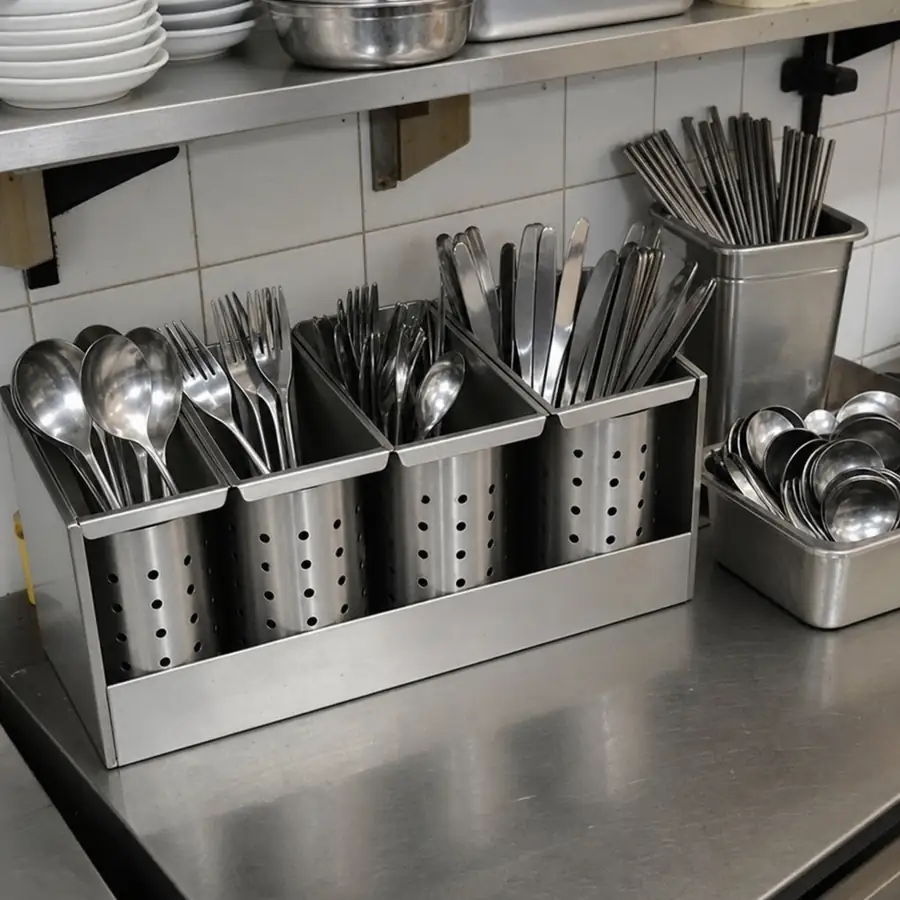
Utensils are only efficient when staff can find them quickly. Storage tools help organize prep areas, reduce clutter, and improve sanitation.
Consider:
- Utensil crocks
- Drawer organizers
- Wall-mounted racks
- Hanging hooks
- Labeled bins
- Food-safe storage containers
- Clean and dirty utensil separation systems
Good storage protects tools from damage and helps staff maintain a clean workflow. It also makes inventory easier when restocking cooking supplies.
22. Color-Coded Utensils for Food Safety
Color-coded utensils can help reduce cross-contact and cross-contamination. They are especially helpful in busy kitchens where multiple cooks handle raw proteins, produce, allergens, and ready-to-eat foods.
Common color-coding systems may separate utensils for:
- Raw poultry
- Raw meat
- Seafood
- Produce
- Dairy
- Allergen-sensitive prep
- Ready-to-eat foods
A color-coded system works best when paired with clear staff training and visible storage areas. Keep the system simple so it can be followed during peak service.
23. Buffet and Catering Utensils
Buffet and catering operations need extra utensils because tools may need to be replaced frequently during service. Presentation also matters, so serving utensils should look clean and professional.
Stock items such as:
- Buffet spoons
- Serving tongs
- Ladles for soups and sauces
- Carving forks
- Carving knives
- Cake servers
- Salad tongs
- Chafing dish spoons
Plan for backups. If a utensil drops, becomes messy, or needs washing, staff should be able to replace it immediately without disrupting service.
24. Bar and Beverage Utensils
Restaurants with beverage service need a separate utensil list for the bar, coffee station, or drink prep area. These tools support speed, consistency, and presentation.
Common bar utensils include:
- Bar spoons
- Muddlers
- Cocktail strainers
- Jiggers
- Ice scoops
- Citrus squeezers
- Garnish tongs
- Bottle openers
- Wine keys
Even non-bar restaurants may need beverage utensils for lemonade, tea, coffee, smoothies, or specialty drinks.
25. Cleaning and Sanitation Utensils
Sanitation tools are just as important as cooking tools. A clean kitchen depends on having the right utensils for scraping, washing, sanitizing, and maintaining work areas.
Essential cleaning tools include:
- Pot brushes
- Scrub pads
- Grill bricks or grill screens
- Squeegees
- Dish scrapers
- Cleaning buckets
- Sanitizer-safe cloths
- Dedicated sink brushes
Keep cleaning utensils separate from food prep utensils. Clear labeling and designated storage can help prevent mistakes.
26. Specialty Utensils Based on Menu Type
Not every restaurant needs the same tools. A sushi bar, bakery, steakhouse, pizzeria, and café will each have different utensil needs.
Examples of specialty utensils include:
- Pizza peels and pizza cutters
- Sushi mats and rice paddles
- Tortilla presses
- Wok ladles and wok spatulas
- Oyster knives
- Seafood crackers
- Pastry cutters
- Cake decorating tools
- Ice cream spades
Use your menu as the guide. The best commercial kitchen utensils list supports the dishes you actually prepare, not a generic inventory that wastes space and budget.
27. Backup Utensils for High-Volume Service
A common mistake is buying only one of each utensil. In a real restaurant environment, tools are washed, misplaced, dropped, or used at multiple stations at once.
Keep backups of high-use items such as:
- Tongs
- Ladles
- Cooking spoons
- Spatulas
- Whisks
- Peelers
- Measuring spoons
- Serving utensils
Backups prevent slowdowns and reduce frustration during rush periods. They also help maintain sanitation because staff are less likely to reuse dirty tools when clean replacements are available.
28. Utensils for Prep Stations
Prep cooks need reliable tools that support batch work and repeatable results. A prep station should be stocked before production begins.
A basic prep station may include:
- Knives
- Cutting boards
- Mixing bowls
- Measuring tools
- Peelers
- Graters
- Tongs
- Spoons
- Scrapers
- Containers
- Labels and markers
Organizing prep utensils by task improves speed and reduces wasted movement. It also helps new staff follow established systems.
29. Utensils for the Hot Line
The hot line needs durable, heat-safe utensils that allow cooks to work quickly under pressure.
Common hot line utensils include:
- Sauté spoons
- Tongs
- Spatulas
- Ladles
- Whisks
- Fish spatulas
- Basting spoons
- Thermometers
- Sauce spoons
- Plating tweezers
Each station should have its own tools when possible. Shared utensils can slow down service and create sanitation concerns.
30. Utensils for the Cold Line
Cold line utensils are used for salads, sandwiches, desserts, garnishes, and ready-to-eat foods. These tools should be clean, accessible, and often separated from raw prep utensils.
Useful cold line tools include:
- Salad tongs
- Portion scoops
- Squeeze bottles
- Spreaders
- Small spoons
- Garnish tongs
- Offset spatulas
- Serrated knives
- Measuring spoons
Because many cold line foods are ready to serve, sanitation and organization are especially important.
How to Choose Commercial Kitchen Utensils
Operators often shop these with restaurant equipment, tableware, and kitchen supplies in one order.
When selecting commercial kitchen utensils for a restaurant, focus on durability, sanitation, comfort, and fit for your menu. The cheapest option is not always the best value if it bends, melts, rusts, or breaks quickly.
Look for utensils that are:
- Made from commercial-grade materials
- Easy to clean and sanitize
- Comfortable for repeated use
- Heat-resistant when needed
- Sized appropriately for your equipment
- Durable enough for high-volume service
- Simple to store and organize
It is also helpful to involve chefs and lead cooks in purchasing decisions. The people using the tools every day can identify what sizes, shapes, and materials work best for each station.
For purchasing, many operators prefer consolidating orders so they can restock key restaurant kitchen utensils and other restaurant kitchen supplies at the same time. The Horeca Store is a practical option to check when you need to replenish everyday smallwares (like spoons, tongs, ladles, and measuring tools) along with other commercial restaurant supplies and foodservice equipment.
Quick Starter Commercial Kitchen Utensils List
If you are opening a restaurant or refreshing your inventory, start with these essentials:
- Cooking spoons in multiple sizes
- Slotted spoons
- Utility tongs
- Long grill tongs
- Ladles in portioned sizes
- Whisks
- Spatulas and turners
- Rubber spatulas
- Skimmers and spiders
- Chef’s knives
- Paring knives
- Serrated knives
- Peelers
- Graters and zesters
- Measuring cups and spoons
- Portion scoops
- Mixing bowls
- Colanders and strainers
- Basting brushes
- Bench scrapers
- Thermometers
- Can openers
- Serving utensils
- Buffet utensils if needed
- Cleaning and sanitation tools
This starter list can be expanded based on your menu, kitchen layout, service style, and volume.
Final Thoughts
The right utensils help a commercial kitchen work faster, cleaner, and more consistently. Spoons, tongs, and ladles may seem simple, but they affect nearly every part of service, from prep to plating. By building a thoughtful commercial kitchen utensils list (and keeping it updated as menu needs change), restaurant operators can reduce delays, improve food quality, and give staff the tools they need to perform well.
Start with the essentials, add specialty utensils based on your menu, and keep backups of the tools your team uses most. When it’s time to restock or standardize your restaurant utensils list, The Horeca Store can be a helpful place to source commercial kitchen utensils alongside other restaurant kitchen supplies and foodservice equipment.