
A commercial iced tea brewer is worth buying when your restaurant, cafe, hotel, bar, or catering operation serves enough iced tea to need consistent flavor, faster batch production, and a cleaner workflow than pitcher-by-pitcher brewing. The right choice depends on your daily volume, counter space, power and water access, dispenser style, and whether you need simple black tea service or programmable recipes for sweet tea, flavored tea, and rotating menus.
In plain terms, commercial tea brewers are foodservice-grade iced tea machines designed to brew concentrated hot tea and dilute it into ready-to-serve iced tea, usually into portable iced tea dispensers. They differ from household iced tea makers because they are built for repeated batches, plumbed water connections, larger brew baskets, stainless components, commercial filters, and easier service access.
What should restaurants look for in commercial iced tea brewers?
Restaurants should look for capacity, brew speed, dispenser compatibility, footprint, electrical requirements, water connection, cleaning access, and parts support. A busy lunch counter needs quick batch recovery and durable dispensers, while a small cafe may care more about compact size, quiet operation, and simple controls. The best commercial iced tea brewers are not always the largest; they are the units that match your menu, peak demand, and staff routine.
For example, a 3-gallon brewer can be ideal for cafes, diners, and casual restaurants with one or two iced tea flavors. Higher-volume operations, convenience stores, hotels, and buffet lines may need twin brewers, 5-gallon dispensers, or programmable tea brewing equipment that lets staff produce multiple recipes without guesswork.
Main types of iced tea machines
Most iced tea machines fall into a few practical categories. Understanding these options helps prevent overbuying, underbuying, or choosing equipment that does not fit your counter.
Automatic plumbed tea brewers
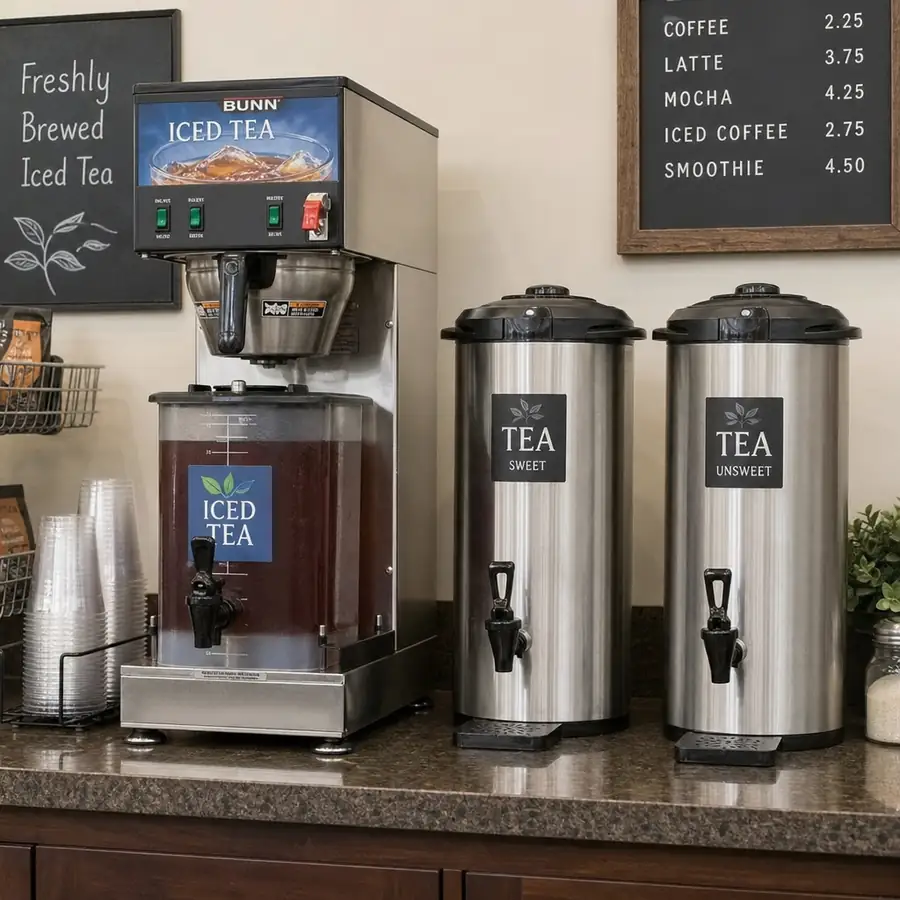
Automatic brewers connect to a water line and are the standard choice for most restaurants and cafes. Staff load the filter and tea, place the dispenser below the funnel, and start the cycle. Because water fill is automated, these units reduce measuring errors and keep batches more consistent during rush periods.
BUNN's TB3Q is a common example of a 3-gallon plumbed iced tea brewer with 120V operation, a quick-brew design, and compatibility with portable servers; BUNN lists it with 1730 watts, 14.4 amps, and a NEMA 5-15P plug, which matters because it can fit many standard commercial 120V setups when the circuit is appropriate.
Low-profile brewers
Low-profile brewers are designed for counters with height restrictions, shelves, or tight service lines. They are especially useful in cafes, bakeries, food trucks, and small quick-service restaurants where vertical clearance is limited.
The trade-off is planning. You must confirm that the selected iced tea dispensers fit under the funnel and that staff can remove baskets, lids, and dispensers without awkward lifting. BUNN's catalog, for instance, separates 29-inch trunk, 25.75-inch trunk, and low-profile options because dispenser clearance changes by configuration.
Twin and high-volume brewers
Twin brewers or dual-station systems make sense when you serve multiple tea varieties or have a sharp lunch/dinner rush. They let staff brew sweet tea and unsweet tea at the same time, or keep one side dedicated to a house blend while the other rotates seasonal flavors.
These units take more counter space and may need higher electrical capacity. The operational benefit is fewer stockouts, less batch waiting, and better separation between recipes.
Programmable digital brewers
Programmable brewers suit operators who need tighter recipe control. Features such as pre-wet, pulse brew, adjustable dilution, brew time settings, and saved recipes help standardize flavor across shifts.
FETCO's TBS-2121, for example, supports touchscreen operation, multiple programmable menus, adjustable brew variables, dilution control, counters, and recipe transfer by SD card, which can help multi-unit operators or high-volume accounts keep tea profiles more consistent.
Features and specifications that affect daily operations
A brewer specification only matters if it changes service. Use the checklist below to connect numbers on a spec sheet with real operational impact.
- Batch size: Common commercial batches are often around 3 to 5 gallons. A smaller cafe can usually manage with 3 gallons, while buffet service, hotels, and convenience stores may benefit from larger dispensers or multiple batches.
- Cups per hour: This shows recovery and output potential. BUNN's iced tea equipment catalog lists some TB3 models at 303 8-ounce cups per hour and TB3Q quick-brew versions at 523 8-ounce cups per hour, showing how brew design can affect throughput.
- Electrical load: Voltage, watts, amps, and plug type determine whether the brewer can run on your available circuit. A 120V unit may be easier to place, but you still need enough amperage and a dedicated setup where required.
- Water access: Plumbed units save labor and improve consistency, but they require water line installation and filtration. Manual or specialty setups may work for temporary service, but they are less efficient for daily restaurant use.
- Dispenser clearance: Trunk height determines which iced tea dispensers fit below the brew basket. Mismatched clearance can slow service or make brewing unsafe.
- Brew basket design: A basket that is easy to remove, clean, and identify reduces cross-flavor contamination. Color-coded handles or recipe labeling can help when staff rotate black, green, sweet, and flavored teas.
- Dilution control: Adjustable dilution matters because iced tea is typically brewed strong and diluted to serving strength. Better control means fewer weak batches and fewer overly bitter batches.
- Cleaning access: Removable funnels, faucets, lids, and brew-through covers make sanitation easier. If cleaning is frustrating, it is less likely to be done correctly during busy operations.
Matching equipment to business type
Different businesses use iced tea makers in different ways. A sit-down restaurant may need dependable lunch and dinner service. A cafe may serve smaller batches but care about beverage quality and presentation. A hotel breakfast area may need a durable dispenser setup that guests can use without staff assistance.
Here is a practical matching guide:
The Horeca Store and similar foodservice equipment suppliers can be useful when comparing brewer bodies, matching dispensers, and checking whether replacement parts, filters, faucets, and brew baskets are readily available before purchase.
Brand and model examples to compare
BUNN is widely associated with commercial beverage brewing, and its TB3/TB3Q family is often considered when operators want straightforward automatic iced tea service. The TB3Q 29-inch trunk model is listed as a 3-gallon brewer with quick-brew operation and a stainless finish, while BUNN's catalog also shows versions with and without included dispensers.
Curtis offers several tea brewer lines, including G4 Tea Brewer, G4 Sweet Tea Brewer, G4 Polaris Low Profile Tea Brewer with dispenser, and rotating basket options. That variety is useful if your operation needs sweet tea workflows, low-profile placement, or more flexible station layouts.
FETCO is worth considering when programmability and recipe control matter. Its TBS-1221 is positioned with the matching 3.5-gallon ITD-1235 dispenser, while the TBS-2121 documentation emphasizes programmable menus, brew and dilution variables, and touchscreen operation.
Bloomfield's 8742 and 8748 manuals identify 3-gallon and 5-gallon iced tea brewer models, with 120V versions listed at 1500 watts and 12.5 amps. Bloomfield also offers 3- and 5-gallon stainless tea dispensers with removable no-drip faucets and brew-through lids, which are practical for operators who want durable serving vessels.
Installation, cleaning, maintenance, and total cost
Installation starts with the basics: counter space, water line, drain planning, electrical circuit, and clearance for dispensers. Always compare the spec sheet to the actual service counter, not just the product photo. Leave room for staff to slide dispensers in and out, remove brew baskets, and clean around the unit.
Water quality affects flavor and equipment life. A proper filtration setup can reduce scale, off-flavors, and service issues. In hard-water areas, deliming and filter replacement should be built into the maintenance calendar rather than treated as emergency repairs.
Daily cleaning should include the brew basket, funnel, dispenser lid, faucet, and vessel interior. Tea residue can affect flavor and appearance quickly, especially with sweet tea. Removable faucets and brew-through lids make this work easier, so they are not minor accessories; they directly influence sanitation labor.
Total cost of ownership includes more than the purchase price. Include filters, paper tea filters, spare faucets, gaskets, brew baskets, water fittings, technician access, downtime risk, and warranty support. A cheaper brewer can become expensive if parts are hard to source or if it slows service during peak hours.
Buying checklist before you order
Use this checklist before choosing tea brewing equipment:
- Estimate peak demand, not average demand. Count how much tea you need during the busiest two-hour window.
- Choose batch size based on turnover. Tea should move quickly enough to stay fresh and appealing.
- Measure counter height, width, and depth. Confirm dispenser clearance and staff access.
- Check electrical requirements. Match voltage, amps, plug, and circuit capacity.
- Confirm water connection and filtration. Plan installation before the brewer arrives.
- Match dispensers to the brewer. Verify height, lid type, capacity, and faucet design.
- Ask about parts and warranty support. Prioritize models with available baskets, faucets, filters, and service documentation.
- Train staff on recipes. Standard tea weight, filter placement, dilution, and holding time matter as much as the machine.
Frequently asked questions
Are commercial iced tea brewers better than regular iced tea makers?
Yes, for foodservice use. Commercial models are designed for larger batches, repeated brewing, plumbed water, compatible dispensers, and easier service access. Household iced tea makers may work for occasional use, but they are not ideal for restaurant volume or sanitation workflows.
What size brewer does a cafe need?
Many cafes can start with a single 3-gallon brewer if iced tea is a secondary beverage. If tea is a major menu item, or if you serve multiple varieties, consider extra dispensers or a programmable unit so staff can rotate batches without delaying service.
Do I need separate iced tea dispensers?
Iced tea glasses are the glass for a finished pour.
In most cases, yes. Many brewers dispense directly into portable servers rather than holding finished tea inside the brewer. Confirm whether the brewer includes a dispenser or whether it must be purchased separately.
How often should iced tea equipment be cleaned?
Foodservice tea equipment should be cleaned daily, with faucets, lids, brew baskets, and dispensers washed according to your sanitation program and manufacturer guidance. Sweet tea setups need special attention because sugar residue can build up around faucets and lids.
Is a programmable brewer worth it?
Satellite coffee brewers cover coffee on the same counter.
A programmable brewer is worth it when you need consistent recipes across shifts, multiple tea profiles, or tighter control over dilution and brew time. For a small operation serving one standard tea, a simpler automatic brewer may be enough.
Which brands should I compare first?
BUNN, Curtis, FETCO, and Bloomfield are all relevant starting points for commercial iced tea brewers. Compare them by capacity, controls, dispenser compatibility, power requirements, service access, and local parts support rather than brand name alone.
Final buying guidance
If your requirement is simple, dependable iced tea for a cafe or casual restaurant, consider a single automatic 3-gallon brewer with compatible stainless iced tea dispensers. If your requirement is faster recovery during rush periods, look at quick-brew models or twin configurations. If your requirement is consistent sweet tea, rotating flavors, or multi-location control, consider programmable iced tea machines with adjustable dilution and saved recipes.
If space is your biggest challenge, choose a low-profile unit and verify dispenser clearance before ordering. If long-term operating cost matters most, prioritize parts availability, cleaning simplicity, filtration, and warranty support. The best choice is the brewer your staff can use correctly every day while keeping tea fresh, consistent, and profitable.