
Choosing a commercial ice machine means matching daily production, storage capacity, and ice shape to your busiest service periods. Start with peak demand, then check how the equipment performs in your actual kitchen conditions - not just under favorable test conditions. This guide explains how to build a practical equipment shortlist, compare ownership costs, and prepare questions for The Horeca Store or another supplier.
How much commercial ice production do you need?
Your required commercial ice production depends on how much ice the business uses on its busiest days, including beverages, food displays, and other applications. Size the machine and storage bin together, and check production charts at the air and incoming-water temperatures expected during peak demand. Manitowoc specifically recommends planning around peak usage rather than relying solely on an existing machine's performance.
Start with a demand audit instead of a guess based on seating capacity. For your planning worksheet, record:
- Beverage service: Drinks sold, typical ice weight per serving, refills, and takeaway orders.
- Food displays: Ice needed for initial setup and replenishment during service.
- Other departments: Catering, guest ice, satellite bars, or additional service stations.
- Demand patterns: Busy weekends, seasonal traffic, events, and planned menu changes.
Measure actual ice portions where possible. A glass's fluid-ounce capacity does not tell you the weight of ice it holds, so weigh representative servings rather than treating those measurements as interchangeable. Keep your assumptions visible so you can update the calculation when the menu changes.
A worked sizing example
Suppose your own measurements show that 400 daily drinks use an average of 0.5 pounds of ice each. Beverage demand would be 200 pounds. If your measured display and preparation requirements add another 60 pounds, the working total becomes 260 pounds per day.
These figures are illustrative, not industry benchmarks. Before choosing equipment, add an allowance that reflects your expected growth and operating uncertainty; Manitowoc's sizing guide suggests 20% for future growth. Then verify that the selected model can supply the resulting requirement under your site conditions.
Separate production capacity from storage capacity
Production capacity describes how much ice a machine can make over a stated period, commonly 24 hours. Storage capacity describes how much its bin can hold. A modular ice-making head and its storage bin are separate components, so neither number should stand in for the other.
For a simplified planning example, imagine a service rush needs 150 pounds while the machine produces only 50 pounds during that window. You would need at least 100 pounds available beforehand, before allowing for uncertainty or losses. This explains why a machine can meet total daily demand yet still need a larger reserve for concentrated service periods.
Map demand across the day rather than stopping at a daily total. Ask whether the bin can hold the required starting reserve and whether production can replenish it before the next rush. Have the supplier review this schedule alongside the proposed head-and-bin combination.
Which ice machine types fit your menu?
The right ice machine types depend on what the ice must do: fill everyday drinks, provide a chewable texture, support food displays, or create a distinctive cocktail presentation. Manufacturers offer different shapes for these applications, so choose the ice first and then compare machines that produce it.
| Ice type | Practical application | What to confirm before buying |
|---|---|---|
| Cube or crescent | Everyday beverage service | Size, appearance, and compatibility with your glasses or dispenser |
| Nugget or cubelet | Drinks where chewable ice is part of the experience | Texture and compatibility with the intended dispensing equipment |
| Flake | Seafood displays, salad bars, and food presentation | Display requirements and the quantity needed for replenishment |
| Specialty shapes | Signature cocktails and presentation-focused service | Glass fit, serving consistency, and production requirements |
Hoshizaki identifies cubelet ice as chewable, flake ice as moldable, and specialty shapes as options for signature drinks. These differences make ice shape an operating decision, not simply a visual preference.
For operators comparing commercial flake ice machines, start with the display's setup and replenishment needs. Flake ice is suited to molding around displayed products, while beverage-focused equipment serves a different purpose. Avoid choosing solely by pounds per day when the resulting ice shape does not match the job.
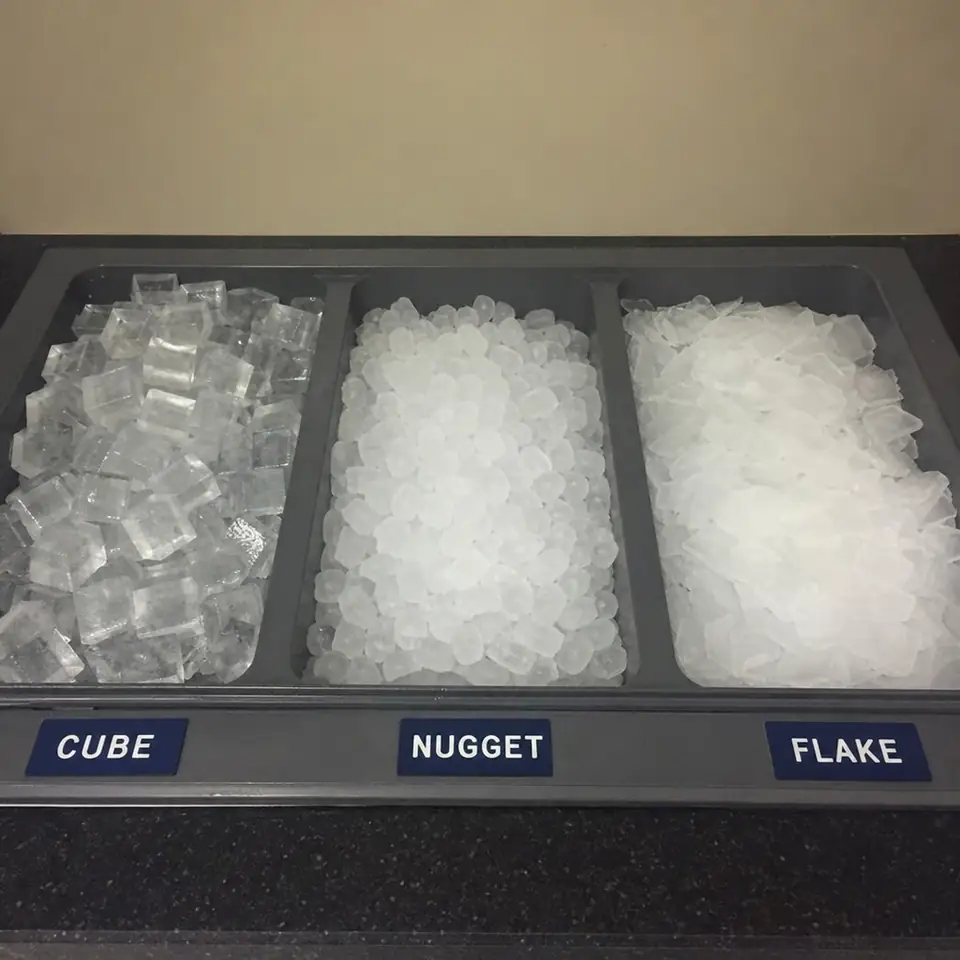
If possible, request an ice sample before committing. Test it in your actual glasses, beverage portions, and display layout. Your shortlist should reflect how the finished ice works during service, not just how it looks in product photography.
Match the machine layout to your workflow
Self-contained machines combine ice production and built-in storage in one cabinet; they are typically smaller units, often installed under counters. Modular machines use a separate ice-making head and storage bin, while remote-condensing systems separate the condenser from the ice-making section.
Use these distinctions to narrow your layout options:
- Undercounter: Consider for a service point where integrated storage and a compact footprint fit the brief.
- Modular head and bin: Consider when you need to select production and storage capacities separately.
- Dispenser configuration: Specify the intended dispenser and request written confirmation of compatibility.
- Remote-condensing system: Consider when moving heat outside the building is important to the installation plan.
Sketch staff movement before choosing a location. Identify where ice is collected, where drinks are prepared, and how equipment will be accessed for cleaning. Ask the supplier to assess the layout rather than treating an empty floor space as proof that the installation will work.
If your project involves industrial ice machines, define the process requirements before applying a restaurant-style checklist. Ask about the required production schedule, storage arrangement, ice handling, and integration with other equipment. The word "industrial" alone is not a sufficiently detailed purchasing specification.
Choose a cooling system that suits the site
Air-cooled machines use fans to remove heat and avoid the condenser-cooling water used by water-cooled models. EPA guidance describes air-cooled equipment as suitable for most commercial settings, provided the installation supports adequate airflow. Check the specific model's required clearances rather than applying one spacing rule to every machine.
Water-cooled equipment requires closer evaluation of the facility and its water use. A single-pass arrangement sends condenser-cooling water down the drain, whereas a recirculating system returns cooled water for reuse. Do not compare water consumption figures without checking whether condenser water is included.
Remote-condensing equipment moves heat outside the building, but the installation still needs a model-specific assessment. Ask your installer to confirm condenser placement, connection requirements, and service access before ordering. A cooling-system choice should follow the site review, not replace it.
What determines the total ice machine cost?
Total ice machine cost includes the equipment purchase, installation, utilities, consumables, maintenance, and repairs over your chosen ownership period. Compare complete installed quotations and operating requirements rather than treating the advertised machine price as the entire investment. Energy and water efficiency belong in that comparison; ENERGY STAR provides certified-model information to support purchasing decisions.
Request an itemized quotation that separates:
- Equipment: Ice-making head, bin or dispenser, and required adapters.
- Installation: Delivery, positioning, electrical work, plumbing, and commissioning.
- Water treatment: Initial equipment and replacement consumables.
- Routine care: Cleaning materials, scheduled service, and staff labor.
- Operating costs: Electricity, production water, and condenser water where applicable.
- Coverage: Warranty terms, service arrangements, and excluded charges.
Use the same assumptions for every candidate. Comparing one machine's equipment-only price with another supplier's installed package will not reveal the better value. Ask each supplier to identify exclusions explicitly rather than leaving them buried in separate documents.
For efficiency comparisons, verify certification for the exact model. ENERGY STAR covers eligible air-cooled batch and continuous-type ice makers, but its commercial ice-maker category excludes water-cooled models and certain other configurations. Certification is useful evidence, not a substitute for checking capacity, installation suitability, and service requirements.
Make ice machine maintenance part of the buying decision
Before purchase, read the proposed model's cleaning instructions and maintenance schedule. For example, Hoshizaki's cited cubelet dispenser manual requires cleaning and sanitizing at least twice a year, with more frequent attention potentially needed under some conditions. That is a model-specific instruction - not a universal schedule for every commercial machine.
Ask who will carry out routine ice machine maintenance and what the work involves. Request a demonstration of access to the bin, water-contact components, and service areas. Use that conversation to establish responsibilities, necessary supplies, and a realistic maintenance budget.
Cleaning and sanitizing instructions also specify chemical handling and what to do before returning equipment to production. Follow the exact manual rather than improvising concentrations or assuming that one product suits every machine. Hoshizaki's instructions, for instance, warn against using ice made from cleaning or sanitizing solutions.
When evaluating commercial ice machines, lifetime guarantee claims, and maintenance plans, request the actual written terms. Ask what "lifetime" refers to, which components are covered, whether labor is included, and what maintenance records are required. Treat these as questions to resolve before purchase, not benefits to assume from a headline.
Read ice machine reviews with a purchasing checklist
Use ice machine reviews to generate questions for the seller, not to replace technical documentation. Give more weight in your comparison to reviews that identify the exact model, installation setting, ownership period, and service experience. A rating without that context gives you little to test against your own requirements.
For each shortlisted machine, record:
- Published output at conditions relevant to your site.
- The proposed storage or dispenser pairing.
- Installation requirements and unresolved site questions.
- Cleaning access and documented maintenance responsibilities.
- Written coverage and the proposed local service arrangement.
The best ice makers for your shortlist are those that satisfy your documented requirements. Ask sellers to substantiate important claims with specification sheets, manuals, compatibility information, and written quotations. Keep unanswered questions visible until someone takes responsibility for resolving them.
One category distinction matters: commercial ice cream machines are frozen-dessert equipment, not substitutes for beverage-ice makers. Soft-serve machines process dessert mix in freezing cylinders; specify them separately if your menu includes frozen desserts as well as iced drinks.
Turn your requirements into a clear buying brief
Before requesting a recommendation from The Horeca Store, prepare one page showing your measured peak demand, busiest service window, preferred ice shape, available space, and known utility connections. Include the storage reserve you expect to need and any unresolved installation questions. Request a model-specific proposal with an itemized installed price and written maintenance and coverage terms.
Choose the machine that answers that brief - not simply the one with the largest production number. A clear specification gives you a sound basis for comparing offers and checking that the final installation matches what you intended to buy.