
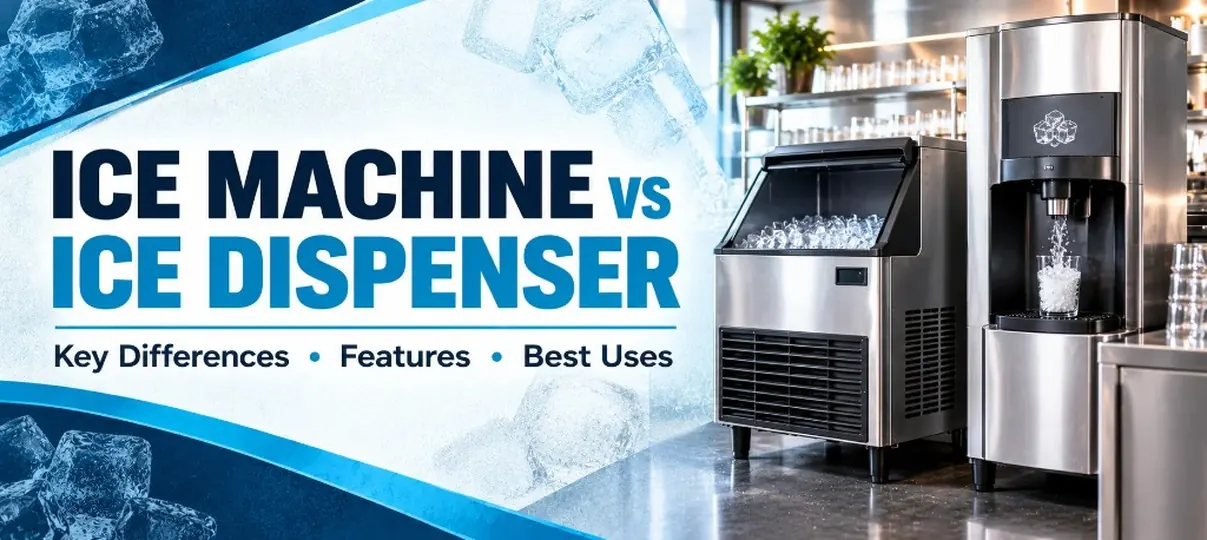
A commercial ice machine makes ice, while an ice dispenser stores ice and releases it into a cup, bucket, or other container. Some equipment combines both functions, so the product name alone does not tell you what you are buying. Understanding that distinction helps you choose a setup that matches your ice demand, service style, and available space. The Horeca Store carries both kinds of equipment for restaurants and hotels.
What is the difference between a commercial ice machine and an ice dispenser?
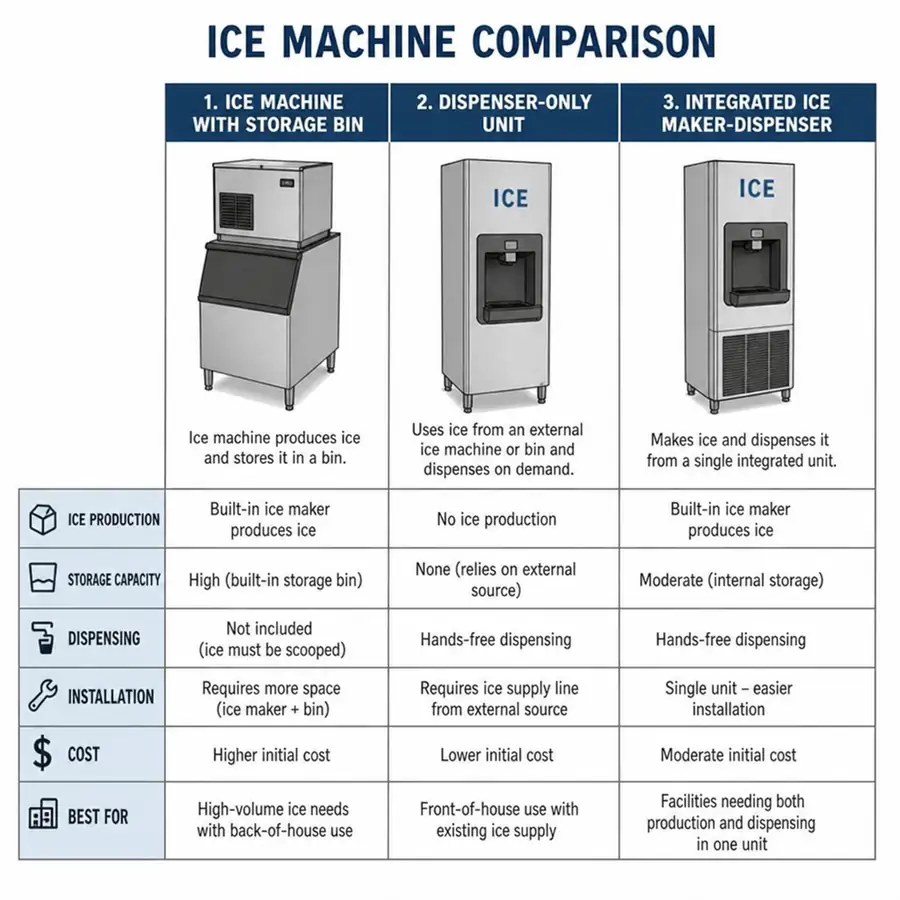
The main difference is production versus delivery. An ice machine supplies the ice; a dispenser controls how people collect it. A dispenser-only unit needs ice from another source, whereas an integrated ice maker-dispenser produces and dispenses ice within one appliance.
Think of your purchase as three separate decisions: how to make ice, where to hold it, and how to serve it. Those functions may sit together in one cabinet or be divided between connected pieces of equipment. Manufacturers offer undercounter machines with storage, modular machines paired with bins or dispensers, and integrated dispensing units.
That is why a useful ice machine comparison starts with the complete system rather than two product labels. Before comparing features, ask the seller to identify exactly which components the quoted price includes.
These configurations appear across manufacturer product ranges, but the exact arrangement depends on the model. Confirm the specification sheet rather than assuming every machine includes storage or every dispenser includes ice production.
Can an ice dispenser make its own ice?
Yes, if it includes an ice-making system. However, a dispenser-only model cannot turn water into ice: it must be filled manually or supplied by a compatible ice machine. Integrated products combine production, storage, and dispensing, sometimes with drinking-water dispensing as well.
There are three arrangements worth distinguishing before requesting a quote:
- Manual-fill dispenser: Staff transfer ice from another source into the dispenser. Include that replenishment task in your workflow assessment, not just the equipment purchase.
- Dispenser with a separate ice machine: A compatible machine supplies the dispenser. Depending on the system, production equipment may be mounted above it or installed remotely.
- Integrated ice maker-dispenser: One appliance handles production and dispensing. Compare its production rating and storage capacity separately before deciding whether it meets demand.
Scotsman documents manually filled dispensers, while Follett offers remote ice delivery systems and Hoshizaki offers integrated ice-and-water units. These are different equipment arrangements, not interchangeable descriptions of the same product.
For a proposal labeled simply "ice dispenser," request a written answer to one question: where will its ice come from? That answer should make the required equipment, connections, and refill responsibilities clear.
Production capacity and storage capacity solve different problems
Production capacity describes how much ice a machine can make over a stated period, typically 24 hours. Storage capacity describes how much ice a bin or dispenser can hold at once. Manufacturer specifications list these separately because a unit can produce substantially more ice throughout the day than it can store at any moment.
For example, imagine a hypothetical operation that uses most of its ice during a short lunch rush. Do not judge its equipment solely by whether the daily production figure exceeds total daily consumption. Ask whether enough ice will be ready when that rush begins and how quickly the system can replenish the supply afterward.
Use this sizing checklist when discussing requirements with a supplier:
- Record total demand. Include drinks, refill service, kitchen use, and any other planned applications.
- Identify peak periods. Note how much demand concentrates into your busiest service window.
- Assess storage needs. Ask how much usable ice should be available before that window starts.
- Check site conditions. Provide expected room and incoming-water temperatures so the supplier can assess realistic output.
- Plan for disruption. Decide how you would cover cleaning downtime, repairs, or unusually busy service.
Temperature deserves particular attention. Hoshizaki notes that higher ambient and incoming-water temperatures can reduce output, making peak-period sizing important. Compare performance at conditions relevant to your installation instead of relying only on the largest advertised production number.
Match ice access to the way you serve
For this decision, separate staff access from customer access. Picture who will collect ice, which containers they will fill, and how frequently they will return. Then evaluate equipment against that sequence rather than choosing a familiar-looking cabinet.
Staff-operated service
Consider a machine-and-bin arrangement when your service plan calls for staff to scoop ice into different containers. Ask employees to walk through the proposed layout: collecting ice, turning toward the preparation area, and returning during busy service. Include scoop storage and bin access in that review; manufacturers offer bins with features specifically intended to support scooping and storage.
The practical ice machine benefits to assess here are supply at the point of work and storage suited to your tasks. Do not assume a dispensing outlet will accommodate every pitcher or bucket. Bring your actual containers to a demonstration, or compare their dimensions with the manufacturer's clearance specifications. Scotsman dispenser documentation, for example, lists cup clearance separately from overall cabinet dimensions.
Self-service access
For guest or employee self-service, consider how easily someone unfamiliar with the equipment can fill a container. Compare activation methods, outlet position, and whether water dispensing is needed. Available designs include lever-operated dispensers, container-activated chutes, and hands-free integrated units.
Request a demonstration using the containers you expect people to bring. Watch where they place the container and whether the filling process feels obvious. Treat these observations as a usability test rather than assuming one activation method suits every location.
Ice type and equipment compatibility matter
Do not assume that any ice machine can feed any dispenser. Scotsman publishes model-specific pairing information, and its dispenser documentation specifies permitted ice types and circumstances requiring a diverter kit. Physical fit alone is not proof of compatibility.
Ask the supplier to confirm the proposed pairing in writing, including the ice machine model, dispenser model, and required adapters. Also confirm that the ice shape you want is supported by the dispensing mechanism. If you are replacing only one component, provide the existing equipment's full model information rather than its approximate size.
This becomes especially important when considering different ice textures. A dispenser manual may prohibit certain forms of ice even though they appear suitable at first glance. Follow the specific model's instructions instead of assuming the agitator can break up unsuitable ice or large frozen clumps.
Installation and maintenance belong in the comparison
Start the installation review before finalizing your shortlist. Manufacturer specifications identify requirements such as water connections, drains, electrical supply, operating temperatures, and equipment dimensions. Airflow also matters: Hoshizaki warns that inadequate ventilation and higher ambient temperatures can affect air-cooled machine performance.
Ask your installer to review the complete arrangement, including access for service. Measure the proposed location, delivery route, and working clearance rather than checking cabinet width alone. For stacked equipment, request the assembled dimensions and any required mounting components.
A remote-production arrangement may be worth discussing if you want the ice-making equipment away from the serving point. Follett describes systems that supply a dispenser from another location, moving production-related heat and noise away from the customer area. That option requires a system designed for remote delivery, not an improvised connection between unrelated products.
Maintenance needs equal attention. Hoshizaki provides model-specific cleaning and sanitizing procedures for integrated ice maker-dispensers, while Scotsman includes cleaning and safety instructions for dispenser-only equipment. Automatic features do not replace the need to follow the relevant manual.
Before buying, assign responsibility for these tasks:
- Routine checks: Decide who will inspect the dispensing area and report spills, drainage problems, or unusual operation.
- Scheduled cleaning: Obtain the model-specific procedure and identify who is trained to perform it.
- Service coordination: Confirm who books maintenance and how the business will manage interrupted ice availability.
- Recordkeeping: Keep manuals, service details, and maintenance records accessible to the responsible team.
Avoid treating "hands-free" as a promise of maintenance-free hygiene. Hoshizaki sells hands-free dispensing equipment and also publishes cleaning and sanitizing instructions for its dispenser range. Evaluate convenient access and cleaning responsibilities as separate considerations.
Read ice machine reviews through the lens of your operation
Use ice machine reviews to generate questions, not to replace specification checks. A reviewer's priorities may differ from yours, so first look for context: business type, installation conditions, daily demand, and service pattern. If those details are missing, be cautious about applying the conclusion to your own site.
Focus your research on issues you can verify before purchase:
- Does the review identify the exact model and whether it includes storage or dispensing?
- Does it distinguish slow production from insufficient storage or delayed manual refilling?
- Are comments about cleaning supported by details about access and procedures?
- Can a local service provider support the proposed equipment?
- Does the quoted package include every component needed for the installation?
Build a complete cost worksheet alongside that research. Request separate figures for equipment, installation, adapters, planned maintenance, and any water-treatment equipment recommended for the site. For a manual-fill setup, estimate staff time using your own refill frequency and labor costs rather than assuming dispensing eliminates handling work.
Compare alternatives over the same ownership period and document your assumptions. This keeps a lower equipment quote from becoming the default winner before you understand what it includes.
Which setup is right for your business?
Choose a machine with a storage bin when your priority is making ice for staff-controlled collection. Choose a dispenser-only setup when you have a suitable ice source and want controlled delivery at the serving point. Consider an integrated ice maker-dispenser when you want both functions together. These choices reflect the configurations manufacturers offer; the final selection still depends on capacity, compatibility, and site requirements.
Start your shortlist with the problem you need to solve: insufficient production, inadequate ready-to-use storage, or inconvenient collection. Ask suppliers to explain how their proposed system addresses that problem, then check the complete equipment schedule and installation requirements.
The takeaway is straightforward: buy production capacity for demand, storage for peak access, and dispensing for the way people collect ice. Once those needs are separated, the comparison becomes much clearer-and the purchase decision becomes easier to justify.